Remote Backend Developer Jobs: Complete 2026 Career Guide
Everything you need to land a remote backend developer job. Salary data by seniority, interview questions, companies hiring, and career paths.
Updated January 20, 2026 • Verified current for 2026
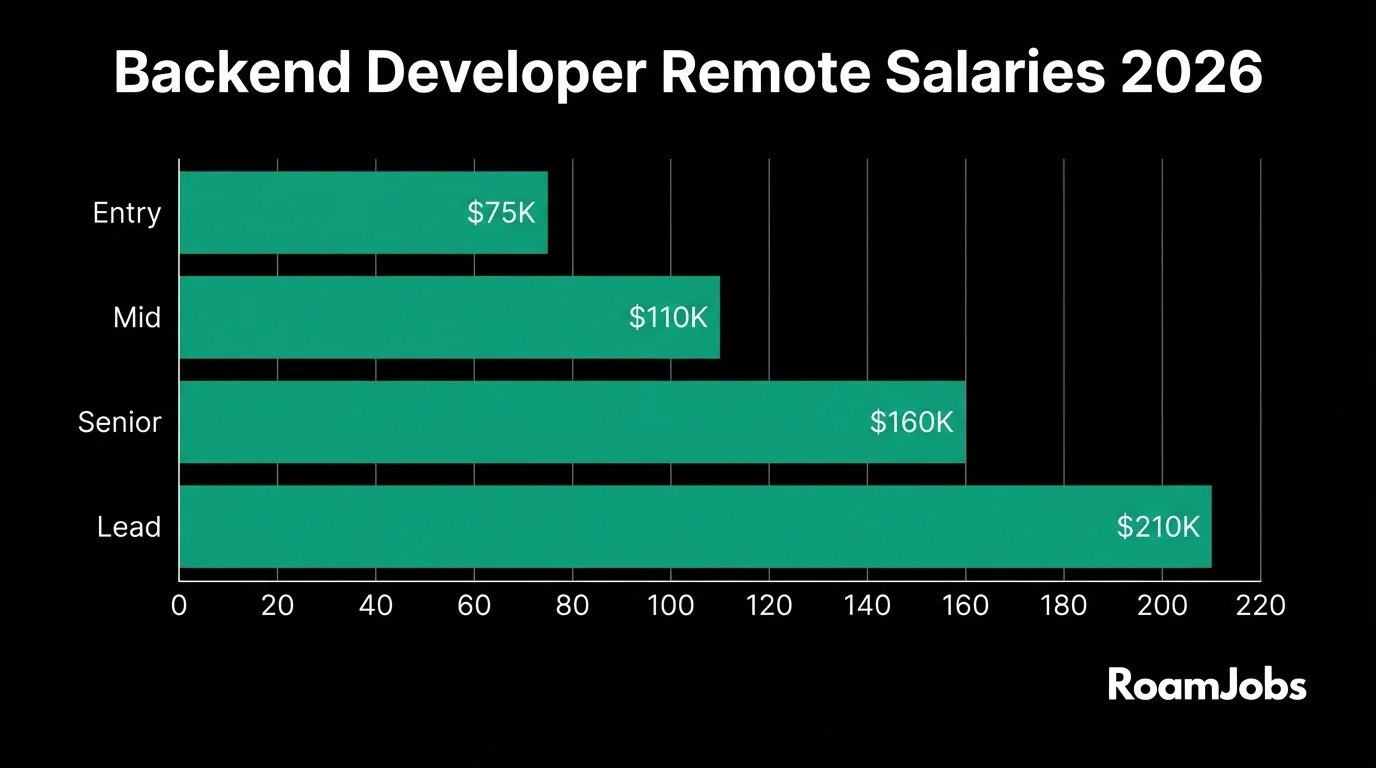
Remote backend developers design, build, and maintain the server-side logic and infrastructure that powers web and mobile applications. In 2026, remote backend developer salaries range from $75,000 to $220,000+ for US-based positions, with senior and staff-level engineers at top companies earning $250,000-$300,000+ in total compensation. The role requires expertise in at least one backend language (Python, Node.js, Go, Java, or Rust), database design, API development, and distributed systems knowledge. Backend development is one of the most remote-friendly engineering disciplines because the work is inherently asynchronous, measurable, and independent of physical location. To land a remote backend role, you need strong fundamentals in data structures and algorithms, experience with cloud platforms (AWS, GCP, or Azure), proficiency in SQL and at least one NoSQL database, and demonstrable system design skills for mid-level and senior positions. The interview process typically spans 5-7 rounds including coding challenges, system design exercises, and behavioral interviews focused on async communication skills.
What Do Remote Backend Developers Actually Do?
Remote backend developers are the architects of the invisible infrastructure that powers digital products. While frontend developers create what users see and interact with, backend developers build the systems, databases, APIs, and services that make everything work behind the scenes. Understanding what this role truly entails will help you determine if it aligns with your interests and career goals.
Day-to-Day Responsibilities
The daily work of a remote backend developer varies by company size, industry, and seniority level, but typically includes several core activities.
API Design and Development forms the backbone of most backend work. You will design, implement, and maintain RESTful APIs or GraphQL endpoints that allow frontend applications, mobile apps, and third-party services to interact with your systems. This includes defining endpoint structures, implementing authentication and authorization, handling request validation, and ensuring proper error handling. In remote settings, well-documented APIs become even more critical since your teammates may be working asynchronously in different time zones.
Database Architecture and Management requires designing efficient database schemas, writing optimized queries, managing migrations, and ensuring data integrity. You will work with relational databases like PostgreSQL and MySQL for structured data, and NoSQL databases like MongoDB, Redis, or DynamoDB for specific use cases. Understanding when to use each type and how to design for scalability is essential.
System Integration and Third-Party Services involves connecting your application to external services such as payment processors (Stripe, PayPal), email providers (SendGrid, SES), cloud storage (S3, GCS), and various SaaS APIs. You must handle authentication, rate limiting, error recovery, and data synchronization between systems.
Performance Optimization means identifying and resolving bottlenecks through profiling, query optimization, caching strategies (Redis, Memcached), and architectural improvements. Remote backend developers often work with APM tools like Datadog, New Relic, or custom monitoring solutions to track system health.
Security Implementation involves protecting systems from common vulnerabilities (SQL injection, XSS, CSRF), implementing proper authentication flows (OAuth, JWT), managing secrets and credentials, and ensuring compliance with security best practices.
Code Review and Documentation takes on heightened importance in remote environments. You will review pull requests from teammates, provide constructive feedback asynchronously, and maintain documentation that enables others to understand and extend your work without real-time conversations.
Why Backend Development Is Ideal for Remote Work
Backend development ranks among the most remote-friendly engineering disciplines for several compelling reasons.
Asynchronous by Nature: Backend work rarely requires real-time collaboration. You can design a database schema, implement an API endpoint, or optimize a query independently without waiting for others. The work product is clearly defined and measurable.
Minimal Design Dependencies: Unlike frontend developers who often need to collaborate closely with designers, backend developers primarily work from technical specifications and API contracts. This reduces the need for synchronous meetings and screen-sharing sessions.
Objective Quality Metrics: Backend code quality can be measured through concrete metrics like test coverage, response times, error rates, and system uptime. Remote managers can evaluate performance without constant observation.
Strong Documentation Culture: The backend community has always valued documentation, from API specifications (OpenAPI/Swagger) to database schemas to architecture decision records. This culture translates naturally to remote work where written communication is paramount.
Cloud-Native Development: Modern backend development is inherently distributed and cloud-based. Whether you are in San Francisco or Sao Paulo, you access the same cloud infrastructure, CI/CD pipelines, and deployment tools.
Who Thrives as a Remote Backend Developer
Remote backend development suits people with specific traits and preferences. You will likely succeed if you enjoy solving complex puzzles and can spend hours optimizing a database query or debugging a race condition. The work requires deep focus and systematic thinking rather than constant context-switching.
Strong written communication skills are essential. You must explain technical decisions clearly in pull request descriptions, documentation, and async messages. You should be comfortable articulating your thought process in writing rather than relying on in-person explanations.
Self-direction and accountability matter significantly in remote backend roles. You will often receive a problem to solve rather than step-by-step instructions. The ability to research solutions, make technical decisions, and execute independently while knowing when to ask for input is crucial.
Finally, successful remote backend developers embrace continuous learning. The technology landscape evolves rapidly, and you must stay current with new frameworks, tools, and best practices while managing your existing responsibilities.
Salary Breakdown by Seniority
Understanding compensation expectations at each career level helps you negotiate effectively and plan your career trajectory. These figures represent remote positions with US-based companies, which typically offer the highest compensation in the global remote market.
Backend Developer Salary by Experience & Location
| Level | 🇺🇸 US Remote | 🇪🇺 EU Remote | 🌎 LATAM | 🌏 Asia |
|---|---|---|---|---|
| Entry Level (0-2 yrs) | $75,000 - $100,000 | $45,000 - $70,000 | $30,000 - $55,000 | $22,000 - $45,000 |
| Mid-Level (2-5 yrs) | $110,000 - $150,000 | $70,000 - $105,000 | $50,000 - $85,000 | $40,000 - $70,000 |
| Senior (5-8 yrs) | $150,000 - $220,000 | $100,000 - $160,000 | $80,000 - $130,000 | $65,000 - $110,000 |
| Staff/Lead (8+ yrs) | $200,000 - $300,000 | $140,000 - $220,000 | $110,000 - $180,000 | $90,000 - $150,000 |
* Estimates, not survey data. Figures are RoamJobs estimates built from publicly reported salary ranges and adjusted for regional market rates; they are not from a proprietary RoamJobs survey. Actual base compensation varies by company, experience, and specific location within a region — verify against current offers before negotiating.
Entry Level / Junior Backend Developer
0-2 years experience
Skills Expected at Entry Level
Entry-level remote backend developers should demonstrate competency in several foundational areas. First, you need proficiency in at least one backend language, with Python and JavaScript (Node.js) being the most accessible entry points. You should be able to build a complete CRUD application, understand language fundamentals, and write clean, readable code.
Basic database skills are essential, including writing SQL queries, understanding table relationships, and knowing the difference between relational and non-relational databases. You should be comfortable creating tables, inserting data, and writing JOINs.
Understanding of REST API principles means knowing HTTP methods, status codes, request/response formats, and basic API design patterns. You should be able to build and consume APIs using frameworks like Express.js, Flask, or Django.
Version control with Git is non-negotiable. You need to understand branching, merging, pull requests, and collaborative workflows. Remote teams rely heavily on Git for code collaboration.
Familiarity with cloud platforms at a basic level helps you stand out. Understanding how to deploy an application to AWS, GCP, or Azure, even using managed services, demonstrates practical knowledge.
Common Entry-Level Titles
- Junior Backend Developer
- Backend Developer I
- Associate Software Engineer (Backend)
- Backend Engineer I
- Software Developer - Backend
- API Developer (Junior)
How to Break Into Backend Development
Build portfolio projects that demonstrate real backend skills. Create a REST API with authentication, a CRUD application with a database, or a simple microservice. Deploy these projects and document them thoroughly.
Contribute to open source backend projects. Start with documentation improvements or bug fixes, then progress to feature contributions. This demonstrates your ability to work in collaborative codebases.
Complete online courses and certifications in backend development fundamentals, databases, and cloud platforms. AWS Certified Cloud Practitioner or similar certifications add credibility.
Practice data structures and algorithms on platforms like LeetCode or HackerRank. Even entry-level positions often include coding assessments.
Network in backend-focused communities including Discord servers, Reddit communities, and Twitter. Engage genuinely, ask questions, and share your learning journey.
Mid-Level Backend Developer
2-5 years experience
Skills Expected at Mid-Level
Mid-level remote backend developers have moved beyond fundamentals and demonstrate deeper expertise. Multiple language proficiency becomes important. While you may specialize in one language, familiarity with others (e.g., Python plus Go, or Node.js plus Java) shows adaptability and broader thinking.
Advanced database skills include query optimization, indexing strategies, database design patterns, understanding of ACID properties, and experience with database migrations in production environments. You should be comfortable with both SQL and NoSQL databases.
System design fundamentals matter at this level. You should understand caching strategies, message queues, load balancing concepts, and basic microservices patterns. You may not architect entire systems, but you should contribute meaningfully to design discussions.
Testing expertise includes writing unit tests, integration tests, and understanding testing strategies. You should advocate for and implement proper test coverage in your codebase.
CI/CD pipeline familiarity means understanding how code moves from development to production, including build processes, automated testing, and deployment strategies.
Debugging and performance optimization skills allow you to diagnose production issues, profile code for bottlenecks, and implement optimizations independently.
What Companies Expect
At the mid-level, companies expect you to work independently on well-defined projects. You should translate requirements into technical implementations without constant guidance. You will own features end-to-end, from database schema to API endpoint to deployment.
Mentoring junior developers becomes part of your role. You will review their code, answer their questions, and help them grow while managing your own deliverables.
You should contribute to technical discussions, proposing solutions and providing thoughtful feedback on others’ proposals. Your opinions should be grounded in experience and best practices.
Proactive communication matters significantly in remote settings. You should provide regular updates on your work, flag blockers early, and document decisions without being reminded.
Career Growth at Mid-Level
Focus on deepening expertise in your primary technology stack while broadening exposure to adjacent areas. If you are a Python backend developer, consider learning infrastructure basics (Terraform, Kubernetes) or exploring different database paradigms.
Take ownership of increasingly complex projects. Volunteer for challenging work that stretches your abilities and exposes you to new systems.
Build your public presence through technical blog posts, conference talks (virtual or in-person), or open source contributions. This establishes credibility and creates opportunities.
Seek feedback proactively from senior engineers and managers. Identify specific areas for improvement and work on them deliberately.
Senior Backend Developer
5-8 years experience
Skills Expected at Senior Level
Senior remote backend developers demonstrate mastery and leadership. System design expertise is paramount. You should be able to design scalable, fault-tolerant systems from scratch, considering trade-offs between consistency and availability, choosing appropriate technologies, and anticipating future requirements.
Deep expertise in distributed systems includes understanding consensus algorithms, CAP theorem implications, event-driven architectures, and microservices patterns. You should have hands-on experience building and operating distributed systems.
Security engineering knowledge goes beyond basic practices. You should understand threat modeling, secure coding patterns, authentication protocols at a deep level, and compliance requirements (SOC2, HIPAA, GDPR as applicable).
Performance engineering means profiling systems at scale, identifying bottlenecks across the stack, and implementing optimizations that measurably improve performance under production load.
Technical leadership involves making architectural decisions, defining coding standards, choosing technologies, and influencing technical direction. You guide others without direct authority.
Cross-functional collaboration requires working effectively with product managers, designers, DevOps engineers, and other stakeholders to deliver business value.
Senior-Level Responsibilities
As a senior backend developer, you will lead complex technical projects from conception to deployment. This includes gathering requirements, designing solutions, breaking down work, coordinating with stakeholders, and ensuring successful delivery.
Mentor and develop mid-level and junior engineers. Provide code reviews that teach rather than just critique. Help others grow through pairing sessions, documentation, and thoughtful feedback.
Improve engineering practices across the team. Identify inefficiencies in processes, propose solutions, and drive adoption. This might include introducing new testing practices, improving documentation standards, or enhancing deployment pipelines.
Handle production incidents with expertise and calm. Lead incident response, diagnose issues quickly, implement fixes, and ensure thorough post-mortems that prevent recurrence.
Communicate technical concepts to non-technical stakeholders. Translate complex systems into understandable explanations. Represent the engineering team in cross-functional discussions.
Path to Staff/Principal
Transitioning from senior to staff or principal level requires expanding your scope of impact. While senior engineers typically own individual projects or components, staff engineers influence entire product areas or technical domains.
Develop architectural vision that shapes how systems evolve over years. Think beyond immediate requirements to anticipate future needs and technical debt implications.
Build cross-team relationships and influence. Staff engineers often work across multiple teams, spreading best practices and ensuring technical consistency.
Drive technical strategy by evaluating new technologies, making build-vs-buy recommendations, and helping leadership understand technical implications of business decisions.
Demonstrate multiplier effects where your contributions make the entire team more effective, not just your individual output.
Lead / Director Backend Developer
8-12 years experience
Skills Expected at Lead/Director Level
Lead and director-level backend developers combine deep technical expertise with strategic thinking and people leadership. Technical vision and strategy means defining multi-year technical roadmaps, making technology bets, and ensuring the engineering organization can execute on business goals.
People leadership includes hiring, developing, and retaining engineering talent. You will conduct interviews, make hiring decisions, manage performance, and create growth opportunities for your team.
Organizational design involves structuring teams for effectiveness, defining roles and responsibilities, and ensuring appropriate staffing for projects and priorities.
Executive communication requires presenting technical concepts and trade-offs to senior leadership, translating business requirements into engineering plans, and representing engineering in strategic discussions.
Budget and resource management means understanding engineering costs, making investment decisions, and optimizing resource allocation across priorities.
Vendor and partnership management includes evaluating external solutions, managing vendor relationships, and making strategic partnership decisions.
Responsibilities at This Level
As a technical leader, you will define and drive technical strategy for your domain. This includes identifying technical investments that enable business goals, managing technical debt strategically, and ensuring the team builds systems that scale with the business.
Build and lead teams through hiring, onboarding, and development. Create an environment where engineers do their best work and grow their careers. In remote settings, this requires intentional culture-building and communication practices.
Align engineering with business objectives by translating company strategy into engineering priorities. Ensure your team understands why they are building what they are building and how it contributes to business success.
Manage stakeholder relationships across product, design, operations, and executive teams. Navigate competing priorities and build consensus on technical decisions.
Ensure operational excellence through appropriate processes, tooling, and practices. Your systems should be reliable, secure, and performant without constant firefighting.
Titles at This Level
- Lead Backend Engineer
- Principal Backend Engineer
- Staff Backend Engineer
- Backend Engineering Manager
- Director of Backend Engineering
- VP of Engineering (Backend focus)
- Head of Backend Development
Backend Languages and Frameworks Comparison
Choosing the right language and framework significantly impacts your career opportunities and day-to-day work satisfaction. Each option has distinct strengths, weaknesses, and market positioning.
Backend Languages Comparison
Source: RoamJobs estimate| Language | Learning Curve | Job Market | Remote Friendliness | Best For |
|---|---|---|---|---|
| Python | Easy | Very High | Excellent | APIs, Data, ML integration |
| Node.js (JavaScript) | Easy-Medium | Very High | Excellent | APIs, Real-time, Startups |
| Go | Medium | High (Growing) | Excellent | Infrastructure, Performance |
| Java | Medium-Hard | High | Good | Enterprise, Finance, Large Scale |
| Rust | Hard | Medium (Growing) | Excellent | Systems, Performance-Critical |
| Ruby | Easy | Medium | Good | Startups, Rapid Development |
| C#/.NET | Medium | High | Good | Enterprise, Microsoft Stack |
Data compiled from RoamJobs estimate. Last verified January 2026.
Python
Python remains one of the most popular backend languages due to its readability, extensive ecosystem, and versatility. Frameworks like Django provide batteries-included web development with built-in ORM, authentication, and admin panels. FastAPI has emerged as the modern choice for building high-performance APIs with automatic documentation and type hints. Flask offers simplicity for smaller projects and microservices.
Python excels for teams integrating machine learning, data processing, or automation into their backend systems. The language’s scientific computing ecosystem (NumPy, Pandas) and ML libraries (TensorFlow, PyTorch) make it unmatched for data-heavy applications.
Remote job availability for Python backend developers is excellent, with positions ranging from early-stage startups to large enterprises. The language’s readability also supports async collaboration since code is generally easier for teammates to review and understand.
Node.js (JavaScript/TypeScript)
Node.js enables JavaScript developers to work across the entire stack, making it popular for fullstack-leaning backend work. Express.js remains the most common framework for building APIs, while NestJS provides a more structured, enterprise-ready approach with TypeScript support. Fastify offers excellent performance for high-throughput applications.
The JavaScript ecosystem’s strength is its massive community and package availability (npm). You can find libraries for virtually any integration or functionality. TypeScript has become the standard for professional Node.js development, adding type safety that reduces bugs and improves maintainability.
Node.js particularly suits real-time applications (chat, notifications, live updates) due to its event-driven architecture. Startups often favor Node.js for rapid development and the ability to share code between frontend and backend.
Go
Go (Golang) has emerged as the preferred language for cloud-native development and infrastructure tooling. Its simplicity, strong typing, built-in concurrency primitives, and excellent performance make it ideal for building microservices, APIs, and DevOps tools. Major projects like Docker, Kubernetes, and Terraform are written in Go.
The language prioritizes readability and maintainability through deliberate simplicity. There is typically one obvious way to accomplish something, reducing cognitive overhead when reading others’ code. This characteristic supports remote collaboration where clear, consistent code matters.
Go’s job market is growing rapidly, particularly at infrastructure companies, cloud providers, and organizations building performance-critical systems. While the total job count is lower than Python or Node.js, competition is also lower, and salaries tend to be higher.
Java
Java remains dominant in enterprise backend development, particularly in finance, healthcare, and large-scale systems. Spring Boot is the standard framework for building production-ready applications with robust ecosystem support. Java’s strong typing, mature tooling, and extensive enterprise patterns make it suitable for complex, long-lived systems.
The JVM ecosystem offers excellent performance, monitoring capabilities, and interoperability with other JVM languages (Kotlin, Scala). Organizations with existing Java infrastructure often prefer expanding their Java footprint rather than introducing new languages.
Remote Java positions are abundant but concentrated in larger companies and enterprises. The interview process for Java roles often emphasizes design patterns, enterprise architecture, and system scalability.
Database Comparison
Source: RoamJobs 2026 Database Skills Survey| Database | Type | Best For | Learning Priority | Remote Job Relevance |
|---|---|---|---|---|
| PostgreSQL | Relational | General purpose, complex queries | Essential | Very High |
| MySQL | Relational | Web applications, read-heavy | Important | High |
| MongoDB | Document | Flexible schemas, prototyping | Important | High |
| Redis | Key-Value | Caching, sessions, real-time | Essential | Very High |
| DynamoDB | Key-Value/Document | AWS-native, serverless | Useful | High (AWS shops) |
| Elasticsearch | Search | Full-text search, analytics | Useful | Medium-High |
Data compiled from RoamJobs 2026 Database Skills Survey. Last verified January 2026.
Database Skills by Seniority
Entry-level: Focus on PostgreSQL or MySQL fundamentals. Write complex queries including JOINs, aggregations, and subqueries. Understand indexing basics and normalization. Know the difference between relational and document databases conceptually.
Mid-level: Master query optimization and explain plans. Design schemas that balance normalization with performance. Implement database migrations safely. Use Redis for caching and sessions. Understand replication and basic high-availability patterns.
Senior: Design database architectures for scale. Make informed decisions about sharding, partitioning, and read replicas. Evaluate database technologies for specific use cases. Handle data migrations for large datasets without downtime. Understand consistency vs. availability trade-offs.
Learning Path Recommendations
For those entering backend development, we recommend starting with Python and PostgreSQL. This combination offers the gentlest learning curve while teaching transferable concepts. Python’s readability allows you to focus on backend concepts rather than language complexity, and PostgreSQL’s standards compliance ensures you learn proper SQL.
Once comfortable, add Redis for caching concepts and MongoDB for NoSQL exposure. Then expand to a second backend language based on your interests: Go for infrastructure work, Node.js for fullstack flexibility, or Java for enterprise opportunities.
For each technology, aim to build at least one complete project that you deploy and maintain. Reading documentation and tutorials is insufficient. Hands-on experience with real deployment, debugging, and optimization provides the depth that interviews and jobs require.
Companies Hiring Remote Backend Developers
The remote backend job market spans from early-stage startups to public companies. Understanding which companies hire remotely and their compensation philosophies helps you target your search effectively.
Remote-First Companies
GitLab stands as the model for remote work, with their entire 1,500+ person company distributed across 65+ countries. They hire backend engineers working on their DevOps platform, with strong emphasis on Ruby, Go, and PostgreSQL. GitLab’s handbook is publicly available and demonstrates their async-first culture. Compensation is location-based but competitive globally.
Automattic (WordPress.com, WooCommerce, Tumblr) employs 1,900+ distributed workers with a strong async culture. Backend positions work primarily with PHP and JavaScript, with opportunities in data engineering and infrastructure. Their compensation philosophy emphasizes paying competitively regardless of location.
Zapier builds workflow automation tools with a fully distributed team of 500+. Backend engineers work with Python and Django, building integrations with thousands of services. Known for excellent work-life balance and thoughtful remote practices.
Elastic (creators of Elasticsearch) operates as a distributed-first company with backend opportunities across their search, observability, and security products. Strong focus on Java and Go for their core platform engineering.
HashiCorp develops infrastructure automation tools (Terraform, Vault, Consul) as a remote-first company. Backend engineers work primarily in Go, building the tools that power modern DevOps practices. Their products’ popularity ensures interesting technical challenges.
Supabase offers an open-source Firebase alternative with a fully remote team. Backend engineers work with PostgreSQL, Elixir, and TypeScript, building developer tools. Strong open-source culture with public development.
API-First and Infrastructure Companies
Stripe operates as remote-first with employees in 40+ countries, building financial infrastructure that powers internet businesses. Backend engineers work on payment processing, fraud detection, and financial systems using Ruby, Java, and Go. Compensation is highly competitive with location adjustments.
Twilio provides cloud communication APIs with strong remote engineering presence. Backend work spans messaging, voice, video, and authentication services. Primary languages include Java, Python, and Go.
Plaid builds financial data infrastructure connecting banks to applications. Backend engineers work on API design, data normalization, and financial integrations. Strong focus on reliability and security given the sensitive nature of financial data.
Datadog provides cloud monitoring and observability with a growing remote workforce. Backend positions work on data ingestion, processing pipelines, and analytics. Go is the primary language for their performance-critical systems.
PlanetScale offers a serverless MySQL platform with a distributed team. Backend engineers work on database technology, including MySQL internals and distributed systems. Rust and Go feature prominently.
Tech Companies with Strong Remote Programs
Shopify went “digital by default” and offers remote positions across their e-commerce platform. Backend engineers work with Ruby on Rails and their evolving architecture. Compensation includes location-based adjustments.
Coinbase operates as remote-first with no official headquarters. Backend engineers build cryptocurrency exchange infrastructure with emphasis on security and reliability. Go is the primary backend language.
Atlassian (Jira, Confluence) offers “Team Anywhere” flexibility with strong remote backend opportunities. Java dominates their backend stack, with opportunities across their product suite.
HubSpot provides “@flex” work arrangements with numerous remote backend positions. Java and Python are the primary languages for their CRM platform.
Vercel (creators of Next.js) builds frontend cloud infrastructure with a distributed team. Backend positions focus on serverless computing, CDN technology, and developer tools.
How to Find Unlisted Opportunities
Many backend positions are never publicly posted. Companies prefer hiring through referrals, reducing the time and cost of recruiting. To access this hidden job market:
Engage with company engineering blogs and open source projects. Comment thoughtfully on technical posts, contribute to their open source repositories, and build relationships with engineers who work there.
Attend virtual meetups and conferences where target company engineers speak. Ask questions, follow up afterward, and maintain the connection.
Build a public presence through technical writing, conference talks, or visible open source contributions. When companies search for candidates, your name should appear.
Use LinkedIn strategically by connecting with recruiters at target companies and engineers in your specialty. When positions open, you will be on their radar.
Leverage your network by informing contacts when you are looking. People often know of upcoming positions before they are posted.
Interview Deep Dive
Backend developer interviews at remote companies typically span 5-7 rounds across several categories. Understanding what to expect and preparing accordingly significantly improves your success rate.
Technical Coding Questions
This classic backend question tests your understanding of caching, time-based logic, and algorithmic thinking. A solid approach uses a sliding window algorithm with Redis or in-memory storage.
Key concepts to demonstrate:
- Use a sliding window or token bucket algorithm rather than fixed windows
- Discuss trade-offs between memory usage and precision
- Consider distributed scenarios where multiple servers need to coordinate
- Address edge cases: what happens at window boundaries, handling clock drift
Example implementation approach: Store request timestamps per user in a sorted set or list. For each new request, remove timestamps older than your window, count remaining timestamps, and either allow or deny the request. Discuss how you would persist this across restarts and distribute it across servers.
This question tests database design, hashing/encoding strategies, and scalability thinking. Start by clarifying requirements: expected URL volume, read/write ratio, analytics needs, and expiration policies.
Key components:
- ID generation strategy (sequential with encoding vs. hash-based)
- Database schema design and indexing
- Caching strategy for popular URLs
- Handling collisions in the shortened URL space
- Analytics and click tracking architecture
Scalability considerations:
- How to distribute writes across multiple databases
- CDN usage for redirects
- Rate limiting to prevent abuse
- Custom domain support
This modified binary search question tests algorithmic thinking. The key insight is that the minimum element is the only one smaller than its predecessor.
Approach: Use binary search, comparing the middle element with the rightmost element. If middle > right, the minimum is in the right half. If middle < right, the minimum is in the left half (including middle). Continue until you narrow down to one element.
Edge cases to address:
- Array not rotated (minimum at start)
- Array with duplicates (discuss how this affects complexity)
- Single element array
- Two element array
This scenario question tests operational knowledge and problem-solving under pressure.
Immediate actions:
- Check what is consuming space (data, logs, temp files, indexes)
- Delete or archive unnecessary data (old logs, temp tables)
- Identify and kill long-running queries that may be creating temp data
- Consider adding disk space if cloud-hosted
Short-term fixes:
- Archive or purge old data according to retention policies
- Optimize table storage (vacuum in PostgreSQL, optimize in MySQL)
- Review and potentially drop unused indexes
- Enable compression where appropriate
Long-term solutions:
- Implement data retention policies with automated archival
- Set up monitoring and alerting for disk usage
- Consider partitioning large tables
- Evaluate if data should be moved to cheaper storage tiers
This sliding window problem is common in backend interviews. The optimal solution uses a hash map to track character positions and two pointers.
Approach: Maintain a sliding window with start and end pointers. Use a hash map to store the most recent index of each character. When you encounter a repeated character, move the start pointer past the previous occurrence. Track the maximum window size seen.
Time complexity: O(n) where n is string length Space complexity: O(min(n, alphabet size))
Code considerations:
- Handle empty strings and single characters
- Consider Unicode characters vs. ASCII-only requirements
- Discuss how the solution changes if we need to return the actual substring vs. just the length
This system design question tests your understanding of message queues, provider integrations, and reliability patterns.
Core architecture:
- API layer accepting notification requests
- Message queue (Kafka, RabbitMQ, SQS) for reliability
- Worker services consuming messages and sending to providers
- Provider abstraction layer for different notification types
- Database for tracking notification status and user preferences
Key design decisions:
- How to handle provider failures and retries
- User preference management (opt-out, channels, quiet hours)
- Template management and personalization
- Rate limiting per user and globally
- Analytics and delivery tracking
Reliability considerations:
- Exactly-once delivery semantics
- Failover between providers
- Dead letter queues for failed messages
- Idempotency keys to prevent duplicate sends
This question tests practical database optimization skills.
Diagnostic steps:
- Run EXPLAIN/EXPLAIN ANALYZE to understand the query plan
- Identify full table scans, missing indexes, or inefficient joins
- Check for implicit type conversions preventing index usage
- Review statistics freshness
Optimization strategies:
- Add appropriate indexes based on WHERE clauses and JOIN conditions
- Rewrite subqueries as JOINs where beneficial
- Consider covering indexes to avoid table lookups
- Partition large tables by commonly-filtered columns
- Cache query results if appropriate
- Consider denormalization for read-heavy queries
When to escalate:
- If the fundamental query pattern does not fit the database’s strengths, consider alternative data stores or architectural changes
This behavioral question assesses your systematic problem-solving and communication skills.
Structure your answer with STAR format:
- Situation: Describe the context and the problem’s impact
- Task: Explain your responsibility in resolving it
- Action: Detail your systematic debugging approach
- Result: Share the outcome and lessons learned
Key points to emphasize:
- How you gathered information and formed hypotheses
- Your communication with stakeholders during the incident
- How you balanced speed with thoroughness
- What you did to prevent similar issues in the future
- How you documented the incident for team learning
This classic data structure question tests your understanding of hash maps and linked lists.
Optimal approach: Use a doubly linked list for O(1) access to least/most recently used elements, combined with a hash map for O(1) lookup by key. Each cache access moves the item to the head of the list. Eviction removes from the tail.
Key operations:
- Get: O(1) lookup via hash map, move to head
- Put: O(1) insert at head, evict from tail if at capacity
- Delete: O(1) removal via hash map and linked list
Implementation details:
- Sentinel nodes simplify edge case handling
- Thread safety considerations for concurrent access
- Discuss variations like LFU (Least Frequently Used)
This question tests distributed systems knowledge and understanding of reliability patterns.
Core components:
- Job submission API with validation
- Persistent job queue (database or distributed queue)
- Scheduler service for job dispatch
- Worker pool for job execution
- Result storage and callback mechanism
Scalability considerations:
- Horizontal scaling of workers
- Database sharding for job storage
- Priority queues for different job types
- Handling job dependencies and DAGs
- Dealing with long-running jobs
Reliability patterns:
- Exactly-once execution guarantees
- Job state management and recovery
- Timeout and retry handling
- Dead letter queues for failed jobs
- Graceful shutdown and job handoff
This question assesses your understanding of remote collaboration best practices.
Key practices:
- Detailed PR descriptions that explain the what, why, and how
- Self-review checklist before requesting reviews
- Automated linting, formatting, and testing in CI
- Small, focused PRs that are easier to review
- Async code review with written feedback
- Documentation of coding standards and patterns
Communication approaches:
- Use PR comments for specific line-level feedback
- Use Loom videos for complex explanations
- Schedule synchronous reviews for critical or complex changes
- Maintain a culture of constructive, educational feedback
This foundational question tests your understanding of database paradigms.
SQL databases (relational):
- Structured data with defined schemas
- ACID transactions for data integrity
- Complex queries with JOINs
- Best for: Financial data, inventory systems, reporting, complex relationships
NoSQL databases (document, key-value, graph, etc.):
- Flexible schemas for evolving data models
- Horizontal scaling for high volume
- Eventual consistency (typically)
- Best for: User profiles, content management, caching, social graphs
Decision factors:
- Data structure and relationships
- Consistency requirements
- Scale and performance needs
- Query patterns
- Team expertise
This question tests your understanding of fairness, distributed systems, and user experience.
Rate limiting strategies:
- Fixed window: Simple but can allow burst at window boundaries
- Sliding window: Smoother but more complex
- Token bucket: Allows controlled bursting
- Leaky bucket: Enforces consistent rate
Implementation considerations:
- Where to enforce (API gateway, application layer, or both)
- Distributed rate limiting across multiple servers (Redis)
- Different limits for different endpoints or user tiers
- Graceful degradation vs. hard rejections
- Response headers indicating limit status
Fairness considerations:
- Per-user vs. per-IP vs. per-API-key limits
- Allowing legitimate bursts while preventing abuse
- Handling distributed denial of service
- Customer communication about limits
This question tests your understanding of database internals.
Index fundamentals:
- Indexes are data structures (typically B-trees) that speed up data retrieval
- Trade-off: faster reads but slower writes (index must be updated)
- Uses disk space to store the index structure
How B-tree indexes work:
- Balanced tree structure keeping data sorted
- Allows O(log n) lookups, inserts, and deletes
- Leaf nodes contain pointers to actual data rows
- Internal nodes guide the search
Index types:
- Primary index (clustered): determines physical row order
- Secondary index (non-clustered): separate structure pointing to rows
- Composite index: multiple columns, order matters
- Covering index: includes all columns needed for a query
Best practices:
- Index columns used in WHERE, JOIN, and ORDER BY
- Avoid over-indexing (slows writes)
- Use EXPLAIN to verify index usage
- Consider partial indexes for filtered queries
This question tests operational expertise and risk management.
Approach for schema changes:
- Create new table with desired schema
- Implement dual-write to both old and new tables
- Backfill historical data in batches
- Verify data consistency
- Switch reads to new table
- Stop writes to old table
- Drop old table after verification period
Approach for data migrations:
- Add new columns as nullable or with defaults
- Backfill data in batches during off-peak hours
- Update application to write new format
- Backfill remaining data
- Add constraints and remove old columns
Risk mitigation:
- Test on staging with production-like data
- Implement rollback plan
- Monitor performance during migration
- Use feature flags to control cutover
- Communicate with stakeholders
This question assesses your collaboration and communication skills in distributed teams.
Key approaches:
- Start by understanding their perspective fully through written clarifications
- Document trade-offs objectively for each approach
- Focus on data and evidence rather than opinions
- Propose experiments or prototypes to gather information
- Escalate appropriately when consensus cannot be reached
Remote-specific considerations:
- Take extra care with tone in written communication
- Use video calls for nuanced discussions
- Document decisions and rationale for future reference
- Avoid letting disagreements fester due to communication delays
This classic algorithm question tests pointer manipulation and the Floyd’s cycle detection algorithm.
Optimal approach (Floyd’s Tortoise and Hare): Use two pointers moving at different speeds. The slow pointer moves one step at a time, the fast pointer moves two steps. If there is a cycle, they will eventually meet. If there is no cycle, the fast pointer will reach null.
Time complexity: O(n) Space complexity: O(1)
Follow-up questions:
- How to find the start of the cycle: After detection, reset one pointer to head, then move both at same speed. They meet at cycle start.
- How to find cycle length: After detection, keep one pointer fixed, move the other until it returns.
This question tests understanding of distributed systems, consistency, and performance.
Core architecture:
- Hash ring for distributing keys across nodes
- Replication for fault tolerance
- Client-side or proxy-based routing
- Eviction policies (LRU, LFU, TTL)
Data structures to support:
- Strings, hashes, lists, sets, sorted sets
- Atomic operations and transactions
- Pub/sub for messaging
Distribution challenges:
- Consistent hashing for minimal rebalancing
- Handling node failures and rejoins
- Replication strategies (sync vs. async)
- Split-brain prevention
Performance optimizations:
- Memory-efficient data structures
- Pipelining for batched operations
- Connection pooling
- Persistence strategies (RDB, AOF)
This foundational question tests database theory understanding.
ACID properties:
- Atomicity: Transactions are all-or-nothing. If any part fails, the entire transaction is rolled back.
- Consistency: Transactions bring the database from one valid state to another. Constraints are always maintained.
- Isolation: Concurrent transactions appear to execute serially. One transaction’s changes are not visible to others until committed.
- Durability: Once committed, changes survive system failures. Data is persisted to non-volatile storage.
Why they matter:
- Financial transactions require atomicity (transfer complete or not at all)
- Data integrity requires consistency (referential integrity maintained)
- Concurrent users require isolation (no dirty reads)
- Disaster recovery requires durability (data survives crashes)
Trade-offs:
- Stronger ACID guarantees typically reduce performance
- Distributed systems often relax properties (BASE model)
- Understanding when full ACID is necessary vs. when eventual consistency suffices
This question assesses problem-solving and stakeholder management.
Immediate actions:
- Document the dependency and communicate the risk clearly
- Escalate through appropriate channels if needed
- Explore workarounds that do not compromise quality
Technical solutions:
- Build against the API contract with mocks/stubs
- Implement feature flags to deploy without the dependency
- Design a graceful degradation path
Communication approach:
- Keep stakeholders informed of risks and trade-offs
- Propose alternatives with their implications
- Document decisions for future reference
Long-term prevention:
- Advocate for API contracts early in planning
- Build resilient systems that handle partial failures
- Maintain good cross-team relationships
What Hiring Managers Look For
Beyond technical skills, remote backend hiring managers evaluate several qualities specific to distributed work.
Async communication excellence tops the list. Your written communication during the interview process itself is evaluated. Are your emails clear and professional? Do your technical explanations in interviews translate well? Can you explain complex concepts in writing?
Self-direction and ownership matter because remote managers cannot see you working. They look for evidence that you take initiative, make progress without constant guidance, and communicate proactively about blockers and progress.
Technical depth with breadth awareness is valued. You should demonstrate expertise in your core areas while showing awareness of adjacent technologies and when to use them.
Problem-solving transparency means showing your work during technical interviews. Remote interviewers want to see how you think, not just your final answer. Verbalize your reasoning, consider trade-offs aloud, and ask clarifying questions.
Cultural fit for distributed teams includes respecting time zones, contributing to documentation, and building relationships despite distance.
LeetCode Expectations by Level
Entry-level: Expect easy to medium problems. Be comfortable with arrays, strings, hash maps, and basic tree/graph traversals. 100-150 LeetCode problems with solid understanding is sufficient.
Mid-level: Medium problems are the norm, with occasional hard problems. Add dynamic programming basics, more complex tree/graph algorithms, and system design fundamentals. 150-200 problems recommended.
Senior: Expect medium to hard problems, with emphasis on optimization and clean code. System design becomes equally important. Focus on problem-solving approach rather than memorization. 200+ problems with deep understanding.
Staff+: Technical interviews may include hard algorithm problems, but system design and architectural discussions dominate. Your experience and judgment matter more than puzzle-solving speed.
Frequently Asked Questions
How do I find remote backend developer jobs?
To find remote backend developer jobs, start with specialized job boards like We Work Remotely, Remote OK, and FlexJobs that focus on remote positions. Set up job alerts with keywords like "remote backend developer" and filter by fully remote positions. Network on LinkedIn by following remote-friendly companies and engaging with hiring managers. Many backend developer roles are posted on company career pages directly, so identify target companies known for remote work and check their openings regularly.
What skills do I need for remote backend developer positions?
Remote backend developer positions typically require the same technical skills as on-site roles, plus strong remote work competencies. Essential remote skills include excellent written communication, self-motivation, time management, and proficiency with collaboration tools like Slack, Zoom, and project management software. Demonstrating previous remote work experience or the ability to work independently is highly valued by employers hiring for remote backend developer roles.
What salary can I expect as a remote backend developer?
Remote backend developer salaries vary based on experience level, company size, location-based pay policies, and the specific tech stack or skills required. US-based remote positions typically pay market rates regardless of where you live, while some companies adjust pay based on your location's cost of living. Entry-level positions start lower, while senior roles can command premium salaries. Check our salary guides for specific ranges by experience level and geography.
Are remote backend developer jobs entry-level friendly?
Some remote backend developer jobs are entry-level friendly, though competition can be high. Focus on building a strong portfolio or demonstrable skills, contributing to open source projects if applicable, and gaining any relevant experience through internships, freelance work, or personal projects. Some companies specifically hire remote junior talent and provide mentorship programs. Smaller startups and agencies may be more open to entry-level remote hires than large corporations.
Which programming language should I learn first for backend development?
Python is the most recommended first backend language due to its readable syntax, extensive learning resources, and versatile job market. It allows you to focus on backend concepts rather than fighting language complexity. Django and Flask provide excellent frameworks for building real applications quickly. Once comfortable with Python, adding Node.js or Go as a second language expands your opportunities significantly. The specific language matters less than developing strong fundamentals in API design, database operations, and system thinking that transfer across languages.
How important is system design knowledge for remote backend positions?
System design is essential for mid-level and senior positions, and increasingly important even for junior roles. Remote backend interviews heavily emphasize system design because it demonstrates your ability to think holistically about problems. At minimum, you should understand load balancing, caching strategies, database scaling, and message queues. For senior roles, expect deep discussions about distributed systems, consistency models, and architectural trade-offs. Practice by designing real systems (Twitter, URL shortener, notification service) and study how major companies solve scaling challenges. Resources like 'Designing Data-Intensive Applications' are invaluable.
Should I specialize in a specific database or learn multiple?
Start by mastering PostgreSQL deeply since it is the most versatile and commonly required database. Learn complex queries, indexing strategies, performance optimization, and operational aspects. Then add Redis for caching and rate limiting since nearly every backend system uses it. Understanding one relational (PostgreSQL) and one document database (MongoDB) at a working level covers most job requirements. Specialization in a specific database becomes valuable for senior roles at data-intensive companies, but breadth with depth in PostgreSQL serves most career paths well.
Is microservices experience required for remote backend jobs?
Microservices experience is valuable but not universally required. Many successful remote backend developers work primarily with monolithic architectures, which remain appropriate for many applications. Understanding microservices concepts (service boundaries, inter-service communication, distributed tracing) is important for senior roles even if you primarily build monoliths. The key is understanding when each architecture is appropriate. Demonstrating you can evaluate trade-offs matters more than having built microservices specifically. Many companies explicitly prefer candidates who can articulate when NOT to use microservices.
How do remote backend interviews differ from in-person interviews?
Remote backend interviews emphasize written communication more heavily. Your emails, documentation, and written explanations during the process are evaluated. Coding interviews use collaborative tools like CoderPad or HackerRank, requiring comfort coding in a browser environment. System design interviews happen via video with shared whiteboards (Excalidraw, Miro). The entire process is typically longer with more asynchronous components, including take-home projects and written responses. Prepare by practicing in remote-interview tools and ensuring your home setup (camera, microphone, internet) is professional and reliable.
What cloud platform should I learn for backend development?
AWS has the largest market share and job availability, making it the default recommendation. Focus on core services: EC2, RDS, S3, Lambda, API Gateway, and SQS. The AWS Certified Solutions Architect Associate certification adds credibility. However, cloud concepts transfer across platforms, so learning any major provider (GCP, Azure) provides value. Some companies are platform-specific, so research your target companies. For remote positions specifically, experience with managed services and serverless architectures is increasingly valued since they reduce operational burden for distributed teams.
How do I transition from frontend to backend development?
The transition is highly achievable since you already understand web fundamentals. Start by building backend services for your existing frontend projects. Node.js is the natural bridge since you already know JavaScript. Focus on learning databases, API design, authentication flows, and server-side concepts. Your frontend experience is valuable since you understand client needs and can design better APIs. Build 2-3 backend projects, contribute to open source backend repos, and highlight your transition in applications. Many companies value fullstack awareness, so position your frontend background as a strength rather than hiding it.
What distinguishes senior backend developers from mid-level developers?
Senior backend developers demonstrate three key differences: technical depth, scope of impact, and leadership. Technical depth means not just implementing solutions but designing systems that anticipate future needs, handle edge cases, and operate reliably at scale. Scope of impact expands from individual features to entire systems or product areas. Leadership manifests as mentoring others, driving technical decisions, and improving team practices. Seniors also communicate more effectively with non-technical stakeholders and handle ambiguous problems without detailed specifications. The transition requires deliberately seeking broader responsibilities and demonstrating reliability over time.
How do I build a backend portfolio without professional experience?
Build projects that demonstrate real backend skills: a REST API with authentication, a service that integrates third-party APIs, a data pipeline that processes and serves information, or a WebSocket-based real-time application. Deploy these projects on AWS or similar platforms. Write thorough README documentation explaining your design decisions. Contribute to open source backend projects to show you can work in existing codebases. Create a technical blog explaining problems you solved. The goal is demonstrating you can build, deploy, and maintain backend systems independently. Quality matters more than quantity since two well-built, documented projects outweigh ten trivial ones.
Are backend developer bootcamps worth it for remote job preparation?
Bootcamps can accelerate learning but are not required for remote backend positions. The best bootcamps provide structured learning, project experience, and networking opportunities. However, self-study with online resources (courses, books, projects) can achieve similar results at lower cost. Remote companies particularly care about demonstrated ability (portfolio, contributions) over credentials. If you choose a bootcamp, select one with strong backend curriculum (not just fullstack with light backend), job placement support specifically for remote positions, and projects that result in deployable applications. Supplement any bootcamp with additional algorithm practice since most bootcamps underemphasize this area.
What soft skills matter most for remote backend developers?
Written communication tops the list since remote backend work is heavily documentation and text-based. You must explain technical concepts clearly, write useful PR descriptions, document systems effectively, and communicate progress asynchronously. Time management and self-discipline follow closely since no one watches your daily work. Proactive communication about blockers, progress, and decisions prevents remote work challenges. Empathy for colleagues across time zones and cultures supports effective collaboration. Finally, comfort with ambiguity helps since remote work often involves less hand-holding and more independent problem-solving than office environments.
How competitive is the remote backend job market in 2026?
Remote backend positions attract strong competition since they combine high compensation with location flexibility. Popular positions at well-known companies receive 200-400+ applications. However, demand remains high and supply of qualified candidates is insufficient, particularly for senior roles. Success requires differentiation through specialized skills (specific languages, industries, or technologies), strong portfolios, and effective networking. Targeting smaller companies, specific industries, or less competitive geographies improves odds. The market rewards specialists over generalists and those who demonstrate remote-specific skills like async communication and documentation. Persistence matters since many successful candidates applied to 50-100+ positions before landing their role.
Related Guides and Next Steps
Building a successful remote backend career requires developing both technical skills and remote work competencies. The following resources help you deepen your preparation.
Related Career Guides
If you are considering adjacent roles or want to understand the broader engineering landscape, explore these related guides:
Remote Engineering Jobs Hub provides an overview of all remote engineering specializations, helping you understand how backend development fits into the broader picture and what adjacent skills might benefit your career.
Remote Fullstack Developer Jobs covers roles that combine frontend and backend skills. If you have any frontend experience or interest in broader responsibilities, fullstack positions offer additional opportunities.
Remote DevOps Engineer Jobs explores the infrastructure side of backend development. Understanding DevOps practices makes you a more effective backend developer and opens additional career paths.
Skill Development Resources
For technical preparation, focus on these areas based on your current level:
Data Structures and Algorithms: LeetCode, HackerRank, and AlgoExpert provide structured practice. Aim for consistent practice rather than cramming before interviews.
System Design: “Designing Data-Intensive Applications” by Martin Kleppmann is essential reading. Complement with YouTube channels like SystemDesign, ByteByteGo, and Gaurav Sen.
Database Deep Dives: “High Performance MySQL” or “PostgreSQL: Up and Running” depending on your focus. Online courses from Postgres or MySQL official resources provide solid foundations.
Cloud Platforms: AWS Certified Solutions Architect preparation materials provide structured learning even if you do not pursue certification.
Building Your Application
When you are ready to apply, ensure you have:
- A strong resume highlighting backend projects, technologies, and quantified achievements
- A GitHub profile with clean, documented code demonstrating your skills
- Prepared stories about technical challenges, remote work experience, and collaboration
- Research on target companies including their tech stack, engineering blog, and open source presence
- Practice with remote interview formats including video calls and shared coding environments
Remote Backend Developer Job Search Checklist
- 1 Master one backend language deeply (Python, Node.js, Go, or Java)
Build multiple projects and understand language internals
- 2 Develop strong SQL skills with PostgreSQL or MySQL
Practice complex queries, understand indexing and optimization
- 3 Learn Redis for caching and common backend patterns
Implement caching, rate limiting, and session management
- 4 Build and deploy 2-3 substantial backend projects
Include authentication, database integration, and API design
- 5 Practice data structures and algorithms (150+ problems)
Focus on arrays, strings, trees, graphs, and dynamic programming
- 6 Study system design fundamentals
Understand load balancing, caching, databases, and message queues
- 7 Get hands-on with at least one cloud platform
Deploy projects to AWS, GCP, or Azure using managed services
- 8 Create a polished GitHub profile with documented projects
Write clear READMEs, use proper commit messages, maintain clean code
- 9 Prepare behavioral stories emphasizing remote work skills
Focus on async communication, self-direction, and collaboration
- 10 Research and create a target company list
Identify 20-30 remote-friendly companies matching your interests
- 11 Optimize your LinkedIn for remote backend keywords
Include technologies, remote experience, and async work skills
- 12 Practice mock interviews in remote formats
Use video calls and collaborative coding tools like CoderPad
The remote backend job market offers exceptional opportunities for developers who combine strong technical foundations with remote work readiness. Success requires consistent skill development, strategic job searching, and demonstrating both your technical abilities and your capacity to thrive in distributed teams.
Get Remote Backend Developer Job Alerts
Weekly curated remote backend positions, salary insights, and interview tips delivered to your inbox.
Continue Reading
Remote Engineering Jobs 2026: Complete Guide to All Software Roles
The definitive hub for remote software engineering careers. Explore salary data, interview guides, and opportunities across frontend, backend, DevOps, ML, security, and more.
Remote Fullstack Developer Jobs: Complete 2026 Career Guide
Everything you need to land a remote fullstack developer job. Salary data by seniority, interview questions, companies hiring, and career paths.
Remote DevOps Engineer Jobs: Complete 2026 Career Guide
Everything you need to land a remote DevOps engineer job. CI/CD, infrastructure automation, cloud platforms - salary data, interview questions, and companies hiring in 2026.
Remote jobs worth opening, every Tuesday
A short weekly list of remote jobs picked for your field, with location limits called out when we can verify them.
Live intake · refreshed every 12 hours
Live openings: remote backend developer
Sourced from publisher feeds, not direct employer postings. Links route through
/go/ with the same anti-fraud checks as our curated boards.