Remote Engineering Manager Jobs: Complete 2026 Career Guide
Everything you need to land a remote engineering manager job. Leading distributed teams - salary data, interview questions, and companies hiring.
Updated January 20, 2026 • Verified current for 2026
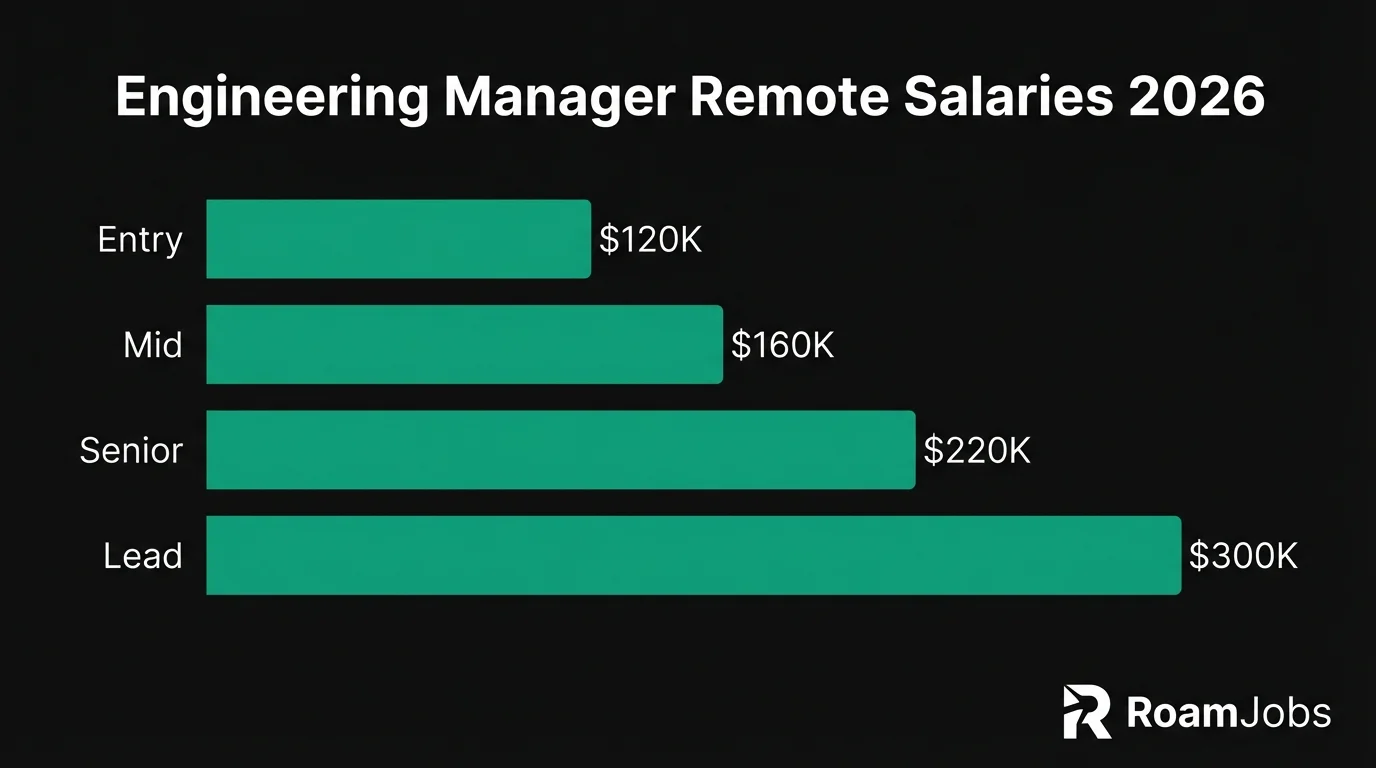
Remote Engineering Managers lead distributed software teams, combining technical expertise with people leadership to deliver products while developing engineers’ careers. In 2026, remote EM salaries range from $140,000 to $300,000+ for US-based positions, with Director and VP roles exceeding $400,000 in total compensation. The role presents unique challenges that don’t exist in co-located settings: building team cohesion across time zones, conducting effective remote 1:1s, maintaining visibility into work without micromanaging, and fostering career growth for engineers you may never meet in person. Unlike individual contributor roles where output is directly measurable through code, engineering management success is measured through team outcomes—shipping velocity, engineer retention, code quality, and cross-functional effectiveness. Remote EMs must master asynchronous communication, written documentation, and video presence while creating psychological safety and high-performance culture in distributed environments. The best remote engineering managers are force multipliers who make their teams significantly more effective than the sum of individual contributions.
What Remote Engineering Managers Actually Do
Engineering management is fundamentally a people and systems role—you’re responsible for building high-performing teams that consistently deliver valuable software. In remote settings, this responsibility comes with additional complexity that requires intentional practices and specialized skills.
Daily Responsibilities
One-on-Ones and Team Meetings
The backbone of remote engineering management is structured communication. Most remote EMs spend 30-50% of their time in 1:1s with direct reports (typically weekly 30-minute sessions), team meetings, and cross-functional collaboration. These aren’t optional overhead—they’re how work gets done when you can’t tap someone on the shoulder.
Hiring and Team Building
Remote EMs are deeply involved in recruiting, often conducting 5-10+ interviews monthly. You’ll write job descriptions, screen resumes, conduct technical and behavioral interviews, close candidates, and onboard new hires. Building a high-performing remote team requires evaluating candidates’ ability to work autonomously and communicate asynchronously—skills that are harder to assess than technical ability.
Project and Delivery Management
While you won’t write most code, you’re accountable for delivery. This means sprint planning, backlog grooming, identifying blockers before they become problems, coordinating with product management, and ensuring the team maintains sustainable velocity. Remote settings require more explicit tracking since you can’t observe work happening organically.
Technical Strategy and Architecture
EMs maintain enough technical depth to make architectural decisions, evaluate technical debt tradeoffs, and participate in system design discussions. You don’t need to be the best coder on the team, but you need credibility and judgment on technical matters.
People Development and Performance
Career conversations, performance reviews, coaching, and sometimes difficult conversations about underperformance. Remote managers must be more deliberate about feedback since casual corridor conversations don’t happen. You’ll also advocate for promotions, manage compensation, and handle the human side of engineering.
Engineering Manager vs Tech Lead vs Director
Understanding role distinctions helps you target the right opportunities:
Tech Lead focuses primarily on technical execution with limited people management. They may mentor engineers and lead projects but typically don’t own hiring, performance reviews, or career development. Some Tech Leads manage 1-3 engineers, but the role is fundamentally technical. Tech Leads often remain individual contributors with additional responsibilities.
Engineering Manager owns people management for a team of 5-10 engineers. Primary focus is team health, delivery, and engineer development. Technical involvement varies—some EMs code 20-30% of the time, others rarely. The key distinction is that EMs are evaluated on team outcomes, not personal technical contribution. Most EM roles include hiring authority and performance management responsibility.
Senior/Staff Engineering Manager manages larger teams (8-12+) or multiple sub-teams with Tech Leads reporting to them. Higher strategic involvement in roadmap planning, cross-team coordination, and organizational design. Often responsible for manager development and team topology decisions.
Director of Engineering manages managers, overseeing 20-50+ engineers across multiple teams. Focuses on organizational health, engineering strategy, technical direction, and executive alignment. Directors spend more time on hiring managers, organizational design, and cross-functional leadership than direct engineering work.
VP of Engineering executive-level leadership responsible for entire engineering organizations (50-200+ engineers). Owns engineering strategy, budget, executive alignment, and organizational culture. Works closely with C-suite on company strategy. Very limited hands-on technical or individual people management.
Unique Challenges of Remote Engineering Leadership
Remote engineering management requires addressing challenges that simply don’t exist in co-located settings:
Building Trust Without Physical Presence
In-office managers build trust through countless micro-interactions: grabbing coffee, casual desk conversations, observing work patterns. Remote managers must build equivalent trust through scheduled touchpoints, written communication, and deliberate relationship building. This takes more time and intentionality but can result in deeper, more meaningful connections.
Visibility Without Surveillance
Managers need to understand what’s happening on their teams without creating a surveillance culture. Remote settings require balancing transparency (knowing project status, identifying blockers) with autonomy (not micromanaging every commit). The solution involves clear expectations, regular check-ins, and outcome-focused measurement rather than activity monitoring.
Developing Engineers You’ve Never Met In Person
Many remote EMs manage engineers they’ve never shared physical space with. Developing careers, identifying growth opportunities, and giving effective feedback requires more structured approaches than the organic mentorship that happens in offices.
Time Zone Complexity
Teams distributed across time zones require thoughtful meeting scheduling, asynchronous communication protocols, and ensuring no group is consistently disadvantaged by meeting times. Some decisions that would take a quick conversation now require waiting overnight for responses.
Remote Onboarding and Culture
New hires can’t absorb culture by osmosis when working remotely. Remote EMs must deliberately design onboarding experiences, document cultural norms, and create opportunities for new engineers to build relationships.
Seniority Levels and Compensation
Understanding the progression from first-time manager to director helps you plan your career trajectory and target appropriate opportunities.
Entry Level / Junior Engineering Manager
0-2 years management experience
The IC to EM Transition
First-time engineering managers typically have 4-8 years of software engineering experience and are making the leap from individual contributor to people leadership. This transition is one of the most significant career shifts in tech—your success metrics change completely from personal output to team outcomes.
Key Skills to Develop
- Delegation and letting go: Learning to achieve through others rather than doing work yourself is the hardest adjustment for new managers. Your instinct to jump in and fix code needs to transform into coaching others to solve problems.
- Difficult conversations: Addressing performance issues, giving constructive feedback, and navigating interpersonal conflicts require skills most ICs haven’t developed.
- Meeting facilitation: Running effective standups, retrospectives, and planning sessions is a learnable skill that new managers often underestimate.
- Time management: With calendars full of 1:1s and meetings, finding time for strategic work requires intentional blocking and prioritization.
- Basic HR knowledge: Understanding performance review processes, promotion criteria, and company policies becomes immediately relevant.
What Companies Expect
- Deep technical background with hands-on engineering experience
- Demonstrated mentorship or tech lead experience
- Strong communication skills, especially written
- Understanding of agile methodologies and delivery practices
- Willingness to learn management fundamentals
Typical Team Scope
First-time remote EMs usually manage 3-6 engineers on a single team. Companies often prefer giving new managers smaller teams to develop skills before expanding scope. Some organizations have dedicated “EM apprenticeship” programs pairing new managers with experienced mentors.
Compensation Breakdown (US Remote)
Base salary typically ranges $140,000-$180,000, with total compensation (including equity and bonus) reaching $160,000-$220,000 at growth-stage and public companies. Startups may offer lower base with higher equity upside. Geographic pay adjustments vary—some remote-first companies pay location-agnostic rates, while others adjust 10-25% for lower cost-of-living areas.
Mid-Level Engineering Manager
2-4 years management experience
Growing Into Established Leadership
With 2-4 years of management experience, you’ve developed core competencies and faced most common challenges at least once. You’re no longer learning management basics—you’re refining your approach and taking on more complex situations.
Key Skills at This Level
- Hiring excellence: You can consistently identify, evaluate, and close strong candidates. Your hiring track record demonstrates ability to build high-performing teams.
- Performance management: Handling underperformance, managing out when necessary, and developing high performers toward promotion become routine rather than terrifying.
- Cross-functional leadership: Working effectively with product managers, designers, and stakeholders requires influence without authority.
- Remote-specific expertise: You’ve developed practices for distributed team building, async communication, and remote culture that consistently produce results.
- Organizational awareness: Understanding how decisions are made, who influences outcomes, and how to navigate company politics becomes increasingly important.
What Companies Expect
- Proven track record managing remote or distributed teams
- Experience hiring, developing, and sometimes managing out engineers
- Demonstrated delivery of significant projects through team leadership
- Cross-functional partnership skills
- Emerging strategic thinking about team structure and processes
Typical Team Scope
Experienced EMs manage 5-10 engineers on a single team or may begin overseeing 2 smaller teams (10-15 engineers total) with Tech Leads handling day-to-day technical leadership. Some organizations have this level manage a complex system or product area.
Compensation Breakdown (US Remote)
Base salaries reach $175,000-$230,000, with total compensation packages of $200,000-$300,000 at competitive companies. At this level, equity becomes more significant—typically 0.1-0.3% at startups or substantial RSU grants at public companies. Annual bonuses of 10-20% are common.
Career Development Focus
This stage often determines whether you pursue the management track or return to IC work. Many engineers try management for 2-3 years, realize it’s not for them, and return to Staff or Principal engineer roles. Those who thrive focus on developing broader organizational impact and preparing for senior management responsibilities.
Senior Engineering Manager
4-7 years management experience
Managing Complexity and Scale
Senior Engineering Managers handle larger scope, more ambiguity, and greater organizational complexity. You may manage multiple teams, own critical systems, or lead engineering for an entire product line.
Key Skills at This Level
- Managing managers: Some Senior EMs begin developing other managers, requiring a different skill set than managing ICs—you’re coaching on management practices rather than engineering.
- Organizational design: Structuring teams for optimal delivery, deciding when to split or merge teams, and designing communication patterns across groups.
- Strategic technical leadership: Making architectural decisions that span multiple teams, balancing innovation against technical debt, and setting engineering direction.
- Executive communication: Presenting to leadership, managing up effectively, and representing engineering in strategic discussions.
- Conflict resolution: Handling complex interpersonal situations, team dynamics issues, and cross-functional disagreements.
What Companies Expect
- Track record building and scaling high-performing remote teams
- Experience managing significant organizational complexity
- Strong executive presence and communication skills
- Ability to drive strategic initiatives across multiple teams
- Demonstrated judgment on technical and organizational tradeoffs
Typical Team Scope
Senior EMs typically manage 12-25 engineers across 2-4 teams, often with Tech Leads or junior managers handling individual team leadership. You might own an entire product area, critical infrastructure, or customer-facing platform. The role requires balancing broad oversight with selective deep involvement.
Compensation Breakdown (US Remote)
Base compensation reaches $220,000-$300,000, with total compensation packages of $280,000-$400,000+ at well-funded startups and public companies. Equity stakes of 0.2-0.5% at startups or six-figure annual RSU grants become typical. Annual bonuses of 15-25% reflect increased organizational impact.
Path to Director
Senior EMs targeting Director roles focus on demonstrating organizational-level impact: improving engineering culture, driving cross-team initiatives, developing other managers, and building executive relationships. The transition requires shifting from team-level optimization to organizational-level thinking.
Lead / Director Engineering
7+ years management experience
Organizational Leadership
Directors of Engineering lead engineering organizations, typically managing managers and overseeing 25-75+ engineers. At this level, you’re shaping engineering culture, strategy, and capability across the organization.
Key Skills at This Level
- Manager development: Your primary people work is developing strong engineering managers. Building management bench strength becomes a key success metric.
- Organizational strategy: Designing team structures, establishing engineering processes, and creating systems that scale with company growth.
- Executive partnership: Working closely with VP Engineering, CTO, and executive team on company strategy, resource allocation, and engineering direction.
- Budget ownership: Managing headcount planning, compensation decisions, and engineering investment allocation.
- Culture stewardship: Setting and maintaining engineering culture, values, and standards across a large organization.
What Companies Expect
- Proven ability to scale engineering organizations
- Track record developing and retaining strong engineering managers
- Executive-level communication and influence skills
- Strategic thinking about engineering as competitive advantage
- Experience navigating organizational change and growth
Typical Scope
Directors oversee 3-8 engineering teams (25-75 engineers) spanning multiple product areas or technical domains. You might own all of mobile engineering, platform infrastructure, or a major product line. Some Directors have broader scope (100+ engineers) at larger companies, while startup Directors might manage smaller organizations with higher strategic impact.
Compensation Breakdown (US Remote)
Base salaries range $280,000-$400,000, with total compensation packages reaching $400,000-$600,000+ at well-funded companies. Equity stakes of 0.3-1.0% at startups or substantial RSU grants (often $200,000-$400,000+ annually at public companies) reflect organizational-level impact. Bonuses of 20-40% of base are typical.
VP Engineering Path
Directors aspiring to VP roles focus on demonstrating engineering-wide impact, executive presence, and ability to represent engineering at the highest levels. The transition requires comfort with ambiguity, political navigation, and strategic thinking that spans the entire company.
Essential Skills and Tools
Remote engineering management requires mastering both technical and organizational tools. Your ability to leverage these effectively directly impacts team performance.
Project Management Tools
Project Management Platforms for Remote Engineering Teams
Source: RoamJobs 2026 Tool Analysis| Tool | Best For | Strengths | Limitations | Pricing |
|---|---|---|---|---|
| Linear | Startups and fast-moving teams | Speed, keyboard shortcuts, clean UX | Less customizable, newer ecosystem | $8/user/mo |
| Jira | Enterprise and complex workflows | Highly customizable, integrations | Steep learning curve, can become bloated | $7.75/user/mo |
| Asana | Cross-functional teams | Flexible views, good for non-engineers | Less engineering-specific features | $10.99/user/mo |
| GitHub Projects | GitHub-centric workflows | Native GitHub integration, free tier | Limited features compared to dedicated tools | Free with GitHub |
| Shortcut (Clubhouse) | Mid-size engineering teams | Balanced features and usability | Smaller community than alternatives | $8.50/user/mo |
| Monday.com | Visual workflow management | Highly visual, easy onboarding | Can feel marketing-focused for engineers | $9/seat/mo |
Data compiled from RoamJobs 2026 Tool Analysis. Last verified January 2026.
Choosing the Right Tool: Your project management tool should match team size, workflow complexity, and integration needs. Linear excels for fast-moving startups prioritizing speed over customization. Jira suits enterprise environments with complex requirements. Asana works well for teams with heavy cross-functional collaboration beyond engineering. Most tools offer similar core functionality—focus on the one your team will actually use consistently.
Communication Tools for Remote Teams
- Slack/Discord: Primary channels for real-time team communication. Establish clear channel structures, notification expectations, and response time norms. Over-communication is better than under-communication in remote settings.
- Zoom/Google Meet/Around: Video meetings for 1:1s, team meetings, and cross-functional sessions. Invest in good lighting, audio, and background for professional presence.
- Loom: Asynchronous video messaging for explaining complex topics, giving demos, or recording announcements that don’t require real-time discussion.
Asynchronous Communication
- Notion/Confluence: Documentation hubs for team processes, technical decisions, meeting notes, and organizational knowledge. Good documentation is essential for remote teams—if it’s not written down, it doesn’t exist.
- GitHub/GitLab: Beyond code, use PR descriptions and comments for technical discussions, design decisions, and code review.
- Email: Use sparingly for external communication and formal announcements. Most internal communication should happen in more collaborative channels.
Best Practices for Remote Communication
Establish explicit communication norms with your team: expected response times for different channels, when to use async vs. sync communication, and how to escalate urgent issues. Document these norms and revisit them regularly as team needs evolve.
Performance Management Approaches
Continuous Feedback Systems
Annual reviews are insufficient for effective remote management. Implement continuous feedback through:
- Weekly 1:1s with documented discussion points and action items
- Quarterly goal check-ins with explicit progress assessment
- Real-time recognition through team channels for visible wins
- 360 feedback cycles (quarterly or semi-annually) for comprehensive perspective
Goal-Setting Frameworks
- OKRs (Objectives and Key Results): Best for aligning individual work with company objectives. Requires discipline to set measurable key results.
- SMART Goals: Specific, Measurable, Achievable, Relevant, Time-bound goals work well for individual development.
- Growth Frameworks: Engineering ladder documents that define expectations at each level help engineers understand promotion criteria.
Remote-Specific Considerations
Remote performance management requires more explicit communication since managers can’t observe work organically. Focus on outcomes rather than activity—measure engineers by what they deliver, not hours logged or messages sent. Create psychological safety for honest conversation about challenges, blockers, and development needs.
Technical Skills to Maintain vs Delegate
Skills to Maintain
Even as you move away from daily coding, maintain enough technical depth to:
- Review architectural decisions and system designs
- Evaluate technical tradeoffs and debt prioritization
- Assess candidate technical ability during interviews
- Understand when estimates are reasonable and when they’re off
- Participate meaningfully in technical discussions
How to Stay Technical
- Review PRs regularly (even if not the approver)
- Participate in architecture discussions and design reviews
- Stay current with technology trends relevant to your stack
- Occasionally take on small technical tasks or prototypes
- Build tools or scripts that help your management work
What to Delegate
Delegate deep implementation work, detailed code reviews, and technology-specific decisions to Tech Leads and senior engineers. Your value isn’t being the best coder—it’s enabling others to do their best work. Trust your technical leads while maintaining enough context to ask good questions.
Leadership Frameworks
Situational Leadership
Adjust your leadership style based on team member development level:
- Directing: High guidance for new team members or unfamiliar tasks
- Coaching: Guidance with explanation for developing team members
- Supporting: Collaborative decision-making for competent team members
- Delegating: Full autonomy for highly skilled, motivated team members
Manager Tools
Essential frameworks for common management situations:
- Radical Candor: Balance caring personally with challenging directly when giving feedback
- GROW Model: Structure coaching conversations (Goal, Reality, Options, Will)
- 5 Whys: Root cause analysis for problems and process improvements
- RACI: Clarify decision-making responsibility in cross-functional work
Building High-Performing Remote Teams
Focus on Patrick Lencioni’s Five Dysfunctions framework adapted for remote:
- Build Trust: Create psychological safety through vulnerability, follow-through, and consistency
- Embrace Conflict: Enable healthy debate in distributed settings through structured discussions
- Achieve Commitment: Ensure alignment through explicit decision documentation
- Ensure Accountability: Make commitments visible and follow up systematically
- Focus on Results: Measure team outcomes, not individual activity
Companies Hiring Remote Engineering Managers
The remote engineering manager job market spans from early-stage startups to established enterprises. Understanding where to look and what each company type offers helps focus your search.
Remote-First Companies with Strong EM Cultures
GitLab remains the gold standard for remote work, with their entire management playbook publicly documented. Engineering managers at GitLab lead teams of 6-10 engineers across product areas. They emphasize async communication, written documentation, and results-based management. Compensation is competitive with location-based pay adjustments.
Automattic (WordPress, WooCommerce, Tumblr) has operated fully distributed since founding. Engineering leads (their EM equivalent) manage small teams with high autonomy. Strong writing culture—candidates complete trial projects before hiring. Annual in-person team meetups provide face time.
Zapier built their engineering organization around remote work principles. Engineering managers lead teams focused on integrations, infrastructure, and platform. Known for exceptional work-life balance and clear documentation. Location-agnostic pay for many roles.
Buffer pioneered remote work transparency, including publishing salaries and equity formulas. Smaller engineering organization with high manager-to-engineer ratio. Strong culture fit emphasis in hiring.
Doist (Todoist, Twist) practices async-first communication, even using their own tools internally. Engineering managers work across globally distributed teams with minimal real-time meetings. Focus on written communication excellence.
Basecamp (37signals) operates with minimal management hierarchy but has engineering leads who manage small teams. Known for calm company philosophy and sustainable pace. Contrarian views on venture capital and growth.
Notion expanded their remote policy and now hires engineering managers for distributed teams across documentation, collaboration, and platform features. Fast-growing with startup energy.
Figma (now Adobe) maintained remote flexibility with engineering manager roles across their design tool and developer platform teams. Strong design and engineering culture intersection.
Companies with Strong Remote Engineering Manager Programs
Shopify went “digital by default” and maintains strong remote engineering management. Large engineering organization with clear career ladders. Location-based pay but broad geographic coverage.
Stripe operates distributed engineering teams with managers across infrastructure, payments, and platform. Exceptional engineering culture and compensation. Some roles have regional restrictions.
Coinbase committed to remote-first with engineering managers across trading, security, and platform teams. Competitive compensation with crypto exposure. Rapidly evolving organization.
Atlassian offers “Team Anywhere” flexibility with engineering managers across Jira, Confluence, and Trello products. Established company with mature management practices.
HubSpot provides @flex remote options with engineering managers across CRM, marketing, and platform teams. Strong people-first culture and development opportunities.
Twilio maintains distributed engineering with managers across communications APIs, infrastructure, and developer experience. Customer-focused engineering culture.
DataDog has remote engineering manager positions across monitoring, security, and infrastructure products. Fast growth with strong engineering emphasis.
Vercel (Next.js creators) hires remote engineering managers for infrastructure and developer experience teams. Frontend and developer tooling focus.
Supabase operates fully remote with engineering managers for their open-source Firebase alternative. Early-stage startup energy with transparent building.
PlanetScale (serverless MySQL) maintains distributed engineering management across database and platform teams. Technical depth emphasis.
Finding Unlisted Opportunities
Many senior engineering manager positions are never publicly posted. Develop sourcing strategies beyond job boards:
Network Cultivation
Build relationships with:
- Other engineering managers at target companies
- Recruiters specializing in engineering leadership
- VCs who can introduce you to portfolio companies
- Former colleagues who’ve moved to interesting companies
Targeted Outreach
Research companies you’d want to work for and reach out directly:
- Connect with VPs of Engineering on LinkedIn
- Engage thoughtfully with company engineering blogs
- Attend virtual events where target company leaders speak
- Contribute to open-source projects from target companies
Executive Recruiters
For Director+ roles, build relationships with engineering-focused recruiters:
- Riviera Partners
- True Search
- Daversa Partners
- Various boutique technical recruiting firms
Senior roles often go through retained searches—having established recruiter relationships surfaces opportunities you’d never find otherwise.
Platform Presence
Make yourself findable by maintaining:
- Complete LinkedIn profile emphasizing remote leadership
- Occasional blog posts or conference talks
- Engagement in engineering management communities
- GitHub presence showing technical activity
Interview Deep Dive
Remote engineering manager interviews evaluate technical credibility, leadership capability, and cultural fit through multiple rounds. Understanding what hiring managers look for helps you prepare effectively.
Interview Process Overview
Typical remote EM interview processes include:
- Recruiter Screen (30 min): Background, interest, salary expectations
- Hiring Manager Screen (45-60 min): Experience deep dive, role fit assessment
- Technical Interview (60 min): System design or technical problem-solving
- Leadership Case Study (60 min): Management scenario discussions
- Behavioral Panel (60 min): Cross-functional interviewers on collaboration
- Skip-Level (30-45 min): VP or Director assessment of fit
- Team Interview (30-60 min): Meeting potential direct reports
Prepare specific examples for each interview type, tailored to remote context.
Behavioral Questions
What interviewers assess: Your ability to address performance issues directly and constructively, adapted for remote contexts.
Strong response structure:
- Describe the specific performance gap and how you identified it remotely
- Explain how you prepared for the conversation (documentation, examples)
- Walk through the feedback conversation approach
- Describe the outcome and any follow-up
- Reflect on what you learned about remote feedback delivery
Key points to emphasize:
- Early identification before issues compound
- Written documentation of expectations and gaps
- Direct but compassionate delivery via video call
- Clear improvement plan with measurable outcomes
- Appropriate follow-up cadence for remote setting
What interviewers assess: Your intentionality about remote relationship building and understanding of trust dynamics.
Strong response elements:
- Initial 1:1 strategy: extended first meetings to learn personal backgrounds
- Consistent availability and response patterns
- Vulnerability and authenticity in sharing your own experience
- Following through on commitments reliably
- Creating psychological safety for team members to raise concerns
- Using video liberally for important conversations
- Finding opportunities for informal connection
Example framework: “I structure the first month with extended 1:1s—90 minutes each—to understand each person’s background, career goals, working style, and communication preferences. I share my own leadership philosophy and past mistakes to model vulnerability. Then I maintain trust through consistent weekly 1:1s, reliable follow-through on commitments, and creating multiple channels for team members to raise concerns or share feedback.”
What interviewers assess: Your ability to balance input with decisiveness, and to maintain team morale after difficult decisions.
Strong response structure:
- Context: What decision needed to be made and why it was contentious
- Process: How you gathered input and made the decision transparent
- Communication: How you explained the decision and rationale
- Follow-through: How you supported the team through implementation
- Outcome: Results and team dynamics after
Key principles to demonstrate:
- “Disagree and commit” culture: gathering genuine input before deciding
- Transparency about decision rationale, especially in writing for async teams
- Acknowledging valid concerns while explaining tradeoffs
- Not revisiting decisions repeatedly once made
- Protecting team from external pressure after committing
What interviewers assess: Conflict resolution skills and ability to maintain team health remotely.
Response framework:
- Identify: How you notice conflict in remote settings (PR friction, meeting tension, direct reports)
- Investigate: Individual 1:1s with each party to understand perspectives
- Mediate: Facilitating direct conversation if appropriate
- Resolve: Finding path forward that both parties can commit to
- Prevent: Adjusting team norms or processes to prevent recurrence
Remote-specific considerations:
- Conflict can fester longer without in-person observation
- Written communication can escalate misunderstandings
- Video calls are essential for resolving emotional situations
- Documentation of agreed-upon outcomes prevents future disputes
What interviewers assess: Your ability to create alignment and engagement in distributed settings.
Strong response elements:
- Regular strategy translation: connecting team work to company objectives
- Team meetings that include strategy updates and Q&A
- Making leadership decisions and rationale visible
- Creating opportunities for team to ask questions directly
- Celebrating wins that connect to broader impact
- Individual 1:1 discussions about career growth and company direction
Concrete practices to mention:
- Weekly team updates that start with company context
- Quarterly planning that explicitly connects to company OKRs
- Skip-level meetings where reports meet your manager
- All-hands meeting attendance and follow-up discussions
- Documentation of how team work contributes to strategic goals
What interviewers assess: Technical credibility and appropriate delegation balance.
Strong response structure:
- Your current technical involvement level and how it’s evolved
- How you stay informed about technical decisions without micromanaging
- When you get involved directly vs. delegate
- How you ensure quality without being the reviewer on everything
- Examples of technical decisions you influenced as a manager
Key principles:
- Trust technical leads for implementation decisions
- Stay involved in architecture and cross-team technical choices
- Maintain enough context to ask good questions
- Delegate but don’t abdicate—know what’s happening
- Create systems (design reviews, RFCs) that ensure quality without manager bottleneck
What interviewers assess: Your 1:1 framework and intentionality about this core management practice.
Strong response elements:
- Cadence: Weekly, consistent timing, rarely canceled
- Ownership: Engineer-driven agenda with manager additions
- Content mix: Career development, blockers, feedback, personal connection
- Documentation: Shared notes for continuity and accountability
- Remote adaptations: Video always on, adequate time, informal warm-up
Common format to describe:
- 5 minutes: Personal check-in and informal connection
- 15-20 minutes: Engineer’s agenda items
- 10 minutes: Manager items (feedback, context, requests)
- 5 minutes: Action items and next steps
What interviewers assess: Your ability to develop talent and create growth opportunities.
Response framework:
- Context: Where the engineer started and the growth opportunity
- Assessment: How you identified their potential and gaps
- Development: Specific actions you took to support their growth
- Outcome: The result of their development and their new scope
- Reflection: What you learned about developing engineers
Strong examples include:
- IC to Tech Lead transitions you supported
- Engineers who grew from mid to senior under your leadership
- People who took on new technical domains or ownership areas
- Engineers who developed skills outside their comfort zone
What interviewers assess: Your approach to performance management without in-person observation.
Performance signals to discuss:
- Output quality: Code quality, design decisions, bug rates
- Delivery consistency: Meeting commitments, sprint completion
- Collaboration signals: PR reviews given/received, async communication quality
- Proactive communication: Updates without prompting, raising blockers early
- Team contribution: Helping others, mentoring, improving processes
- Growth trajectory: Taking on new challenges, expanding scope
Anti-patterns to avoid:
- Measuring hours online or messages sent
- Conflating visibility with performance
- Penalizing time zone differences in response times
- Relying solely on outcome metrics without context
What interviewers assess: Your ability to balance multiple priorities and negotiate with stakeholders.
Strong response structure:
- Your framework for evaluating priority tradeoffs
- How you negotiate with product management on timeline/scope
- How you create space for technical debt and team development
- Specific examples of tradeoffs you’ve navigated
Practical approaches to mention:
- Allocating percentage of capacity to tech debt (20% is common)
- Including tech debt in sprint planning alongside features
- Making debt impact visible to product partners
- Connecting development time to team retention and velocity
- Using roadmap planning to batch related improvements
What interviewers assess: Your hiring process and ability to evaluate remote-specific capabilities.
Evaluation criteria for remote candidates:
- Written communication quality in application materials
- Self-direction and autonomy signals from past experience
- Experience with remote or distributed work
- Communication style during interview (clarity, proactiveness)
- Problem-solving approach when given ambiguous situations
- Time management and organization indicators
Process elements to discuss:
- Async components (take-home, written exercises)
- How you structure video interviews for signal
- Reference questions specific to remote work
- Trial periods or contract-to-hire approaches
- Onboarding design for remote success
What interviewers assess: Your ability to navigate organizational dynamics and advocate effectively.
Strong response structure:
- Context: What needed to change and why you believed it mattered
- Stakeholder analysis: Understanding what your leadership cared about
- Approach: How you framed your case and built support
- Execution: The conversation or process you used
- Outcome: The result and any relationship impact
Key principles to demonstrate:
- Understanding your audience’s priorities and constraints
- Building evidence and data to support your position
- Choosing the right timing and forum
- Being willing to accept outcomes you disagree with
- Maintaining relationship regardless of outcome
What interviewers assess: Your ability to address behavior issues and navigate team dynamics.
Response framework:
- Document: Gather specific examples of the friction
- Understand: 1:1 conversation to understand their perspective
- Clarify: Make behavior expectations explicit
- Coach: Work with them on specific behavior changes
- Evaluate: Set timeline for improvement and consequences
- Decide: Make retention decision if patterns continue
Key points to address:
- Technical contribution doesn’t override collaboration requirements
- Specific, observable behavior feedback (not personality)
- Impact of their behavior on team productivity and morale
- Clear expectations and improvement timeline
- Willingness to make hard decisions if needed
What interviewers assess: Your operational efficiency and meeting facilitation skills.
Effective remote meeting practices:
- Clear agenda shared in advance
- Appropriate participants only (not everyone for everything)
- Video on as norm for engagement
- Designated facilitator to manage participation
- Real-time documentation of decisions and action items
- Time-boxed discussions to maintain energy
- Asynchronous alternatives when appropriate
Types of meetings to discuss:
- Team syncs/standups (15 min, focused on blockers)
- Sprint planning (time-boxed, well-prepared)
- Retrospectives (structured format, action-oriented)
- 1:1s (as discussed above)
- All-hands (cadenced, strategy-focused)
What interviewers assess: Self-awareness, learning orientation, and honesty about failure.
Strong response structure:
- Context: The project and what was expected
- What went wrong: Honest assessment of failure factors
- Your responsibility: What you could have done differently
- Team/systemic factors: Other contributors without deflecting
- Lessons learned: Specific changes you made going forward
- Subsequent success: How you applied learning later
Key principles:
- Take genuine ownership without excessive self-flagellation
- Be specific about what you learned, not generic platitudes
- Show evidence of actual behavior change afterward
- Demonstrate resilience and growth orientation
What interviewers assess: Technical engagement balance and trust-building.
Practices to discuss:
- Regular architecture and design review participation
- PR review scanning (not approving, but reading)
- Sprint demo attendance and questions
- Technical debt and incident discussions
- Periodic pairing or shadowing sessions
- Tech lead 1:1s with technical agenda component
- On-call or incident participation
Boundaries to establish:
- Not being a bottleneck on technical decisions
- Trusting technical leads for day-to-day choices
- Asking questions vs. mandating solutions
- Making technical suggestions vs. requirements
- Staying informed vs. second-guessing
What interviewers assess: Intentionality about culture and understanding of remote dynamics.
Culture-building practices:
- Explicit documentation of team values and norms
- Regular team rituals (Friday demos, weekly wins, coffee chats)
- Recognition and celebration of achievements
- Safe space for feedback and concerns
- Onboarding that emphasizes culture transmission
- Team offsites or occasional in-person gatherings
- Informal connection opportunities (optional social channels)
Key principles:
- Culture requires active maintenance remotely—it won’t happen by accident
- Written documentation makes culture transmissible to new members
- Rituals create shared experience that bonds distributed teams
- Leaders model the culture they want to see
What interviewers assess: Your evaluation criteria and self-awareness about fit.
Questions to ask (that you can discuss having asked):
- How are engineering managers evaluated and promoted?
- What does the relationship between EM and PM look like here?
- How much technical work do EMs typically do?
- What’s the typical team size and scope for an EM?
- How does the company handle underperformance?
- What’s the approach to remote collaboration and async work?
- How are technical decisions made—top-down or bottoms-up?
- What’s the org’s approach to technical debt?
- How often do teams restructure or reorg?
What interviewers assess: Your change management approach and ability to turn around teams.
90-day approach to discuss:
First 30 days: Listen and diagnose
- 1:1s with every team member to understand their perspective
- Review team metrics, delivery history, incident patterns
- Meet with stakeholders to understand perceptions
- Identify quick wins for early credibility
- Don’t make major changes yet
Days 30-60: Stabilize
- Address most urgent issues (process gaps, tooling problems)
- Begin rebuilding trust through consistent behavior
- Start improving team rituals and communication
- Have difficult conversations if needed
- Quick wins to build momentum
Days 60-90: Improve
- Implement structural improvements based on diagnosis
- Set clear expectations and metrics
- Build accountability systems
- Develop longer-term improvement roadmap
- Re-evaluate team composition if necessary
What interviewers assess: Your ability to advocate for engineering while maintaining partnerships.
Strong response structure:
- Context: The request and why you disagreed
- Stakes: What would happen if you simply complied
- Approach: How you communicated your position
- Negotiation: Finding alternatives or compromises
- Outcome: The result and relationship impact
Key principles to demonstrate:
- Saying no with data and alternatives, not just resistance
- Understanding business context while advocating for engineering
- Finding win-win solutions where possible
- Maintaining relationship through disagreement
- Knowing when to escalate vs. commit
Frequently Asked Questions
Frequently Asked Questions
How do I transition from individual contributor to engineering manager in a remote company?
The IC to EM transition is challenging in any setting but requires additional intentionality remotely. Start by taking on informal leadership: mentoring newer engineers, leading project coordination, or facilitating meetings. Make your interest known to your manager and ask for management responsibilities before the title—running 1:1s with a mentee, leading hiring efforts, or owning a team process. Build management skills through resources like The Manager's Path, Manager Tools podcast, or formal training. When interviewing for EM roles, emphasize your remote collaboration skills, written communication, and any distributed team leadership experience. Many companies prefer promoting internally, so express interest early and seek stretch opportunities.
How do I maintain technical skills while doing less coding as a manager?
Technical atrophy is real for managers who don't intentionally maintain skills. Practical approaches include: reading PRs regularly to stay current with your team's codebase, participating in design reviews and architecture discussions, occasionally taking on small technical tasks like internal tools or prototypes, staying current with technology trends through reading and side projects, and maintaining your development environment so you can jump in when needed. The goal isn't remaining the strongest coder—it's maintaining enough technical credibility and context to lead effectively. Most managers find their technical skills shift from depth to breadth over time, which is appropriate for the role.
How do I run effective 1:1s when I can only meet someone on video?
Video 1:1s can be as effective as in-person meetings with the right approach. Use video rather than audio-only for the relationship benefits of face time. Create consistent structure: same time weekly, shared agenda document, standard format. Allocate time for personal connection at the start—ask about their life outside work. Keep cameras on and minimize distractions during the call. Document decisions and action items in real-time. Send a brief summary after significant conversations. For difficult feedback or sensitive topics, ensure extra time and consider whether a same-day follow-up would help. The key is consistency and quality of attention during the meeting.
How do I build team cohesion when my team has never met in person?
Remote team cohesion requires deliberate effort that would happen naturally in offices. Create regular rituals: weekly team meetings with personal check-ins, virtual coffee chats, shared celebrations of wins. Use team channels for informal conversation alongside work discussions. Plan virtual team activities—games, show-and-tell sessions, or learning time together. When budget allows, advocate for occasional in-person gatherings (quarterly or annually). Pair team members on projects to build relationships through work. Share personal context: encourage team members to share about their lives, interests, and working environments. The goal is creating enough shared experience that the team develops genuine connection despite distance.
What's the best way to handle performance issues with a remote engineer?
Remote performance management requires more documentation and explicit communication than in-person. When you identify a performance gap, first ensure your expectations were clear—unclear remote expectations often cause apparent performance issues. Document specific examples of the gap with dates and details. Schedule a dedicated video call (not your regular 1:1) to address the issue directly. Use clear language: describe the gap, share specific examples, explain the impact, and state your expectations. Create a written improvement plan with measurable outcomes and timeline. Follow up in writing after the conversation. Check in frequently during the improvement period. If improvement doesn't happen, document the pattern and work with HR on appropriate next steps. The key difference from in-person is that everything should be written and explicit—you can't rely on casual observation.
How do I manage engineers across significantly different time zones?
Managing across 8+ hour time zone differences requires adapting your practices significantly. Embrace asynchronous communication as the default—most work should be able to progress without real-time interaction. Establish core overlapping hours (even if just 2-3 hours) for essential synchronous work. Rotate meeting times to share the burden of inconvenient schedules. Document everything thoroughly so people can pick up context without waiting for responses. Use recorded video (Loom) for updates that don't require real-time discussion. For 1:1s, find the time that works best for the remote person and protect it. Be explicit about response time expectations during and outside overlapping hours. Some decisions will take longer—build buffer into planning for timezone latency.
Should I manage my team's time or just focus on outputs?
Focus on outputs while establishing reasonable availability expectations. Tracking hours worked or monitoring activity creates surveillance culture that undermines trust and autonomy—the key advantages of remote work. Instead, set clear expectations for deliverables, measure against commitments, and evaluate based on outcomes. That said, establish team norms for availability: expected response times during working hours, core hours for synchronous collaboration, and communication expectations during off-hours. If someone consistently misses commitments, address the pattern through 1:1s rather than monitoring activity. The exception is if you observe concerning patterns (missing meetings, unreachable for extended periods)—those warrant direct conversation about whether something is wrong, not surveillance.
How do I interview and evaluate candidates for remote work success?
Evaluating remote work potential requires looking beyond technical skills. Assess written communication through application materials and async exercises. Look for self-direction in past experience—did they work autonomously or require constant oversight? Ask about their home office setup and work environment. Probe for proactive communication: ask how they'd approach getting unblocked when stuck. Include async components in your interview process to see how candidates communicate in writing. Ask references specifically about remote work habits and communication style. During interviews, note whether candidates communicate clearly without prompting and how they handle ambiguity. Red flags include needing significant guidance during interviews, vague answers about past work, or resistance to async communication. Green flags include thoughtful questions, clear communication, and evidence of self-management.
How much should I be coding as an engineering manager?
The right amount varies by team size, company stage, and role scope—but generally decreases as scope increases. First-time EMs managing small teams might code 20-30% of time. Experienced EMs with larger teams typically code 0-10%. Directors and above rarely code production features. The important principle is that coding should never be on the critical path—if the team is waiting on your code, you're creating a bottleneck. Focus coding time on internal tools, prototypes, or exploratory work that helps you stay technical without blocking delivery. Some successful EMs stop coding entirely and maintain technical context through reviews and discussions. Others maintain a small coding practice for personal satisfaction and skill retention. Neither approach is wrong—find what works for your situation and team needs.
What should I do if I realize management isn't for me after trying it?
Many engineers try management and decide to return to IC work—this is normal and respectable, not failure. If you're questioning the fit, first determine whether you dislike management itself or just aspects of your current situation (bad company culture, difficult team dynamics, inadequate support). If it's the latter, consider whether a different management role might be better before abandoning the path. If you genuinely prefer IC work, plan your transition thoughtfully. Most companies value experienced engineers with management perspective—the combination is valuable for Staff/Principal roles. Talk openly with your manager about returning to IC work; most organizations prefer retention to losing you entirely. Update your skills if you've been away from hands-on work. Target roles that value your broadened perspective. Many successful Staff+ engineers have management experience that informs their technical leadership.
How do I handle it when my team is distributed across multiple countries with different cultures?
Cross-cultural remote leadership requires additional awareness and adaptation. Learn about the communication norms of represented cultures—directness varies significantly, as do attitudes toward hierarchy, disagreement, and feedback. Create explicit team norms that establish shared expectations rather than assuming everyone shares your cultural defaults. Be aware that silence in meetings may mean agreement in some cultures and disagreement in others—check understanding explicitly. Account for language differences by speaking clearly, avoiding idioms, and using written summaries of important discussions. Be sensitive to different holidays and working patterns. Provide multiple channels for contribution so people can participate in ways comfortable to their communication style. Address friction directly when cultural differences cause misunderstanding—these are learning opportunities, not problems to avoid.
What's the difference between managing a remote team vs. managing a team that's partially remote (hybrid)?
Hybrid presents unique challenges that fully remote doesn't. When some team members are co-located and others remote, the in-office group naturally has advantages: casual conversations, relationship building, visibility to leadership. Remote team members can become second-class citizens. To manage hybrid effectively: treat everyone as remote (all meetings on video even when some participants are co-located), ensure remote voices are heard equally, don't make decisions in hallway conversations, document everything, and be extra intentional about including remote team members in social activities. Some managers find fully remote easier to manage fairly than hybrid because everyone has the same constraints and advantages. If you have a choice of team structure, consider whether you can create true equity in a hybrid setting.
Next Steps in Your Remote EM Journey
Landing a remote engineering manager role requires preparation across multiple dimensions: building management skills, developing remote-specific capabilities, and positioning yourself effectively in the job market.
If you’re transitioning from IC to EM:
- Seek informal leadership opportunities on your current team
- Read foundational management resources (The Manager’s Path, High Output Management)
- Practice remote collaboration skills through cross-team projects
- Build relationships with managers who can advocate for your transition
If you’re an experienced EM seeking remote roles:
- Update your LinkedIn to emphasize remote leadership experience
- Prepare specific examples of distributed team success
- Research target companies’ remote work philosophies
- Network with managers at remote-first organizations
If you’re a senior EM or Director:
- Build executive recruiter relationships
- Develop thought leadership through writing or speaking
- Network at the VP/Director level for opportunities
- Consider whether fully remote or flexible hybrid fits your goals
The remote engineering management market continues to expand as companies recognize that effective leadership doesn’t require physical proximity. For managers who develop the right skills and position themselves thoughtfully, exceptional opportunities await—the ability to lead teams from anywhere while building products that matter.
Related Resources
Explore these related guides to continue building your remote engineering management capabilities:
- Remote Engineering Jobs: Overview of the entire remote engineering landscape including all specializations
- Remote Interview Guide: Comprehensive preparation for remote interview processes
- Negotiating Remote Salary: Strategies for maximizing your compensation package
Get Remote Engineering Leadership Insights
Weekly curated remote engineering management opportunities, leadership insights, and career advice delivered to your inbox.
Frequently Asked Questions
How do I find remote engineering manager jobs?
To find remote engineering manager jobs, start with specialized job boards like We Work Remotely, Remote OK, and FlexJobs that focus on remote positions. Set up job alerts with keywords like "remote engineering manager" and filter by fully remote positions. Network on LinkedIn by following remote-friendly companies and engaging with hiring managers. Many engineering manager roles are posted on company career pages directly, so identify target companies known for remote work and check their openings regularly.
What skills do I need for remote engineering manager positions?
Remote engineering manager positions typically require the same technical skills as on-site roles, plus strong remote work competencies. Essential remote skills include excellent written communication, self-motivation, time management, and proficiency with collaboration tools like Slack, Zoom, and project management software. Demonstrating previous remote work experience or the ability to work independently is highly valued by employers hiring for remote engineering manager roles.
What salary can I expect as a remote engineering manager?
Remote engineering manager salaries vary based on experience level, company size, location-based pay policies, and the specific tech stack or skills required. US-based remote positions typically pay market rates regardless of where you live, while some companies adjust pay based on your location's cost of living. Entry-level positions start lower, while senior roles can command premium salaries. Check our salary guides for specific ranges by experience level and geography.
Are remote engineering manager jobs entry-level friendly?
Some remote engineering manager jobs are entry-level friendly, though competition can be high. Focus on building a strong portfolio or demonstrable skills, contributing to open source projects if applicable, and gaining any relevant experience through internships, freelance work, or personal projects. Some companies specifically hire remote junior talent and provide mentorship programs. Smaller startups and agencies may be more open to entry-level remote hires than large corporations.
Continue Reading
Remote Engineering Jobs 2026: Complete Guide to All Software Roles
The definitive hub for remote software engineering careers. Explore salary data, interview guides, and opportunities across frontend, backend, DevOps, ML, security, and more.
Senior Remote Jobs 2026: Advancing Your Remote Career
Guide for senior professionals seeking remote positions including leadership roles and compensation negotiation.
Remote Executive Jobs 2026: C-Suite & VP Positions
Guide to landing remote executive positions including search strategies, compensation, and leading distributed organizations.
Land Your Remote Job Faster
Get the latest remote job strategies, salary data, and insider tips delivered to your inbox.