Remote Engineering Jobs 2026: Complete Guide to All Software Roles
The definitive hub for remote software engineering careers. Explore salary data, interview guides, and opportunities across frontend, backend, DevOps, ML, security, and more.
Updated January 27, 2026 • Verified current for 2026
Remote software engineering is the largest and highest-paying segment of the remote job market in 2026. This comprehensive guide covers 10 distinct engineering specializations—from Frontend and Backend to DevOps, Machine Learning, and Security—each with unique salary ranges ($70K-$400K+), interview processes, and career paths. Whether you’re a career-switcher exploring which path to pursue or a senior engineer looking to specialize, this hub connects you to detailed guides for every remote engineering role, plus cross-cutting skills that every remote engineer needs to master.
Which Remote Engineering Role Is Right for You?
Choosing the right engineering specialization significantly impacts your career trajectory, earning potential, and day-to-day satisfaction. This decision tree helps you identify which of the 10 engineering paths aligns best with your interests and strengths.
Decision Framework
Do you prefer building things users interact with directly?
If you enjoy creating visual interfaces, animations, and user experiences, consider Frontend Development or Mobile Development. These roles require strong aesthetic sensibility, attention to detail, and empathy for end users. Remote frontend and mobile roles often require more real-time collaboration with designers.
Do you prefer building systems and infrastructure?
If you enjoy database optimization, API design, and server architecture, consider Backend Development, DevOps/Platform Engineering, or Data Engineering. These roles emphasize scalability, reliability, and performance. They’re among the most remote-friendly because the work is inherently asynchronous and measurable.
Do you enjoy combining multiple disciplines?
If you want to work across the entire stack and value versatility over deep specialization, Fullstack Development or Engineering Management might suit you. These roles require breadth and the ability to context-switch between technologies.
Are you drawn to specialized, high-impact domains?
Consider Machine Learning Engineering (if you love math and data), Security Engineering (if you’re detail-oriented and enjoy adversarial thinking), or QA Engineering (if you have a quality mindset and enjoy breaking things).
Quick Role Comparison
Engineering Roles at a Glance
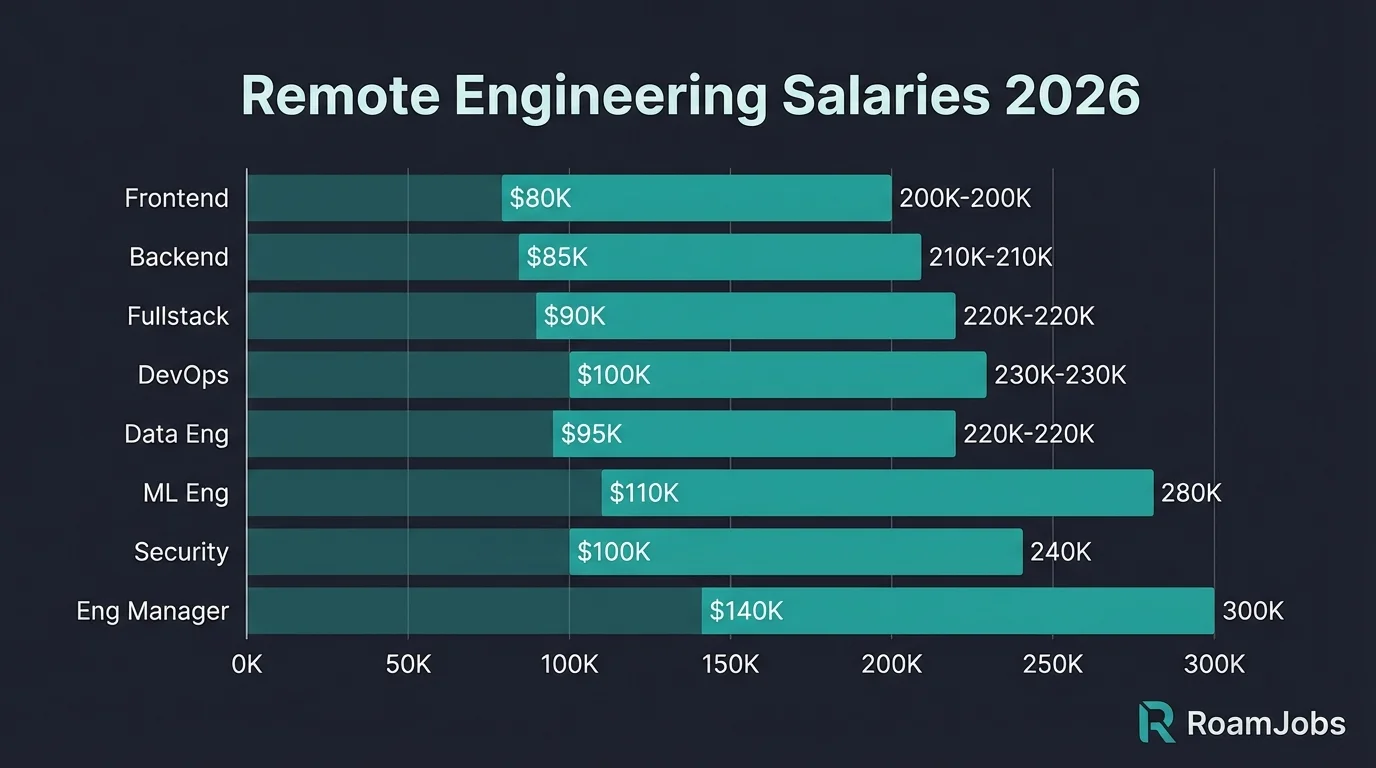
Source: RoamJobs estimate| Role | US Salary (Senior) | Remote Friendliness | Entry Barrier | Growth Trajectory |
|---|---|---|---|---|
| Frontend Developer | $140K-$200K | High | Medium | Strong |
| Backend Developer | $150K-$220K | Very High | Medium | Strong |
| Fullstack Developer | $145K-$210K | High | Medium | Strong |
| Mobile Developer | $155K-$220K | High | Medium-High | Strong |
| DevOps Engineer | $160K-$230K | Very High | High | Very Strong |
| Data Engineer | $165K-$240K | Very High | High | Very Strong |
| ML Engineer | $190K-$280K | High | Very High | Very Strong |
| QA Engineer | $115K-$165K | High | Low-Medium | Moderate |
| Security Engineer | $170K-$250K | Very High | High | Very Strong |
| Engineering Manager | $220K-$300K | High | Very High | Strong |
Data compiled from RoamJobs estimate. Last verified January 2026.
Comprehensive Salary Comparison: All Engineering Roles
Understanding compensation across all engineering specializations helps you make informed career decisions. These figures represent remote positions with US-based companies, the most competitive segment of the remote job market.
Software Engineering Salary by Experience & Location
| Level | 🇺🇸 US Remote | 🇪🇺 EU Remote | 🌎 LATAM | 🌏 Asia |
|---|---|---|---|---|
| Entry Level (0-2 yrs) | $70,000 - $110,000 | $45,000 - $75,000 | $28,000 - $55,000 | $20,000 - $45,000 |
| Mid-Level (2-5 yrs) | $100,000 - $160,000 | $68,000 - $110,000 | $48,000 - $85,000 | $38,000 - $72,000 |
| Senior (5-8 yrs) | $150,000 - $250,000 | $100,000 - $165,000 | $72,000 - $125,000 | $62,000 - $110,000 |
| Staff/Director (8+ yrs) | $200,000 - $400,000 | $140,000 - $280,000 | $105,000 - $200,000 | $95,000 - $180,000 |
* Estimates, not survey data. Figures are RoamJobs estimates built from publicly reported salary ranges and adjusted for regional market rates; they are not from a proprietary RoamJobs survey. Actual base compensation varies by company, experience, and specific location within a region — verify against current offers before negotiating.
Salary Trends by Specialization
Highest-paying specializations:
- Machine Learning Engineering - Premium for AI/ML expertise, 15-25% above general software engineering
- Security Engineering - Cybersecurity talent shortage drives premiums, especially for senior roles
- DevOps/Platform Engineering - Infrastructure expertise commands strong compensation
- Engineering Management - Leadership premium once you reach director+ levels
Fastest-growing compensation:
- Data Engineering - 12% YoY salary growth as data infrastructure becomes critical
- ML Engineering - 15% YoY growth driven by AI adoption
- Security Engineering - 10% YoY growth due to increasing cyber threats
Most location-agnostic pay:
- Remote-first companies increasingly offer location-agnostic compensation for senior engineers
- Backend, DevOps, and Security roles see highest rates of equal-pay policies
- Frontend and Mobile roles more likely to see location-based adjustments
- European markets like Germany offer strong remote engineering opportunities with competitive local salaries
Cross-Cutting Skills for All Remote Engineers
Regardless of your specialization, certain skills separate successful remote engineers from those who struggle with distributed work.
Technical Skills Every Remote Engineer Needs
Asynchronous collaboration mastery
- Git workflow expertise (branching strategies, PR best practices)
- Code review skills that provide clear, actionable feedback
- Technical documentation that enables others to work independently
- Self-documenting code with clear naming and structure
Communication tools proficiency
- Slack/Discord for real-time communication
- Notion/Confluence for documentation
- Loom for async video explanations
- Miro/Excalidraw for async diagramming
DevOps fundamentals (even for non-DevOps roles)
- Basic CI/CD pipeline understanding
- Container basics (Docker)
- Cloud platform familiarity (at least one of AWS/GCP/Azure)
- Infrastructure as code concepts
Security awareness
- OWASP Top 10 vulnerabilities
- Secure coding practices
- Authentication/authorization best practices
- Data privacy fundamentals
Soft Skills That Make Remote Engineers Successful
Written communication excellence
- Clear, concise technical writing
- Appropriate tone and context
- Anticipating questions and addressing them proactively
- Knowing when to escalate to synchronous communication
Self-management and autonomy
- Time management without oversight
- Meeting deadlines consistently
- Proactive problem identification
- Unblocking yourself before asking for help
Cross-timezone collaboration
- Respecting others’ working hours
- Providing sufficient context for async handoffs
- Building relationships despite distance
- Cultural sensitivity in global teams
Visibility and communication of work
- Regular status updates without micromanagement
- Making work visible through documentation
- Celebrating team wins publicly
- Asking for feedback proactively
Top Companies Hiring Remote Engineers
These companies actively hire remote engineers across multiple specializations. Company culture, compensation philosophy, and team structure vary significantly—research each before applying.
Fully Remote / Remote-First Companies
GitLab - The gold standard for remote work. 1,500+ employees across 65+ countries. Exceptional documentation culture. Hires frontend, backend, security, DevOps, and engineering managers.
Automattic (WordPress, WooCommerce, Tumblr) - 1,900+ distributed employees. Strong async culture with annual team meetups. Focuses on backend, frontend, mobile, and infrastructure roles.
Zapier - Workflow automation platform. 500+ remote employees. Known for excellent work-life balance. Hires fullstack, backend, data, and ML engineers.
Elastic (Elasticsearch) - Distributed-first company. Strong engineering culture. Hires across backend, DevOps, security, and data engineering.
HashiCorp - Infrastructure automation tools. Remote-first since before the pandemic. Strong DevOps and backend engineering opportunities.
Remote-First Tech Giants
Shopify - “Digital by default” e-commerce platform. Competitive compensation with location-based adjustments. Hires across all engineering specializations.
Stripe - Financial infrastructure. Remote-first with employees in 40+ countries. Exceptional engineering culture. Competitive pay.
Coinbase - Cryptocurrency exchange. Remote-first with no official headquarters. Backend, security, and data engineering focus.
Atlassian - Makers of Jira and Confluence. “Team Anywhere” policy. Strong opportunities across engineering roles.
Companies with Strong Remote Engineering Teams
Twilio - Cloud communications. Remote-first in most engineering roles. Backend and DevOps heavy.
Datadog - Cloud monitoring. Hybrid with many remote positions. DevOps, backend, and ML opportunities.
HubSpot - CRM platform. @flex work arrangements. Engineering and data roles.
Vercel - Frontend cloud platform. Creators of Next.js. Distributed team focusing on frontend and infrastructure.
Supabase - Open-source Firebase alternative. Fully remote, building in the open. Backend and infrastructure roles.
Career Paths and Transitions
Common Career Progressions
Individual Contributor Track: Junior → Mid → Senior → Staff → Principal → Distinguished
Management Track: Senior Engineer → Tech Lead → Engineering Manager → Senior EM → Director → VP Engineering → CTO
Specialization Transitions:
- Frontend → Fullstack → Backend (common broadening path)
- Backend → DevOps → Platform Engineering (infrastructure path)
- QA → Security → Security Engineering (quality to security)
- Data Engineering → ML Engineering (data to AI path)
- Any IC → Engineering Management (leadership path)
Transitioning Between Specializations
Easiest transitions:
- Frontend ↔ Fullstack ↔ Backend (stack-adjacent)
- DevOps ↔ Backend (infrastructure overlap)
- QA ↔ DevOps (automation overlap)
- Data Engineering ↔ Backend (data systems overlap)
More challenging transitions:
- Frontend → Security (minimal overlap)
- QA → ML Engineering (skill gap)
- Any → Management (different skill set entirely)
Tips for successful transitions:
- Build side projects in the target area
- Seek hybrid roles that bridge your current and target specialization
- Get certifications relevant to the new field
- Contribute to open source in the target domain
- Network with engineers in your target role
Remote Engineering Job Search Checklist
Remote Engineering Career Launch
- 1 Choose your specialization based on interests and market demand
Use the decision framework above to identify your ideal path
- 2 Build 2-3 portfolio projects demonstrating your chosen specialization
Quality over quantity—each project should be deployable with tests and documentation
- 3 Optimize your GitHub profile with clean, well-documented code
Pin your best repositories and ensure consistent activity
- 4 Update LinkedIn with remote-focused keywords and experience
Set location to 'Remote' and highlight async collaboration skills
- 5 Master your specialization's interview process
See the specific guide for your role below
- 6 Create a target company list of 20-30 remote-friendly employers
Research their tech stacks, culture, and compensation philosophy
- 7 Apply to 5-10 targeted positions per week
Quality applications with customized materials beat mass applications
- 8 Practice coding challenges appropriate to your level
150+ LeetCode problems for most roles; see role-specific guides
- 9 Prepare behavioral stories emphasizing remote work skills
Written communication, self-management, async collaboration
- 10 Network in relevant communities and contribute to discussions
Twitter, Discord communities, open source projects
Explore Each Engineering Specialization
Dive deep into the specific role that matches your career goals. Each guide includes detailed salary breakdowns by seniority, 20+ interview questions, company lists, tools, and career paths.
Frontend Developer
Build user interfaces with React, Vue, or Angular. Strong design sensibility required.
Backend Developer
Design APIs, databases, and server systems. The backbone of every application.
Fullstack Developer
Work across the entire stack. Ideal for generalists who value versatility.
Mobile Developer
Build iOS and Android apps. Native or cross-platform (React Native, Flutter).
DevOps Engineer
Build and maintain infrastructure, CI/CD, and deployment systems.
Data Engineer
Design data pipelines, warehouses, and analytics infrastructure.
Machine Learning Engineer
Build and deploy ML models. Combines software engineering with data science.
QA Engineer
Ensure software quality through manual and automated testing.
Security Engineer
Protect systems from threats. Application security, infrastructure security, and more.
Engineering Manager
Lead engineering teams. Combines technical expertise with people management.
Frequently Asked Questions
How do I find remote engineering jobs?
To find remote engineering jobs, start with specialized job boards like We Work Remotely, Remote OK, and FlexJobs that focus on remote positions. Set up job alerts with keywords like "remote engineering" and filter by fully remote positions. Network on LinkedIn by following remote-friendly companies and engaging with hiring managers. Many engineering roles are posted on company career pages directly, so identify target companies known for remote work and check their openings regularly.
What skills do I need for remote engineering positions?
Remote engineering positions typically require the same technical skills as on-site roles, plus strong remote work competencies. Essential remote skills include excellent written communication, self-motivation, time management, and proficiency with collaboration tools like Slack, Zoom, and project management software. Demonstrating previous remote work experience or the ability to work independently is highly valued by employers hiring for remote engineering roles.
What salary can I expect as a remote engineering?
Remote engineering salaries vary based on experience level, company size, location-based pay policies, and the specific tech stack or skills required. US-based remote positions typically pay market rates regardless of where you live, while some companies adjust pay based on your location's cost of living. Entry-level positions start lower, while senior roles can command premium salaries. Check our salary guides for specific ranges by experience level and geography.
Are remote engineering jobs entry-level friendly?
Some remote engineering jobs are entry-level friendly, though competition can be high. Focus on building a strong portfolio or demonstrable skills, contributing to open source projects if applicable, and gaining any relevant experience through internships, freelance work, or personal projects. Some companies specifically hire remote junior talent and provide mentorship programs. Smaller startups and agencies may be more open to entry-level remote hires than large corporations.
Which engineering specialization has the best remote job opportunities?
Backend Development, DevOps/Platform Engineering, and Data Engineering have the highest proportion of remote positions because the work is inherently asynchronous and measurable. Frontend and Mobile development have strong remote opportunities but slightly more collaboration requirements with designers. Security Engineering and ML Engineering have excellent remote options but smaller overall job markets. For the best balance of opportunity volume and remote-friendliness, Backend and DevOps are optimal choices.
Can I switch between engineering specializations in a remote role?
Yes, but it requires intentional effort. The easiest transitions are between adjacent specializations (Frontend ↔ Fullstack ↔ Backend, or Backend ↔ DevOps). For larger transitions, you'll need to: (1) Build side projects in your target area, (2) Seek hybrid roles that bridge specializations, (3) Get relevant certifications, and (4) Network with engineers in your target role. Many remote- first companies are more open to internal transitions because they evaluate output rather than presence.
How do remote engineering salaries compare to on-site positions?
Remote engineering salaries vary by company philosophy. Remote-first companies like GitLab and Zapier often pay location-agnostic salaries based on expensive markets (SF/NYC), which benefits engineers in lower cost-of-living areas. Large tech companies (Google, Meta) typically adjust salaries 15-40% based on location. For senior+ engineers, total compensation (including equity) at remote-first companies increasingly matches or exceeds on-site roles. The key is researching each company's compensation philosophy before applying.
What's the typical interview process for remote engineering roles?
Remote engineering interviews typically span 6-8 rounds over 4-8 weeks: (1) Recruiter screen, (2) Technical phone screen with coding, (3) Take-home project or additional coding rounds, (4) System design interview (for mid+ levels), (5) Multiple behavioral/culture fit interviews, (6) Hiring manager deep dive, (7) Final panel or leadership interview. The entire process is conducted via video conferencing. Companies emphasize written communication and async collaboration abilities more than on-site interviews would.
Do I need previous remote work experience to get a remote engineering job?
No, but you must demonstrate remote-ready skills: written communication excellence, self-management, async collaboration, and independent problem-solving. Highlight any experience working independently (freelance projects, distributed open source contributions, managing your own learning). Set up a professional home workspace, master remote collaboration tools (Slack, Notion, Loom), and prepare specific examples of how you've worked autonomously. Many companies hire engineers without remote experience if they show strong fundamentals.
Which programming languages are most in demand for remote roles?
TypeScript/JavaScript leads for frontend and fullstack roles (a large share of remote engineering jobs require it). Python is essential for backend, data engineering, ML, and DevOps. Go is rapidly growing for backend and infrastructure roles, especially at cloud-native companies. Java remains dominant in enterprise remote roles. Rust is emerging for systems programming and blockchain with excellent demand-to-supply ratio. The best strategy is mastering one language deeply while maintaining familiarity with others relevant to your specialization.
How important is a computer science degree for remote engineering jobs?
Less important than it used to be, especially at remote-first companies that emphasize skills over credentials. Many successful remote engineers have non- traditional backgrounds: bootcamps, self-taught, or degrees in other fields. What matters more: strong portfolio projects, open source contributions, technical blog posts, and demonstrated ability to learn. That said, certain specializations (ML Engineering, some backend roles at large companies) still favor CS degrees for their algorithmic foundations. Focus on demonstrating capability through work, not credentials.
What's the best way to stand out when applying for remote engineering jobs?
Remote applications require extra effort to stand out from 250-400+ applicants: (1) Customize each application with company-specific details, (2) Maintain an active GitHub with quality, documented projects, (3) Have a technical blog or published articles, (4) Demonstrate remote-specific skills in your application materials, (5) Get referrals through networking in relevant communities, (6) Contribute to the company's open source projects if they have them, (7) Engage thoughtfully with the company's content on social media. The goal is demonstrating both technical excellence and remote work readiness.
Start Your Remote Engineering Journey
The remote engineering job market offers unprecedented opportunities across every specialization. Whether you’re drawn to the visual creativity of frontend development, the system design challenges of backend engineering, or the cutting-edge world of machine learning, there’s a remote path waiting for you.
Next steps:
- Choose your path - Review the role comparison above and select your target specialization
- Dive deep - Read the detailed guide for your chosen role (linked above)
- Build your portfolio - Create 2-3 projects demonstrating your specialization
- Prepare for interviews - Master the role-specific interview process
- Apply strategically - Target companies aligned with your values and goals
Remote engineering isn’t just about working from anywhere—it’s about accessing the best opportunities regardless of your location, working with global talent, and designing a career that fits your life.
Get the Remote Engineering Career Guide
Weekly curated remote engineering jobs, salary insights, and interview tips delivered to your inbox.
Continue Reading
How to Ace Remote Job Interviews in 2026
Complete guide to preparing for and succeeding in remote job interviews, from technical setup to answering remote-specific questions.
How to Negotiate Remote Salary in 2026: Complete Guide
Master remote salary negotiation with scripts, strategies, and tactics for maximizing your compensation.
Where to Find Remote Jobs in 2026: Complete List of Job Boards
Discover the best remote job boards, company career pages, and strategies for finding legitimate remote work opportunities.
Remote jobs worth opening, every Tuesday
A short weekly list of remote jobs picked for your field, with location limits called out when we can verify them.
Live intake · refreshed every 12 hours
Live openings: remote engineering
Sourced from publisher feeds, not direct employer postings. Links route through
/go/ with the same anti-fraud checks as our curated boards.