Remote Content Marketing Jobs 2026: Complete Career Guide
Master remote content marketing careers with comprehensive salary data ($50K-$200K), 20+ interview questions, essential tools, and proven strategies for landing content marketing roles at top remote-first companies.
Updated January 27, 2026 • Verified current for 2026
Remote content marketing professionals create, manage, and optimize written and multimedia content that attracts, educates, and converts target audiences for businesses operating in distributed environments. This role is among the most remote-friendly in marketing, with salaries ranging from $50K to $200K depending on experience and specialization, because the core work—writing, editing, and strategy—is inherently asynchronous and output-driven rather than presence-based.
What Do Remote Content Marketers Actually Do?
Content marketing sits at the intersection of creativity, strategy, and data. Remote content marketers are responsible for developing content that drives organic growth, establishes brand authority, and nurtures prospects through the buyer journey—all while working from anywhere in the world.
Core Responsibilities
Content Strategy and Planning
- Develop content strategies aligned with business objectives and audience needs
- Create and maintain editorial calendars across multiple content types and channels
- Conduct audience research to understand pain points, questions, and content preferences
- Map content to buyer journey stages (awareness, consideration, decision)
- Set content KPIs and performance benchmarks
Content Creation and Production
- Write long-form blog posts, guides, whitepapers, and ebooks
- Develop case studies, customer stories, and testimonials
- Create landing page copy and conversion-focused content
- Script video content, podcasts, and webinars
- Collaborate with designers on visual content and infographics
SEO and Content Optimization
- Conduct keyword research to identify high-value content opportunities
- Optimize existing content for search performance and user engagement
- Develop internal linking strategies to improve site architecture
- Monitor and improve content performance through data analysis
- Stay current with search algorithm updates and best practices
Distribution and Promotion
- Develop content distribution strategies across owned, earned, and paid channels
- Coordinate with social media, email, and paid teams on content amplification
- Build relationships for guest posting and content partnerships
- Manage content syndication and republishing strategies
- Optimize content for different platforms and audience segments
Performance Analysis and Optimization
- Track content performance using analytics tools
- Generate reports on traffic, engagement, conversions, and ROI
- Conduct content audits to identify optimization opportunities
- A/B test headlines, formats, and calls-to-action
- Use data insights to refine content strategy continuously
Remote vs. Office Content Marketing: Key Differences
Content marketing translates exceptionally well to remote environments because the output is tangible, measurable, and asynchronous. However, there are important differences to understand:
What Works Better Remotely:
- Deep work and writing — No interruptions means higher quality, faster output
- Async collaboration — Written feedback on drafts is often more thoughtful than verbal
- Global perspective — Remote teams bring diverse viewpoints to content strategy
- Flexibility for creativity — Writers can work during their most productive hours
- Documentation — Remote teams naturally document processes and style guides better
What Requires Adaptation:
- Brainstorming sessions — Need structured async or sync approaches
- Quick feedback loops — Must plan for timezone differences on urgent content
- Cross-functional alignment — Requires more intentional communication with design, product, sales
- Brand voice consistency — Needs robust style guides and review processes
- Team building — Social connection requires deliberate effort
Content Marketing Salary by Seniority Level
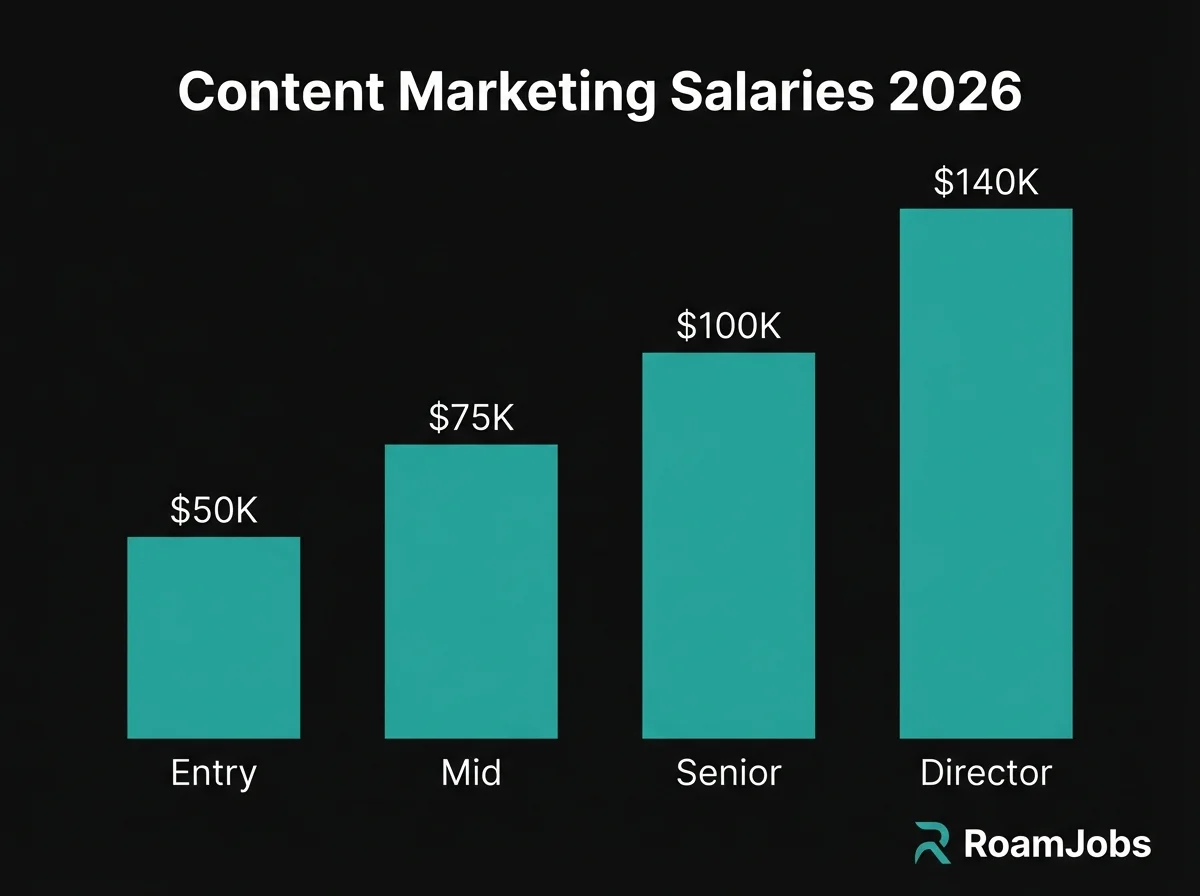
Understanding compensation expectations at each career stage helps you negotiate effectively and plan your career progression. These figures represent remote positions with US-based companies—the most competitive segment of the remote content marketing job market.
Content Marketing Salary by Experience & Location
| Level | 🇺🇸 US Remote | 🇪🇺 EU Remote | 🌎 LATAM | 🌏 Asia |
|---|---|---|---|---|
| Entry Level (0-2 yrs) | $50,000 - $70,000 | $35,000 - $50,000 | $22,000 - $38,000 | $18,000 - $32,000 |
| Mid-Level (2-5 yrs) | $75,000 - $105,000 | $52,000 - $72,000 | $35,000 - $55,000 | $28,000 - $48,000 |
| Senior (5-8 yrs) | $105,000 - $145,000 | $72,000 - $100,000 | $50,000 - $78,000 | $42,000 - $68,000 |
| Director (8+ yrs) | $140,000 - $200,000 | $98,000 - $140,000 | $72,000 - $110,000 | $60,000 - $95,000 |
* Salaries represent base compensation for remote positions. Actual compensation may vary based on company, experience, and specific location within region.
Salary Factors That Impact Compensation
Industry matters significantly:
- B2B SaaS: +15-25% above average due to complex content requirements
- Fintech and healthtech: +10-20% for specialized knowledge
- E-commerce: Market rate, volume-focused
- Consumer tech: Slightly below SaaS, but often better lifestyle benefits
- Agencies: Generally 15-25% below in-house roles
Skills that command premium compensation:
- Technical writing ability (API docs, developer content): +10-20%
- SEO expertise with proven traffic results: +10-15%
- Video and multimedia production skills: +5-15%
- Data analysis and experimentation skills: +10-15%
- Multiple language fluency: +5-10% per additional language
Geographic arbitrage in content marketing:
- Content marketing has some of the smallest location-based salary variance in marketing
- US-based companies increasingly offer location-agnostic pay for senior roles
- LATAM content marketers working for US companies typically earn 2-3x local market rates
- EU rates have compressed closer to US rates for senior content strategists
Career Progression: From Entry-Level to Director
Entry Level / Junior Content Marketer
0-2 years experience
What Entry-Level Content Marketers Do
Entry-level content marketers typically focus on content production with guidance from senior team members. You’ll spend most of your time writing, editing, and learning the fundamentals of content strategy.
Typical responsibilities:
- Write blog posts, social media content, and email copy based on briefs
- Research topics and compile source materials for content pieces
- Edit and proofread content for grammar, style, and brand consistency
- Assist with content calendar management and publishing workflows
- Track basic content metrics and compile reports
- Support senior marketers with research and content updates
Skills to develop:
- Strong writing fundamentals (grammar, structure, clarity)
- Basic SEO understanding (keywords, meta descriptions, headers)
- Familiarity with CMS platforms (WordPress, Webflow, Contentful)
- Google Analytics basics for understanding content performance
- Time management for meeting deadlines consistently
- Openness to feedback and ability to incorporate edits
How to break in without experience:
- Start a blog or newsletter in a niche you’re passionate about
- Contribute guest posts to industry publications
- Take freelance content writing projects to build portfolio
- Get certifications (HubSpot Content Marketing, Google Analytics)
- Volunteer content work for nonprofits to get real samples
- Document any content work from previous roles (even if not primary job)
What employers look for:
- Writing samples that demonstrate clarity and engagement
- Evidence of ability to meet deadlines and take feedback
- Enthusiasm for learning and growing in the role
- Basic understanding of how content drives business results
- Remote work readiness (self-direction, written communication)
Mid-Level Content Marketer
2-5 years experience
What Mid-Level Content Marketers Do
Mid-level content marketers take ownership of specific content programs or channels. You’ll develop strategy within defined parameters, manage content calendars, and begin mentoring junior team members.
Typical responsibilities:
- Own specific content channels or programs (blog, resources, email content)
- Develop content briefs and manage production from ideation to publication
- Conduct keyword research and content gap analysis
- Optimize existing content for improved performance
- Collaborate with design, product, and sales on content needs
- Mentor junior content team members on writing and strategy
- Report on content performance and make data-driven recommendations
Skills to develop:
- Content strategy frameworks and editorial planning
- Advanced SEO (technical SEO basics, link building strategies)
- Data analysis for content decisions (beyond basic metrics)
- Project management for multi-piece content programs
- Cross-functional communication and influence
- Basic understanding of content’s role in demand generation
What differentiates top mid-level performers:
- Proactive identification of content opportunities
- Ability to tie content metrics to business outcomes
- Strong relationships with cross-functional partners
- Consistent track record of high-performing content
- Beginning to develop a unique voice or specialty
Common career paths from mid-level:
- Promotion to Senior Content Marketer
- Specialization in SEO, technical writing, or video
- Transition to Product Marketing (with positioning skills)
- Move to Content Lead/Manager role at smaller company
- Shift to Growth Marketing (with analytical skills)
Senior Content Marketer
5-8 years experience
What Senior Content Marketers Do
Senior content marketers own content strategy at the program or team level. You’ll set direction, define success metrics, and influence content decisions across the organization while still contributing hands-on to key initiatives.
Typical responsibilities:
- Develop comprehensive content strategies aligned with business goals
- Define content KPIs and reporting frameworks
- Lead content planning across multiple channels and content types
- Manage relationships with external writers, agencies, and partners
- Mentor and develop junior and mid-level team members
- Present content strategy and results to leadership
- Drive cross-functional initiatives (product launches, campaigns)
- Innovate with new content formats and distribution channels
Skills that define senior content marketers:
- Strategic thinking that connects content to revenue
- Influence and stakeholder management across functions
- Data storytelling and executive communication
- Content operations and workflow optimization
- Budget management and resource allocation
- Building and developing high-performing content teams
What separates good from great at senior level:
- Demonstrable impact on pipeline or revenue metrics
- Thought leadership in content marketing community
- Ability to scale content through systems and processes
- Track record of developing team members
- Cross-functional reputation as trusted content partner
Career path considerations:
- Senior IC track: Staff/Principal Content Strategist
- Management track: Content Manager/Director
- Pivot opportunities: Head of Content, VP Marketing (at smaller companies)
- Specialization: Content Operations, Content Strategy Consulting
Lead / Director Content Marketing
8+ years experience
What Directors of Content Marketing Do
Content Directors or Heads of Content own the content function, typically managing a team and responsible for content’s contribution to company-wide goals. This is a strategic leadership role with significant business impact.
Typical responsibilities:
- Define content vision, strategy, and roadmap for the organization
- Build, manage, and develop content teams (writers, strategists, editors)
- Own content budget and make investment decisions
- Partner with CMO, VP Marketing, and executive team on marketing strategy
- Establish content operations, governance, and quality standards
- Drive content’s contribution to pipeline, revenue, and brand metrics
- Represent content marketing to board, investors, and external stakeholders
- Stay ahead of industry trends and evolve content approach
Skills required at director level:
- Executive presence and communication
- Team building, hiring, and talent development
- Strategic planning and business case development
- Cross-functional leadership at executive level
- Content operations and technology decisions
- Budget management and ROI demonstration
What makes directors successful:
- Clear vision that inspires and aligns teams
- Ability to connect content work to business outcomes
- Track record of building high-performing teams
- Strong relationships across executive team
- Balance of strategic thinking and operational excellence
- External reputation and industry credibility
Typical team structure under a Content Director:
- Content Strategists (1-3)
- Content Writers/Editors (2-5)
- SEO Specialist (1)
- Content Operations (1)
- Freelance and agency relationships
Essential Skills and Tools for Content Marketers
Success in remote content marketing requires mastery of both craft skills and tools. Here’s what you need to know at each stage of your career.
Core Content Marketing Skills
Writing Excellence (Foundation)
- Clear, concise prose that engages readers
- Ability to write for different audiences and purposes
- Strong editing and self-editing capabilities
- Storytelling that connects emotionally
- Adaptation to brand voice and tone guidelines
SEO and Content Optimization
- Keyword research and search intent understanding
- On-page SEO best practices
- Content structure for featured snippets
- Technical SEO fundamentals
- Link building strategies
Strategy and Planning
- Audience research and persona development
- Content gap analysis and competitive research
- Editorial calendar management
- Content-to-journey mapping
- Goal setting and KPI definition
Analytics and Measurement
- Google Analytics proficiency
- Content performance analysis
- Attribution understanding
- A/B testing for headlines and content
- ROI calculation and reporting
Remote Collaboration
- Async communication excellence
- Clear written briefs and feedback
- Cross-timezone coordination
- Documentation and knowledge sharing
- Self-direction and time management
Content Marketing Tool Stack
Essential Content Marketing Tools
Source: RoamJobs Content Marketing Tool Survey 2026| Category | Tool | Primary Use | Skill Level |
|---|---|---|---|
| SEO Research | Semrush | Keyword research, competitor analysis, site audits | Essential |
| SEO Research | Ahrefs | Backlink analysis, content explorer, rank tracking | Essential |
| Content Optimization | Clearscope | Content optimization for search intent | Intermediate |
| Content Optimization | Surfer SEO | Real-time content scoring and optimization | Intermediate |
| Writing Assistance | Grammarly | Grammar, clarity, and tone checking | Essential |
| Writing Assistance | Hemingway Editor | Readability and concision improvements | Beginner |
| Analytics | Google Analytics 4 | Traffic, engagement, and conversion tracking | Essential |
| Analytics | Google Search Console | Search performance and indexing data | Essential |
| CMS | WordPress | Content publishing and management | Essential |
| CMS | Webflow | Design-focused content publishing | Intermediate |
| Project Management | Notion | Content calendars, briefs, and collaboration | Essential |
| Project Management | Airtable | Content database and workflow management | Intermediate |
| Marketing Automation | HubSpot | CRM, email, and content hub | Essential |
| Marketing Automation | Marketo | Enterprise marketing automation | Advanced |
| Design Collaboration | Figma | Collaborating with designers on content assets | Beginner |
| Async Communication | Loom | Video feedback and content walkthroughs | Essential |
Data compiled from RoamJobs Content Marketing Tool Survey 2026. Last verified January 2026.
Tool Proficiency by Career Stage
Entry Level: Must-Know Tools
- WordPress or similar CMS
- Google Docs/Notion for drafting
- Grammarly for editing
- Google Analytics basics
- Slack/email for communication
Mid-Level: Expanding Toolkit
- All entry-level tools, plus:
- Semrush or Ahrefs for SEO
- Clearscope or similar for optimization
- Google Search Console
- HubSpot or marketing automation platform
- Loom for async collaboration
Senior/Director: Strategic Tools
- All above, plus:
- Advanced analytics (Amplitude, Mixpanel)
- Content operations tools (Airtable, ContentCal)
- Budget and resource planning tools
- Presentation tools for executive communication
- AI writing tools for research and drafting efficiency
15+ Companies Actively Hiring Remote Content Marketers
These companies are known for strong content marketing teams and have historically offered remote content marketing positions. Company culture, compensation, and team structure vary—research each thoroughly before applying.
Fully Remote / Remote-First Companies
HubSpot One of the most content-forward companies in B2B SaaS. HubSpot’s marketing blog is an industry benchmark, and their content team produces everything from blog posts to comprehensive guides to video content. Remote-first culture with excellent benefits, including unlimited PTO and sabbaticals. Strong learning and development focus.
Zapier Known for their exceptional content marketing—their blog drives significant organic traffic and product adoption. Small but high-impact content team. Fully remote since founding, with excellent async culture and no-meetings-Wednesday policy. Strong emphasis on written communication.
Buffer Pioneered remote work transparency and continues to lead in content-driven growth. Small content team with significant individual impact. Famous for transparent salaries and strong work-life balance. Four-day work week option available.
GitLab Exceptional documentation culture extends to content marketing. Content team supports developer-focused marketing with technical content, guides, and thought leadership. Fully remote with excellent async practices. Competitive compensation with location factor adjustments.
Automattic (WordPress, WooCommerce, Tumblr) Massive distributed team with content marketers across multiple product lines. Strong async culture with annual team meetups. Open vacation policy and excellent benefits. Particularly strong opportunity if you’re passionate about publishing and web content.
ConvertKit Email marketing platform with content-focused growth strategy. Small team where content marketers have significant ownership. Profit sharing, async culture, and strong creator community focus.
Notion Productivity workspace company with excellent content marketing. Content team creates educational resources, templates, and community-focused content. Hybrid-flexible with strong remote options. Competitive equity packages.
Remote-Friendly Tech Companies
Shopify “Digital by default” policy. Large content marketing organization supporting e-commerce education and merchant success. Strong learning budget and stock options. Multiple content specializations available.
Stripe Premium content quality—their documentation and educational content sets industry standards. Remote-friendly with employees across many countries. Exceptional compensation and equity. High hiring bar.
Canva Design platform with strong content team focused on education and inspiration. Remote-friendly with offices in Australia and beyond. Growing content needs as they expand globally.
Webflow Visual development platform with excellent content marketing. Remote-first approach with content team creating educational content, case studies, and thought leadership. Strong equity and wellness benefits.
Figma Design tools company with remote content opportunities. Content team supports product education and community building. Strong equity packages and design-forward culture.
Airtable Productivity platform with growing content needs. Remote-first with content team focused on use cases, education, and thought leadership. Learning and development budget included.
Mailchimp (Intuit) Email and marketing platform with mature content operation. Remote-friendly with large content team across multiple functions. Intuit benefits package.
Semrush SEO and marketing tools company—content marketing is core to their model. Remote-friendly with content team having access to their own tools. Industry expertise development opportunity.
Monday.com Work operating system with strong content marketing. Remote-friendly with content team supporting broad business audience. Growing international content needs.
Emerging Remote-First Content Opportunities
Linear Issue tracking with exceptional content quality despite small team. High-impact opportunity in a design-led environment.
Supabase Open-source Firebase alternative. Developer-focused content with technical depth. Fully remote, building in public.
Vercel Frontend cloud platform. Technical content marketing for developer audience. Distributed team with strong remote culture.
Descript Audio/video editing platform. Content team supports creator-focused marketing. Remote-first with media production opportunities.
20+ Content Marketing Interview Questions
Content marketing interviews typically include portfolio review, writing tests, and strategy discussions. Here are the questions you’re most likely to encounter, organized by category.
Content Strategy Questions
What they’re evaluating: Strategic thinking, business acumen, process approach
Strong answer framework:
- Research phase (2-3 weeks): Audit existing content, analyze competitors, interview stakeholders (sales, product, CS), review customer data and personas
- Strategy development: Define goals tied to business objectives, identify target audience segments, map content to buyer journey stages
- Content pillar definition: Identify 3-5 core themes based on audience needs and business expertise
- Channel and format strategy: Determine mix of content types and distribution channels
- Measurement framework: Define KPIs at each funnel stage, establish reporting cadence
- Roadmap: 90-day quick wins plus 12-month content calendar
Mention specific frameworks: Content pillars, hub-and-spoke model, jobs-to-be-done, buyer journey mapping
Tie to business outcomes: Always connect strategy elements to revenue, pipeline, or strategic company goals
What they’re evaluating: Prioritization frameworks, business judgment, data-driven decision making
Strong answer approach:
- Discuss a prioritization framework (ICE scoring, RICE, 2x2 matrix)
- Factors to consider: search volume, competition difficulty, business relevance, stage of funnel, resource requirements
- Balance between quick wins and long-term investments
- Stakeholder alignment and input
- Flexibility to adjust based on results
Example answer: “I use a weighted scoring system that considers search volume, keyword difficulty, business value, and production effort. But I also maintain flexibility for timely opportunities and ensure a mix of top-of-funnel awareness content and bottom-funnel conversion content. I review and re-prioritize quarterly based on performance data.”
What they’re evaluating: Results orientation, ability to connect content to business outcomes, storytelling
Use the STAR method:
- Situation: Context of the company, challenge, and starting point
- Task: Your specific responsibility and goals
- Action: What you did—strategy, execution, optimization
- Result: Quantifiable outcomes (traffic, leads, revenue influence)
Metrics to include:
- Traffic growth (organic sessions, new users)
- Engagement (time on page, scroll depth, shares)
- Conversion (leads, MQLs, opportunities influenced)
- Revenue (pipeline influenced, closed-won attribution)
Show iteration: Describe how you learned from data and improved the program over time
What they’re evaluating: Strategic judgment, understanding of content operations, quality standards
Key points to address:
- Quality should never be sacrificed, but “quality” is defined by audience needs, not perfection
- Different content types require different quality bars (comprehensive guide vs. social post)
- Publishing velocity matters for SEO and audience building
- Content operations and processes enable both quality and quantity
- Repurposing and updating existing content extends value
Strong perspective: “I focus on ‘right quality for the purpose.’ A quick answer blog post doesn’t need the depth of a pillar page, but both should serve the audience well. I invest in processes—templates, style guides, editing workflows—that maintain quality at scale.”
What they’re evaluating: Analytics knowledge, business acumen, understanding of attribution
Framework for answering:
- Leading indicators: Traffic, rankings, engagement, social shares
- Lagging indicators: Leads, MQLs, opportunities, revenue influenced
- Content-specific metrics: Time on page, scroll depth, content downloads
- Attribution approaches: First-touch, multi-touch, content-influenced pipeline
Address the full funnel:
- Awareness: Organic traffic, brand search volume, social reach
- Engagement: Time on site, pages per session, return visitors
- Conversion: Lead captures, content-to-lead rate, demo requests
- Revenue: Opportunity influence, pipeline contribution, customer acquisition
Show sophistication: Discuss challenges like attribution complexity and how you’ve addressed them
Writing and Editorial Questions
What they’re evaluating: Research process, intellectual curiosity, learning ability
Strong answer components:
- Research phase: Competitive content, industry reports, expert interviews
- SME collaboration: Working with internal experts for accuracy
- Source triangulation: Multiple sources to verify information
- Drafting approach: Start with outline, validate with SME, iterate
- Fact-checking: Verification process before publishing
Show intellectual humility: Acknowledge that thorough research is essential for credibility and that you actively seek expert input
What they’re evaluating: Editing skills, attention to detail, process orientation
Multi-pass editing approach:
- Structural edit: Does the piece flow logically? Is the structure right?
- Content edit: Is the information accurate, complete, and valuable?
- Line edit: Is each sentence clear, concise, and engaging?
- Copy edit: Grammar, spelling, punctuation, style guide adherence
- Final review: Links, formatting, metadata, CTA
Tools and techniques:
- Read aloud to catch awkward phrasing
- Grammarly/Hemingway for technical accuracy
- Fresh eyes after stepping away
- Peer review for important pieces
What they’re evaluating: Content operations thinking, scalability mindset, leadership
Key elements to discuss:
- Style guide: Comprehensive documentation of voice, tone, grammar rules
- Example library: Best-in-class examples for each content type
- Onboarding: How new writers learn the voice
- Review process: Editorial checkpoints to catch inconsistencies
- Training: Ongoing education and calibration sessions
- Templates: Structured formats that encode voice elements
Advanced answer includes: How you’ve built or improved style guides, how you handle voice evolution, how you balance consistency with individual writer strengths
What they’re evaluating: Ability to simplify, audience empathy, technical communication
Strong approach:
- Understand the topic deeply yourself first
- Identify the audience’s current knowledge level
- Find analogies and examples that connect to familiar concepts
- Structure from simple to complex (progressive disclosure)
- Use visuals to support abstract concepts
- Test with target audience members when possible
Show examples: Reference specific complex topics you’ve simplified successfully
What they’re evaluating: Coachability, professionalism, collaboration
Balanced answer:
- Welcome feedback as essential for improvement
- Listen fully before responding
- Distinguish subjective preferences from substantive issues
- When you disagree, explain your reasoning professionally
- Defer to editors on style, push back on factual inaccuracies
- Ultimately, know when to let go and when to advocate
Demonstrate growth mindset: Share an example of feedback that made your writing better
SEO and Distribution Questions
What they’re evaluating: SEO knowledge, tool proficiency, strategic thinking
Comprehensive process:
- Seed keyword identification: Brainstorm core topics from audience needs
- Tool research: Use Semrush/Ahrefs to expand keyword universe
- Search intent analysis: Understand what the searcher actually wants
- Competition assessment: Analyze top-ranking content, identify gaps
- Keyword clustering: Group related keywords for comprehensive coverage
- Prioritization: Balance volume, difficulty, business relevance
- Content brief: Define target keywords, structure, and optimization requirements
Show nuance: Discuss long-tail vs. head terms, search intent types, and how keyword strategy differs by funnel stage
What they’re evaluating: Multi-channel thinking, distribution strategy, promotion skills
Distribution channels to discuss:
- Owned channels: Email newsletter, social media, community
- Earned channels: Guest posting, PR, influencer partnerships, backlinks
- Paid channels: Content promotion ads, sponsored content
- Syndication: Republishing on Medium, LinkedIn, industry platforms
Strategic approach:
- Match distribution to content type and audience
- Repurpose content for different channels
- Build systematic promotion workflows
- Measure channel effectiveness and optimize
What they’re evaluating: SEO troubleshooting, optimization skills, analytical thinking
Diagnostic approach:
- Analyze search intent—does content match what searchers want?
- Compare to top-ranking content—what are they doing better?
- Check technical issues—page speed, mobile optimization, indexing
- Assess content quality—depth, freshness, expertise signals
- Review internal linking—is the page receiving link equity?
- Analyze backlink profile vs. competitors
Optimization actions:
- Improve content comprehensiveness and depth
- Optimize on-page elements (title, headers, meta)
- Build internal links from relevant pages
- Update with fresh information
- Pursue backlink opportunities
- Consider featured snippet optimization
What they’re evaluating: Analytics depth, engagement understanding, optimization mindset
Engagement metrics to track:
- Time on page and scroll depth
- Pages per session from entry points
- Return visitor rate for content readers
- Social shares and comments
- Content downloads and email signups
- Video completion rates (for video content)
Improvement strategies:
- Analyze drop-off points using heatmaps
- A/B test headlines and introductions
- Improve internal linking and content suggestions
- Optimize content structure (scanability, visuals)
- Add interactive elements where appropriate
Analytics and Measurement Questions
What they’re evaluating: Attribution sophistication, business acumen, analytics skills
Attribution approaches to discuss:
- First-touch: Content that first brought the prospect in
- Last-touch: Content engaged before conversion
- Multi-touch: Weighted credit across content interactions
- Influenced pipeline: All content touched during buyer journey
Practical implementation:
- CRM integration to track content touches
- UTM parameters for campaign tracking
- Content scoring in marketing automation
- Regular pipeline attribution reporting
Honest about challenges: Acknowledge attribution complexity, discuss how you’ve handled imperfect data
What they’re evaluating: Business case development, executive communication, strategic thinking
Business case components:
- Clear objective tied to company priorities
- Target audience and their value
- Expected outcomes with realistic projections
- Investment required (team, tools, time)
- Timeline to results
- Risk assessment and mitigation
- Measurement plan
Projection approaches:
- Benchmark against similar initiatives
- Conservative, moderate, optimistic scenarios
- ROI calculation methodology
- Opportunity cost of not investing
What they’re evaluating: Operational rigor, understanding of metric cadences
Daily monitoring:
- Traffic anomalies and spikes
- New content performance (first 24-48 hours)
- Critical conversion metrics if issues arise
Weekly review:
- Content performance vs. goals
- SEO ranking changes
- Engagement trends
- Publishing calendar adherence
Monthly analysis:
- Traffic and lead trends
- Content performance by type/topic
- SEO progress against targets
- Pipeline and revenue influence
- Content audit and optimization opportunities
What they’re evaluating: Data-driven decision making, adaptability, learning orientation
Strong answer structure:
- Describe the original strategy and assumptions
- Explain what data you collected and analyzed
- Share the insight that emerged
- Describe how you changed approach
- Quantify the results of the change
Show intellectual humility: Demonstrate willingness to abandon approaches that aren’t working based on evidence
Remote Work and Collaboration Questions
What they’re evaluating: Async collaboration skills, remote work experience, communication
Key practices to discuss:
- Clear written briefs that stand alone without explanation
- Documented style guides and processes
- Async feedback using Loom, Notion comments, or similar
- Establishing reasonable turnaround expectations
- Scheduled sync time for high-bandwidth discussions
- Using project management tools for visibility
Specific examples: Share how you’ve handled review cycles, managed multiple writers, or coordinated content across time zones
What they’re evaluating: Self-management, productivity systems, remote work readiness
Elements of a strong answer:
- Structured work blocks for deep writing time
- Environmental optimization (workspace, distractions)
- Breaking large projects into smaller milestones
- Accountability mechanisms (deadlines, check-ins)
- Balance between productivity and avoiding burnout
- Specific tools or systems you use
Be specific: Share your actual daily routine and productivity practices
What they’re evaluating: Flexibility, communication, priority management
Balanced approach:
- Define what constitutes truly “urgent” vs. important
- Establish communication channels for urgent requests
- Build flexibility into content calendar for timely needs
- Communicate trade-offs clearly (what gets delayed)
- Post-mortem to improve planning and reduce urgency
Show boundaries: Demonstrate you can be flexible while also protecting focused work time
What they’re evaluating: Relationship building, collaboration skills, proactive communication
Relationship-building approaches:
- Regular 1:1 video calls with key partners
- Proactive communication about content plans and needs
- Understanding their goals and how content can help
- Celebrating shared wins publicly
- Virtual coffee chats and informal connection
- Over-communicating appreciation and recognition
Show results: Describe cross-functional projects that succeeded through strong remote relationships
Content Marketing Career Paths
Content marketing offers multiple career trajectories depending on your interests, whether you prefer deep expertise, people management, or cross-functional roles.
Individual Contributor Track
Content Writer → Content Marketer → Senior Content Marketer → Staff Content Strategist → Principal Content StrategistThe IC track is ideal for those who love the craft of content creation and strategy. Staff and Principal roles can command $140K-$180K+ while remaining hands-on. These senior IC roles typically:
- Lead major content initiatives without direct reports
- Mentor other content team members
- Influence content strategy across the organization
- Develop innovative content approaches and frameworks
- Serve as subject matter experts externally
Management Track
Content Marketer → Content Manager → Senior Content Manager → Director of Content → VP of Content Marketing → CMOThe management path involves building and leading content teams. Directors typically manage 3-8 person teams with $500K-$2M+ content budgets. Leadership roles require:
- Hiring, developing, and retaining content talent
- Budget management and resource allocation
- Executive communication and influence
- Cross-functional leadership
- Strategic planning at organizational level
Common Career Pivots From Content Marketing
| Transition | Overlap Skills | Additional Development |
|---|---|---|
| Content Marketing → Product Marketing | Messaging, positioning, audience understanding | Competitive intelligence, sales enablement, pricing |
| Content Marketing → SEO | Search optimization, content strategy | Technical SEO, link building, analytics depth |
| Content Marketing → Growth Marketing | Data analysis, experimentation | Acquisition channels, product metrics, technical skills |
| Content Marketing → UX Writing | Clear communication, user focus | Product thinking, design process, microcopy |
| Content Marketing → Brand Strategy | Storytelling, voice development | Visual identity, brand architecture, agency management |
Transitioning Into Content Marketing
| Current Role | Path to Content Marketing | Leverage These Skills |
|---|---|---|
| Journalism | Direct transition—similar core skills | Writing, research, interviewing, storytelling |
| Technical Writing | Specialize in B2B/SaaS content | Clarity, accuracy, complex topic simplification |
| Social Media | Expand to long-form and strategy | Platform knowledge, audience engagement, viral content |
| Copywriting | Add strategic and SEO elements | Persuasive writing, conversion focus, A/B testing |
| Teaching/Academia | Emphasize educational content | Explanation skills, curriculum design, audience adaptation |
| Any Field + Strong Writing | Build portfolio in target industry | Subject matter expertise, credibility |
Remote Content Marketing Job Search Checklist
Landing Your Remote Content Marketing Role
- 1 Build a portfolio of 5-10 strong writing samples
Include variety: blog posts, guides, case studies. Personal projects count!
- 2 Create a personal website or blog showcasing your work
Demonstrates both content and basic web skills
- 3 Get certified in key tools (HubSpot, Google Analytics)
Free certifications that signal competence
- 4 Master SEO fundamentals with hands-on practice
Learn Semrush or Ahrefs, understand keyword research and optimization
- 5 Develop proficiency in a content CMS (WordPress, Webflow)
Ability to publish independently is often required
- 6 Update LinkedIn with content marketing keywords and samples
Include writing samples and quantified achievements
- 7 Prepare for writing tests with practice under time constraints
Many roles include timed writing or editing exercises
- 8 Research 20-30 target companies with remote content roles
Focus on remote-first companies and those with strong content operations
- 9 Customize applications with company-specific content insights
Show you've analyzed their content and have ideas
- 10 Practice articulating content's business impact
Be ready to discuss how content drives traffic, leads, and revenue
- 11 Network in content marketing communities
Superpath, Content Marketing Institute, Twitter content marketing circles
- 12 Apply to 5-10 targeted positions per week
Quality applications beat volume—customize each one
Frequently Asked Questions
Frequently Asked Questions
Do I need a specific degree to become a content marketer?
No specific degree is required for content marketing. Hiring managers value writing ability, strategic thinking, and demonstrated results over credentials. Many successful content marketers have backgrounds in English, communications, journalism, marketing, or completely unrelated fields. What matters most is your portfolio, writing samples, and ability to articulate how content drives business outcomes. If you're changing careers, invest in building a portfolio through personal projects, freelance work, or volunteer opportunities rather than pursuing additional degrees.
How do I break into content marketing without professional experience?
Start by building proof of your abilities: (1) Create your own blog or newsletter in a niche you're knowledgeable about and grow it using content marketing principles, (2) Freelance for small companies or startups who need content help, (3) Volunteer for nonprofits to gain real experience with real metrics, (4) Guest post on industry publications to build credibility, (5) Get certifications from HubSpot, Google, and Semrush to demonstrate knowledge. Most hiring managers care about demonstrated writing ability and results, not formal experience. A strong portfolio with 5-10 pieces and evidence of driving results can outweigh years of mediocre professional experience.
What's the difference between content marketing and copywriting?
Content marketing and copywriting serve different purposes with different formats. Content marketing focuses on educating and engaging audiences through blog posts, guides, whitepapers, and resources—building trust and authority over time. Copywriting focuses on persuading action through sales pages, email sequences, ads, and landing pages—driving immediate conversions. Content marketers typically work on longer-form educational content with SEO considerations; copywriters focus on shorter, conversion-focused copy. Many professionals have skills in both, but roles are usually specialized. Content marketing roles often have more long-term strategic components, while copywriting is more campaign and conversion focused.
How important is SEO knowledge for content marketers?
SEO knowledge is increasingly essential for content marketers, especially at mid-level and above. While you don't need to be a technical SEO expert, you should understand: keyword research and search intent, on-page optimization best practices, how to structure content for search, basic technical SEO concepts, and how to use SEO tools like Semrush or Ahrefs. Companies expect content marketers to drive organic traffic, which requires SEO integration into content strategy. At senior levels, you'll be expected to develop SEO-informed content strategies and collaborate effectively with dedicated SEO specialists.
What writing samples should I include in my portfolio?
Include 5-10 samples that demonstrate range and relevance: (1) At least one long-form comprehensive guide (2,000+ words), (2) Several blog posts in your target industry, (3) A case study or customer story if possible, (4) Content that drove measurable results (include metrics if available), (5) Samples from guest posts or publications for credibility. If you're transitioning industries, include samples from your target industry even if they're personal projects. Quality matters more than quantity—5 excellent pieces beat 20 mediocre ones. If possible, include metrics or context about each piece's performance.
How do remote content marketing salaries compare to in-office roles?
Remote content marketing salaries are generally competitive with or slightly above in-office roles, particularly when working for US-based remote-first companies. Location-based salary adjustments are less common in content marketing than in engineering—many companies pay based on role value rather than location. Content marketers in LATAM, Eastern Europe, or Asia working for US companies often earn 2-3x what local companies pay. At senior levels, location-agnostic pay is increasingly common. The key is targeting remote-first companies with established remote compensation policies rather than traditional companies offering remote work as a perk.
What AI tools should content marketers learn?
Content marketers should understand how to use AI as a tool while maintaining originality and quality: (1) AI writing assistants (Claude, ChatGPT) for research, outlining, and first-draft acceleration—not for publishing directly, (2) SEO optimization tools with AI (Clearscope, Surfer) for content optimization, (3) AI-powered grammar and editing tools (Grammarly) for polish, (4) AI research and summarization tools for competitive analysis. The key is using AI to enhance your work, not replace your thinking. Employers value content marketers who can leverage AI efficiently while maintaining the strategic thinking, originality, and quality that AI alone cannot provide.
How do I transition from agency content marketing to in-house roles?
Agency-to-in-house transitions are common and valued. To make the move: (1) Emphasize deep client relationships where you functioned as an embedded team member, (2) Highlight experience with specific industries relevant to your target companies, (3) Demonstrate strategic thinking beyond execution—show you developed strategies, not just implemented them, (4) Address the main concern: prove you can go deep on one brand rather than broad across many, (5) Prepare to discuss how you'd approach long-term content building versus campaign-based work. In-house roles often pay 10-20% more than agency roles for similar experience levels and offer better work-life balance.
What's the typical career timeline for content marketers?
A typical content marketing career progression: Entry level (0-2 years): Focus on building writing skills and learning tools, earning $50K-$70K. Mid-level (2-5 years): Own channels or programs, develop strategy skills, earning $75K-$105K. Senior (5-8 years): Lead content strategy, mentor others, drive significant results, earning $105K-$145K. Director+ (8+ years): Build and lead teams, own content function, earning $140K-$200K. Movement between levels typically takes 2-3 years of strong performance. Some accelerate through strategic job moves; others stay longer at each level building expertise. The IC track can parallel the management track in compensation at senior levels.
Should I specialize or stay generalist in content marketing?
The right approach depends on your career goals and market: Early career (0-3 years): Stay generalist to discover your strengths and build broad skills. Mid-career (3-7 years): Develop depth in 1-2 areas (e.g., SEO + long-form, technical content, video) while maintaining general competence. Senior (7+ years): Choose between deep specialization (Staff/Principal IC) or broad leadership (Director+). Specializations that command premiums: technical/developer content, B2B enterprise content, SEO-focused content strategy, video and multimedia. The market rewards both paths—specialists at companies needing specific expertise, generalists at companies needing versatile content leaders.
Start Your Remote Content Marketing Career
Content marketing remains one of the most accessible, flexible, and rewarding paths into remote marketing work. The skills transfer across industries, the work is inherently async-friendly, and the demand continues to grow as companies invest in organic growth and brand building.
Your next steps:
- Assess your current skills against the requirements at your target level
- Build your portfolio with samples that demonstrate writing quality and strategic thinking
- Get certified in essential tools (HubSpot, Google Analytics, SEO platforms)
- Practice articulating how content drives business results
- Target remote-first companies that align with your interests and experience
- Apply strategically with customized applications that show you understand their content needs
The best content marketers combine creative storytelling with data-driven optimization. Whether you’re entering from journalism, switching from another marketing discipline, or starting fresh, the path to remote content marketing success is clear: build proof, develop skills, and target the right opportunities.
Explore related guides:
- Remote Marketing Jobs Hub — Overview of all marketing career paths
- Remote SEO Jobs — Deep dive into SEO specialization
- Remote Interview Preparation — General interview guidance
Get the Remote Content Marketing Career Guide
Weekly curated remote content marketing jobs, salary insights, and career tips delivered to your inbox. Join 12,000+ content marketers growing their remote careers.
Frequently Asked Questions
How do I find remote content marketing jobs?
To find remote content marketing jobs, start with specialized job boards like We Work Remotely, Remote OK, and FlexJobs that focus on remote positions. Set up job alerts with keywords like "remote content marketing" and filter by fully remote positions. Network on LinkedIn by following remote-friendly companies and engaging with hiring managers. Many content marketing roles are posted on company career pages directly, so identify target companies known for remote work and check their openings regularly.
What skills do I need for remote content marketing positions?
Remote content marketing positions typically require the same technical skills as on-site roles, plus strong remote work competencies. Essential remote skills include excellent written communication, self-motivation, time management, and proficiency with collaboration tools like Slack, Zoom, and project management software. Demonstrating previous remote work experience or the ability to work independently is highly valued by employers hiring for remote content marketing roles.
What salary can I expect as a remote content marketing?
Remote content marketing salaries vary based on experience level, company size, location-based pay policies, and the specific tech stack or skills required. US-based remote positions typically pay market rates regardless of where you live, while some companies adjust pay based on your location's cost of living. Entry-level positions start lower, while senior roles can command premium salaries. Check our salary guides for specific ranges by experience level and geography.
Are remote content marketing jobs entry-level friendly?
Some remote content marketing jobs are entry-level friendly, though competition can be high. Focus on building a strong portfolio or demonstrable skills, contributing to open source projects if applicable, and gaining any relevant experience through internships, freelance work, or personal projects. Some companies specifically hire remote junior talent and provide mentorship programs. Smaller startups and agencies may be more open to entry-level remote hires than large corporations.
Continue Reading
Remote Marketing Jobs 2026: Complete Guide to Content, SEO, Paid Ads & Growth
The definitive hub for remote marketing careers. Explore salary data, interview guides, and opportunities across content marketing, SEO, paid ads, growth, product marketing, email marketing, and social media roles.
Remote Writing Jobs 2026: Content, Technical & Copywriting
Complete guide to finding remote writing positions including portfolio building, pitch strategies, and rate negotiation.
Land Your Remote Job Faster
Get the latest remote job strategies, salary data, and insider tips delivered to your inbox.