Remote SEO Jobs 2026: Complete Career Guide
Everything you need to land a remote SEO job. Comprehensive salary data by seniority, technical and content SEO skills, tools comparison, 20+ interview questions, and top companies hiring SEO specialists.
Updated January 27, 2026 • Verified current for 2026
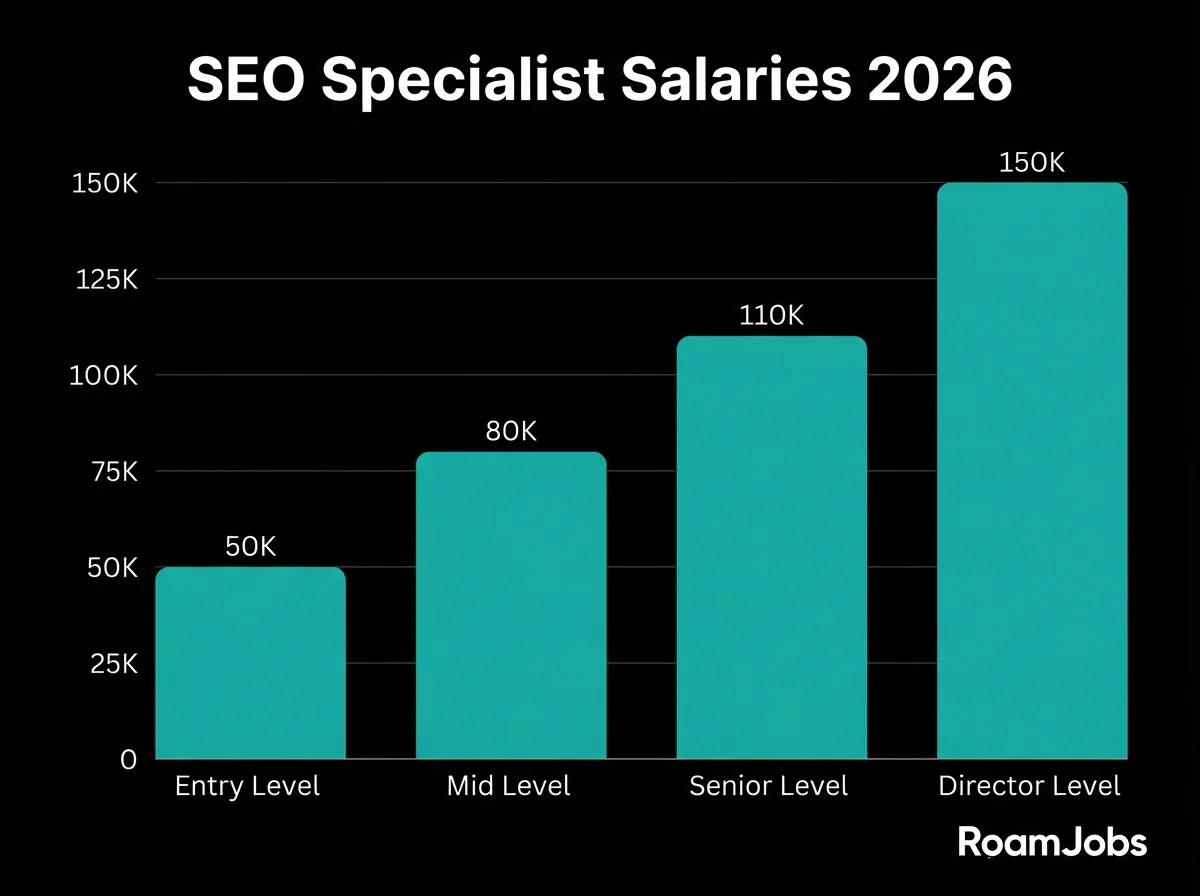
Remote SEO specialists and managers drive organic traffic growth by optimizing websites for search engines, earning between $52,000 and $210,000+ depending on experience and specialization. This role uniquely combines technical website optimization, content strategy, data analysis, and strategic thinking to build sustainable traffic channels that compound over time. To succeed in remote SEO, you need proficiency in tools like Semrush, Ahrefs, and Google Search Console, the ability to communicate complex technical recommendations asynchronously, and a track record of measurable organic growth. SEO is one of the most naturally remote-compatible marketing disciplines because the work is project-based, results are clearly measurable, and collaboration happens primarily through documentation and data.
Role Overview: What Remote SEO Specialists Actually Do
Search Engine Optimization has evolved from simple keyword stuffing into a sophisticated discipline that spans technical website architecture, content strategy, user experience, and competitive intelligence. Modern remote SEO professionals must be part technical analyst, part content strategist, and part digital marketer to drive sustainable organic growth.
The Four Pillars of SEO Work
SEO work divides into four interconnected specializations. Most professionals develop depth in one or two areas while maintaining working knowledge across all four.
Technical SEO focuses on the infrastructure that enables search engines to crawl, index, and rank your content effectively. Technical SEO specialists audit website architecture, fix crawlability issues, optimize page speed, implement structured data markup, manage XML sitemaps, and ensure proper canonicalization. This specialization requires comfort with HTML, basic JavaScript understanding, and the ability to communicate technical requirements to engineering teams.
Content SEO centers on creating and optimizing content that ranks for target keywords while serving user intent. Content SEO professionals conduct keyword research, develop content strategies, create content briefs, optimize existing content, and measure content performance. This area requires strong writing skills, understanding of search intent, and the ability to balance SEO requirements with user experience.
Link Building involves acquiring backlinks from authoritative external websites to improve domain authority and rankings. Link building specialists develop outreach strategies, create link-worthy content, manage digital PR campaigns, analyze competitor backlink profiles, and build relationships with publishers. This specialization requires excellent communication skills, creativity, and persistence.
Local SEO focuses on optimizing for location-based searches, particularly important for businesses with physical locations or service areas. Local SEO specialists manage Google Business Profiles, build local citations, optimize for “near me” searches, and manage review acquisition strategies. This area requires understanding of local search algorithms and attention to consistency across directories.
Day-to-Day Remote SEO Work
Remote SEO professionals structure their work around analysis, strategy, implementation, and reporting cycles.
Analysis and auditing:
A significant portion of SEO work involves analyzing data to identify opportunities and diagnose problems. You review Google Search Console for indexing issues and search performance, analyze competitor rankings in Ahrefs or Semrush, audit technical issues with Screaming Frog, and examine user behavior in Google Analytics. Remote work excels here because analysis requires deep focus without interruptions.
Strategy development:
Based on analysis, you develop prioritized action plans. This might include keyword targeting strategies, content calendars, technical remediation roadmaps, or link building campaigns. Strategy documentation is especially important for remote teams since stakeholders need clear written rationale for recommendations.
Implementation and coordination:
SEO implementation often requires collaboration with content writers, developers, and designers. You create detailed briefs for content teams, write technical requirements for engineering tickets, and coordinate with design on page layout optimization. Async communication skills are essential since your collaborators work different schedules.
Reporting and communication:
Regular reporting demonstrates SEO value and guides strategy adjustments. You create dashboards tracking organic traffic, keyword rankings, and conversion metrics. For remote teams, clear data visualization and written analysis replace in-person presentations.
Why SEO Excels in Remote Environments
SEO adapts exceptionally well to distributed work for several structural reasons.
Measurable outcomes: SEO results are quantifiable through rankings, traffic, and conversions. Remote workers can demonstrate value through data rather than facetime, and managers can evaluate performance objectively.
Project-based workflow: SEO work naturally divides into discrete projects (audits, content pieces, link campaigns) with clear deliverables. This structure suits async collaboration where you complete work independently and sync periodically.
Tool-centric work: SEO tools like Semrush, Ahrefs, and Search Console are cloud-based and accessible from anywhere. You do not need physical resources or special equipment beyond a laptop and internet connection.
Documentation culture: Good SEO practice already requires extensive documentation for recommendations, processes, and reporting. This documentation orientation aligns perfectly with remote work communication needs.
Global applicability: SEO principles apply across markets, and many companies need coverage across time zones. Remote SEO teams can provide around-the-clock monitoring and support for international properties.
Who Thrives in Remote SEO Roles
Remote SEO suits certain personality types and working styles particularly well.
Analytical thinkers who enjoy investigating data patterns and testing hypotheses thrive in SEO. The work involves constant experimentation and learning from results.
Self-motivated learners succeed because search algorithms evolve continuously. You must stay current with industry changes, test new tactics, and adapt strategies without waiting for instruction.
Strong writers excel since SEO requires clear documentation, compelling content briefs, and persuasive recommendations. Most of your communication happens in writing.
Patient strategists appreciate that SEO results compound over time rather than appearing immediately. You plant seeds today that bear fruit months or years later.
Detail-oriented workers catch the small issues that create big problems: missing canonicals, broken redirects, inconsistent metadata. SEO rewards meticulousness.
Seniority Breakdown: From Junior to Director
Understanding expectations at each career level helps you assess where you are, identify skill gaps, and plan your growth trajectory. Salary data represents US-based remote positions at technology companies.
Entry Level / Junior SEO Specialist
0-2 years experience
What Junior SEO Specialists Do
Entry-level SEO specialists execute tactical work under guidance from senior team members. You implement defined optimizations, conduct basic audits, and learn the tools and processes that form the foundation of SEO practice.
Typical responsibilities:
- Conducting keyword research for assigned topics using Semrush or Ahrefs
- Writing and optimizing meta titles and descriptions at scale
- Performing basic technical audits identifying common issues
- Monitoring keyword rankings and traffic metrics
- Creating content briefs based on keyword research
- Building and submitting XML sitemaps
- Managing Google Business Profile listings for local SEO
- Assisting with link building outreach campaigns
- Documenting processes and learnings
Skills required at this level:
- Foundational understanding of how search engines work
- Basic proficiency in one enterprise SEO tool (Semrush, Ahrefs, or Moz)
- Google Search Console navigation and basic interpretation
- Google Analytics fundamentals (traffic analysis, conversion tracking)
- Understanding of on-page optimization elements
- Basic HTML knowledge (understanding page structure, meta tags)
- Excel/Google Sheets for data analysis
- Strong written communication skills
- Attention to detail and organizational skills
Common titles: SEO Specialist, SEO Coordinator, SEO Analyst, Junior SEO Strategist, SEO Associate
How to Break Into Remote SEO
Landing your first remote SEO role requires demonstrating foundational knowledge and practical application even without professional experience.
Build demonstrable SEO experience:
Start a blog or website on a topic you know well and practice SEO techniques. Document your keyword research, track your rankings, and write about your learnings. Real results on a personal project, even at small scale, prove you can apply SEO concepts practically.
Alternatively, volunteer to help local businesses or nonprofits with their SEO. Offer free audits and basic optimizations in exchange for permission to use results as case studies. Documented improvements to organic traffic provide concrete evidence of capability.
Get foundational certifications:
While certifications alone do not guarantee jobs, they demonstrate commitment and baseline knowledge. Prioritize these free credentials:
- Google Analytics 4 Certification
- Google Search Console training (via Google Search Central)
- Semrush SEO Fundamentals Certification
- HubSpot SEO Certification
Learn the essential tools:
Gain proficiency in at least one enterprise SEO platform (Semrush, Ahrefs, or Moz Pro). Many offer limited free access or student discounts. Learn Screaming Frog for technical audits since most SEO teams use it. Master Google Search Console and Google Analytics 4 since every SEO role requires these.
Target appropriate opportunities:
Remote SEO positions at the entry level are competitive. Improve your odds by targeting smaller agencies where you get broader exposure, remote-first SEO agencies specifically, in-house positions at startups with established SEO programs, and SEO-focused content agencies that need execution support.
Demonstrate remote work readiness:
Junior remote candidates face extra scrutiny about whether they can work independently. Address this by maintaining a consistent professional presence online, writing thoughtfully about SEO topics, showing evidence of self-directed learning, and communicating clearly and professionally in all interactions.
Mid-Level SEO Specialist
2-5 years experience
What Mid-Level SEO Specialists Do
Mid-level SEO specialists own significant projects and accounts with moderate complexity. You develop strategies within defined parameters, make tactical decisions independently, and begin mentoring junior team members.
Typical responsibilities:
- Developing and executing SEO strategies for assigned properties
- Conducting comprehensive technical audits and prioritizing fixes
- Creating content strategies based on keyword research and competitive analysis
- Managing link building campaigns and outreach programs
- Analyzing algorithm updates and adjusting strategies accordingly
- Building reports and dashboards for stakeholder communication
- Collaborating with content, engineering, and product teams
- Training and supporting junior team members
- Testing new tools and tactics, documenting learnings
- Managing vendor relationships (content writers, link builders)
Skills expected at this level:
- Deep expertise in at least one SEO platform (Semrush, Ahrefs, or Moz Pro)
- Advanced Google Search Console analysis (manual actions, core web vitals, index coverage)
- Technical SEO proficiency (crawling issues, redirects, canonicals, structured data)
- Content SEO expertise (keyword research, content optimization, gap analysis)
- Link building strategy and execution experience
- Understanding of web technologies (HTML, CSS basics, JavaScript SEO considerations)
- Data analysis skills including Excel pivot tables and basic SQL
- Project management capabilities
- Strong stakeholder communication skills
- Experience with testing and experimentation
Common titles: SEO Specialist, SEO Strategist, SEO Manager (small scope), Technical SEO Specialist, Content SEO Strategist
Expectations and Growth at Mid-Level
Mid-level represents the transition from executing assigned work to owning outcomes. Companies expect you to identify problems, propose solutions, and drive results with limited oversight.
Ownership of outcomes:
You are accountable for SEO performance on your assigned accounts or properties. This means proactively identifying issues before they become problems, proposing strategic adjustments when results lag expectations, and communicating transparently about what is working and what is not.
Strategic contribution:
You participate in strategy development, not just execution. You provide input on quarterly planning, identify new opportunities through competitive research, and recommend resource allocation based on potential impact.
Cross-functional leadership:
You lead SEO initiatives requiring coordination across teams. This might include driving a site migration from the SEO perspective, coordinating content production for a new content hub, or championing Core Web Vitals improvements with engineering.
Quality ownership:
Rather than having work reviewed before delivery, you ensure quality yourself. You validate your recommendations with data, check work for accuracy, and maintain high standards without external enforcement.
Mentorship beginnings:
You support junior team members by answering questions, reviewing their work, and sharing knowledge. Even without formal mentorship responsibilities, helping others develops your leadership skills.
Senior SEO Specialist
5-8 years experience
What Senior SEO Specialists Do
Senior SEO specialists lead strategy for major accounts or the entire SEO function at mid-sized companies. You make significant technical and strategic decisions, mentor teams, and influence broader business direction through SEO insights.
Typical responsibilities:
- Developing and owning SEO strategy for high-value accounts or properties
- Architecting technical SEO solutions for complex website structures
- Leading cross-functional initiatives affecting organic performance
- Building and refining SEO processes and playbooks
- Mentoring junior and mid-level SEO practitioners
- Presenting SEO performance and recommendations to executives
- Evaluating and implementing new tools and technologies
- Contributing to thought leadership and industry presence
- Managing significant SEO budgets and resource allocation
- Driving innovation in SEO tactics and measurement
Skills expected at this level:
- Expert-level proficiency across multiple SEO disciplines
- Deep technical SEO expertise including JavaScript rendering, log file analysis, and edge SEO
- Strategic planning and roadmap development
- Executive communication and presentation skills
- Team leadership and mentorship capabilities
- Advanced data analysis including statistical significance testing
- Understanding of broader digital marketing ecosystem
- Project and program management
- Budget management and ROI analysis
- Industry relationships and network
Common titles: Senior SEO Specialist, Senior SEO Strategist, SEO Lead, Senior SEO Manager, Principal SEO Analyst
Senior-Level Expectations
Senior SEO specialists operate as experts whose judgment the organization trusts for significant decisions. You succeed by elevating team capabilities, not just individual contribution.
Technical authority:
You make final calls on complex technical SEO decisions. When questions arise about JavaScript rendering strategies, international SEO architecture, or migration approaches, your judgment guides the direction.
Strategic leadership:
You shape SEO strategy based on deep understanding of business goals, competitive landscape, and search ecosystem trends. You do not wait for direction; you identify opportunities and propose initiatives.
Organizational influence:
You advocate for SEO investment and priorities across the organization. This requires translating SEO concepts for non-technical stakeholders and demonstrating clear business value.
Team development:
You actively grow team capabilities through mentorship, knowledge sharing, and process improvement. Your success multiplies through others rather than depending solely on your individual output.
Industry presence:
Senior SEO specialists typically contribute to the broader community through conference speaking, blog writing, or community participation. This presence benefits both personal brand and employer reputation.
Lead / Director SEO
8+ years experience
What SEO Directors and Heads of SEO Do
At the director level, you lead the entire SEO function, managing teams, budgets, and strategic direction. Your focus shifts from hands-on execution to building capabilities, setting vision, and driving business impact at scale.
Typical responsibilities:
- Setting SEO vision and strategy aligned with business objectives
- Building, leading, and developing SEO teams
- Managing multi-million dollar budgets for tools, content, and resources
- Representing SEO in executive discussions and planning
- Evaluating partnerships with agencies and technology vendors
- Driving innovation in SEO practices and measurement
- Building relationships with search engine representatives
- Contributing to company-wide digital strategy
- Managing stakeholder relationships across the organization
- Developing talent and succession planning
Skills expected at this level:
- All senior-level skills plus strategic business thinking
- Team building, hiring, and performance management
- Budget planning and financial management
- Executive presence and communication
- Vendor and partnership management
- Organizational change management
- Industry leadership and network
- P&L understanding and business acumen
- Long-term vision development
- Crisis management and reputation protection
Common titles: Director of SEO, Head of SEO, VP of SEO, Director of Organic Growth, VP of Organic Marketing
Director-Level Leadership
At this level, your impact comes through others. You succeed by building strong teams, setting clear direction, and creating environments where SEO practitioners thrive.
Team building:
You hire, develop, and retain exceptional SEO talent. This includes defining role requirements, leading interviews, making hiring decisions, and creating growth paths for team members.
Strategic vision:
You develop multi-year SEO vision considering industry trends, competitive dynamics, and organizational goals. You communicate this vision compellingly to secure resources and alignment.
Executive partnership:
You partner with other functional leaders on digital strategy, representing SEO interests while understanding broader business constraints. You translate technical SEO concepts for business audiences.
Operational excellence:
You establish processes, tools, and standards that enable consistent high-quality SEO execution. You identify and remove obstacles that impede team effectiveness.
Business impact:
You tie SEO performance directly to business outcomes, demonstrating ROI and justifying continued investment. You make resource allocation decisions that maximize business value.
Skills and Tools: What You Need to Know
The SEO toolkit spans platforms for research, auditing, tracking, and optimization. Understanding which tools to learn and when helps you invest your development time effectively.
Enterprise SEO Platform Comparison
Choosing your primary SEO platform affects your workflow and job prospects. Each major platform has distinct strengths.
Enterprise SEO Platform Comparison
Source: RoamJobs SEO Tool Survey 2026| Platform | Job Demand | Best For | Pricing | Standout Features |
|---|---|---|---|---|
| Semrush | Highest | All-around SEO | $120-450/mo | Content marketing tools, competitive intelligence |
| Ahrefs | Very High | Link building, competitive analysis | $99-999/mo | Best backlink database |
| Moz Pro | Moderate | Local SEO, beginners | $99-599/mo | Domain Authority metric, local tools |
| Screaming Frog | Very High | Technical audits | Free-$229/yr | Most comprehensive crawler |
| Surfer SEO | Growing | Content optimization | $59-219/mo | Real-time content scoring |
| Clearscope | Growing | Enterprise content optimization | $170-1200/mo | Content grading, enterprise features |
Data compiled from RoamJobs SEO Tool Survey 2026. Last verified January 2026.
Semrush offers the broadest feature set, making it the most common requirement in job postings. Its keyword research, site audit, position tracking, and content marketing tools cover most SEO needs. If you learn one platform deeply, Semrush provides the best job market versatility.
Ahrefs maintains the most comprehensive backlink database and excels at competitive analysis. Link builders and those focused on off-page SEO often prefer Ahrefs. Its content explorer helps identify link-worthy content opportunities.
Moz Pro pioneered the Domain Authority metric that remains industry standard for evaluating site authority. Its local SEO tools serve location-based businesses well. The learning curve is gentler than Semrush or Ahrefs.
Screaming Frog is the industry-standard desktop crawler for technical audits. Nearly every SEO team uses it for crawling websites, identifying technical issues, and analyzing site structure. Learn it thoroughly regardless of which enterprise platform you choose.
Content Optimization Tools
Content optimization tools help ensure content meets SEO requirements while remaining readable and comprehensive.
Content Optimization Tool Comparison
Source: RoamJobs Content Tool Survey 2026| Tool | Approach | Best For | Pricing | Integration |
|---|---|---|---|---|
| Clearscope | NLP analysis | Enterprise teams | $170-1200/mo | Google Docs, WordPress |
| Surfer SEO | SERP analysis | Content writers | $59-219/mo | Google Docs, WordPress, Jasper |
| Frase | AI + analysis | AI-assisted writing | $15-115/mo | Google Docs, WordPress |
| MarketMuse | Content planning | Content strategy | Custom pricing | Limited |
| Semrush Writing Assistant | SEO + readability | Semrush users | Included with Semrush | Google Docs, WordPress, MS Word |
Data compiled from RoamJobs Content Tool Survey 2026. Last verified January 2026.
Clearscope provides sophisticated content grading based on NLP analysis of top-ranking content. Enterprise teams appreciate its reliability and Google Docs integration. Higher pricing limits adoption at smaller companies.
Surfer SEO analyzes SERP results to recommend content structure, word count, and term usage. Its real-time content editor and accessible pricing make it popular with content-focused SEO teams.
Essential Free Tools
Several free tools are essential for any SEO professional.
Google Search Console provides direct data from Google about how your site appears in search results. Index coverage reports, performance data, Core Web Vitals, and manual action notifications make it indispensable. Every SEO professional must master Search Console.
Google Analytics 4 tracks user behavior on your website. Understanding traffic sources, user engagement, and conversion paths helps you measure SEO impact and identify optimization opportunities.
Google Trends reveals search interest over time and across regions. Use it for seasonal keyword planning, trend identification, and understanding relative search volume.
Google PageSpeed Insights analyzes page performance and provides Core Web Vitals data. Performance increasingly affects rankings, making this tool essential for technical SEO.
Chrome DevTools enables inspection of page source, network requests, and rendering behavior. Technical SEO requires comfort navigating developer tools.
Skills by Seniority Level
SEO skills compound as you advance. Each level assumes proficiency in everything from previous levels.
Entry Level (0-2 years) core skills:
- Understanding of search engine fundamentals (crawling, indexing, ranking)
- Keyword research methodology and tools
- On-page optimization elements (titles, meta descriptions, headers, content)
- Basic technical SEO concepts (robots.txt, sitemaps, canonicals)
- Google Search Console navigation and interpretation
- Google Analytics fundamentals
- One enterprise SEO tool at basic proficiency
- Excel/Sheets for data organization
- Written communication for reporting
Mid-Level (2-5 years) additions:
- Advanced keyword strategy including clustering and intent mapping
- Comprehensive technical auditing capabilities
- Content strategy development and brief creation
- Link building strategy and execution
- Competitive analysis and benchmarking
- Site migration planning and execution support
- JavaScript SEO basics (rendering, indexing considerations)
- Structured data implementation
- Cross-functional project management
- Stakeholder communication and presentation
Senior (5-8 years) additions:
- Enterprise-scale SEO strategy and architecture
- Advanced technical SEO (log file analysis, edge SEO, international)
- Team mentorship and knowledge transfer
- Executive communication and business case development
- Budget management and resource allocation
- Process development and documentation
- Algorithm update analysis and strategic response
- Industry networking and thought leadership
- Vendor evaluation and management
Director (8+ years) additions:
- Organizational SEO vision and strategy
- Team building and talent development
- Budget planning and financial management
- Executive partnership and cross-functional leadership
- Change management and cultural influence
- Industry leadership and representation
- M&A due diligence for SEO assets
- Long-term planning and forecasting
Valuable Certifications
Certifications demonstrate commitment and baseline knowledge, though practical experience matters more.
SEO Certifications Worth Getting
Source: RoamJobs Certification Survey 2026| Certification | Best For | Cost | Time Investment |
|---|---|---|---|
| Google Analytics 4 Cert | All SEO professionals | Free | 4-6 hours |
| Semrush SEO Toolkit Course | Semrush users | Free | 8-10 hours |
| Semrush Technical SEO | Technical specialists | Free | 6-8 hours |
| Ahrefs SEO Course | Ahrefs users, beginners | Free | 4-5 hours |
| HubSpot SEO Certification | Beginners | Free | 4-5 hours |
| Moz SEO Essentials | Beginners | Free | 5-6 hours |
Data compiled from RoamJobs Certification Survey 2026. Last verified January 2026.
Companies Hiring Remote SEO Specialists
Targeting the right companies dramatically improves your chances of landing a remote SEO role. These organizations actively hire remote SEO professionals across experience levels.
Remote-First Companies with SEO Teams
Semrush - The SEO tool company practices what they preach, maintaining remote-friendly culture for their own SEO team. Deep SEO expertise required given the audience. Access to the full Semrush toolset and opportunity to influence product development.
Ahrefs - Another SEO tool company with distributed team. Known for exceptional content marketing that demonstrates SEO expertise. High bar for candidates who must have demonstrated SEO results.
HubSpot - Inbound marketing pioneer with large remote-first SEO team. Work spans the full HubSpot content ecosystem. Strong career growth paths and excellent benefits.
Zapier - Workflow automation platform with content-driven growth strategy. SEO team focuses on programmatic SEO and content optimization. Async-first culture with documented processes.
Shopify - E-commerce platform with significant SEO investment. Opportunities span merchant-facing content, app store optimization, and platform SEO. Digital-by-default work policy.
GitLab - DevOps platform with fully remote culture and extensive public handbook. SEO work supports developer-focused content strategy. Exceptional documentation culture.
Automattic (WordPress.com, WooCommerce, Tumblr) - Fully distributed company with various properties needing SEO support. WordPress expertise valuable given platform focus.
Buffer - Social media management platform with transparent, remote-first culture. Smaller SEO scope but strong work-life balance and company values.
Webflow - Visual web development platform with remote-friendly culture. SEO supports their extensive educational content and templates ecosystem.
SEO Agencies Hiring Remote
Siege Media - Content-focused SEO agency known for link building through quality content. Remote positions for content strategists and link builders.
Victorious - Full-service SEO agency with distributed team. Positions span technical SEO, content, and link building across client accounts.
Straight North - Digital marketing agency with remote SEO positions. Enterprise client focus with comprehensive SEO services.
Directive - B2B-focused SEO agency with distributed team. Strong emphasis on data-driven SEO and technical capabilities.
iPullRank - Technical SEO-focused agency with remote options. Known for advanced technical SEO and machine learning applications.
Seer Interactive - Data-driven SEO agency with flexible remote arrangements. Strong culture and emphasis on professional development.
Tech Companies with Strong SEO Functions
Canva - Design platform with significant content and SEO investment. Remote-friendly positions supporting global growth.
Notion - Productivity tool with content-driven growth strategy. SEO supports template galleries and educational content.
Figma - Design tool with developer and designer focus. SEO opportunities in technical content and community resources.
Stripe - Financial infrastructure with extensive documentation. Technical SEO expertise valuable for developer-focused content.
Cloudflare - Internet infrastructure company with significant technical content. SEO positions require technical depth given the audience.
Twilio - Communication APIs with developer education focus. SEO supports documentation and tutorial content.
Where to Find Remote SEO Jobs
Specialized job boards:
- Remote OK - Filter for marketing/SEO positions
- We Work Remotely - Marketing category includes SEO roles
- Remotive - Strong marketing job section
- FlexJobs - Curated remote positions including SEO
SEO-specific resources:
- SEO Jobs by Semrush - Dedicated SEO job board
- Detailed.com SEO Jobs - Curated SEO positions
- Twitter/X #SEOjobs - Community job sharing
General platforms with remote filters:
- LinkedIn - “Remote” location filter + SEO titles
- Indeed - Remote filter for SEO positions
- Glassdoor - Remote filter with company insights
Direct outreach:
- Company career pages often post before job boards
- Following SEO leaders on Twitter surfaces opportunities
- SEO community Slack groups share positions early
Interview Deep Dive
Remote SEO interviews evaluate both technical expertise and ability to communicate complex concepts clearly. Prepare for comprehensive assessment across multiple dimensions.
Technical SEO Interview Questions
A comprehensive technical SEO audit follows a structured approach covering crawlability, indexability, and performance.
Start with crawl analysis using Screaming Frog or similar crawler. Configure the crawler to respect robots.txt initially, then run an unrestricted crawl to identify blocked resources. Analyze crawl data for response codes (404s, 301/302 redirects, 500 errors), duplicate content issues, orphaned pages, and crawl depth problems.
Review Google Search Console for index coverage issues: excluded pages, crawl errors, valid pages with warnings, and any manual actions. Compare indexed pages against crawled pages to identify indexation gaps.
Examine technical fundamentals: robots.txt directives, XML sitemap completeness and submission status, canonical tag implementation, hreflang for international sites, and structured data validity using Google’s Rich Results Test.
Analyze Core Web Vitals using PageSpeed Insights and Chrome UX Report data. Identify pages with poor LCP, FID/INP, and CLS scores. For JavaScript-heavy sites, test rendering using Google’s URL Inspection tool.
Review internal linking structure: link equity distribution, anchor text usage, and navigation hierarchy. Check for excessive link depth to important pages.
Document findings by severity and potential impact, prioritizing issues that affect the most pages or highest-value content. Provide clear recommendations with estimated effort and expected impact for each item.
Google renders JavaScript using a headless Chromium browser, but the rendering process has important nuances affecting SEO.
Google uses a two-phase indexing process. In the first wave, Google indexes raw HTML content immediately. JavaScript rendering happens in a second wave that can be delayed hours to weeks depending on crawl budget and resource availability. Time-sensitive content may not appear in search results promptly if it relies on JavaScript rendering.
Rendering consumes significant Googlebot resources, affecting crawl budget. Sites with heavy JavaScript may see slower indexing of new or updated content. Static HTML or server-side rendering ensures content is immediately available in the first indexing wave.
Google’s renderer executes JavaScript but has limitations. It does not interact with pages like users (no clicking, scrolling, or form submissions). Content loaded only through user interaction will not be indexed. Infinite scroll implementations need proper pagination or “load more” alternatives that create crawlable links.
Common JavaScript SEO issues include content behind user interactions, client-side redirects that Googlebot may not follow, dynamically generated meta tags that may not be processed, lazy-loaded content that loads only on scroll, and blocked JavaScript resources preventing proper rendering.
Solutions vary by severity. Server-side rendering or static site generation eliminates rendering dependency. Dynamic rendering serves pre-rendered content to bots while users get the JavaScript version. For client-side sites, ensure critical content appears in initial HTML, use progressive enhancement, and verify rendering with URL Inspection in Search Console.
Faceted navigation creates exponential URL variations that can cause massive duplicate content and crawl budget waste. A systematic approach prevents these issues.
First, audit the current state. Crawl the site including all facet parameters. Identify how many unique URLs facets generate, which facets create valuable distinct pages versus duplicates, and how internal linking currently treats faceted URLs.
Categorize facets by SEO value. Some facets create genuinely distinct, valuable pages (brand, category, significant attributes). Others create thin variations with little unique value (minor color variations, sizes, sort orders). This classification drives technical treatment.
For low-value facets, implement URL parameter handling to prevent indexation. Options include using robots.txt to block specific parameter patterns, adding noindex meta tags to faceted pages, using Google Search Console’s URL Parameters tool (deprecated but some signals remain), and implementing JavaScript-based facets that do not create crawlable URLs.
For valuable facets, create clean canonical URLs. Implement self-referencing canonicals on each valuable page. Ensure canonical URLs are absolute and accessible. Internal linking should point to canonical versions.
Handle parameter ordering consistently. Different parameter orders creating identical pages should canonicalize to a single version. URL standardization in your CMS or through redirects prevents fragmentation.
Implement proper pagination if faceted pages have multiple pages. Ensure crawlable links exist between pages. Consider view-all pages for small sets when appropriate.
Monitor implementation through Search Console index coverage and crawl stats. Watch for unexpected indexation patterns or crawl budget issues.
Core Web Vitals are three metrics measuring user experience: Largest Contentful Paint (LCP), Interaction to Next Paint (INP, replacing First Input Delay), and Cumulative Layout Shift (CLS). Google uses them as ranking signals.
LCP measures loading performance, specifically how long until the largest content element renders. Target is under 2.5 seconds. Common issues include slow server response time, render-blocking JavaScript/CSS, slow resource load times, and client-side rendering delays. Diagnose using PageSpeed Insights, Chrome DevTools Performance panel, and real user monitoring. Solutions include optimizing server response, implementing preloading for critical resources, removing render-blocking resources, and optimizing images.
INP measures interactivity, specifically how long the browser takes to respond to user interactions. Target is under 200 milliseconds. Issues typically involve long JavaScript tasks blocking the main thread. Diagnose with Chrome DevTools and Lighthouse. Solutions include breaking up long tasks, optimizing JavaScript execution, using web workers for heavy computation, and minimizing main thread work.
CLS measures visual stability, specifically unexpected layout shifts during page load. Target is under 0.1. Common causes include images without dimensions, dynamically injected content, ads and embeds without reserved space, and web fonts causing text shifts. Diagnose using Layout Shift visualization in DevTools. Solutions include adding explicit width/height to images and videos, reserving space for dynamic content, using font-display: optional or swap with preloading, and avoiding inserting content above existing content.
For diagnosis workflow, start with PageSpeed Insights for field and lab data. Use Search Console Core Web Vitals report for site-wide patterns. Chrome UX Report provides real user data by URL group. DevTools Performance panel enables detailed diagnosis of specific issues.
Crawl budget represents how many pages Googlebot will crawl on your site within a given timeframe. It combines crawl rate limit (server capacity consideration) and crawl demand (how much Google wants to crawl based on site value and freshness).
Crawl budget matters most for large sites (100K+ pages), sites with rapidly changing content, and sites with significant technical issues consuming crawl resources.
To diagnose crawl budget issues, analyze Search Console Crawl Stats report for pages crawled per day trends, average response time, and crawl request breakdown by status code. High numbers of 404s, redirects, or soft errors waste crawl budget on non-valuable responses.
Optimization strategies focus on helping Googlebot find and crawl important pages efficiently.
Improve crawl efficiency by fixing or removing pages returning errors. Reduce redirect chains to single hops. Block low-value pages from crawling (admin pages, search results, filters generating thin content). Ensure fast server response times to maximize pages crawled per minute.
Guide crawlers to valuable content through clean XML sitemaps including only indexable, valuable pages. Strategic internal linking emphasizes important pages. Fresh content signals encourage more frequent crawling.
Reduce crawl waste by implementing proper noindex or blocking for duplicate content. Consolidate pagination through better internal linking or view-all pages where appropriate. Remove or canonicalize outdated content.
Monitor impact through Search Console Crawl Stats. Watch for changes in pages crawled, response time trends, and discovery of new important pages.
Content and Keyword Strategy Questions
Effective keyword research combines quantitative data with qualitative understanding of user intent and business value.
Start with seed keyword expansion. Identify core topics from business objectives, competitor content, and customer questions. Use Semrush or Ahrefs keyword tools to expand seeds into comprehensive keyword lists, including variations, questions, and related terms.
Analyze search intent for each keyword cluster. Categorize as informational, navigational, commercial investigation, or transactional. Review current SERP results to understand what Google considers relevant. Intent determines content format and approach.
Evaluate keyword metrics including search volume, keyword difficulty, click potential (considering SERP features), and trend direction. High volume with low difficulty represents opportunity; high difficulty may require long-term content investment.
Map keywords to the customer journey. Top-funnel informational queries build awareness. Middle-funnel comparison and evaluation queries capture consideration. Bottom-funnel transactional queries drive conversion. A complete strategy covers the full funnel.
Assess competitive landscape for each cluster. Identify who ranks currently, content quality and comprehensiveness, backlink requirements for competitive positioning, and content gaps competitors have missed.
Prioritize based on business value, competitive opportunity, and resource requirements. Quick wins (lower difficulty, aligned with existing content) balance longer-term investments in competitive keywords.
Document keyword targets with primary and secondary keywords per page, target search intent, content format recommendation, and success metrics. This documentation guides content creation and enables performance tracking.
A comprehensive content brief balances SEO requirements with reader needs and writer guidance.
Start with strategic context: primary and secondary keywords, target search intent based on SERP analysis, and desired content format. Explain why this content matters to the business and where it fits in the broader content strategy.
Provide SERP analysis insights. Summarize what currently ranks, typical content length and format, common topics and subtopics covered, and gaps or angles competitors miss. This helps writers understand the competitive landscape.
Outline required sections based on keyword research and SERP analysis. Identify must-cover topics, recommended subtopics, and questions to answer. Structure recommendations consider header hierarchy and logical flow. Be prescriptive enough for SEO needs while leaving creative latitude.
Include specific SEO elements: target word count range, primary keyword usage guidance, secondary keywords to incorporate naturally, internal linking targets, and external linking considerations. Recommend header structure with keyword incorporation.
Address user experience considerations. Define target audience and their knowledge level. Specify desired tone and voice. Include guidance on formatting for readability (short paragraphs, bulleted lists, visual breaks).
Provide reference materials including competitor content links, relevant internal content to reference, data sources, and brand guidelines if applicable.
Set clear success metrics: target ranking positions, traffic goals, and engagement benchmarks. This helps writers understand what success looks like beyond just completing the piece.
Content refresh requires diagnosing the decline cause before prescribing solutions.
Start with diagnostic analysis. Review Search Console performance data: when did decline start, which queries lost rankings, and how did impressions versus clicks change? Check for technical issues that might affect the specific page. Analyze what competitors now rank ahead of you and how their content differs.
Identify decline causes. Algorithm updates may have changed what Google values for this query. New competitors may have published better content. Content freshness signals may have decayed. SERP features may have changed, affecting click-through rates. User behavior signals might indicate content no longer satisfies intent.
For content quality issues, audit against current top-ranking pages. Identify gaps in topic coverage, outdated information, missing formats (videos, images, tools), and comprehensiveness deficits. Update content to exceed competitor coverage while maintaining your unique angle.
For freshness issues, update statistics, examples, and references. Add recent developments and remove outdated sections. Change the publication date only if updates are substantial.
For intent mismatch, search intent may have evolved since original publication. If SERP now shows different content formats (videos, tools, listicles versus guides), consider reformatting or creating new content matching current intent.
Optimize on-page elements. Refresh title tags and meta descriptions for improved CTR. Update headers to incorporate current keyword variations. Improve internal linking from high-authority pages. Add structured data where appropriate.
After updates, request indexing in Search Console. Monitor performance over 2-4 weeks for initial signals, tracking full recovery over 1-3 months as Google reprocesses the content.
Link Building Interview Questions
Building authority for a new domain requires a phased approach starting with foundational links and progressively pursuing higher-value opportunities.
Phase one focuses on foundational links. Create profiles on relevant industry directories, social platforms, and community sites. These provide initial domain signals and referral traffic even if link value is limited. Claim local listings if applicable. Submit to relevant industry associations and organizations.
Phase two develops link-worthy content assets. Analyze competitor backlinks to identify content types attracting links in your space. Create data-driven research, tools, comprehensive guides, or original insights that provide genuine value worth linking to. Focus resources on 2-3 high-quality assets rather than many mediocre pieces.
Phase three pursues strategic outreach. Identify sites linking to competitors’ similar content using Ahrefs or Semrush backlink analysis. Develop personalized outreach explaining why your content provides additional value. Offer guest posting on relevant industry publications with genuine expertise.
Phase four builds relationships. Engage with industry communities, provide expert commentary, and participate in discussions without immediate link expectations. Relationships lead to organic link opportunities over time.
Throughout, avoid tactics that risk penalties: PBNs, link exchanges, paid links without nofollow, and mass outreach with templated pitches. Focus on earning links through genuine value creation.
Track progress through domain authority metrics, referring domain growth, and most importantly, ranking improvements for target keywords. Link building success ultimately manifests in organic traffic growth.
Link opportunity evaluation combines relevance, authority, and acquisition feasibility.
For relevance assessment, evaluate topical alignment between the linking site and your content. Links from closely related sites carry more weight than generic high-authority sites. Review the linking page’s content to ensure contextual fit.
For authority metrics, check domain authority/rating, organic traffic, and traffic trends. Growing sites with genuine traffic indicate real authority versus inflated metrics. Verify the site has not been penalized by checking for sudden traffic drops.
Evaluate link placement quality. Editorial links within body content carry more weight than footer, sidebar, or author bio links. Follow links pass more value than nofollow, though nofollow from high-authority sites still provides referral traffic and brand exposure.
Assess acquisition feasibility. Guest posting opportunities, resource pages, broken link targets, and sites that have linked to competitors represent different difficulty levels. Prioritize opportunities with reasonable acquisition probability given your resources.
Red flags to avoid include: sites with unnatural link patterns (too many outbound links), thin or low-quality content, aggressive monetization through ads, link farms or PBNs, and sites with no apparent genuine audience.
Build prospect lists segmented by opportunity type and priority. Track outreach status and conversion rates to refine targeting over time. Quality over quantity prevents wasted effort and reputation damage from poor link neighborhoods.
Algorithm Updates and Analytics Questions
Diagnosing traffic drops requires systematic elimination of potential causes.
First, verify the drop in multiple data sources. Confirm in Google Analytics, Search Console, and rank tracking tools. Sudden drops appearing across all sources suggest real changes versus tracking issues.
Check timing against known algorithm updates. Google Search Central Twitter account, Search Engine Roundtable, and industry trackers document confirmed and suspected updates. If the drop correlates with update timing, algorithm change becomes likely.
Analyze which pages and queries were affected. Algorithm updates typically affect patterns: specific content types, keyword categories, or page templates. Manual actions or technical issues show different patterns.
Review Search Console for manual actions and security issues. These notifications appear in the Manual Actions and Security Issues sections. Manual actions cause sudden, severe drops.
Audit for technical changes. Did a site update deploy around the drop time? Check for accidental noindex tags, robots.txt changes, canonical issues, or JavaScript errors. Review crawl stats for anomalies.
Examine competitor movements. If your competitors also dropped, the issue is likely algorithmic. If they gained while you lost, the algorithm may have favored different content characteristics.
Check for seasonality. Compare year-over-year data to identify normal seasonal patterns versus genuine decline.
For algorithm updates, identify what changed in search results. Are different content formats now ranking? Did user intent interpretation shift? This analysis guides recovery strategy.
Document your findings with evidence. Clear diagnosis enables appropriate response rather than panicked changes that might worsen the situation.
Effective SEO reporting translates technical metrics into business outcomes stakeholders care about.
Start with business impact metrics. Revenue or leads attributed to organic search, conversion rates from organic traffic, and organic traffic’s share of total business metrics speak directly to business value. Connect SEO work to outcomes executives track.
Provide context for changes. Raw numbers without context are meaningless. Show month-over-month and year-over-year comparisons. Explain external factors affecting performance (seasonality, algorithm updates, market changes). Compare against goals and benchmarks.
Visualize trends over time. Graphs showing organic traffic, revenue, and ranking trends communicate progress more effectively than tables of numbers. Highlight inflection points and correlate with SEO initiatives.
Explain technical wins in business terms. Rather than “improved crawl efficiency by 40%,” communicate “search engines can now discover and index our new content faster, reducing time-to-traffic for new pages.” Translate jargon into impact.
Balance leading and lagging indicators. Rankings and indexation are leading indicators that predict future traffic. Traffic and conversions are lagging indicators showing realized results. Show both to demonstrate momentum and results.
Be transparent about challenges. Acknowledge setbacks, explain causes, and describe remediation plans. Stakeholders respect honesty and lose trust when problems are hidden.
Provide actionable insights, not just data. End reports with clear recommendations and resource needs. Connect reporting to planning and decision-making.
Tailor depth to audience. Executive summaries for leadership, detailed analysis for marketing managers, and technical specifics for implementation teams.
Comprehensive SEO measurement requires integrating multiple data sources and establishing baselines before optimization begins.
Implement foundational tracking first. Set up Google Analytics 4 with proper goals and conversion tracking. Verify Google Search Console ownership and configure settings. Connect both platforms for integrated reporting.
Configure rank tracking for target keywords. Select a rank tracking tool (Semrush, Ahrefs, or dedicated tools like AccuRanker). Track primary keywords daily, secondary keywords weekly. Include competitor tracking for benchmarking.
Establish technical monitoring. Set up crawl monitoring for large sites to catch issues quickly. Configure alerts for significant ranking or traffic changes. Monitor Core Web Vitals through Search Console and RUM tools.
Create baseline documentation. Record current traffic, rankings, and conversion metrics before starting optimization. Document technical audit findings and content inventory. This baseline enables accurate measurement of improvement.
Build reporting dashboards. Create views for different audiences: executive summaries, detailed marketing reports, and technical monitoring. Automate where possible using Looker Studio, Databox, or similar tools.
Define KPIs aligned with business objectives. Traffic metrics (sessions, users), engagement metrics (time on site, pages per session), conversion metrics (leads, sales), and ranking metrics (position distribution, share of voice). Each initiative should have clear success metrics.
Document measurement methodology so reporting is consistent over time. Changes in tracking configuration can create false signals; documentation prevents misinterpretation.
Behavioral and Remote Work Questions
Strong answers demonstrate strategic communication and stakeholder management skills.
Frame the situation clearly: what initiative, what investment required, and why results would be delayed. SEO initiatives like content hubs, technical overhauls, or new market entry often require 6-12 months before significant results.
Explain your approach to building the business case. How did you quantify the opportunity using keyword data, competitor analysis, and market research? What comparable cases or industry benchmarks supported your projections?
Describe how you addressed stakeholder concerns about delayed ROI. Did you propose interim metrics to track progress? Did you phase the initiative to demonstrate early signals before full investment?
Discuss the communication strategy. How did you explain SEO timelines to non-technical stakeholders? What visualizations or analogies made the concept accessible?
Share the outcome. Did you secure the investment? What results eventually materialized? If you did not secure approval, what did you learn?
Demonstrate that you understand stakeholder perspectives, can translate technical SEO concepts into business value, and persist professionally when facing initial resistance.
Effective prioritization balances impact, effort, and strategic alignment.
Describe your prioritization framework. Common approaches include impact/effort matrices, ICE scoring (Impact, Confidence, Ease), or business value alignment. Explain why you chose your approach.
Discuss how you estimate impact. What data informs your projections? How do you account for uncertainty? Showing rigorous estimation demonstrates analytical capability.
Explain how you handle stakeholder requests that may not align with optimal prioritization. How do you push back professionally while maintaining relationships? How do you accommodate urgent requests without derailing strategic work?
Address how you communicate prioritization decisions to stakeholders. Transparency about what is being deprioritized and why builds trust even when people disagree with specific decisions.
Provide a specific example of a prioritization decision you made. What did you choose to do, what did you defer, and how did results validate (or challenge) your judgment?
Show that you make thoughtful, data-informed decisions while remaining flexible to changing circumstances.
Demonstrate intentional learning habits that work in remote environments.
Describe your information sources. Follow specific industry publications (Search Engine Land, Search Engine Journal, Search Engine Roundtable), individual experts on Twitter, and official Google channels (Search Central blog, Twitter). Explain why you trust these sources.
Discuss how you filter signal from noise. The SEO industry produces enormous amounts of content, much speculative or low-quality. How do you identify what is worth your attention?
Explain your testing and validation approach. You do not accept claims at face value; describe how you test new tactics and validate update impacts on your own sites or clients.
Mention community participation. SEO Slack groups, Twitter discussions, and industry forums provide real-time information sharing. How do you engage with community while managing time?
Address how you share learnings with teammates. Remote teams benefit when individuals synthesize industry developments and share actionable insights.
Show that you are proactively curious rather than passively waiting for information to reach you.
Demonstrate async communication skills essential for distributed SEO teams.
Explain your documentation practices. How do you create SEO briefs and technical requirements that are comprehensive enough for collaborators to execute without real-time clarification? Thorough upfront documentation reduces back-and-forth across time zones.
Describe your communication tool usage. How do you use Slack, Loom, project management tools, and documentation platforms to communicate effectively? What belongs in each channel?
Discuss how you handle urgent issues requiring collaboration. When someone else’s work blocks your progress, how do you minimize delay while respecting their schedule?
Address how you provide feedback across time zones. Code reviews, content feedback, and design input work differently when you cannot have quick conversations. What practices ensure your feedback is clear and actionable?
Mention relationship building despite limited overlap. How do you develop rapport with teammates you rarely speak with synchronously?
Show awareness of remote work challenges and specific strategies you use to overcome them.
Show you take remote work seriously with intentional setup and practices.
Describe your physical workspace: dedicated space, ergonomic setup, equipment that supports SEO work (multiple monitors for data analysis are common). Demonstrate investment in your remote work capability.
Explain your internet and backup situation. SEO work requires reliable connectivity for accessing tools and participating in meetings. What contingencies exist if your primary connection fails?
Discuss your productivity practices. How do you structure your day for focus work versus collaboration? What techniques manage distractions? How do you maintain boundaries between work and personal time?
Address tool setup. SEO professionals often have many browser tabs, multiple tools open, and significant data to manage. How do you organize your digital workspace?
Mention health and sustainability practices. Long-term remote work requires attention to physical health, mental wellbeing, and social connection. What practices support your sustainability?
Avoid describing a perfect situation; authenticity about challenges you have addressed builds credibility.
Frequently Asked Questions
How do I find remote seo.mdx jobs?
To find remote seo.mdx jobs, start with specialized job boards like We Work Remotely, Remote OK, and FlexJobs that focus on remote positions. Set up job alerts with keywords like "remote seo.mdx" and filter by fully remote positions. Network on LinkedIn by following remote-friendly companies and engaging with hiring managers. Many seo.mdx roles are posted on company career pages directly, so identify target companies known for remote work and check their openings regularly.
What skills do I need for remote seo.mdx positions?
Remote seo.mdx positions typically require the same technical skills as on-site roles, plus strong remote work competencies. Essential remote skills include excellent written communication, self-motivation, time management, and proficiency with collaboration tools like Slack, Zoom, and project management software. Demonstrating previous remote work experience or the ability to work independently is highly valued by employers hiring for remote seo.mdx roles.
What salary can I expect as a remote seo.mdx?
Remote seo.mdx salaries vary based on experience level, company size, location-based pay policies, and the specific tech stack or skills required. US-based remote positions typically pay market rates regardless of where you live, while some companies adjust pay based on your location's cost of living. Entry-level positions start lower, while senior roles can command premium salaries. Check our salary guides for specific ranges by experience level and geography.
Are remote seo.mdx jobs entry-level friendly?
Some remote seo.mdx jobs are entry-level friendly, though competition can be high. Focus on building a strong portfolio or demonstrable skills, contributing to open source projects if applicable, and gaining any relevant experience through internships, freelance work, or personal projects. Some companies specifically hire remote junior talent and provide mentorship programs. Smaller startups and agencies may be more open to entry-level remote hires than large corporations.
What is the best entry path into remote SEO for career changers?
Content marketing provides the most accessible entry path, as writing skills transfer directly and content SEO roles have lower technical barriers. Start by learning SEO fundamentals through free courses from Semrush, Ahrefs, or HubSpot. Build a personal project (blog, affiliate site, or portfolio) where you practice keyword research and on-page optimization. Document your results as case studies. Target content-focused SEO roles at agencies where you get broad exposure, or in- house positions at companies with established SEO programs where you can learn from experienced practitioners. Alternatively, if you have technical background, technical SEO offers a differentiated entry point where your web development or analytical skills provide advantage.
Do I need to know how to code to work in SEO?
You do not need to be a developer, but technical comfort is increasingly important. At minimum, understand HTML well enough to read page source and diagnose on-page issues. Familiarity with how CSS and JavaScript affect rendering helps with technical SEO. For data analysis, basic SQL opens doors to querying large datasets. Python skills enable automation and advanced analysis but are not required except for specialized technical SEO roles. As you advance to senior levels, technical depth differentiates you and enables more sophisticated strategies. However, many successful SEO professionals focus on content and strategy with limited coding knowledge. Know enough to communicate effectively with developers and understand technical constraints, even if you do not implement solutions yourself.
How long does it take to see results in SEO, and how do I set expectations with employers?
SEO typically requires 4-6 months for initial ranking improvements and 12-18 months for significant traffic impact, though this varies by competition level, starting authority, and investment. Set expectations by communicating this timeline clearly during interviews and early in your role. Propose interim metrics that demonstrate progress before traffic results appear: indexation improvements, ranking position gains (even if not yet page one), backlink acquisition, and technical health improvements. Create 30-60-90 day plans with specific milestones appropriate for each phase. If joining a new company, audit current state first and establish realistic timelines based on competitive analysis. Under-promise and over-deliver rather than setting aggressive targets that damage credibility.
Should I specialize in technical SEO, content SEO, or link building?
Generalist knowledge across all areas is valuable early in your career, but specialization accelerates advancement and compensation. Choose based on your strengths and interests. Technical SEO suits analytical, detail-oriented people comfortable with web technologies; it commands premium compensation due to relative scarcity. Content SEO fits strong writers who enjoy research and strategy; opportunities are plentiful but competition is higher. Link building suits relationship-builders with persistence and creativity; it is often undervalued but critical for competitive niches. Local SEO serves those interested in small business clients and multi-location optimization. Many senior roles require breadth across specializations while leading in one area. Your specialization can evolve; starting in content and developing technical skills over time is a common path.
What is the difference between in-house SEO and agency SEO roles?
In-house SEO offers deep focus on one brand with greater ability to implement recommendations directly, more integration with product and engineering teams, and typically better work-life balance. You see long-term results of your work but may have less variety. Agency SEO provides exposure to multiple industries and challenges, faster skill development through varied problems, and clear career progression paths. However, you may face client politics, implement recommendations inconsistently, and work longer hours. Remote in-house roles often offer better stability; agency roles offer faster learning. Many SEO professionals start in agencies for breadth then move in-house for depth, or vice versa. Consider what energizes you: variety and speed versus depth and ownership.
How important are certifications for landing remote SEO jobs?
Certifications demonstrate baseline knowledge and learning commitment but rarely differentiate candidates by themselves. Google Analytics 4 certification is nearly expected; it shows you can use the essential tool. Semrush and HubSpot certifications fill resume gaps for career changers. More advanced certifications from CXL or similar providers show deeper investment. However, practical experience, case studies demonstrating results, and demonstrable expertise in interviews matter far more. Hiring managers evaluate whether you can actually do SEO work, not whether you passed certification exams. Use certifications to build foundational knowledge, especially when entering the field, but invest proportionally more time in practical application and portfolio development.
How do remote SEO salaries compare across different regions?
US-based remote companies typically pay highest, with salaries ranging from $52K-$210K based on experience. European rates run approximately 25-40% lower than US for equivalent roles, though cost of living adjustments vary significantly by country. LATAM professionals working for US companies earn 2-4x local market rates while still providing cost savings to employers. Asian markets show similar patterns with international companies paying premiums. Some companies pay location-agnostic rates (same pay regardless of location), particularly for senior roles where talent is scarce. Others adjust by cost of living. During job search, clarify the company's compensation philosophy. If you are in a lower cost-of- living area working for a US company, you may have significant purchasing power advantages even at adjusted rates.
What are the biggest mistakes to avoid in remote SEO work?
Common mistakes include working in isolation without regular stakeholder communication, which causes misalignment and reduced trust in SEO investment. Failing to document recommendations and rationale creates confusion when colleagues reference your work. Chasing algorithm updates reactively instead of maintaining fundamentally sound practices leads to whiplash strategies. Over- promising timeline or results damages credibility when SEO reality proves slower. Neglecting to build relationships with content and engineering teams limits your ability to implement recommendations. Focusing only on rankings without connecting to business metrics makes SEO appear disconnected from company goals. In remote work specifically, inadequate communication is the most common failure mode. Over- communicate progress, challenges, and needs rather than assuming stakeholders understand your work.
How do I transition from SEO to related roles like Growth Marketing or Product?
SEO provides strong foundation for growth and product roles due to data analysis skills, experimentation mindset, and cross-functional collaboration experience. To transition to Growth Marketing, expand your channel knowledge beyond organic to include paid acquisition, email, and product-led growth tactics. Demonstrate full- funnel thinking rather than focusing only on top-of-funnel traffic. For Product Management, emphasize your user research experience (keyword research is a form of demand research), A/B testing background, and ability to prioritize based on impact. In either case, take on adjacent projects in your current role: collaborate on conversion optimization, contribute to product feature discussions, or run experiments outside pure SEO. Document your expanding skills and seek roles that value your SEO background while offering growth into new areas.
What should I include in my SEO portfolio to stand out for remote positions?
Strong portfolios demonstrate results, process, and communication skills. Include case studies with specific metrics: traffic growth, ranking improvements, conversion increases. Quantify results with percentages and absolute numbers. Show before-and-after comparisons with clear explanation of what you changed and why. Demonstrate your process: include sample audits, content briefs, or strategy documents that show how you think and work. Sanitize client data if needed while preserving the substance. Highlight remote-relevant skills: written documentation quality, async communication examples, and independent project management. If you lack client work, document results from personal projects, volunteer work, or hypothetical analyses of real sites. Your portfolio website itself demonstrates SEO knowledge, so practice what you preach with solid technical and content optimization.
Career Paths and Advancement
SEO offers multiple career trajectories depending on your interests and strengths.
Individual Contributor Track
SEO Specialist → Senior SEO Specialist → Staff SEO → Principal SEOThis path suits those who love hands-on optimization work and want to become recognized experts. Staff and Principal roles exist at larger companies, commanding $140K-$180K+ while remaining individual contributors. These roles involve setting technical standards, mentoring across teams, and tackling the most complex challenges.
Management Track
SEO Specialist → SEO Manager → Senior Manager → Director → VP/Head of SEOThe leadership path involves managing teams, budgets, and strategy. Directors typically oversee $500K-$2M+ in SEO investment across tools, content, and resources. VP roles at larger companies can reach $200K-$300K+ with significant equity.
Cross-Functional Transitions
| From | Common Transition | Overlap Skills |
|---|---|---|
| SEO | Growth Marketing | Data analysis, experimentation, channel strategy |
| SEO | Content Strategy | Content planning, audience research, editorial |
| SEO | Product Management | User research, prioritization, cross-functional work |
| SEO | Marketing Analytics | Data analysis, measurement, reporting |
| SEO | Digital Marketing Leadership | Channel expertise, strategy, team building |
Building Toward Leadership
To advance beyond senior individual contributor roles, develop these capabilities:
Business acumen: Understand how SEO fits into overall business strategy. Connect your work to revenue, customer acquisition cost, and company objectives. Speak the language of business outcomes.
People skills: Mentor others effectively, provide constructive feedback, and build high-performing teams. Leadership requires multiplying impact through others.
Strategic thinking: Move from executing tactics to setting direction. Identify opportunities competitors miss, anticipate industry changes, and make resource allocation decisions.
Executive communication: Present confidently to senior leadership. Distill complex SEO concepts into business implications. Influence without authority across the organization.
Industry presence: Build reputation through speaking, writing, or community involvement. Industry visibility enhances your career opportunities and benefits your employer’s brand.
Next Steps
- Assess your current skills against the requirements for your target seniority level
- Identify your specialization interest (technical, content, link building, or local)
- Build foundational tool proficiency starting with Google Search Console and one enterprise platform
- Create portfolio evidence through personal projects or volunteer work if lacking professional experience
- Get essential certifications to demonstrate baseline knowledge
- Target appropriate companies matching your experience level and specialization
- Prepare for interviews using the questions in this guide
Return to our Remote Marketing Jobs hub to explore other marketing specializations and cross-functional career paths.
Get the Remote SEO Career Kit
Weekly curated remote SEO jobs, salary insights, algorithm update summaries, and interview preparation tips delivered to your inbox.
Continue Reading
Remote Marketing Jobs 2026: Complete Guide to Content, SEO, Paid Ads & Growth
The definitive hub for remote marketing careers. Explore salary data, interview guides, and opportunities across content marketing, SEO, paid ads, growth, product marketing, email marketing, and social media roles.
How to Ace Remote Job Interviews in 2026
Complete guide to preparing for and succeeding in remote job interviews, from technical setup to answering remote-specific questions.
How to Negotiate Remote Salary in 2026: Complete Guide
Master remote salary negotiation with scripts, strategies, and tactics for maximizing your compensation.
Remote jobs worth opening, every Tuesday
A short weekly list of remote jobs picked for your field, with location limits called out when we can verify them.
Live intake · refreshed every 12 hours
Live openings: remote seo
Sourced from publisher feeds, not direct employer postings. Links route through
/go/ with the same anti-fraud checks as our curated boards.