Remote Growth Marketing Jobs: Complete 2026 Career Guide
Everything you need to land a remote growth marketing job. Full-funnel strategy, experimentation frameworks, salary data by seniority, interview questions, and companies hiring.
Updated January 20, 2026 • Verified current for 2026
Remote Growth Marketing is a data-driven, full-funnel discipline focused on driving sustainable user acquisition, activation, retention, and revenue through systematic experimentation and product-led strategies. With salaries ranging from $65,000 to $260,000+ depending on experience and company stage, Growth Marketing has become one of the highest-paying marketing specializations in 2026. Unlike traditional marketers who focus on individual channels, Growth Marketers own the entire customer journey and work at the intersection of marketing, product, and data science. This guide covers everything you need to land a remote growth marketing role: seniority expectations, compensation benchmarks, essential tools like Amplitude and Mixpanel, interview preparation with 20+ questions, and companies actively hiring growth marketers.
Role Overview: What Remote Growth Marketers Actually Do
Growth Marketing emerged from the startup world as companies realized that traditional marketing approaches were insufficient for achieving the exponential growth required by venture-backed businesses. Today, Growth Marketing has matured into a sophisticated discipline that combines marketing creativity with engineering rigor, data analysis, and product thinking.
The Full-Funnel Growth Framework
Growth Marketers think in terms of the complete customer lifecycle, often called the AARRR framework (Acquisition, Activation, Retention, Referral, Revenue) or variations thereof. Unlike channel-specific marketers who optimize for impressions or clicks, Growth Marketers optimize for business outcomes across the entire funnel.
Acquisition focuses on bringing new users into the product through both paid and organic channels. Growth Marketers analyze customer acquisition costs (CAC), channel efficiency, and payback periods to determine optimal acquisition strategies. This involves paid advertising, SEO, content marketing, partnerships, and viral mechanics.
Activation ensures new users experience the product’s core value quickly. Growth Marketers work with product teams to optimize onboarding flows, reduce friction, and guide users to their “aha moment.” This is where Growth Marketing intersects most directly with product development.
Retention keeps users engaged over time. Growth Marketers analyze cohort behavior, identify churn signals, and develop lifecycle campaigns to re-engage users. Retention optimization often provides higher ROI than acquisition since it costs less to keep existing users than acquire new ones.
Referral turns satisfied users into advocates who bring in new users. Growth Marketers design and optimize referral programs, viral loops, and word-of-mouth mechanics that create compounding growth.
Revenue optimization ensures the business captures value from its user base through pricing experiments, upsell campaigns, and monetization strategy.
Product-Led Growth (PLG)
Product-Led Growth has become the dominant go-to-market strategy for SaaS companies, and Growth Marketers are at the center of PLG execution. In PLG companies, the product itself is the primary driver of acquisition, conversion, and retention, rather than relying primarily on sales teams or marketing campaigns.
PLG Growth Marketing responsibilities include:
Designing self-serve onboarding experiences that guide users from signup to value without human intervention. This requires deep understanding of user psychology, product analytics, and conversion optimization.
Creating upgrade and expansion motions that move users from free tiers to paid plans based on usage patterns and engagement signals. Growth Marketers work with product teams to identify conversion triggers and design prompts that feel helpful rather than pushy.
Building viral and network effects into the product experience. Growth Marketers identify opportunities for users to invite colleagues, share their work, or create public artifacts that attract new users.
Developing lifecycle marketing that supports the product experience through email, in-app messaging, and push notifications. PLG lifecycle marketing is highly personalized based on user behavior and product usage.
Experimentation and A/B Testing
Experimentation is the methodological backbone of Growth Marketing. Growth Marketers run dozens or hundreds of experiments simultaneously, using statistical rigor to separate signal from noise.
Core experimentation skills include:
Hypothesis formation based on qualitative and quantitative research. Good experiments start with clear hypotheses about why a change should improve a specific metric.
Statistical design including sample size calculations, test duration, and experiment architecture. Growth Marketers understand concepts like statistical power, confidence intervals, and multiple comparison corrections.
Analysis and interpretation of results, including understanding why experiments succeeded or failed. Learning from failed experiments is as valuable as celebrating wins.
Building an experimentation culture that values data over opinions and encourages calculated risk-taking. Senior Growth Marketers establish experimentation frameworks and governance for their organizations.
Day-to-Day Responsibilities
A typical week for a remote Growth Marketer varies significantly based on seniority and company stage, but generally includes several core activities.
Analytics and insights work occupies significant time. Growth Marketers spend hours in Amplitude, Mixpanel, or similar tools analyzing user behavior, identifying patterns, and diagnosing funnel problems. This work informs where to focus experimentation efforts.
Experiment management includes designing new experiments, monitoring running tests, and analyzing completed ones. Growth Marketers maintain experiment roadmaps and prioritize based on potential impact and effort required.
Cross-functional collaboration with product, engineering, and data teams is essential. Growth Marketers often work in “growth squads” that include engineers and designers dedicated to growth initiatives. Remote growth work requires strong async communication to keep these collaborations productive.
Channel optimization varies by focus area. Some Growth Marketers focus heavily on paid acquisition, others on organic and SEO, and still others on lifecycle and retention. Most have a primary focus area while maintaining broad funnel ownership.
Strategy and planning includes quarterly OKR setting, experiment roadmap development, and budget allocation across channels and initiatives.
Seniority Breakdown: From Junior to VP
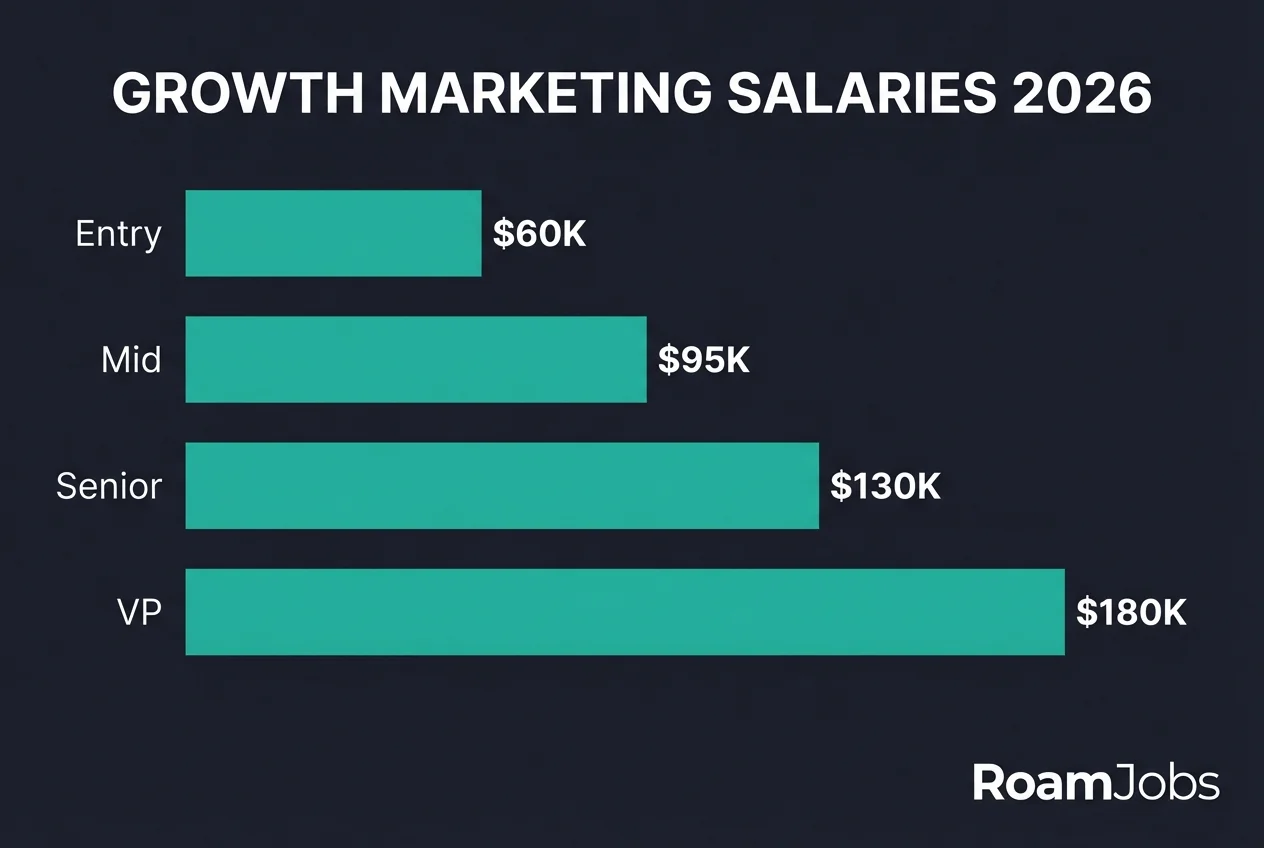
Understanding expectations at each career level helps you assess where you are, identify skill gaps, and plan your growth trajectory. Salary data represents US-based remote positions at technology companies.
Growth Marketing Salary by Experience & Location
| Level | 🇺🇸 US Remote | 🇪🇺 EU Remote | 🌎 LATAM | 🌏 Asia |
|---|---|---|---|---|
| Entry Level (0-2 yrs) | $65,000 - $90,000 | $45,000 - $65,000 | $25,000 - $50,000 | $20,000 - $42,000 |
| Mid-Level (2-5 yrs) | $100,000 - $140,000 | $70,000 - $100,000 | $45,000 - $80,000 | $38,000 - $70,000 |
| Senior (5-8 yrs) | $140,000 - $195,000 | $100,000 - $140,000 | $70,000 - $115,000 | $60,000 - $100,000 |
| Director/VP (8+ yrs) | $180,000 - $260,000 | $130,000 - $190,000 | $95,000 - $155,000 | $85,000 - $145,000 |
* Estimates, not survey data. Figures are RoamJobs estimates built from publicly reported salary ranges and adjusted for regional market rates; they are not from a proprietary RoamJobs survey. Actual base compensation varies by company, experience, and specific location within a region — verify against current offers before negotiating.
Entry Level / Junior Growth Marketer
0-2 years experience
What Companies Expect at Entry Level
Entry-level Growth Marketers execute experiments and campaigns with guidance from senior team members. You should be able to run basic A/B tests, analyze results using predefined frameworks, manage campaigns in advertising platforms, write compelling copy for emails and ads, and communicate findings clearly.
Core Skills to Develop
Analytics Fundamentals
- Google Analytics 4 proficiency for web analytics
- Basic SQL for querying user databases
- Excel or Google Sheets for analysis and reporting
- Understanding of key metrics (CAC, LTV, conversion rates, retention curves)
- Ability to create and interpret funnel reports
Experimentation Basics
- Setting up A/B tests using tools like Optimizely or Google Optimize
- Understanding statistical significance and sample sizes
- Documenting experiment hypotheses, results, and learnings
- Following established experimentation processes
Channel Execution
- Managing campaigns in Google Ads and Meta Ads platforms
- Email marketing execution using tools like Braze or Iterable
- Basic SEO understanding for content optimization
- Social media advertising fundamentals
Remote Work Skills
- Clear written communication for async updates
- Self-management and time prioritization
- Proactive status reporting without being asked
- Comfort with video meetings and remote presentations
How to Break Into Growth Marketing
Build demonstrable experience:
Start a side project where you can apply growth tactics. This could be a newsletter, blog, e-commerce store, or app. Document your experiments, results, and learnings in case studies.
Learn the tools:
Get certified in Google Analytics and Google Ads (free). Take courses on experimentation platforms. Practice SQL through online courses like Mode Analytics tutorials.
Study the methodology:
Read foundational resources like “Hacking Growth” by Sean Ellis and “Lean Analytics” by Croll and Yoskovitz. Follow growth practitioners on Twitter and subscribe to newsletters like Reforge’s content and Lenny’s Newsletter.
Position your background:
If coming from another marketing discipline, emphasize your data comfort and experimentation mindset. From engineering or data science, emphasize your interest in user psychology and marketing creativity. From product roles, highlight your customer empathy and cross-functional collaboration skills.
Target the right companies:
Startups and growth-stage companies are more likely to hire entry-level Growth Marketers since they need hands to execute. Enterprise companies typically hire more senior growth practitioners.
Mid-Level Growth Marketer
2-5 years experience
What Companies Expect at Mid-Level
Mid-level Growth Marketers own significant funnel segments or channels with minimal supervision. You should independently design and execute experiments, manage channel budgets with P&L responsibility, analyze complex data to identify growth opportunities, collaborate effectively with product and engineering, and demonstrate measurable impact on key metrics.
Skills That Define Mid-Level
Advanced Analytics
- Proficiency with product analytics tools (Amplitude, Mixpanel)
- SQL fluency for complex queries and data exploration
- Cohort analysis and retention curve interpretation
- Attribution modeling understanding
- Building and maintaining dashboards
Experimentation Leadership
- Designing multi-variant experiments
- Running experiments across multiple funnel stages
- Understanding when to launch, iterate, or kill experiments
- Calculating experiment impact and documenting learnings
- Building experiment roadmaps and prioritization frameworks
Channel Mastery
- Deep expertise in at least one acquisition channel
- Budget management and ROI optimization
- Understanding of channel economics and scaling dynamics
- Lifecycle marketing strategy and execution
- Cross-channel attribution and optimization
Cross-Functional Skills
- Working effectively with product managers on growth initiatives
- Collaborating with engineers to implement experiments
- Presenting findings and recommendations to stakeholders
- Influencing without direct authority
Career Growth Considerations
Mid-level is the critical junction for Growth Marketers. You need to decide whether to go deep in a specific area (acquisition, lifecycle, product growth) or develop broader strategic capabilities for leadership roles. Both paths are valuable, but the IC track toward Staff/Principal increasingly requires specialized depth.
Consider whether you want to focus on:
- Acquisition Growth: Deep expertise in paid and organic channels
- Product Growth: Working closely with product on PLG and activation
- Lifecycle Growth: Retention, engagement, and monetization optimization
- Growth Leadership: Building and leading growth teams
Senior Growth Marketer
5-8 years experience
What Companies Expect at Senior Level
Senior Growth Marketers are strategic leaders who drive significant business impact. You should define growth strategy for major initiatives, lead cross-functional growth squads, establish experimentation culture and frameworks, mentor junior growth practitioners, and demonstrate executive-level business impact.
Skills That Define Senior Level
Strategic Growth Leadership
- Setting growth strategy aligned with business objectives
- Identifying highest-leverage growth opportunities
- Building growth models and forecasts
- Allocating resources across initiatives and channels
- Making trade-off decisions with incomplete information
Advanced Experimentation
- Designing experimentation programs at scale
- Establishing governance and quality standards for experiments
- Building statistical literacy across teams
- Introducing new experimentation methodologies
- Connecting experiments to business outcomes
Technical Depth
- Working knowledge of data infrastructure and pipelines
- Understanding of engineering constraints and possibilities
- Ability to scope technical requirements for growth initiatives
- Comfort with product development processes
Organizational Impact
- Building growth culture across the organization
- Hiring and developing growth talent
- Influencing product roadmap with growth perspective
- Presenting to executives and board members
- Establishing growth frameworks and processes
Remote-Specific Challenges
Senior Growth Marketers face unique remote challenges. Building influence without physical presence requires exceptional communication skills. Leading cross-functional growth squads remotely demands structured processes and strong async practices. Mentoring remotely requires intentional one-on-ones and documented feedback. Successful senior remote growth leaders over-index on visibility, documentation, and proactive relationship-building.
Lead / Director Growth Marketer
8+ years experience
What Companies Expect at Director/VP Level
Directors and VPs of Growth own growth strategy across the organization. You should define multi-year growth vision, build and lead growth teams, manage significant budgets with P&L responsibility, drive organizational change, and represent growth at executive and board level.
Skills That Define Director/VP Level
Executive Leadership
- Setting company-wide growth strategy
- Building and scaling growth organizations
- Managing multi-million dollar budgets
- Board-level communication and reporting
- Hiring and developing growth leaders
Business Acumen
- Deep understanding of business model economics
- Strategic planning and scenario analysis
- Competitive analysis and market positioning
- M&A and partnership evaluation from growth perspective
- Investor relations and fundraising support
Organizational Development
- Building growth culture at scale
- Designing growth organization structure
- Establishing career frameworks for growth practitioners
- Creating learning and development programs
- Driving cross-functional alignment on growth
Innovation Leadership
- Identifying emerging channels and opportunities
- Building growth capabilities ahead of competition
- Evaluating and adopting new technologies
- Thought leadership and industry contribution
Career Path Options
At Director/VP level, career paths diverge significantly. Some growth leaders pursue CMO or CGO tracks, becoming overall marketing or growth executives. Others move into GM or CEO roles, using growth expertise as a foundation for broader business leadership. Still others become operators at earlier-stage companies, applying their expertise to build growth functions from scratch.
Remote-first companies often provide stronger VP of Growth opportunities because they have been building distributed leadership capabilities longer than traditional companies transitioning to remote work.
Essential Skills and Tools for Remote Growth Marketers
Success as a remote Growth Marketer requires mastering both strategic thinking and the technical tools that enable data-driven experimentation. This section covers the essential skills and tools you need at each career stage.
Analytics and Product Analytics Tools
Product Analytics Platform Comparison
Source: RoamJobs 2026 Growth Tools Survey| Tool | Best For | Learning Curve | Pricing | Remote Value |
|---|---|---|---|---|
| Amplitude | Product analytics at scale | Medium | $0-$995+/mo | Excellent |
| Mixpanel | Event-based analytics | Medium | $0-$833+/mo | Excellent |
| Google Analytics 4 | Web analytics | Low | Free | Good |
| Heap | Auto-capture analytics | Low | Custom pricing | Very Good |
| PostHog | Open-source analytics | Medium | $0-$450+/mo | Very Good |
| Pendo | Product experience | Medium | Custom pricing | Good |
Data compiled from RoamJobs 2026 Growth Tools Survey. Last verified January 2026.
Amplitude has become the industry standard for product analytics at growth-stage and enterprise companies. Its powerful segmentation, cohort analysis, and funnel visualization make it essential for understanding user behavior. Growth Marketers should be proficient in building charts, creating cohorts, and using Amplitude’s experimentation features.
Mixpanel offers similar capabilities with a slightly different approach to data modeling. Many companies use Mixpanel for its strong mobile analytics and flexible querying. Growth Marketers should understand Mixpanel’s event-based model and JQL querying language.
Google Analytics 4 remains essential for web analytics despite its complexity. Growth Marketers need GA4 proficiency for understanding traffic sources, attribution, and basic conversion tracking. The new event-based model requires relearning for those familiar with Universal Analytics.
Customer Data and Segmentation Platforms
Customer Data Platform Comparison
Source: RoamJobs 2026 Growth Tools Survey| Tool | Primary Use | Integration Depth | Learning Curve | Typical Users |
|---|---|---|---|---|
| Segment | Data infrastructure | Very Deep | High | Growth teams with eng support |
| Rudderstack | Open-source CDP | Very Deep | High | Technical growth teams |
| mParticle | Mobile-first CDP | Deep | Medium | Mobile app companies |
| Hightouch | Reverse ETL | Deep | Medium | Data-mature companies |
| Census | Reverse ETL | Deep | Medium | PLG companies |
Data compiled from RoamJobs 2026 Growth Tools Survey. Last verified January 2026.
Segment powers the data infrastructure at many growth-focused companies. While Growth Marketers may not implement Segment directly, understanding how it collects, routes, and distributes customer data is essential for effective analytics and marketing automation.
Experimentation Platforms
Experimentation Platform Comparison
Source: RoamJobs 2026 Growth Tools Survey| Tool | Best For | Statistical Rigor | Ease of Use | Integration |
|---|---|---|---|---|
| Optimizely | Full-stack experimentation | Very High | Medium | Excellent |
| LaunchDarkly | Feature flags + experiments | High | Medium | Excellent |
| Statsig | Product experiments | Very High | Medium | Very Good |
| Split | Feature delivery | High | Easy | Very Good |
| GrowthBook | Open-source experiments | High | Medium | Good |
| VWO | Web experimentation | Medium | Easy | Good |
Data compiled from RoamJobs 2026 Growth Tools Survey. Last verified January 2026.
Optimizely is the enterprise standard for experimentation, offering both web and full-stack capabilities. Growth Marketers should understand Optimizely’s statistical methodology, experiment design features, and integration capabilities.
LaunchDarkly and Statsig have gained significant adoption for product experimentation, combining feature flag management with robust experimentation. These platforms are increasingly common at PLG companies.
Marketing Automation and Lifecycle Tools
Lifecycle Marketing Platform Comparison
Source: RoamJobs 2026 Growth Tools Survey| Tool | Best For | Channel Coverage | Personalization | Growth Focus |
|---|---|---|---|---|
| Braze | Cross-channel lifecycle | Email, push, in-app, SMS | Excellent | Very High |
| Iterable | Lifecycle automation | Email, push, SMS, in-app | Excellent | Very High |
| Customer.io | Behavior-triggered messaging | Email, push, SMS | Very Good | Very High |
| Klaviyo | E-commerce lifecycle | Email, SMS | Very Good | High |
| OneSignal | Push notifications | Push, email, in-app | Good | Medium |
| Intercom | Product messaging | Chat, email, in-app | Very Good | High |
Data compiled from RoamJobs 2026 Growth Tools Survey. Last verified January 2026.
Braze and Iterable are the leading platforms for sophisticated lifecycle marketing. Growth Marketers should understand how to build behavioral segments, design triggered campaigns, and personalize messaging based on user attributes and behavior.
Customer.io has become increasingly popular with growth teams for its flexibility and developer-friendly approach. Its workflow builder and liquid templating enable highly personalized campaigns.
Required Skills by Seniority
Skills requirements compound as you advance. Each level assumes proficiency in everything from previous levels.
Entry Level (0-2 years) core skills:
- Google Analytics 4 proficiency
- Basic SQL (SELECT, WHERE, GROUP BY, JOIN)
- Excel/Sheets for analysis and reporting
- One advertising platform (Google Ads or Meta Ads)
- Basic email marketing (Mailchimp, Klaviyo, or similar)
- Understanding of A/B testing concepts
- Written communication for async collaboration
Mid-Level (2-5 years) additions:
- Product analytics tools (Amplitude or Mixpanel)
- Advanced SQL including window functions and CTEs
- Statistical concepts (significance, power, confidence intervals)
- Experimentation platform proficiency
- Lifecycle marketing automation
- Attribution modeling understanding
- Cross-functional collaboration skills
Senior (5-8 years) additions:
- Growth strategy and modeling
- Experimentation program design
- Technical requirements scoping
- Stakeholder management and executive communication
- Mentorship and team development
- Budget management and forecasting
Director/VP (8+ years) additions:
- Organizational design and team building
- Board-level communication
- Multi-year strategic planning
- Cross-functional leadership
- Industry thought leadership
Companies Actively Hiring Remote Growth Marketers
The remote Growth Marketing job market is robust, with opportunities across company stages from early-stage startups to public companies. This section highlights companies with strong remote growth cultures and active hiring.
Remote-First Growth Leaders
Notion - Productivity workspace with exceptional PLG growth. Growth Marketers work on viral loops, activation optimization, and expansion. Strong design culture with high craft standards. Competitive compensation.
Figma - Design platform with powerful network effects. Growth team focuses on virality, team expansion, and product-led conversion. Remote-friendly with location-based compensation.
Zapier - Workflow automation pioneer with fully remote culture since founding. Growth Marketers work on acquisition, activation, and lifecycle. Known for excellent work-life balance and async practices.
GitLab - Fully remote company with gold-standard documentation practices. Growth team focuses on developer acquisition and product-led conversion. Transparent culture with public handbook.
Webflow - Visual web development platform with strong PLG motion. Growth Marketers work on creator acquisition, agency expansion, and product growth. Remote-first culture.
Linear - Issue tracking tool known for exceptional product craft. Small, senior growth team focused on viral mechanics and product-led growth. High standards with significant impact opportunity.
Loom - Async video platform with distributed team. Growth Marketers work on viral sharing, activation, and team expansion. Strong product-market fit with growth opportunity.
Amplitude - Analytics platform that practices what it preaches on data-driven growth. Growth team uses their own product to optimize acquisition and conversion.
Growth-Stage Companies with Remote Growth Teams
Canva - Visual design platform with massive scale and continued growth. Growth Marketers work on acquisition across segments, activation, and monetization. Remote-friendly with strong benefits.
Airtable - Flexible database platform with PLG and sales motions. Growth team focuses on activation, expansion, and lifecycle. Remote-first engineering and marketing teams.
Miro - Visual collaboration platform that grew significantly during remote work shift. Growth Marketers work on viral sharing, team expansion, and retention.
Calendly - Scheduling tool with strong viral mechanics. Growth team optimizes viral loops, conversion, and expansion. Competitive compensation.
Deel - Global payroll platform with rapid growth. Growth Marketers work on B2B acquisition, activation, and expansion across international markets.
Remote.com - HR platform for distributed teams with remote-first culture. Growth team focuses on acquisition and product-led conversion.
ClickUp - Productivity platform competing in the project management space. Growth Marketers work on acquisition, activation, and competitive positioning.
Monday.com - Work management platform with significant growth investment. Large growth team with opportunities across acquisition and product growth.
Enterprise Companies with Remote Growth Roles
HubSpot - CRM platform with @flex work policy. Growth Marketers work across the marketing hub, CRM, and free tools. Large team with structured career progression.
Shopify - E-commerce platform with “digital by default” policy. Growth team focuses on merchant acquisition, activation, and expansion. Significant scale and impact.
Atlassian - Enterprise tools with “Team Anywhere” policy. Growth Marketers work on PLG motion for Jira, Confluence, and other products.
Twilio - Communications platform with remote-friendly culture. Growth team focuses on developer acquisition and product-led conversion.
Datadog - Monitoring platform with hybrid remote options. Growth Marketers work on developer acquisition and expansion.
Where to Find Remote Growth Marketing Jobs
Specialized job boards:
- We Work Remotely - Strong marketing and growth category
- Remotive - Growth-specific filters available
- Wellfound (AngelList) - Startup growth roles
- The Muse - Startup and growth-stage companies
Community job boards:
- Reforge community job board (for members)
- Lenny’s Newsletter job board
- Product-Led Growth Slack community
Direct sourcing:
- Company career pages (many roles not posted elsewhere)
- LinkedIn with “Remote” filter
- Twitter following growth leaders who share opportunities
Interview Preparation: Questions and Strategies
Remote Growth Marketing interviews are comprehensive, typically spanning 4-6 rounds over 3-5 weeks. Understanding each phase and preparing thoroughly significantly improves your success rate.
Interview Structure Overview
Round 1: Recruiter Screen (30 minutes) Initial fit assessment covering your background, interest in the role, salary expectations, and remote work experience. Prepare a concise pitch for your growth experience and impact.
Round 2: Hiring Manager Screen (45-60 minutes) Deeper discussion of your growth experience, methodology, and approach. Expect questions about specific experiments, results, and learnings. Prepare 2-3 detailed examples.
Round 3: Technical Assessment (60-90 minutes) Assessment of analytical skills through case studies, data analysis, or take-home projects. May include SQL assessment, funnel analysis, or experiment design.
Round 4: Cross-Functional Interviews (2-3 hours) Meetings with product, engineering, and marketing partners. These assess collaboration skills, communication, and cultural fit.
Round 5: Final Round (45-60 minutes) Meeting with VP or executive to assess strategic thinking, cultural alignment, and leadership potential.
Experimentation and A/B Testing Questions
How to answer: Demonstrate structured thinking about experimentation methodology. Show you understand the full lifecycle from hypothesis to analysis.
Strong answer approach:
Start by clarifying the current state: What is the baseline conversion rate? Where in onboarding are users dropping off? What qualitative insights exist about why users don’t complete onboarding?
Define a clear hypothesis: “Based on [insight/data], I hypothesize that [change] will improve [metric] by [amount] because [reason].”
Design the experiment: Define control and treatment, determine sample size requirements based on minimum detectable effect, establish success metrics and guardrail metrics, set experiment duration.
Plan analysis: Pre-register your analysis plan, define statistical approach, plan for segment analysis (new vs returning users, device type, acquisition source).
Discuss iteration: What would you do if the experiment wins? Loses? Is inconclusive?
What interviewers evaluate: Structured thinking, statistical understanding, business context awareness, ability to translate insights into action.
How to answer: Be honest about a real failure while demonstrating learning orientation and intellectual honesty. The best Growth Marketers learn more from failures than successes.
Strong answer approach:
Describe the context and hypothesis clearly. Explain your thinking at the time and why you believed the experiment would work.
Share what happened: the results, what you observed, and why it failed. Be specific about metrics and magnitude.
Discuss your analysis: Did you understand why it failed? Was the hypothesis wrong? The execution flawed? The measurement incorrect?
Share what you learned and how you applied those learnings. Did this failure inform future experiments? Change your approach to hypothesis formation?
Demonstrate intellectual honesty: acknowledge uncertainty, avoid blaming others, show genuine curiosity about understanding failure.
What interviewers evaluate: Learning orientation, intellectual honesty, analytical rigor, growth mindset.
How to answer: Show you have a systematic framework for prioritization that balances impact, effort, and learning value.
Strong answer approach:
Describe your framework (ICE, RICE, or custom). Explain how you score impact (potential improvement * traffic), confidence (based on research and precedent), and ease (engineering effort, cross-functional dependencies).
Discuss how you balance exploitation vs exploration: some experiments test proven concepts, others explore new territory.
Explain how you consider learning value: some experiments teach you something valuable even if they fail.
Share how you involve stakeholders in prioritization and build alignment around the roadmap.
Give an example of a time prioritization was difficult and how you made the decision.
What interviewers evaluate: Structured thinking, stakeholder management, balance of data and intuition.
How to answer: Demonstrate understanding of statistical power and practical considerations in experiment design.
Strong answer approach:
Ask clarifying questions: What is the current conversion rate? What is the minimum effect you want to detect? What statistical power and significance level are standard at the company?
Walk through the calculation: explain that sample size depends on baseline conversion rate, minimum detectable effect (MDE), statistical power (typically 80%), and significance level (typically 95%).
Discuss practical considerations: traffic volume affects how long the experiment runs, and longer experiments face risks of seasonality and novelty effects.
Show awareness of tools: sample size calculators, power analysis in experimentation platforms.
Address multiple comparisons if testing multiple variants.
What interviewers evaluate: Statistical literacy, practical experience, ability to explain technical concepts clearly.
How to answer: Show you can advocate for data-driven decisions while maintaining relationships and considering valid objections.
Strong answer approach:
Acknowledge that intuition has value: experienced stakeholders have pattern-matching that deserves consideration.
Describe your approach to understanding the objection: Is there a flaw in the experiment design? Segment effects we didn’t consider? External factors affecting results?
Explain how you present data: clear visualizations, confidence intervals, segment analysis, sensitivity analysis.
Discuss when you would advocate for following the data vs. running additional experiments to increase confidence.
Share an example where you navigated this successfully, including the outcome and relationship impact.
What interviewers evaluate: Stakeholder management, data advocacy, communication skills, judgment.
Funnel Optimization Questions
How to answer: Demonstrate systematic diagnostic thinking that considers multiple hypotheses and uses data to narrow down causes.
Strong answer approach:
Clarify the metric: How is activation defined? What timeframe? Is this statistically significant or noise?
Segment the problem: Is the drop across all users or specific segments? New vs returning? By acquisition channel? By device or platform? By geography?
Check for external factors: Were there product changes shipped? Seasonality? Market events? Competitor actions?
Examine the funnel: Where in the activation flow is drop-off occurring? Has the profile of users reaching activation changed?
Consider measurement issues: Were there instrumentation changes? Data quality issues? Definition changes?
Propose investigation steps: Which analyses would you run first? What data would you need?
What interviewers evaluate: Analytical thinking, hypothesis generation, systematic approach, data intuition.
How to answer: Show full-funnel thinking and understanding of PLG conversion levers.
Strong answer approach:
Start with understanding: What is the current conversion rate? What does the conversion funnel look like? What qualitative insights exist about why users do or don’t convert?
Analyze the user journey: Map the path from signup to conversion. Identify where users drop off. Understand what behaviors correlate with conversion.
Identify opportunities: Activation improvement (users who experience value convert more), friction reduction in the upgrade flow, value demonstration (helping users understand what they get), trigger optimization (when and how you prompt for upgrade).
Prioritize based on impact and effort: Which opportunities have the largest potential impact? Which can you test quickly?
Propose specific experiments: What would you test first? What would you measure?
What interviewers evaluate: Full-funnel thinking, PLG understanding, strategic prioritization, experimentation mindset.
How to answer: Demonstrate understanding of retention as a multi-faceted problem requiring both product and marketing solutions.
Strong answer approach:
Start with diagnosis: What is the current churn rate by segment? When does churn happen (early vs late)? What are users saying about why they leave?
Build a churn prediction model (conceptually): What behaviors predict churn? Can you identify at-risk users before they leave?
Develop intervention strategies: For early churn, focus on activation and onboarding. For late churn, focus on feature adoption and value reinforcement. For involuntary churn (payment failures), focus on dunning optimization.
Design lifecycle campaigns: Win-back campaigns for churned users, re-engagement for at-risk users, value reinforcement for healthy users.
Measure and iterate: Define success metrics, run experiments, learn and improve.
What interviewers evaluate: Retention understanding, lifecycle thinking, analytical approach, cross-functional solutions.
How to answer: Show understanding of comprehensive growth metrics beyond vanity metrics.
Strong answer approach:
Structure your answer around the growth funnel:
Acquisition metrics: CAC by channel, payback period, acquisition volume, channel efficiency trends.
Activation metrics: Time to value, activation rate, onboarding completion, feature adoption.
Retention metrics: Cohort retention curves, DAU/MAU ratio, engagement frequency, churn rate by segment.
Monetization metrics: Revenue per user, conversion rate, expansion revenue, LTV.
Efficiency metrics: LTV:CAC ratio, payback period, viral coefficient, magic number.
Discuss leading vs lagging indicators: what metrics predict future performance?
Explain how you balance metrics: avoiding over-optimization on one metric at the expense of others.
What interviewers evaluate: Metrics literacy, full-funnel thinking, business acumen.
Acquisition Channel Questions
How to answer: Demonstrate understanding of channel economics and strategic thinking about portfolio allocation.
Strong answer approach:
Define evaluation criteria: CAC relative to LTV, payback period, scalability potential, audience quality, brand fit.
Discuss testing methodology: How would you test the channel before major investment? What budget and timeline for initial test? What success metrics?
Analyze strategic fit: Does the channel reach your target audience? Does it complement existing channels? What are the risks?
Consider competitive dynamics: How saturated is the channel? What are competitors doing?
Plan scaling approach: If the test succeeds, how would you scale? What infrastructure is needed?
What interviewers evaluate: Channel knowledge, strategic thinking, analytical rigor, risk awareness.
How to answer: Show diagnostic thinking and understanding of CAC drivers.
Strong answer approach:
Diagnose the cause: Is CAC increasing across all channels or specific ones? Is it CPM/CPC increasing or conversion rates declining? Is the audience quality changing?
Consider external factors: Market competition, seasonality, platform algorithm changes, economic conditions.
Examine internal factors: Creative fatigue, audience exhaustion, landing page changes, product changes affecting conversion.
Propose solutions: Channel diversification, creative refresh, audience expansion, conversion optimization, LTV improvement to justify higher CAC.
Prioritize based on impact and feasibility: What would you do first?
What interviewers evaluate: Diagnostic thinking, channel expertise, strategic response, business acumen.
How to answer: Demonstrate understanding of attribution complexity and practical approaches.
Strong answer approach:
Acknowledge the challenge: Attribution is inherently uncertain in a multi-touch journey.
Discuss attribution models: Last-touch, first-touch, linear, time-decay, position-based, data-driven. Each has tradeoffs.
Explain incrementality: Attribution tells you who converted, not whether they would have converted anyway. Incrementality testing (geo-tests, holdout experiments) measures true channel impact.
Address practical considerations: Platform attribution vs. internal attribution, cross-device tracking challenges, privacy changes (iOS ATT, cookie deprecation).
Share your philosophy: How do you use attribution while acknowledging its limitations? How do you make investment decisions under uncertainty?
What interviewers evaluate: Attribution sophistication, practical experience, intellectual honesty about uncertainty.
Data Analysis Questions
How to answer: Show understanding of viral program metrics and analysis approaches.
Strong answer approach:
Define success metrics: Referral volume, conversion rate, referred user quality (LTV), K-factor, referral program ROI.
Analyze the referral funnel: Invitation rate (what % of users invite others), acceptance rate (what % of invitees sign up), conversion rate (what % of referred signups become quality users).
Compare referred vs non-referred users: Do referred users have higher LTV? Better retention? Faster activation?
Calculate program ROI: Cost of incentives vs. LTV of acquired users.
Identify optimization opportunities: Where in the funnel can you improve? What’s driving top-performing referrers?
What interviewers evaluate: Viral mechanics understanding, analytical approach, ROI thinking.
How to answer: Write clean, efficient SQL while asking clarifying questions about the data model and engagement definition.
Strong answer approach:
Ask clarifying questions: How is engagement defined? What events represent engagement? What time period? What tables and columns are available?
Structure your query clearly:
SELECT
    user_id,
    COUNT(DISTINCT event_date) as active_days,
    COUNT(*) as total_events,
    MAX(event_timestamp) as last_active
FROM user_events
WHERE event_timestamp >= DATEADD(day, -30, CURRENT_DATE)
    AND event_type IN ('feature_used', 'content_created', 'share')
GROUP BY user_id
ORDER BY total_events DESC
LIMIT 10;
Explain your reasoning: Why you chose certain metrics, how you handled edge cases.
Discuss extensions: How would you handle ties? Segment by user type? Add quality filters?
What interviewers evaluate: SQL proficiency, analytical thinking, communication about technical work.
How to answer: Demonstrate awareness of data quality issues and systematic approaches to validation.
Strong answer approach:
Discuss common issues: Missing data, duplicate events, tracking errors, definition inconsistencies, sampling biases.
Explain validation approaches: Sanity checks (does the data make sense?), consistency checks (does it match other sources?), trend analysis (are there unexpected changes?), documentation review (what are known issues?).
Describe collaboration: Working with data engineering on instrumentation, establishing data contracts, alerting on anomalies.
Share an example: A time you caught a data quality issue before it affected a decision.
What interviewers evaluate: Data skepticism, analytical rigor, collaboration with technical teams.
How to answer: Show understanding of effective data visualization and metric hierarchy.
Strong answer approach:
Define the audience: Who will use this dashboard? What decisions will it inform?
Structure metrics hierarchically: North star metric at top, supporting metrics by funnel stage, diagnostic metrics for drill-down.
Design for action: Metrics should be actionable. Include comparisons (vs. prior period, vs. target), trends, and segment breakdowns.
Consider refresh cadence: What needs real-time vs. daily vs. weekly updates?
Plan for iteration: Dashboards should evolve based on what questions users ask.
Discuss tools: Amplitude dashboards, Looker/Mode, Tableau depending on company stack.
What interviewers evaluate: Metrics thinking, communication design, practical experience.
Remote Work and Behavioral Questions
How to answer: Demonstrate self-management skills essential for remote work.
Strong answer approach:
Explain your framework: How you evaluate impact, urgency, and dependencies.
Describe communication approach: How you keep stakeholders informed about prioritization decisions and tradeoffs.
Discuss tools and systems: How you track projects and manage your time.
Share an example: A time you successfully managed competing priorities.
Address when you escalate: How you handle situations where you cannot complete everything.
What interviewers evaluate: Self-management, communication, stakeholder awareness.
How to answer: Show you understand cross-functional partnership and can influence without authority.
Strong answer approach:
Describe your approach: Building relationships, understanding their priorities, speaking their language.
Explain how you scope growth work: Writing clear requirements, quantifying potential impact, making the case for prioritization.
Discuss how you handle disagreements: Working through tradeoffs, finding win-win solutions, escalating appropriately.
Share an example: A successful cross-functional growth initiative and your role in making it happen.
What interviewers evaluate: Collaboration skills, influence, cross-functional effectiveness.
How to answer: Show genuine curiosity and systematic approach to learning.
Strong answer approach:
Share specific sources: Newsletters (Lenny’s Newsletter, Growth Unhinged), podcasts, communities (Reforge, Product-Led Growth community).
Discuss how you apply learnings: Reading is not enough; how do you translate insights into your work?
Mention community involvement: Sharing your own learnings, participating in discussions.
Show intellectual curiosity: What recent trend or tactic are you most excited about?
What interviewers evaluate: Learning orientation, intellectual curiosity, community engagement.
How to answer: Demonstrate communication skills essential for growth roles that work across functions.
Strong answer approach:
Set up the situation: What data, who was the audience, what was at stake.
Explain your approach: How you simplified without losing accuracy, what visualizations you used, how you structured the narrative.
Share the outcome: Did they understand? Did it lead to good decisions?
Discuss what you learned about communicating data effectively.
What interviewers evaluate: Communication skills, empathy for audience, ability to simplify.
Frequently Asked Questions
How do I find remote growth marketing jobs?
To find remote growth marketing jobs, start with specialized job boards like We Work Remotely, Remote OK, and FlexJobs that focus on remote positions. Set up job alerts with keywords like "remote growth marketing" and filter by fully remote positions. Network on LinkedIn by following remote-friendly companies and engaging with hiring managers. Many growth marketing roles are posted on company career pages directly, so identify target companies known for remote work and check their openings regularly.
What skills do I need for remote growth marketing positions?
Remote growth marketing positions typically require the same technical skills as on-site roles, plus strong remote work competencies. Essential remote skills include excellent written communication, self-motivation, time management, and proficiency with collaboration tools like Slack, Zoom, and project management software. Demonstrating previous remote work experience or the ability to work independently is highly valued by employers hiring for remote growth marketing roles.
What salary can I expect as a remote growth marketing?
Remote growth marketing salaries vary based on experience level, company size, location-based pay policies, and the specific tech stack or skills required. US-based remote positions typically pay market rates regardless of where you live, while some companies adjust pay based on your location's cost of living. Entry-level positions start lower, while senior roles can command premium salaries. Check our salary guides for specific ranges by experience level and geography.
Are remote growth marketing jobs entry-level friendly?
Some remote growth marketing jobs are entry-level friendly, though competition can be high. Focus on building a strong portfolio or demonstrable skills, contributing to open source projects if applicable, and gaining any relevant experience through internships, freelance work, or personal projects. Some companies specifically hire remote junior talent and provide mentorship programs. Smaller startups and agencies may be more open to entry-level remote hires than large corporations.
What is the difference between Growth Marketing and Performance Marketing?
Performance Marketing focuses primarily on paid acquisition channels and optimizing for immediate, measurable conversions. Performance Marketers manage advertising budgets across Google, Meta, and other platforms to drive efficient customer acquisition. Growth Marketing takes a broader view, owning the entire customer journey from acquisition through retention and monetization. Growth Marketers work on paid channels but also product-led growth, activation optimization, lifecycle marketing, and viral mechanics. Growth Marketing also involves closer collaboration with product teams and more emphasis on experimentation methodology. Many Growth Marketers have performance marketing backgrounds but have expanded their scope. Performance Marketing roles typically pay 10-20% less than equivalent Growth Marketing roles due to the broader scope and strategic responsibility of growth positions.
Do I need to know how to code to be a Growth Marketer?
Coding is not required for most Growth Marketing roles, but technical comfort is essential. At minimum, you need SQL proficiency for data analysis and querying user databases. Understanding how web applications work (HTML, JavaScript basics, APIs) helps you scope experiments and communicate with engineers. Some Growth Marketers learn Python for more sophisticated analysis or automation, but this is optional and role-dependent. What matters more than coding is technical curiosity: the willingness to understand how things work, ask good questions of engineers, and learn enough technical context to be effective. Senior Growth Marketers who can bridge business and technical thinking are highly valuable.
How do I transition from traditional marketing to Growth Marketing?
The transition requires developing three core capabilities. First, build analytical skills: learn SQL, become proficient with product analytics tools, and practice thinking in terms of funnels and metrics. Second, develop experimentation methodology: understand statistical concepts, practice designing experiments, and build a portfolio of experiments you have run (even on side projects). Third, learn product thinking: study PLG companies, understand how product decisions affect growth, and practice thinking about user behavior. Position your existing marketing experience as an asset: channel expertise, customer understanding, and creative skills are valuable in growth roles. Many successful Growth Marketers started in content marketing, paid acquisition, or email marketing before expanding their scope. Consider taking courses like Reforge or CXL to formalize growth knowledge.
Is Growth Marketing more stressful than other marketing roles?
Growth Marketing can be more stressful due to its metrics-driven nature and close tie to business outcomes. You live by your numbers, and when metrics decline, there is pressure to diagnose and fix quickly. The experimentation culture means frequent failure (most experiments do not win), which can be emotionally challenging if you tie your identity to individual results. However, many Growth Marketers find this environment energizing rather than stressful. The rapid feedback loops, continuous learning, and clear impact create satisfaction. Remote Growth Marketing can actually reduce stress by providing autonomy and flexibility. The key is finding a company culture that treats experimentation as learning rather than performance evaluation, and building personal resilience around failed experiments.
What industries pay the most for Growth Marketing?
Fintech and crypto companies typically pay the highest Growth Marketing salaries due to the direct revenue impact and competitive talent market. B2B SaaS companies, especially developer tools and infrastructure, pay well and offer strong equity packages. Consumer subscription businesses (streaming, fitness apps, learning platforms) pay competitively, especially for lifecycle and retention expertise. E-commerce pays moderately but offers faster career progression at growth-stage companies. Healthcare and enterprise software pay well but may have slower experimentation cycles due to regulatory constraints. Early-stage startups may offer lower base salaries but significant equity upside. Consider total compensation including equity, not just base salary.
How important is a Growth Marketing-specific degree or certification?
Formal education matters less in Growth Marketing than demonstrated results and skills. Most Growth Marketing leaders did not have growth-specific degrees; they came from various backgrounds including engineering, economics, psychology, and liberal arts. However, targeted education can accelerate your learning. Reforge programs are highly respected for senior growth practitioners, though expensive ($1,995+). CXL mini-degrees offer practical skills at lower cost. Google Analytics and Google Ads certifications demonstrate baseline competence. What matters most is your portfolio of experiments and results. Document your growth work thoroughly, quantify your impact, and be able to discuss your methodology in interviews. A strong portfolio of growth case studies outweighs any certification.
What is the career ceiling for Growth Marketing?
Growth Marketing offers multiple high-level career paths. The most common is VP of Growth or Chief Growth Officer at growth-stage or public companies, roles that can earn $300,000-$500,000+ in total compensation. Some Growth Marketers become CMOs, especially at PLG companies where growth expertise is central to marketing. Others move into general management or CEO roles, using growth expertise as a foundation for broader business leadership. The IC track goes to Staff or Principal Growth roles, typically at large tech companies, earning $200,000-$300,000 while remaining hands-on. Many senior Growth Marketers become operators, joining early- stage companies as founding growth hires or fractional growth leaders. The skills developed in Growth Marketing, particularly data fluency, experimentation methodology, and cross-functional collaboration, transfer well to many leadership roles.
How do remote Growth Marketing interviews differ from in-person?
Remote Growth Marketing interviews are similar in content but require additional preparation for the format. Ensure you have reliable technology: stable internet, quality audio/video, and a professional background. Practice screen sharing for case presentations and have your portfolio easily accessible for walkthrough. Remote interviews may include asynchronous components: take-home exercises, recorded video responses, or written analyses. Prepare to communicate clearly in writing as well as verbally. Time zone coordination is more complex, so be flexible and responsive about scheduling. The interview process may be longer (more rounds, stretched over more weeks) because remote companies are more thorough in evaluating remote work fit. Prepare examples that demonstrate your ability to work asynchronously, communicate proactively, and drive results without constant oversight.
Should I specialize in a specific funnel stage or stay generalist?
The optimal answer depends on your career stage and goals. Early in your career (0-3 years), stay broad enough to understand the full funnel while developing depth in one area that interests you. This breadth helps you understand how pieces connect and provides career flexibility. Mid-career (3-7 years), develop recognized expertise in your strongest area while maintaining cross-funnel literacy. Specialists in acquisition, product growth, or lifecycle command premium salaries and are sought after for specific challenges. Senior-level (7+ years), you can go two directions: become a deep specialist (Staff Growth focused on PLG, for example) or develop strategic breadth for leadership roles (VP of Growth who oversees all funnel stages). Remote-first companies often prefer generalists at smaller sizes (where you need to do everything) and specialists at larger sizes (where teams are more segmented).
What are the biggest mistakes new Growth Marketers make?
The most common mistakes include: focusing on vanity metrics rather than business outcomes (page views instead of activation rate), running too few experiments rather than building a high-velocity experimentation program, shipping winning experiments without understanding why they won (limiting future learning), optimizing local maxima without questioning whether the overall strategy is right, neglecting retention while over-indexing on acquisition, making decisions without sufficient statistical rigor, and working in silos rather than collaborating with product and engineering. New Growth Marketers also sometimes over-rely on tactics from other companies without adapting them to their specific context. What worked at Airbnb may not work for your B2B SaaS product. Focus on building first- principles understanding rather than copying playbooks.
Career Paths: Where Growth Marketing Can Take You
Growth Marketing provides an excellent foundation for multiple senior career paths. The combination of analytical skills, business acumen, and cross-functional experience makes Growth Marketers valuable candidates for leadership roles across the organization.
Progression Within Growth
The most direct path is advancing within growth functions:
Growth Marketer → Senior Growth Marketer → Lead/Manager → Director → VP of Growth → Chief Growth Officer
This path keeps you focused on growth while expanding scope from individual contribution to team leadership to organizational strategy. VP and CGO roles are increasingly common at growth-stage and public companies, with total compensation reaching $300,000-$500,000+.
Transition to Product
Growth Marketers frequently move into product management, particularly at PLG companies:
Growth Marketer → Product Manager (Growth) → Senior PM → Director of Product → VP of Product
The overlap in skills is significant: data analysis, experimentation methodology, user understanding, and cross-functional collaboration. Product growth PM roles are among the most competitive in product management, and growth experience is highly valued. This path works best for Growth Marketers who enjoy product development and want to own feature roadmaps.
Transition to Marketing Leadership
Growth experience translates well to broader marketing leadership:
Growth Marketer → Marketing Manager → Director of Marketing → VP of Marketing → CMO
At PLG companies especially, CMOs increasingly come from growth backgrounds rather than brand marketing. Understanding customer acquisition economics, lifecycle optimization, and data-driven decision making are essential CMO skills. This path suits Growth Marketers who want to expand into brand, communications, and marketing strategy.
Transition to General Management
Growth skills provide a foundation for broader business leadership:
Growth Marketer → GM/Business Unit Lead → CEO
Understanding how to acquire, activate, and retain customers while managing P&L creates preparation for general management. Many startup CEOs have growth backgrounds. This path suits Growth Marketers interested in overall business strategy and team building beyond marketing.
Independent and Advisory Paths
Senior Growth Marketers can build independent careers:
Fractional Growth Leader: Serving multiple startups part-time, applying expertise across portfolios Growth Advisor/Consultant: Advising companies on growth strategy without operational execution Angel Investor: Using growth pattern recognition to identify promising startups Course Creator/Author: Teaching growth methodology to the next generation
These paths offer autonomy and variety while leveraging accumulated expertise.
Related Guides and Resources
Growth Marketing connects to the broader marketing and product ecosystem. Explore these related guides to understand how growth fits within career opportunities and identify adjacent paths.
Marketing Hub Guide
The Remote Marketing Jobs guide provides a comprehensive overview of all marketing specializations, including content marketing, SEO, paid advertising, and product marketing. Use this hub to compare roles and understand the full landscape of remote marketing careers.
Product Marketing Guide
If you are interested in the intersection of growth and positioning, explore Product Marketing. PMMs work closely with Growth Marketers on go-to-market strategy, messaging, and launch optimization.
Product Management Guide
The Remote Product Jobs guide covers product roles that Growth Marketers frequently transition to. Understanding product management helps Growth Marketers collaborate more effectively with product teams.
Interview Preparation
The Remote Interview guide covers best practices for succeeding in video interviews, handling case studies, and demonstrating remote work readiness.
Salary Negotiation
Once you receive offers, understanding negotiation strategies helps you maximize compensation. Growth Marketing roles often have significant equity components that require careful evaluation.
Next Steps: Launching Your Remote Growth Marketing Career
Remote Growth Marketing offers exceptional career opportunities for those who combine analytical rigor with marketing creativity and experimentation mindset. The combination of high demand, competitive salaries, and remote-friendly work makes growth one of the most attractive marketing specializations.
Immediate actions to take:
-
Assess your current skills against the requirements for your target seniority level. Identify gaps in analytics, experimentation methodology, or channel expertise.
-
Build SQL proficiency if you do not already have it. SQL is the most important technical skill for Growth Marketers, enabling direct access to user data.
-
Learn product analytics tools by exploring free tiers of Amplitude or Mixpanel. Build sample dashboards and analyses.
-
Document your growth experience in case study format. Even if your current role is not titled “Growth,” identify and quantify growth-related work you have done.
-
Build your target company list of 20-30 companies with strong remote growth cultures. Research their products, growth models, and team structures.
-
Develop your experimentation portfolio through side projects if needed. Run real experiments on a newsletter, blog, or side business.
-
Join growth communities like Reforge, Product-Led Growth Slack, or Lenny’s Newsletter to learn from practitioners and discover opportunities.
-
Start applying strategically with customized applications that demonstrate understanding of each company’s growth challenges.
Remote Growth Marketing is not just about working from anywhere. It is about joining companies building the future, applying rigorous methodology to drive business outcomes, and developing skills that remain valuable throughout your career. The combination of analytical depth, creative problem-solving, and cross-functional collaboration makes Growth Marketing intellectually stimulating work with clear, measurable impact.
Get the Remote Growth Marketing Career Kit
Weekly curated remote growth jobs, experiment teardowns, and interview tips delivered to your inbox.
Continue Reading
Remote Marketing Jobs 2026: Complete Guide to Content, SEO, Paid Ads & Growth
The definitive hub for remote marketing careers. Explore salary data, interview guides, and opportunities across content marketing, SEO, paid ads, growth, product marketing, email marketing, and social media roles.
Remote Product Jobs 2026: Complete Guide to PM, TPM & Leadership Careers
The definitive hub for remote product careers. Explore salary data, interview guides, and opportunities across product management, technical PM, product owner, and leadership roles.
Remote Product Analyst Jobs: Complete 2026 Career Guide
Everything you need to land a remote product analyst job. Metrics, A/B testing, experimentation - salary data, interview questions, and companies hiring.
Remote jobs worth opening, every Tuesday
A short weekly list of remote jobs picked for your field, with location limits called out when we can verify them.
Live intake · refreshed every 12 hours
Live openings: remote growth marketing
Sourced from publisher feeds, not direct employer postings. Links route through
/go/ with the same anti-fraud checks as our curated boards.