Remote Paid Ads Jobs: The Complete 2026 Guide to Performance Marketing Careers
Everything you need to land a remote paid ads or performance marketing job. Comprehensive salary data, interview questions for Google Ads, Meta, and programmatic platforms, plus companies actively hiring.
Updated January 20, 2026 • Verified current for 2026
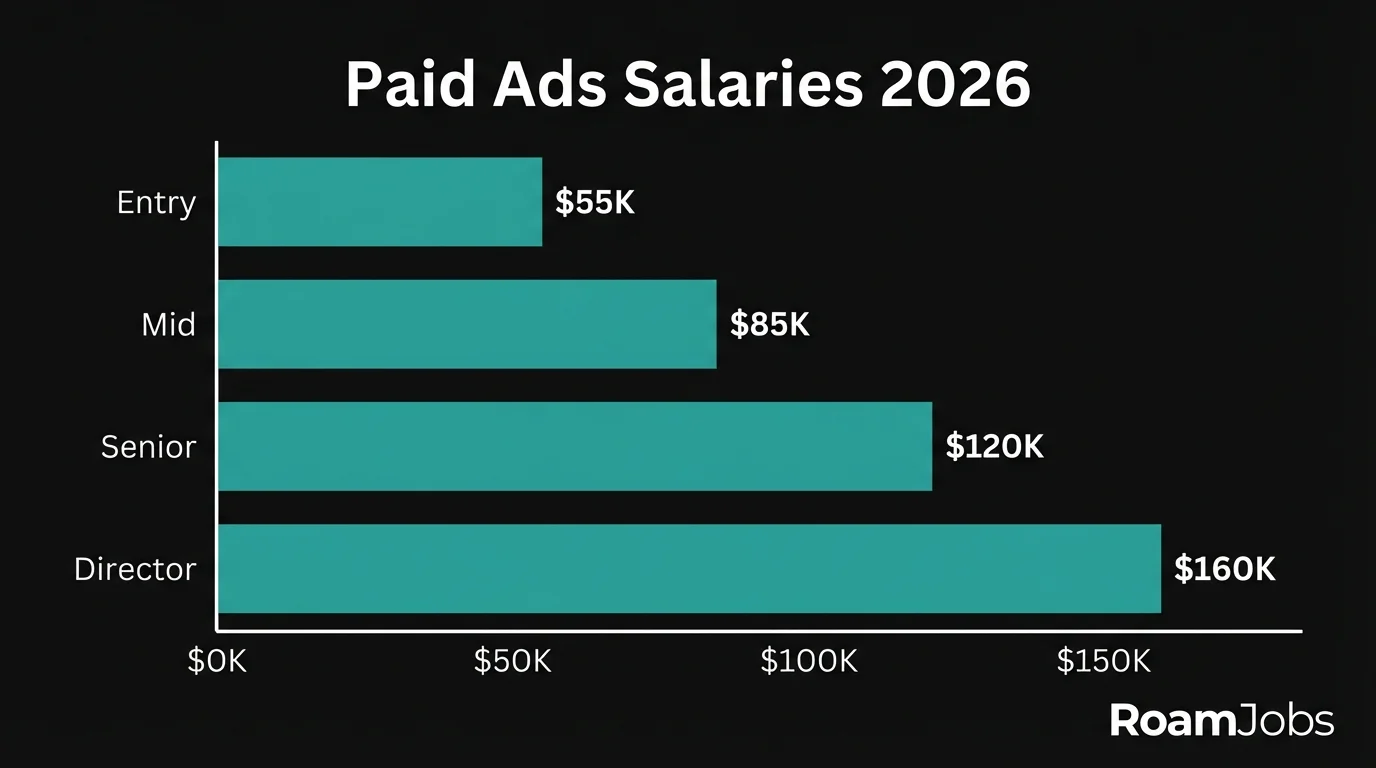
Remote Paid Ads and Performance Marketing specialists manage advertising campaigns across platforms like Google Ads, Meta (Facebook/Instagram), LinkedIn, TikTok, and programmatic networks to drive measurable business outcomes such as leads, sales, and app installs. With US remote salaries ranging from $55,000 to $220,000+ depending on experience and specialization, this is one of the highest-paying marketing disciplines due to its direct revenue impact. Success in remote paid ads requires mastering platform-specific optimization, understanding attribution and analytics, managing substantial budgets efficiently, and communicating performance insights clearly to stakeholders across time zones.
Role Overview: What Remote Paid Ads Specialists Actually Do
Paid Ads specialists, also known as Performance Marketers, PPC Specialists, or Media Buyers, are responsible for planning, executing, and optimizing paid advertising campaigns that drive measurable business results. Unlike brand marketing which focuses on awareness and perception, performance marketing is defined by direct accountability to metrics like cost per acquisition (CPA), return on ad spend (ROAS), and customer lifetime value (LTV).
Day-to-Day Responsibilities
As a remote paid ads specialist, your typical workday involves a blend of strategic planning, hands-on campaign management, data analysis, and cross-functional collaboration.
Campaign Management and Optimization
The core of paid ads work involves daily campaign monitoring and optimization. You review performance data each morning, identifying campaigns that need attention. This includes adjusting bids based on performance trends, pausing underperforming ads and scaling winners, refining audience targeting based on conversion data, managing budget allocation across campaigns and platforms, and testing new creative concepts and copy variations.
Creative Strategy and Development
While you may not design ads yourself, you direct creative strategy and work closely with designers. You analyze which creative elements drive performance, develop creative briefs based on data insights, A/B test headlines, images, videos, and calls-to-action, provide feedback to creative teams on performance data, and stay current on platform-specific creative best practices.
Analytics and Reporting
Performance marketers spend significant time analyzing data and communicating insights. You build dashboards tracking key performance indicators, conduct deep-dive analyses to understand performance drivers, create regular reports for stakeholders and leadership, present findings and recommendations in meetings, and translate complex data into actionable insights.
Budget Planning and Forecasting
As you advance, budget responsibility increases significantly. You forecast performance based on historical data and market conditions, allocate budgets across channels to maximize ROI, manage pacing to ensure budgets are spent efficiently, model scenarios for budget increases or decreases, and justify budget requests with data-driven projections.
Platform Management and Technical Setup
Paid ads specialists handle technical implementation across platforms. You set up conversion tracking and pixel implementation, configure audiences and targeting parameters, manage product feeds for shopping campaigns, troubleshoot tracking discrepancies, and stay current on platform updates and new features.
Platforms and Channels Covered
Remote paid ads roles typically involve expertise in multiple platforms, with specialization depending on company type and industry.
Google Ads
Google Ads remains the dominant paid search platform, covering search advertising (text ads on Google Search), display advertising (banner ads across Google Display Network), YouTube advertising (video ads), shopping campaigns (product listing ads), Performance Max (AI-driven cross-channel campaigns), and app campaigns (driving app installs and engagement). Google Ads expertise is near-universal in paid ads job requirements, making it the foundational platform to master.
Meta Ads (Facebook and Instagram)
Meta’s advertising platform is essential for B2C and increasingly B2B marketing. It encompasses Facebook feed, Stories, Reels, and Messenger ads, Instagram feed, Stories, Reels, and Explore ads, audience targeting based on demographics, interests, and behaviors, custom audiences and lookalike audience creation, and conversion optimization through the Meta Pixel and Conversions API. Meta’s sophisticated targeting and massive reach make it a cornerstone of most paid social strategies.
LinkedIn Campaign Manager
LinkedIn dominates B2B advertising with professional targeting. You work with sponsored content, Message Ads, and text ads, targeting by job title, company, industry, and seniority, account-based marketing capabilities, lead generation forms, and event promotion and webinar registration. LinkedIn’s higher CPMs are offset by precise B2B targeting and quality leads.
Programmatic and DSPs
Senior paid ads specialists often manage programmatic buying. This includes demand-side platforms (The Trade Desk, DV360, Amazon DSP), real-time bidding and private marketplace deals, cross-device and connected TV advertising, audience data platforms and data management, and brand safety and viewability optimization.
Emerging Platforms
The paid ads landscape continually evolves with new platforms. TikTok Ads has exploded for reaching younger demographics with short-form video. Pinterest Ads serves high-intent shopping audiences. Reddit Ads reaches niche communities with engaged users. Snapchat Ads targets younger demographics with immersive formats. Amazon Advertising dominates e-commerce with product discovery. Twitter/X Ads offers real-time engagement despite platform changes.
Remote vs Office Differences for Paid Ads Work
Paid ads work adapts well to remote environments, though certain aspects require intentional adjustment.
Advantages of remote paid ads work:
Campaign management tools are inherently cloud-based. Google Ads, Meta Business Manager, and analytics platforms work identically from anywhere. You can optimize campaigns from any location with reliable internet.
Asynchronous reporting works effectively. Performance data does not change based on when you analyze it, making async communication of insights natural. Dashboards and scheduled reports keep stakeholders informed without requiring meetings.
Deep analysis benefits from focus time. Understanding why campaigns perform requires concentrated analysis. Remote work enables the uninterrupted time needed for thorough data investigation.
Challenges requiring adaptation:
Real-time campaign issues require availability. When campaigns overspend, tracking breaks, or ads get disapproved, rapid response is necessary regardless of time zone. Remote paid ads specialists need clear on-call expectations and monitoring systems.
Creative collaboration is harder remotely. Reviewing ad creative, providing feedback, and iterating quickly is more fluid in person. Remote teams need structured creative review processes and clear feedback formats.
Budget discussions require stakeholder trust. Justifying significant budget allocations or requesting increases requires relationships with leadership. Building that trust remotely demands proactive communication and thorough documentation.
Who Thrives in Remote Paid Ads Roles
Remote performance marketing suits certain personalities and working styles particularly well.
Data-driven decision makers excel because paid ads is fundamentally analytical. You make decisions based on metrics, not gut feelings. If you love spreadsheets and find patterns in data satisfying, this role fits naturally.
People comfortable with constant change thrive because platforms update frequently, algorithms shift, and what worked yesterday may not work tomorrow. Adaptability and continuous learning are essential.
Detail-oriented individuals succeed because small optimizations compound into significant results. A 10% improvement in click-through rate, combined with a 10% improvement in conversion rate, creates meaningful business impact.
Those who enjoy immediate feedback appreciate that unlike brand marketing with delayed results, paid ads provides rapid performance data. You can test a hypothesis in the morning and have results by afternoon.
Strong communicators excel because translating complex performance data into stakeholder-friendly insights is crucial. Remote work amplifies this requirement since written communication replaces casual office conversations.
Seniority Breakdown: From Junior to Director
Understanding expectations and compensation at each career level helps you assess where you are, identify skill gaps, and plan your growth trajectory. Salary data represents US-based remote positions at technology and marketing companies.
Paid Ads / Performance Marketing Salary by Experience & Location
| Level |  US Remote US Remote |  EU Remote EU Remote | 🌎 LATAM | 🌏 Asia |
|---|---|---|---|---|
| Entry Level (0-2 yrs) | $55,000 - $78,000 | $38,000 - $55,000 | $18,000 - $38,000 | $15,000 - $32,000 |
| Mid-Level (2-5 yrs) | $85,000 - $120,000 | $58,000 - $85,000 | $35,000 - $62,000 | $28,000 - $52,000 |
| Senior (5-8 yrs) | $120,000 - $165,000 | $82,000 - $115,000 | $55,000 - $92,000 | $45,000 - $78,000 |
| Director (8+ yrs) | $155,000 - $220,000 | $105,000 - $155,000 | $75,000 - $125,000 | $62,000 - $108,000 |
* Salaries represent base compensation for remote positions. Actual compensation may vary based on company, experience, and specific location within region.
Entry Level / Junior Paid Ads Specialist
0-2 years experience
What Companies Expect at Entry Level
Entry-level paid ads specialists execute campaigns under supervision from senior team members. You should be able to set up basic campaigns following established processes, monitor campaign performance and flag issues, pull standard reports and present findings, conduct keyword research and audience analysis, and learn platform interfaces and best practices quickly.
Core Skills to Develop
Platform Fundamentals
- Google Ads interface navigation and campaign setup
- Meta Ads Manager basic campaign creation
- Understanding of campaign structures (campaigns, ad sets, ads)
- Basic targeting options and audience creation
- Conversion tracking setup assistance
Analytical Foundations
- Google Analytics familiarity
- Spreadsheet proficiency (Excel/Sheets) for data analysis
- Basic understanding of marketing metrics (CTR, CPC, CPA, ROAS)
- Report creation and data visualization basics
- Statistical concepts for A/B testing
Remote Work Skills
- Clear written communication for async updates
- Time management and self-direction
- Proactive status updates and visibility
- Comfort with video calls and screen sharing
How to Break Into Remote Paid Ads
Get certified:
Google Ads certifications are free and demonstrate platform knowledge. Complete at minimum the Search, Display, and Measurement certifications. Meta Blueprint certifications add credibility for social advertising roles. These certifications signal commitment even without professional experience.
Build practical experience:
Manage small ad accounts for local businesses, nonprofits, or personal projects. Even $500/month in ad spend provides real learning. Document your results as case studies showing before/after metrics, your process, and outcomes.
Develop analytical skills:
Take Google Analytics and data analysis courses. Comfort with spreadsheets and basic data manipulation separates strong entry-level candidates from weaker ones.
Target remote-first companies:
Remote-first organizations have better infrastructure for training junior employees remotely. They have documentation, async communication norms, and mentorship processes designed for distributed work.
Mid-Level Paid Ads Specialist
2-5 years experience
What Companies Expect at Mid-Level
Mid-level paid ads specialists manage campaigns independently and make optimization decisions without constant oversight. You should be able to own specific platforms or campaign types end-to-end, make data-driven optimization decisions independently, manage five to six-figure monthly budgets effectively, present performance insights to stakeholders, and mentor junior team members informally.
Skills That Define Mid-Level
Campaign Expertise
- Advanced campaign structures and optimization techniques
- Sophisticated audience targeting and segmentation
- A/B testing methodology and statistical significance
- Budget pacing and allocation optimization
- Creative testing frameworks and analysis
Cross-Platform Proficiency
- Deep expertise in at least two major platforms
- Understanding of cross-channel attribution
- Ability to recommend channel mix based on objectives
- Platform-specific best practices and creative requirements
Stakeholder Communication
- Regular performance reporting to leadership
- Budget recommendations with supporting data
- Quarterly business reviews and strategic planning
- Cross-functional collaboration with creative, product, and sales teams
Technical Skills
- UTM strategy and tracking implementation
- Pixel and conversion tracking troubleshooting
- Basic SQL for data extraction
- Marketing automation integration understanding
Expectations and Growth at Mid-Level
Mid-level represents the stage where you shift from executing instructions to making strategic decisions within your area of responsibility.
Ownership mentality:
You own campaign performance outcomes, not just task completion. When campaigns underperform, you diagnose issues and implement solutions rather than escalating everything to senior team members.
Business context understanding:
You understand how paid ads fits into broader company goals. Budget requests connect to revenue targets. Campaign strategies align with product launches and seasonal patterns.
Proactive optimization:
Rather than waiting for performance to decline, you anticipate issues and opportunities. You identify tests that could improve performance, surface scaling opportunities, and flag potential problems before they impact results.
Senior Paid Ads Specialist
5-8 years experience
What Companies Expect at Senior Level
Senior paid ads specialists are strategic leaders who drive significant business impact. You should be able to develop paid media strategy aligned with business objectives, manage seven-figure annual budgets with accountability for ROI, lead and mentor junior and mid-level team members, drive innovation in testing and optimization approaches, and influence cross-functional strategy and resource allocation.
Skills That Define Senior Level
Strategic Leadership
- Multi-channel paid media strategy development
- Budget planning and forecasting at scale
- Vendor and agency relationship management
- New platform evaluation and launch
- Executive-level performance communication
Advanced Technical Skills
- Attribution modeling and measurement strategy
- Marketing mix modeling concepts
- Advanced automation and bidding strategies
- Data warehouse integration and analysis
- Privacy and tracking evolution adaptation
Team Development
- Mentoring and developing team members
- Interview and hiring participation
- Process documentation and training
- Performance feedback and career guidance
Cross-Functional Impact
- Collaboration with product on growth initiatives
- Input into creative strategy and brand guidelines
- Partnership with analytics on measurement
- Alignment with sales on lead quality and handoff
Senior-Level Expectations
Senior paid ads specialists operate as strategic partners to the business, not just campaign operators.
Business impact focus:
You think in terms of revenue and business outcomes, not just campaign metrics. Budget recommendations connect to pipeline and revenue forecasts. Strategy aligns with company growth objectives.
Innovation and improvement:
You identify opportunities to improve processes, test new approaches, and stay ahead of platform changes. You bring ideas to leadership rather than waiting for direction.
Team multiplication:
Your impact extends through others. You elevate team capabilities through mentorship, documentation, and process improvement. The team performs better because of your leadership.
Lead / Director Paid Ads Specialist
8+ years experience
What Companies Expect at Director Level
Directors of Paid Ads or Performance Marketing own the entire paid media function for an organization. You should be able to set paid media strategy and vision for the company, manage eight-figure annual budgets with executive accountability, build and lead high-performing remote teams, represent paid media in executive and board discussions, and drive organizational capabilities and competitive advantage.
Skills That Define Director Level
Executive Leadership
- Department budget ownership and forecasting
- Executive and board-level communication
- Cross-functional leadership team participation
- Strategic planning and annual goal setting
- Organizational design and team building
Strategic Vision
- Multi-year paid media roadmap development
- Competitive analysis and market positioning
- Technology and platform strategy
- Partnership and vendor strategy
- Innovation and emerging channel evaluation
Organizational Impact
- Hiring, developing, and retaining top talent
- Culture building in remote environments
- Process and operational excellence
- Performance management and accountability
- Career development framework creation
Business Partnership
- Revenue and growth strategy contribution
- Product and market expansion planning
- Customer acquisition cost optimization
- Lifetime value and retention integration
- Finance and operations alignment
Leadership Responsibilities
At the director level, your impact comes primarily through strategy, team building, and organizational influence rather than hands-on campaign work.
Team building:
You hire and develop strong teams, creating environments where talented people do their best work. You make hard decisions about performance and fit while maintaining team morale and culture.
Strategic influence:
You shape company strategy through a paid media lens, advocating for investments that drive growth. You balance short-term performance with long-term capability building.
External relationships:
You manage relationships with platform partners, agencies, and vendors. You stay connected to industry trends and bring outside perspectives into the organization.
Skills and Tools: What You Need to Know
Success in remote paid ads requires mastering both platform-specific skills and the analytics tools that enable data-driven optimization.
Platform Tool Comparison
Essential Paid Ads Platforms
Source: RoamJobs 2026 Paid Ads Survey| Platform | Primary Use | Learning Curve | Certification | Market Demand |
|---|---|---|---|---|
| Google Ads | Search, Display, YouTube | Medium | Free | Essential |
| Meta Ads Manager | Facebook, Instagram | Medium | Free-$150 | Essential |
| LinkedIn Campaign Manager | B2B, Professional | Low | Available | High for B2B |
| Google Analytics 4 | Web Analytics | Medium-High | Free | Essential |
| The Trade Desk | Programmatic, DSP | High | Certification available | Growing |
| TikTok Ads | Short-form Video | Low-Medium | Available | Growing rapidly |
| Amazon Advertising | E-commerce | Medium | Available | High for retail |
Data compiled from RoamJobs 2026 Paid Ads Survey. Last verified January 2026.
Analytics and Reporting Tools
Analytics and Reporting Stack
Source: RoamJobs Tool Survey 2026| Tool | Category | Primary Use | Cost | Skill Level |
|---|---|---|---|---|
| Google Analytics 4 | Web Analytics | Traffic and conversion analysis | Free | Required |
| Supermetrics | Data Integration | Pull ad data into sheets/dashboards | $39-$299/mo | Intermediate |
| Looker Studio | Visualization | Dashboard creation and reporting | Free | Intermediate |
| Tableau | BI Platform | Advanced data visualization | $70-$150/user/mo | Advanced |
| Segment | CDP | Customer data unification | $120+/mo | Advanced |
| Amplitude | Product Analytics | User behavior analysis | $0-$995/mo | Intermediate |
| Excel/Sheets | Analysis | Data manipulation and modeling | Free-$12/mo | Required |
Data compiled from RoamJobs Tool Survey 2026. Last verified January 2026.
Google Ads Mastery
Google Ads remains the foundational platform for paid ads specialists. Beyond basic campaign setup, remote paid ads specialists need advanced skills.
Search Campaign Excellence
Advanced keyword strategies separate strong performers from average ones. Master match type strategy and optimization, negative keyword management at scale, search query analysis and mining, bid adjustments by device, location, time, and audience, and responsive search ad optimization.
Smart Bidding Expertise
Automated bidding has transformed Google Ads optimization. Understand when to use Target CPA, Target ROAS, or Maximize Conversions, conversion value tracking and optimization, portfolio bid strategies across campaigns, seasonality adjustments and bid caps, and Performance Max campaign optimization.
Measurement Setup
Accurate measurement underlies all optimization decisions. Master Google Ads conversion tracking implementation, enhanced conversions for improved attribution, offline conversion import for lead generation, Google Analytics 4 integration, and data-driven attribution configuration.
Meta Ads Proficiency
Meta’s advertising platform requires distinct skills from Google Ads, emphasizing creative and audience strategy.
Audience Strategy
Meta’s targeting capabilities are its primary advantage. Develop expertise in custom audience creation from multiple sources, lookalike audience modeling and scaling, detailed targeting combination strategies, advantage+ audience optimization, and retargeting sequence development.
Creative Excellence
Creative quality drives Meta performance more than any other factor. Understand creative testing frameworks and statistical significance, ad format selection by objective, video creative best practices, dynamic creative optimization, and Advantage+ creative features.
Measurement and Attribution
Meta’s measurement has evolved significantly with privacy changes. Master Conversions API implementation, aggregated event measurement configuration, attribution setting selection, lift testing and incrementality measurement, and reporting discrepancy troubleshooting.
Required Skills by Seniority
Skills requirements compound as you advance, with each level assuming proficiency in everything from previous levels.
Junior (0-2 years) core skills:
- Platform interfaces: Google Ads, Meta Ads Manager
- Basic campaign setup and monitoring
- Spreadsheet proficiency for reporting
- Google Analytics navigation
- Fundamental metrics understanding (CTR, CPC, CPA, ROAS)
- Written communication for async updates
- Time management and task prioritization
Mid-level (2-5 years) additions:
- Advanced optimization techniques per platform
- A/B testing design and analysis
- Budget management and pacing
- Attribution understanding across channels
- SQL basics for data extraction
- Stakeholder presentation skills
- Mentoring junior team members
Senior (5-8 years) additions:
- Multi-channel strategy development
- Advanced bidding and automation strategies
- Marketing mix modeling concepts
- Executive communication and influence
- Team leadership and development
- Vendor and agency management
- Privacy and measurement evolution adaptation
Director (8+ years) additions:
- Department strategy and vision
- Executive and board communication
- Organizational design and hiring
- Cross-functional leadership
- Industry relationships and trends
- Innovation and emerging platform strategy
Certifications Worth Getting
Valuable Paid Ads Certifications
Source: RoamJobs Certification Survey 2026| Certification | Provider | Cost | Time Investment | Value |
|---|---|---|---|---|
| Google Ads Search | Free | 2-4 hours | Essential | |
| Google Ads Display | Free | 2-3 hours | High | |
| Google Ads Measurement | Free | 2-3 hours | High | |
| Google Analytics 4 | Free | 4-6 hours | Essential | |
| Meta Blueprint (Associate) | Meta | Free | 4-6 hours | High |
| Meta Blueprint (Professional) | Meta | $99-$150 | 10-15 hours | Moderate |
| LinkedIn Marketing | Free | 2-3 hours | Moderate for B2B | |
| The Trade Desk Edge Academy | The Trade Desk | Free | 8-12 hours | Growing |
Data compiled from RoamJobs Certification Survey 2026. Last verified January 2026.
Google certifications are effectively required for paid ads roles. Complete Search, Display, Video, Shopping, and Measurement certifications at minimum. Meta Blueprint certifications add credibility, particularly the professional-level certification requiring a proctored exam.
Companies Actively Hiring Remote Paid Ads Specialists
The remote paid ads job market spans from small agencies to major tech companies. These organizations actively hire remote performance marketers.
Remote-First Companies
HubSpot - CRM and marketing platform with remote-first culture. Paid ads specialists work on customer acquisition across channels. Strong learning culture with extensive training resources. Competitive compensation with excellent benefits.
Zapier - Workflow automation platform known for exceptional remote culture. Performance marketing team drives growth through paid channels. Async-first communication with no-meeting Wednesdays. Strong work-life balance emphasis.
Shopify - E-commerce platform with digital-by-default policy. Large performance marketing team managing significant budgets across platforms. Focus on merchant acquisition and activation. Strong equity packages.
GitLab - DevOps platform with fully remote team across 65+ countries. Performance marketing supports developer-focused growth. Exceptional documentation culture. Transparent company with public handbook.
Buffer - Social media management platform with transparent, values-driven culture. Smaller marketing team with high individual impact. Known for 4-day workweek and work-life balance.
Automattic (WordPress, WooCommerce) - Pioneer of distributed work with 2,000+ employees globally. Performance marketers support multiple product lines. Strong async culture with annual team meetups.
Webflow - Visual web development platform with remote-first culture. Performance marketing drives user acquisition for the no-code platform. Design-led company with strong growth trajectory.
ConvertKit - Email marketing platform for creators with fully remote team. Performance marketing focuses on creator acquisition. Strong community focus and profit-sharing culture.
High-Growth Tech Companies
Notion - Productivity workspace with exceptional growth trajectory. Performance marketing supports both B2C and B2B acquisition. Design-forward company with high standards.
Figma - Design tool company with distributed team. Performance marketers drive designer and team acquisition. Exceptional product-market fit creating interesting growth challenges.
Canva - Visual design platform with strong remote presence. Large performance marketing team managing global campaigns. High growth with significant budget responsibility.
Airtable - Database platform with remote-first culture. Performance marketing supports both self-serve and enterprise acquisition. Interesting challenge of marketing technical products.
Miro - Visual collaboration platform with hybrid remote options. Performance marketing drives team adoption and expansion. Strong international presence.
Linear - Issue tracking tool known for exceptional design. Small team with high individual impact. Premium positioning creating interesting marketing challenges.
Vercel - Frontend platform with distributed team. Performance marketing supports developer acquisition. Technical audience requiring sophisticated targeting.
E-Commerce and Retail
Warby Parker - Eyewear company with remote marketing roles. Performance marketing drives both online and retail traffic. Interesting omnichannel attribution challenges.
Allbirds - Sustainable footwear brand with remote-friendly culture. Performance marketing supports D2C growth. Strong brand enabling creative performance strategies.
Chewy - Pet supplies company with remote positions. Large-scale performance marketing operation. Interesting customer lifecycle and retention marketing.
ThredUp - Online resale platform with remote options. Performance marketing drives both buyer and seller acquisition. Two-sided marketplace complexity.
Glossier - Beauty brand with digital-first approach. Performance marketing supports D2C growth. Strong brand and community focus.
B2B and SaaS
Salesforce - CRM giant with remote marketing positions. Large performance marketing operation across product lines. Enterprise-scale budgets and challenges.
Stripe - Financial infrastructure with remote-first engineering and marketing. Performance marketing supports developer acquisition. Sophisticated, technical audience.
Twilio - Cloud communications platform with remote options. Performance marketing drives developer and enterprise acquisition. Technical audience requiring nuanced targeting.
Datadog - Cloud monitoring platform with hybrid remote. Performance marketing supports developer and enterprise growth. High-growth environment.
MongoDB - Database company with remote positions. Performance marketing drives developer acquisition. Technical audience and community marketing integration.
Agencies and Consultancies
Tinuiti - Performance marketing agency with remote positions. Manages campaigns for major brands across platforms. Diverse client exposure and rapid learning.
Wpromote - Digital marketing agency with remote options. Full-service performance marketing for growth-focused brands. Strong training and career development.
PMG - Digital agency with remote-friendly culture. Sophisticated performance marketing for major brands. Data-driven culture with proprietary technology.
Jellyfish - Global digital partner with remote positions. Performance marketing across platforms for enterprise clients. International exposure and diverse challenges.
Brainlabs - Performance marketing agency with remote options. Known for testing culture and data-driven approach. Strong learning environment.
Where to Find Remote Paid Ads Jobs
- We Work Remotely - Marketing category with remote performance marketing roles
- Remotive - Marketing and growth filters
- FlexJobs - Curated remote marketing positions
- LinkedIn - “Remote” filter + paid ads titles (PPC Specialist, Performance Marketing Manager)
- Twitter/X - Follow #remotejobs and performance marketing leaders
- Company career pages - Many remote roles posted only on company sites
- Marketing-specific boards - MarketingHire, Built In, AngelList
Interview Deep Dive: Paid Ads Questions
Remote paid ads interviews evaluate both technical platform expertise and strategic thinking. Prepare for comprehensive assessment across multiple dimensions including platform-specific questions, optimization scenarios, budget discussions, and analytics challenges.
Google Ads Interview Questions
How to approach this question:
Start with understanding the business context, then outline a logical account structure that balances organization with optimization flexibility.
Strong answer structure:
Begin by asking clarifying questions about target audience, products, and goals. Then outline your approach:
First, campaign structure based on product lines or customer segments. Separate brand campaigns (capturing existing demand) from non-brand campaigns (generating new demand).
Second, ad group organization by keyword themes. Group tightly related keywords together so ad copy can be highly relevant. Typically 10-20 keywords per ad group maximum.
Third, match type strategy starting broad. Use phrase and exact match for highest-intent terms, broad match with smart bidding for discovery. Build negative keyword lists proactively.
Fourth, measurement setup before launching. Implement conversion tracking for key actions (demo requests, trial signups, purchases). Set up Google Analytics 4 integration for deeper analysis.
Fifth, budget allocation prioritizing high-intent terms initially. Start with conservative daily budgets, scaling as you establish baseline performance.
What interviewers evaluate: Strategic thinking, platform knowledge, measurement focus, and business context consideration.
How to approach this question:
Demonstrate systematic diagnostic thinking, moving from quick checks to deeper analysis.
Strong answer structure:
Start with the most common causes and work toward more complex issues:
First, landing page review. Check if the landing page loads properly, matches ad messaging, has clear calls-to-action, and works on mobile. High CTR with low conversion often indicates landing page problems.
Second, conversion tracking verification. Confirm tracking is firing correctly. Check for recent tracking changes that might explain the drop. Verify attribution window settings.
Third, traffic quality analysis. Review search terms report for irrelevant queries driving clicks but not conversions. Check audience segments and device performance for quality indicators.
Fourth, competitive and market analysis. Investigate whether competitor offers have changed. Consider seasonal or economic factors affecting conversion willingness.
Fifth, funnel analysis. If conversion requires multiple steps, identify where users drop off. Check form length, required fields, and user experience barriers.
Sixth, historical comparison. Compare current period to previous high-performing periods. Identify what changed in campaigns, landing pages, or external factors.
What interviewers evaluate: Systematic troubleshooting, platform knowledge, user experience understanding, and data-driven approach.
How to approach this question:
Demonstrate understanding of how each strategy works and the business contexts where each is appropriate.
Strong answer structure:
Target CPA (Cost Per Acquisition): Optimizes to achieve a specific cost per conversion. Use when you have a clear target acquisition cost and consistent conversion values. Best for lead generation where each lead has similar value. Requires at least 30 conversions per month for effective learning.
Target ROAS (Return on Ad Spend): Optimizes to achieve a specific return on each dollar spent. Use when conversion values vary significantly (e-commerce with different product prices). Best when you can accurately track revenue per conversion. Requires conversion value tracking and sufficient data volume.
Maximize Conversions: Optimizes to get the most conversions within budget without a target efficiency. Use when launching new campaigns without enough data for Target CPA/ROAS. Good for scaling when you have budget to spend and want to maximize volume regardless of efficiency. Can transition to target-based strategies once you establish baselines.
Additional context: Discuss Portfolio bid strategies for managing across campaigns, and mention the importance of conversion action setup in determining which strategy performs best.
What interviewers evaluate: Platform expertise, strategic thinking about when to apply different approaches, and understanding of data requirements.
How to approach this question:
Show that you understand the significant shift Performance Max represents while being thoughtful about its appropriate use cases.
Strong answer structure:
Performance Max consolidates campaigns across Google’s inventory (Search, Display, YouTube, Gmail, Maps, Discovery) using machine learning to optimize placement and creative combinations.
How it changed approach:
Creative becomes more important since Google tests combinations across formats. You need to provide diverse assets (images, videos, headlines, descriptions) and trust the algorithm to optimize combinations.
Audience signals replace targeting since you cannot control where ads appear. You provide audience signals (custom segments, customer lists, remarketing) to guide machine learning rather than forcing specific targeting.
Reporting is less granular. You cannot see search queries (only themes) or specific placements. This requires trust in Google’s optimization and focusing on business outcomes over intermediate metrics.
Limitations to discuss:
Reduced control over brand safety and placement. Limited insight into what is actually driving performance. Can cannibalize other campaigns without proper setup. Requires sufficient conversion data to optimize effectively. Not ideal for all business types, particularly those needing placement control or detailed reporting.
Balanced perspective:
Performance Max works well for e-commerce with good product feeds and for advertisers comfortable with algorithmic control. It is less appropriate for brand-sensitive advertisers or those needing detailed optimization levers.
What interviewers evaluate: Current platform knowledge, nuanced understanding of tradeoffs, and ability to match solutions to business contexts.
Meta Ads Interview Questions
How to approach this question:
Demonstrate understanding of Meta’s audience capabilities and a systematic testing approach.
Strong answer structure:
Initial audience strategy:
Start with a prospecting and retargeting split. Allocate roughly 70% to prospecting (new customer acquisition) and 30% to retargeting (converting existing website visitors and engaged users).
Prospecting audiences:
First, lookalike audiences based on existing customers. Create lookalikes from purchasers, high-LTV customers, and email subscribers. Test 1%, 3%, and 5% lookalike sizes.
Second, interest and behavior targeting. Build audiences based on relevant interests and purchasing behaviors. Layer demographics where appropriate for the product.
Third, Advantage+ audience. Test Meta’s broad targeting with audience signals to let the algorithm find optimal users. Increasingly effective with sufficient pixel data.
Retargeting audiences:
Website visitors by recency (1-7 days, 8-30 days, 31-90 days). Video viewers by engagement level. Engaged users on Facebook and Instagram. Cart abandoners and high-intent visitors.
Testing approach:
Launch with multiple audiences at sufficient budget for learning. Let campaigns run through the learning phase before making changes. Consolidate toward winning audiences over time.
What interviewers evaluate: Platform expertise, systematic testing mindset, understanding of audience layers, and B2C marketing fundamentals.
How to approach this question:
Show systematic diagnostic thinking specific to Meta’s platform characteristics.
Strong answer structure:
Immediate checks (within first hour):
Check for ad rejections or account issues. Review Meta Business Manager notifications for policy violations. Verify pixel is firing correctly using Meta Pixel Helper. Check for recent campaign or account changes in Activity Log.
Platform-level investigation:
Review audience saturation metrics. Check frequency to see if you are over-serving the same users. Look at auction overlap with other campaigns. Check if audience sizes have changed.
Creative fatigue analysis:
Review creative performance over time. Look for declining CTR or increasing CPM as indicators of creative fatigue. Check if specific ad formats or creative variations are underperforming.
External factors:
Consider seasonal patterns and market changes. Check if competitors have increased spending (higher CPMs without creative changes). Review iOS privacy update impacts if applicable. Consider news or events affecting user behavior.
Measurement issues:
Verify conversion tracking is working correctly. Check for attribution window changes. Review server-side tracking (Conversions API) if implemented. Compare platform reporting to backend data.
Response plan:
Prioritize issues by likely impact. Implement quick fixes for definite problems. Develop test plan for hypotheses requiring validation. Communicate status and plan to stakeholders.
What interviewers evaluate: Platform-specific troubleshooting knowledge, systematic approach, awareness of Meta-specific issues, and communication mindset.
How to approach this question:
Demonstrate rigorous testing methodology while being practical about real-world constraints.
Strong answer structure:
Testing framework:
Test one variable at a time when possible. Prioritize testing variables with highest potential impact: concept/message first, then format, then execution details. Allow sufficient budget and time for statistically meaningful results.
Structure for testing:
Create separate ad sets for each test variant to ensure equal budget distribution. Use identical audience targeting across variants. Run tests for minimum of 7 days to account for day-of-week variation. Require at least 100 conversions per variant for reliable conclusions.
Statistical significance approach:
Use confidence intervals rather than just comparing averages. Standard practice is 95% confidence level. For quick directional decisions, 80% confidence may be acceptable. Several tools can calculate this: Meta’s native testing, third-party calculators, or manual chi-square tests.
Practical considerations:
Budget constraints often limit ability to achieve perfect statistical significance. Balance rigor with business timelines. Document confidence levels in decisions. Build institutional knowledge even from directional learnings.
Dynamic Creative approach:
Meta’s Dynamic Creative tests element combinations automatically. Useful for execution-level testing (headlines, images). Less useful for concept testing where you need to understand why something works.
What interviewers evaluate: Testing rigor, statistical understanding, practical judgment, and ability to balance ideal methodology with real constraints.
How to approach this question:
Show you understand the technical and strategic implications of privacy changes and have adapted accordingly.
Strong answer structure:
Impact on Meta advertising:
Reduced visibility into user-level conversions, particularly for iOS users who opted out of tracking. Decreased audience sizes for retargeting and lookalike creation. Longer attribution windows with more modeled conversions. Aggregated Event Measurement limits optimization to eight conversion events per domain.
Technical adaptations:
Implement Conversions API for server-side event tracking, improving data quality and reliability. Prioritize conversion events carefully since AEM limits to eight. Configure domain verification and event prioritization. Use Event Match Quality scores to improve server-side data matching.
Strategic adaptations:
Shift toward broader targeting and trusting Meta’s algorithms with less signal. Invest more in creative quality since it matters more when targeting is less precise. Increase first-party data collection and use for custom audiences. Diversify channel mix to reduce Meta dependency. Develop stronger contextual and creative-led strategies.
Measurement adaptations:
Accept that platform-reported metrics are modeled, not precise. Implement incrementality testing to understand true impact. Compare platform data to backend results more rigorously. Consider marketing mix modeling for budget allocation.
Forward-looking perspective:
Recognize this is the direction privacy is heading. Build strategies that are resilient to further privacy restrictions. Invest in first-party data assets and direct relationships.
What interviewers evaluate: Current knowledge of industry changes, strategic adaptation, technical implementation understanding, and forward-thinking mindset.
Budget and Strategy Questions
How to approach this question:
Demonstrate strategic thinking about channel mix while acknowledging that allocation depends on specific business context.
Strong answer structure:
First, ask clarifying questions:
What is the primary goal (leads, trials, revenue)? What is the current marketing maturity and existing channels? What is the average deal size and sales cycle length? Are there existing benchmarks for channel performance? What is the competitive landscape?
Proposed allocation framework (adjustable based on answers):
Google Ads Search: 40-50% ($200-250K). Foundational channel for capturing existing demand. Highest intent traffic. Allocate across brand, competitor, and non-brand terms.
LinkedIn Ads: 20-25% ($100-125K). Essential for B2B targeting by job title, company size, and industry. Higher CPMs justified by audience quality. Focus on thought leadership content and gated assets.
Meta Ads: 10-15% ($50-75K). Broader awareness and remarketing. Test lookalikes from customer lists. Lower CPMs extend reach.
Programmatic/Display: 5-10% ($25-50K). Retargeting across the web. Account-based marketing targeting.
Content Syndication/Sponsorships: 5-10% ($25-50K). Lead generation through industry publications. Webinar and event promotion.
Testing Budget: 5% ($25K). New channels and experimental campaigns. Emerging platforms (Reddit, podcasts, etc.).
Allocation logic:
Start with channels with clearest ROI attribution. Weight toward channels matching the buyer journey stage you need to influence. Reserve budget for testing and optimization. Plan for reallocation based on performance.
What interviewers evaluate: Strategic thinking, channel expertise, business context consideration, and flexibility based on data.
How to approach this question:
Show you can think strategically about budget planning while being grounded in data and business realities.
Strong answer structure:
Historical performance analysis:
Review past 12-24 months of performance by channel. Identify trends in efficiency (CPA, ROAS) over time. Understand seasonality patterns affecting performance. Calculate current customer acquisition cost and lifetime value.
Market and competitive factors:
Research industry CPM and CPC trends. Assess competitive intensity and share of voice. Consider economic factors affecting customer behavior. Account for platform changes (privacy, auction dynamics).
Business objectives alignment:
Understand company growth targets and revenue goals. Work backwards from revenue to required lead volume. Factor in conversion rates through the funnel. Build in assumptions about efficiency changes at scale.
Scenario modeling:
Create conservative, moderate, and aggressive scenarios. Model diminishing returns as budgets increase. Identify inflection points where additional investment faces challenges. Plan for budget flexibility based on performance.
Presentation approach:
Present forecast with clear assumptions documented. Show sensitivity analysis for key variables. Include risk factors and mitigation strategies. Recommend testing investments to validate assumptions.
Ongoing management:
Plan for monthly or quarterly budget reviews. Build in reallocation mechanisms based on performance. Create escalation paths for budget adjustments. Establish leading indicators for forecast accuracy.
What interviewers evaluate: Analytical rigor, business acumen, communication skills, and realistic planning approach.
How to approach this question:
Demonstrate strategic thinking, business partnership, and ability to present options while respecting leadership concerns.
Strong answer structure:
Initial response:
Acknowledge the concern is valid and the decision ultimately rests with leadership. Express commitment to making the most of whatever budget is available. Request time to analyze options and present recommendations.
Analysis to conduct:
Model impact of 30% cut on lead generation and revenue. Identify which channels and campaigns drive highest ROI. Calculate payback period for current customer acquisition. Assess competitive implications of reduced presence.
Options to present:
Option 1: Strategic 30% reduction. Cut lowest-performing channels and campaigns first. Consolidate budget into proven winners. Accept reduced lead volume while maintaining efficiency. May result in X% revenue impact based on modeling.
Option 2: Phased reduction with testing. Implement 15% cut immediately. Test impact over 60 days. Proceed with remaining cut if results confirm minimal impact. Provides data to inform decision.
Option 3: Efficiency-focused restructuring. Implement 30% cut from least efficient areas. Reallocate some savings to high-performing campaigns. Net budget reduction of 20-25% with similar output. Requires time to implement properly.
Recommendation framing:
Present tradeoffs clearly without being defensive. Show you understand the business context. Provide data-driven perspective on implications. Make a clear recommendation while respecting their authority.
What interviewers evaluate: Business partnership mentality, analytical approach, communication skills, and ability to work within constraints.
Analytics and Attribution Questions
How to approach this question:
Show you understand attribution complexity while being practical about implementation.
Strong answer structure:
Attribution fundamentals:
Each platform claims credit for conversions it influenced, leading to over-counting when summed. Last-click attribution misses upper-funnel contribution. First-click attribution overvalues awareness channels. Multi-touch models attempt to distribute credit but require assumptions.
Practical approach:
Use platform reporting for channel-level optimization. Platform data is most useful for making decisions within that platform. Accept that cross-channel attribution will always be imperfect.
Implement a source of truth for overall measurement. Google Analytics 4 with consistent UTM tagging provides neutral ground. CRM or backend conversion data offers the ultimate truth for B2B.
Handle discrepancies systematically. Expect platform totals to exceed backend conversions by 20-40%. Establish “efficiency factors” for each platform based on historical data. Update factors quarterly based on new data.
Advanced approaches (where applicable):
Marketing mix modeling for budget allocation decisions. Incrementality testing to understand true channel impact. Geo-based experiments for clean measurement. Holdout testing for remarketing and other influenced conversions.
Communication approach:
Be transparent about attribution limitations with stakeholders. Present ranges rather than false precision. Focus discussions on directional trends rather than exact numbers. Use consistent methodology over time for apples-to-apples comparison.
What interviewers evaluate: Attribution sophistication, practical judgment, analytical rigor, and communication skills.
How to approach this question:
Demonstrate understanding of incrementality testing methodology and practical implementation.
Strong answer structure:
Why incrementality testing matters:
Retargeting campaigns often claim credit for conversions that would have happened anyway. Users in retargeting audiences have already shown interest. Incrementality testing measures the true lift from ad exposure.
Test design:
Use Meta’s Conversion Lift study or geo-based holdout. In Meta Conversion Lift: platform randomly assigns users to test (sees ads) vs control (held out). In geo holdout: select similar geographic regions for test vs control. Run for minimum 2-4 weeks to gather sufficient data. Ensure holdout represents 10-20% of eligible audience for statistical power.
Setup steps:
Define the conversion event to measure (purchases, signups, etc.). Establish baseline conversion rate for the audience. Calculate required sample size for statistical significance. Set up proper measurement for both test and control groups. Document all parameters before launching.
Analysis approach:
Compare conversion rates between test and control groups. Calculate lift: (Test conversion rate - Control conversion rate) / Control conversion rate. Calculate statistical significance of the difference. Determine cost per incremental conversion. Compare incremental CPA to blended CPA.
Interpreting results:
Positive lift validates retargeting investment at that budget level. Negative or zero lift suggests reducing or eliminating retargeting spend. Consider diminishing returns at different spending levels. Use results to inform budget allocation decisions.
What interviewers evaluate: Testing methodology knowledge, statistical understanding, practical implementation ability, and analytical rigor.
How to approach this question:
Show you understand reporting hierarchy and can tailor information to different audiences.
Strong answer structure:
Dashboard philosophy:
Different stakeholders need different views. Executive dashboards focus on business outcomes. Manager dashboards balance outcomes with optimization levers. Operator dashboards provide detailed campaign-level data.
Executive dashboard metrics:
Total spend vs budget. Blended cost per acquisition or ROAS. Lead or revenue volume vs targets. Month-over-month and year-over-year trends. Simple visualizations with clear takeaways.
Marketing manager dashboard metrics:
Performance by channel with efficiency metrics. Budget pacing and forecast. Conversion funnel visualization. Testing results and learnings. Audience and creative performance summaries.
Optimization dashboard metrics:
Campaign and ad set level performance. Daily trending for key metrics. Search terms and audience insights. Creative performance breakdown. Annotation for changes and tests.
Tools and implementation:
Looker Studio for cost-effective dashboards with Google data. Supermetrics or similar for pulling cross-platform data. Tableau or Power BI for more complex analysis needs. Automated refresh schedules appropriate for each dashboard. Documentation of metric definitions and data sources.
Best practices:
Include context (targets, benchmarks) for interpretation. Add annotations for changes and external events. Design for the questions stakeholders actually ask. Update dashboards based on feedback and usage.
What interviewers evaluate: Reporting and communication skills, stakeholder awareness, tool knowledge, and practical implementation ability.
Remote Work Questions
How to approach this question:
Demonstrate proactive learning habits and specific resources you use.
Strong answer structure:
Platform-specific sources:
Google Ads blog and YouTube channel for official announcements. Meta for Business blog and Advertiser Help Center. Platform-specific newsletters like Search Engine Land and Marketing Land. Official certification courses which include latest features.
Industry resources:
Newsletters: PPC Hero, WordStream, Jon Loomer (Meta). Podcasts: Marketing O’Clock, Paid Search Podcast. Twitter/X follows: industry experts and platform employees. LinkedIn groups and content from performance marketing leaders.
Community engagement:
Slack communities like PPCChat and Marketing Twitter. Reddit communities for performance marketing. Webinars from platforms and industry vendors. Virtual conferences like SMX and Pubcon.
Hands-on learning:
Testing new features in sandbox accounts or small budgets. Documenting learnings to share with team. Side projects for experimenting without client risk.
Team knowledge sharing:
Regular team updates on platform changes. Shared documentation of new feature tests. Rotation for monitoring and summarizing industry news.
What interviewers evaluate: Learning habits, industry engagement, proactive approach, and knowledge sharing mindset.
How to approach this question:
Show you understand async communication best practices and can adapt to distributed team dynamics.
Strong answer structure:
Documentation-first approach:
Create comprehensive written reports that stand alone. Include context, key findings, recommendations, and next steps. Use clear structure with executive summary upfront. Anticipate questions and address them proactively.
Visual communication:
Use Loom videos to walk through complex analyses. Record dashboard reviews for stakeholders to watch asynchronously. Create annotated screenshots for quick visual explanations. Share screen recordings of platform changes or issues.
Meeting efficiency:
Reserve synchronous time for discussions requiring real-time interaction. Send pre-read materials before meetings. Record meetings for those who cannot attend live. Follow up with written summaries and action items.
Cadence and timing:
Establish regular reporting cadence that works across time zones. Send reports at times convenient for the recipient. Provide sufficient time for async review before decisions needed. Respect others’ working hours for non-urgent communication.
Feedback mechanisms:
Ask stakeholders what information they need and when. Adapt reporting based on feedback and questions. Create channels for quick questions between formal reports. Document preferences for communication style.
What interviewers evaluate: Communication skills, async work maturity, stakeholder management, and adaptability.
How to approach this question:
Demonstrate you can act independently while following appropriate protocols.
Strong answer structure:
Immediate triage:
Assess severity and potential business impact. Determine if immediate action is required or if it can wait. Pause campaigns if spending is at risk. Escalate through established channels if needed.
Established protocols:
Follow documented runbooks for common issues. Know authorization limits for independent action. Understand escalation paths and on-call rotations. Have access to necessary accounts and tools for emergency response.
Communication during crisis:
Document actions taken in real-time (Slack, email, ticket). Alert relevant stakeholders even if they cannot respond immediately. Provide clear status updates on issue and response. Flag if additional help is needed when people come online.
Post-incident process:
Complete incident report documenting what happened and response. Identify root cause and prevention measures. Share learnings with broader team. Update runbooks based on experience.
Prevention measures:
Set up automated alerts for budget and performance anomalies. Configure spending limits and billing alerts. Regular checks on tracking health. Clear documentation of emergency procedures.
What interviewers evaluate: Independent judgment, crisis management, communication during stress, and systematic thinking.
Frequently Asked Questions
Frequently Asked Questions
What is the difference between paid ads specialist, PPC specialist, and performance marketer?
These titles often describe similar roles with slight variations in emphasis. PPC Specialist typically focuses on search advertising (Google Ads, Microsoft Ads) with expertise in keyword strategies and bid management. Paid Ads Specialist covers broader platforms including search, social, display, and video. Performance Marketer or Performance Marketing Manager implies a more strategic role encompassing all paid channels with responsibility for overall ROI and growth metrics. In practice, job descriptions matter more than titles. Read requirements carefully as companies use these terms inconsistently. Senior roles tend toward 'Performance Marketing Manager' while more tactical roles use 'PPC Specialist' or 'Paid Media Specialist.' Remote roles often prefer generalists who can manage multiple platforms.
Do I need certifications to get a remote paid ads job?
Certifications are not strictly required but are highly valuable, especially for entry-level roles. Google Ads certifications are effectively expected for most positions since they are free and demonstrate basic platform competency. Complete Search, Display, Video, Shopping, and Measurement certifications at minimum. Meta Blueprint certifications add credibility for social advertising roles. For experienced candidates, results and experience matter more than certifications. A track record of managing significant budgets with strong results outweighs any certification. However, keeping certifications current signals you stay updated on platform changes. For career changers or those new to paid ads, certifications provide a way to demonstrate knowledge without professional experience.
How much budget management experience do I need for different seniority levels?
Budget expectations scale with seniority. Entry-level positions typically require managing $5K-$50K monthly budgets, often in an agency context managing multiple small accounts. Mid-level roles expect $50K-$200K monthly budget responsibility with clear performance accountability. Senior positions typically involve $200K-$1M+ monthly budgets or annual budgets in the millions. Director-level roles may manage eight-figure annual budgets. Quality of experience matters as much as quantity. Managing $50K monthly with strong documented results beats managing $200K without clear outcomes. For career changers, start with any budget you can access, even small personal projects or nonprofit work, and document your results rigorously.
Should I specialize in one platform or be a generalist across all paid channels?
Early in your career, develop competence across major platforms (Google Ads, Meta, LinkedIn) while building depth in one area. This T-shaped profile makes you most versatile for remote roles. At mid to senior levels, the market values both specialists and generalists differently. Platform specialists (e.g., Google Ads expert) often work at agencies or large companies with dedicated channel teams. They command premium rates for deep expertise. Generalists who can manage full paid media strategies are preferred at startups and mid-size companies where they own all paid channels. Consider your career goals. Agency paths often favor specialization. In-house paths at growth companies favor strategic generalists. Remote-first companies typically prefer generalists who can work independently across channels.
How do I break into paid ads with no professional experience?
Several paths exist for entering paid ads without traditional experience. Get certified in Google Ads and Meta Blueprint to demonstrate platform knowledge. Run campaigns for small businesses, nonprofits, or personal projects with any budget you can access. Document results as case studies showing your process and outcomes. Consider agency roles which often train entry-level specialists and expose you to diverse clients. Freelance platforms (Upwork, Fiverr) offer opportunities to gain experience, though rates are low initially. Internships at digital agencies or marketing teams provide structured entry points. Courses from CXL, Demand Curve, or Reforge provide structured learning. Build a portfolio showing campaign setup, optimization approach, and results, even from small budgets or simulated scenarios.
What technical skills beyond platform knowledge do I need?
Essential technical skills include spreadsheet proficiency (Excel/Sheets) for data analysis, reporting, and modeling. Google Analytics 4 knowledge is required for understanding traffic sources and user behavior. Basic SQL helps extract data from warehouses and enables more sophisticated analysis. Understanding of conversion tracking, pixel implementation, and server-side tagging becomes important at mid-level and above. For senior roles, familiarity with marketing automation platforms, CRM systems, and data visualization tools (Looker Studio, Tableau) is valuable. Light coding knowledge (JavaScript for tag management, Python for automation) is a differentiator but not required. Understanding of statistics for A/B testing and incrementality analysis becomes important for senior roles.
How do remote paid ads salaries compare to in-office roles?
Remote paid ads salaries at US companies are generally comparable to or slightly below major market rates (SF, NYC), but significantly higher than most local markets. Remote-first companies often pay at market rates regardless of location, making remote work highly lucrative for those outside expensive metros. Some companies adjust salaries based on cost of living, paying less for remote workers in lower-cost areas. Others pay the same regardless of location to attract top talent. When evaluating offers, consider total compensation (salary, equity, benefits, perks). Remote work savings (commuting, meals, wardrobe) often offset modest salary differences. For international workers, US remote roles typically pay 2-4x local market rates, making them exceptionally attractive despite any location adjustments.
What is the career path from paid ads specialist to marketing leadership?
Common progression paths include: Individual Contributor track moving from Specialist to Senior Specialist to Staff/Principal Specialist, reaching $150K-$200K+ while staying hands-on. Management track moving from Specialist to Manager to Senior Manager to Director to VP, with increasing team and budget responsibility. Many paid ads specialists transition into Growth Marketing for broader scope, Product Marketing for product-focused work, or general Marketing leadership. Cross-functional moves to analytics, business operations, or revenue operations leverage the data-driven skills developed in paid ads. Some specialists start agencies or consultancies after building expertise. Remote work enables geographic arbitrage but can make management tracks harder due to relationship-building challenges.
How important is industry experience for paid ads roles?
Industry experience importance varies by role and company. For agency roles, diverse industry exposure is often preferred over deep specialization, as you will serve various clients. For in-house roles at specialized companies (healthcare, finance, enterprise software), relevant industry experience can be highly valued due to regulatory requirements, complex sales cycles, or technical audiences. E-commerce performance marketing has specific patterns (shopping campaigns, feed optimization, LTV focus) that benefit from experience. B2B SaaS performance marketing involves longer sales cycles and different attribution challenges than B2C. Generally, strong platform skills and proven results transfer across industries. Industry knowledge can be learned on the job, while performance marketing fundamentals are harder to acquire quickly.
What should I expect from remote paid ads interviews?
Remote paid ads interviews typically span 4-6 rounds over 2-4 weeks. Expect a recruiter screen covering background, salary expectations, and remote work experience. A hiring manager interview goes deeper on experience and approach. Technical interviews cover platform knowledge, optimization scenarios, and analytics challenges. Case studies or take-home assignments may involve creating a campaign strategy or analyzing performance data. Cross-functional interviews assess collaboration skills with creative, product, and sales teams. Final rounds with senior leadership evaluate strategic thinking and culture fit. Prepare to discuss specific campaigns you have managed, including budgets, strategies, results, and learnings. Have examples ready of both successes and failures with what you learned from each. Demonstrate remote work maturity through clear communication throughout the process.
Career Paths and Progression
Paid ads specialists have multiple career advancement paths depending on interests and strengths.
Individual Contributor Track
Junior Specialist → Specialist → Senior Specialist → Staff/PrincipalThis path suits those who love hands-on campaign work and want to become deep experts. Staff and Principal roles can reach $150K-$200K+ while remaining individual contributors. You influence through expertise rather than management authority.
Management Track
Specialist → Manager → Senior Manager → Director → VP Performance MarketingThe management path involves leading teams, managing larger budgets, and developing people. Directors typically manage $1M-$10M+ annual budgets. VPs may oversee entire marketing functions with $10M-$50M+ budgets and teams of 10-50+.
Adjacent Career Pivots
| From Paid Ads | Common Pivot To | Overlap Skills |
|---|---|---|
| Paid Ads | Growth Marketing | Experimentation, full-funnel thinking |
| Paid Ads | Marketing Analytics | Data analysis, attribution, reporting |
| Paid Ads | Product Marketing | Campaign strategy, audience insights |
| Paid Ads | Revenue Operations | Funnel metrics, forecasting, systems |
| Paid Ads | Marketing Leadership | Strategy, team building, stakeholder management |
Building Toward Leadership
Whether pursuing IC or management paths, certain skills differentiate leaders.
Strategic thinking: Connecting campaign tactics to business outcomes. Understanding how paid ads fits into overall growth strategy.
Cross-functional influence: Building relationships with product, sales, finance, and creative teams. Advocating for paid ads investments effectively.
Team development: Mentoring others, sharing knowledge, elevating team capabilities. Leadership starts before formal management roles.
Communication excellence: Translating complex performance data into stakeholder-friendly insights. Presenting to executives confidently.
Getting Started: Your Action Plan
Remote paid ads offers an accessible entry point into marketing with strong career prospects and competitive compensation. Here is how to launch or advance your career.
For those new to paid ads:
- Complete Google Ads certifications (Search, Display, Video, Measurement) within the next two weeks
- Set up Google Analytics 4 certification alongside platform certifications
- Practice with personal projects or volunteer opportunities to gain hands-on experience
- Build 2-3 case studies documenting your approach and results, even from small budgets
- Target entry-level agency roles or marketing coordinator positions with paid ads exposure
For those advancing to mid-level:
- Deepen expertise in your primary platform while expanding secondary platform knowledge
- Take on larger budget responsibility and document results
- Develop stakeholder communication skills through regular performance presentations
- Learn SQL basics and advanced spreadsheet techniques for deeper analysis
- Seek mentorship from senior performance marketers
For those targeting senior roles:
- Lead strategic initiatives beyond daily campaign management
- Develop team members and share knowledge proactively
- Build relationships with executives and cross-functional leaders
- Demonstrate thought leadership through writing or speaking
- Take ownership of measurement strategy and budget planning
For aspiring directors:
- Build track record of leading teams and developing talent
- Demonstrate business impact beyond campaign metrics
- Develop executive communication and influence skills
- Build external network and industry presence
- Show ability to hire and retain strong performers
Return to our comprehensive Remote Marketing Jobs hub to explore other marketing specializations including Content Marketing, SEO, Growth Marketing, and Product Marketing.
Get the Remote Paid Ads Career Guide
Weekly curated remote performance marketing jobs, platform updates, and career insights delivered to your inbox. Join 12,000+ marketers advancing their careers.
Frequently Asked Questions
How do I find remote paid ads.mdx jobs?
To find remote paid ads.mdx jobs, start with specialized job boards like We Work Remotely, Remote OK, and FlexJobs that focus on remote positions. Set up job alerts with keywords like "remote paid ads.mdx" and filter by fully remote positions. Network on LinkedIn by following remote-friendly companies and engaging with hiring managers. Many paid ads.mdx roles are posted on company career pages directly, so identify target companies known for remote work and check their openings regularly.
What skills do I need for remote paid ads.mdx positions?
Remote paid ads.mdx positions typically require the same technical skills as on-site roles, plus strong remote work competencies. Essential remote skills include excellent written communication, self-motivation, time management, and proficiency with collaboration tools like Slack, Zoom, and project management software. Demonstrating previous remote work experience or the ability to work independently is highly valued by employers hiring for remote paid ads.mdx roles.
What salary can I expect as a remote paid ads.mdx?
Remote paid ads.mdx salaries vary based on experience level, company size, location-based pay policies, and the specific tech stack or skills required. US-based remote positions typically pay market rates regardless of where you live, while some companies adjust pay based on your location's cost of living. Entry-level positions start lower, while senior roles can command premium salaries. Check our salary guides for specific ranges by experience level and geography.
Are remote paid ads.mdx jobs entry-level friendly?
Some remote paid ads.mdx jobs are entry-level friendly, though competition can be high. Focus on building a strong portfolio or demonstrable skills, contributing to open source projects if applicable, and gaining any relevant experience through internships, freelance work, or personal projects. Some companies specifically hire remote junior talent and provide mentorship programs. Smaller startups and agencies may be more open to entry-level remote hires than large corporations.
Continue Reading
Remote Growth Marketing Jobs: Complete 2026 Career Guide
Everything you need to land a remote growth marketing job. Full-funnel strategy, experimentation frameworks, salary data by seniority, interview questions, and companies hiring.
40 min readRemote Marketing Jobs 2026: Complete Guide to Content, SEO, Paid Ads & Growth
The definitive hub for remote marketing careers. Explore salary data, interview guides, and opportunities across content marketing, SEO, paid ads, growth, product marketing, email marketing, and social media roles.
20 min readRemote Marketing Jobs 2026: Digital, Content, Growth & More
Find remote marketing positions across specializations with tips for portfolio, interviews, and salary negotiation.
13 min readLand Your Remote Job Faster
Get the latest remote job strategies, salary data, and insider tips delivered to your inbox.