Remote Product Jobs 2026: Complete Guide to PM, TPM & Leadership Careers
The definitive hub for remote product careers. Explore salary data, interview guides, and opportunities across product management, technical PM, product owner, and leadership roles.
Updated January 27, 2026 • Verified current for 2026
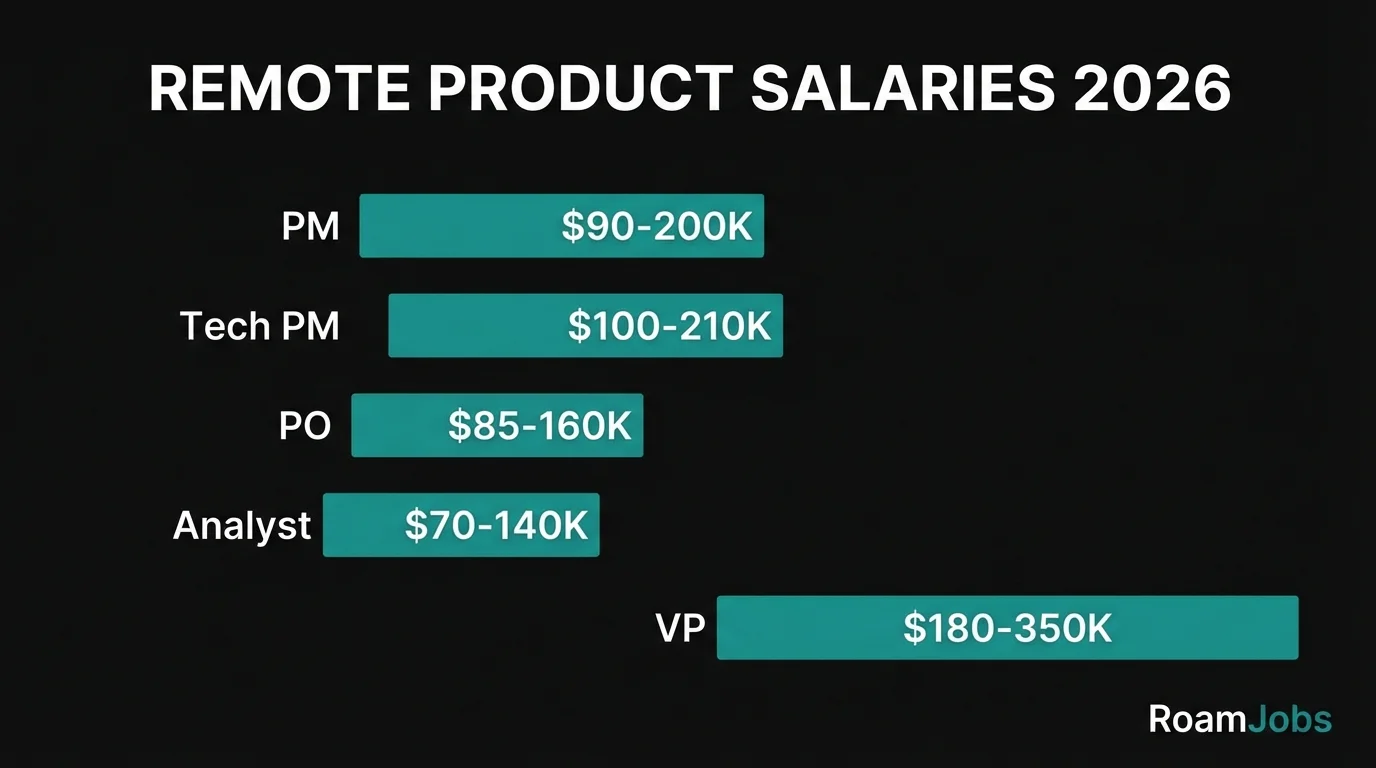
Remote product management is one of the most competitive and rewarding career paths in tech, with salaries ranging from $70K to $600K+ across five distinct specializations: Product Manager, Technical Product Manager, Product Owner, Product Analyst, and Product Leadership (VP/CPO). This comprehensive guide helps you navigate the product career landscape—whether you’re transitioning into product from engineering or design, choosing between PM and TPM paths, or advancing to product leadership. The key to success is demonstrating product sense, stakeholder management, and the ability to drive outcomes without direct authority—skills that translate exceptionally well to remote environments.
Which Product Role Is Right for You?
Choosing the right product specialization depends on your background, interests, and career goals. Use this framework to identify your ideal path.
Decision Framework
Do you have a technical background and enjoy deep technical discussions?
If you’re an engineer transitioning to product or want to work on highly technical products (APIs, infrastructure, developer tools), consider Technical Product Manager. TPMs work closely with engineering teams on complex technical decisions and often have coding experience or CS degrees.
Do you want to own product strategy and work broadly across functions?
If you enjoy strategy, user research, and working across design, engineering, and business teams, Product Manager is the classic path. PMs own the “what” and “why” of products, balancing user needs with business goals.
Do you prefer working in agile teams with a focus on execution?
If you thrive in sprint-based environments and enjoy the day-to-day of backlog management and agile ceremonies, Product Owner might suit you. POs focus more on tactical execution than strategic vision.
Do you love working with data and providing insights to inform decisions?
If you’re analytically minded and enjoy uncovering insights from data, Product Analyst combines product thinking with data analysis. This role informs product decisions through metrics and experimentation.
Are you ready to lead product teams and shape company strategy?
If you have 8+ years of product experience and want to lead PMs, own product vision, and influence company direction, Product Leadership (VP, CPO) is your path.
Quick Role Comparison
Product Roles at a Glance
Source: RoamJobs 2026 Remote Salary Report| Role | US Salary (Senior) | Technical Depth | Strategy Focus | Entry Barrier |
|---|---|---|---|---|
| Product Manager | $165K-$230K | Medium | Very High | Medium-High |
| Technical PM | $180K-$250K | Very High | High | High |
| Product Owner | $140K-$190K | Medium | Medium | Medium |
| Product Analyst | $130K-$175K | Medium-High | Medium | Medium |
| VP/CPO | $340K-$600K+ | Medium | Very High | Very High |
Data compiled from RoamJobs 2026 Remote Salary Report. Last verified January 2026.
Comprehensive Salary Comparison: All Product Roles
Understanding compensation across product specializations helps you make informed career decisions. These figures represent remote positions with US-based companies.
Product Salary by Experience & Location
| Level | 🇺🇸 US Remote | 🇪🇺 EU Remote | 🌎 LATAM | 🌏 Asia |
|---|---|---|---|---|
| Entry Level (0-2 yrs) | $75,000 - $115,000 | $50,000 - $78,000 | $30,000 - $58,000 | $25,000 - $48,000 |
| Mid-Level (2-5 yrs) | $110,000 - $170,000 | $75,000 - $115,000 | $50,000 - $85,000 | $42,000 - $72,000 |
| Senior (5-8 yrs) | $150,000 - $250,000 | $105,000 - $175,000 | $78,000 - $135,000 | $65,000 - $120,000 |
| Director/VP (8+ yrs) | $220,000 - $600,000 | $155,000 - $420,000 | $115,000 - $340,000 | $100,000 - $305,000 |
* Salaries represent base compensation for remote positions. Actual compensation may vary based on company, experience, and specific location within region.
Salary Trends by Specialization
Highest-paying product specializations:
- Product Leadership (VP/CPO) - Executive-level compensation including significant equity
- Technical Product Manager - Premium for technical depth, especially in infrastructure and developer tools
- Product Manager - Core PM roles at top tech companies offer excellent compensation
- Product Owner - Slightly lower than PM but strong compensation in enterprise
Fastest-growing compensation:
- Technical PM - 12% YoY salary growth as companies build more technical products
- Product Leadership - Growing demand for remote product executives
- Product Analyst - 10% YoY growth as data-driven product decisions become standard
Remote compensation considerations:
- Product roles are among the most likely to offer location-agnostic compensation
- Senior+ PMs often negotiate for equal pay regardless of location
- Technical PMs at developer tools companies see highest rates of equal pay
Cross-Cutting Skills for All Remote Product Managers
Regardless of your specialization, certain skills separate successful remote PMs from those who struggle with distributed work.
Product Skills Every Remote PM Needs
Async communication mastery
- Writing clear PRDs and specs that stand alone
- Creating compelling presentations for async review
- Managing stakeholders across time zones
- Running effective remote workshops
Data-driven decision making
- Defining and tracking product metrics
- Running A/B tests and experiments
- SQL and basic data analysis
- Building dashboards for visibility
Cross-functional leadership
- Influencing without direct authority
- Building relationships remotely
- Aligning engineering, design, and business
- Managing up and sideways
Strategic thinking
- Market and competitive analysis
- User research synthesis
- Roadmap prioritization frameworks
- Business case development
Soft Skills That Make Remote PMs Successful
Written communication excellence
- PRDs that engineers can implement without questions
- Stakeholder updates that drive alignment
- Slack communication that’s clear and concise
- Documentation that scales knowledge
Proactive visibility
- Sharing wins and learnings broadly
- Regular status updates without micromanagement
- Building trust through transparency
- Advocating for your team’s work
Remote facilitation
- Running effective remote planning sessions
- Facilitating async decision-making
- Creating inclusive remote team dynamics
- Time zone-aware scheduling
Self-management
- Prioritizing ruthlessly
- Managing energy, not just time
- Staying connected to users remotely
- Maintaining work-life boundaries
Top Companies Hiring Remote Product Managers
These companies actively hire remote PMs across multiple specializations. Research each company’s product culture before applying.
Fully Remote / Remote-First Product Teams
GitLab - Fully remote with exceptional product documentation. Strong PM culture with clear decision frameworks. Technical products requiring deep understanding.
Automattic (WordPress, WooCommerce) - 1,900+ distributed employees. PMs work on products serving millions. Strong async culture.
Zapier - Workflow automation with complex product challenges. Strong data-driven PM culture.
Buffer - Known for transparent culture. Small product team with high impact opportunities.
Deel - Global payroll and compliance platform. Fast-growing product team hiring remote PMs.
Remote.com - HR platform for distributed teams. PM team building products for remote work.
Remote-First Tech Giants
Shopify - “Digital by default” e-commerce platform. Large PM organization with various specializations.
Stripe - Financial infrastructure with remote PM opportunities. Technical products with high bar.
Coinbase - Cryptocurrency exchange with remote-first PM team. Fast-paced product environment.
Atlassian - “Team Anywhere” policy. PMs work on collaboration tools used by millions.
HubSpot - CRM platform with @flex work arrangements. Strong PM mentorship culture.
Companies with Strong Remote PM Teams
Notion - Productivity workspace with design-led product culture. Remote PM opportunities.
Linear - Issue tracking with exceptional product quality. Small but impactful PM team.
Figma - Design tools company hiring remote PMs. Dog-fooding their collaboration products.
Webflow - Visual web development. PMs work on complex no-code/low-code products.
Vercel - Frontend cloud platform. Technical PM opportunities working with developers.
Breaking Into Product Management Remotely
Product management is notoriously difficult to break into. Here are proven paths for remote PM roles.
Common Entry Paths
From Engineering:
- Leverage technical credibility
- Start with technical PM or growth PM roles
- Transition internally if possible
- Build product thinking through side projects
From Design:
- Leverage user empathy and research skills
- Focus on user-facing product roles
- Demonstrate strategic thinking in portfolio
- Partner with PMs on current projects
From Business/Analytics:
- Leverage data and business acumen
- Start with Product Analyst or Growth PM
- Demonstrate product thinking in current role
- Build technical literacy
From Customer-Facing Roles:
- Leverage customer empathy
- Document product insights from customers
- Transition through internal programs
- Focus on B2B PM opportunities
Building PM Experience Without PM Title
Internal transitions:
- Take on PM-adjacent responsibilities
- Lead cross-functional initiatives
- Document product impact of your work
- Build relationships with PMs
Side projects:
- Build and launch your own products
- Document decisions and outcomes
- Show metrics and learning
- Demonstrate product sense
PM programs and bootcamps:
- Product Management Certificate programs
- Company APM/RPM programs
- Product School, Reforge, etc.
- Network with program alumni
Remote Product Job Search Checklist
Remote Product Career Launch
- 1 Choose your specialization based on background and interests
Use the decision framework above to identify your ideal path
- 2 Build a product portfolio or case studies
Document product work, even from non-PM roles
- 3 Learn SQL and basic data analysis
Data skills are expected for all PM roles
- 4 Master async communication and documentation
Write PRDs, create presentations, practice clear writing
- 5 Understand PM interview formats thoroughly
Product sense, execution, analytical, and behavioral questions
- 6 Practice case study interviews extensively
Favorite product, metrics, prioritization, estimation questions
- 7 Update LinkedIn with product-focused keywords
Highlight product impact from any role
- 8 Join PM communities for networking
Lenny's Newsletter, Product Hunt, local PM groups
- 9 Create a target company list of 20-30 remote-friendly employers
Research their product culture, org structure, and interview process
- 10 Apply to 5-10 targeted positions per week
Customize your resume and cover letter for each role
Explore Each Product Specialization
Dive deep into the specific role that matches your career goals. Each guide includes detailed salary breakdowns by seniority, interview questions, and career paths.
Product Manager
Own product strategy, roadmap, and execution. The classic PM path for generalists.
Technical Product Manager
Lead technical products requiring deep engineering collaboration. Ideal for engineers.
Product Owner
Drive agile execution, backlog management, and sprint delivery.
Product Analyst
Inform product decisions through data analysis and experimentation.
VP of Product / CPO
Lead product organizations and shape company product vision.
Frequently Asked Questions
Frequently Asked Questions
How do I break into product management with no PM experience?
Breaking into PM requires demonstrating product thinking without the title. Key strategies: (1) Take on PM-adjacent responsibilities in your current role—lead cross-functional projects, write specs, analyze metrics, (2) Build side projects and document your product decisions, (3) Transition internally if possible—it's easier than external hiring, (4) Apply to Associate PM (APM) or Rotational PM programs at larger companies, (5) Target PM roles in your domain expertise (e.g., engineer → technical PM, marketer → growth PM). The path typically takes 6-18 months of intentional preparation.
What's the difference between Product Manager and Product Owner?
Product Manager and Product Owner have significant overlap but different emphases. PMs own product strategy, vision, and roadmap—they focus on 'what' to build and 'why.' They work across the organization and often own P&L or key metrics. Product Owners are more execution-focused, managing the backlog, writing user stories, and working closely with scrum teams on delivery. POs focus on 'how' work gets done within sprints. In some organizations, one person does both; in others, they're distinct roles. PMs typically have higher compensation and more strategic responsibility.
Do I need a technical background to be a PM?
No, but technical literacy is increasingly important. For Technical PM roles, engineering experience is typically required. For general PM roles, you should be able to: understand technical constraints and trade-offs, read and write basic SQL, communicate effectively with engineers, understand architecture at a high level. Many successful PMs come from non-technical backgrounds (design, business, consulting) but invest in building technical fluency. The key is respecting engineering and being able to have productive technical discussions, not being able to code yourself.
How do remote PM interviews differ from on-site?
Remote PM interviews are conducted via video and typically include: (1) Product sense cases ('How would you improve X product?'), (2) Execution/prioritization cases ('How would you prioritize this backlog?'), (3) Analytical cases ('What metrics would you track?', estimation questions), (4) Behavioral interviews ('Tell me about a time...'), (5) Cross-functional interviews with engineering and design. Remote interviews place extra emphasis on communication clarity—how you structure your thinking, write in chat, and present virtually. Practice presenting cases on video before interviews.
Is Product Manager or Technical PM better for career growth?
Both paths lead to product leadership, but through different routes. PM path: broader scope, more cross-functional, leads to general product leadership. Best for those who enjoy strategy and user problems over technical details. TPM path: deeper technical scope, closer to engineering, leads to technical product leadership (often at infrastructure, platform, or developer tools companies). Best for those with engineering background who want to stay technical. Neither is objectively 'better'—it depends on your background, interests, and target companies. The best PMs often have experience in both.
How competitive are remote PM roles?
Remote PM roles are among the most competitive in tech. Popular postings receive 300-500+ applications. To stand out: (1) Have relevant domain expertise or transferable experience, (2) Demonstrate product thinking through case studies or side projects, (3) Customize every application with company-specific insights, (4) Get referrals whenever possible—referrals have 5-10x higher interview rates, (5) Target less obvious companies (not just FAANG), (6) Consider adjacent roles (Product Analyst, APM) as entry points. The interview process is rigorous—expect 5-7 rounds over 4-8 weeks.
What skills should I develop to become a better remote PM?
Remote PMs need skills beyond traditional PM competencies: (1) Written communication—PRDs, specs, and updates must stand alone without real-time explanation, (2) Async decision-making—driving alignment without synchronous meetings, (3) Remote facilitation—running effective workshops and planning sessions virtually, (4) Self-management—staying productive and prioritized without office structure, (5) Visibility—proactively sharing context and building relationships across time zones, (6) Documentation—creating scalable knowledge that enables distributed teams. Practice these skills in your current role before transitioning to PM.
Should I get a PM certification or MBA for remote PM roles?
Neither is required, but they can help in certain situations. PM certifications (Product School, Pragmatic Institute, etc.) are most useful for career changers who need structured learning and networking. They don't carry as much weight with experienced hiring managers. MBAs are valuable for: transitioning from non-tech to tech PM roles, targeting consulting-to-PM paths, aiming for strategy-heavy or leadership roles. For most remote PM roles, demonstrated product experience and interview performance matter far more than credentials. Invest in building a portfolio of product work rather than collecting certifications.
Start Your Remote Product Journey
The remote product management market offers exceptional opportunities for those who can demonstrate product sense, stakeholder management, and the ability to drive outcomes in distributed environments. Whether you’re drawn to strategy-heavy PM roles, technical TPM positions, or executive leadership, there’s a remote path waiting for you.
Next steps:
- Choose your path - Review the role comparison above and select your target specialization
- Dive deep - Read the detailed guide for your chosen role (linked above)
- Build your portfolio - Document product thinking through case studies or projects
- Master PM interviews - Practice product sense, execution, and analytical cases
- Apply strategically - Target companies aligned with your experience and goals
Remote product management isn’t just about working from anywhere—it’s about driving product outcomes for global users, influencing company direction, and building a career that combines strategy with execution.
Get the Remote Product Career Guide
Weekly curated remote PM jobs, interview tips, and career advice delivered to your inbox.
Frequently Asked Questions
How do I find remote product jobs?
To find remote product jobs, start with specialized job boards like We Work Remotely, Remote OK, and FlexJobs that focus on remote positions. Set up job alerts with keywords like "remote product" and filter by fully remote positions. Network on LinkedIn by following remote-friendly companies and engaging with hiring managers. Many product roles are posted on company career pages directly, so identify target companies known for remote work and check their openings regularly.
What skills do I need for remote product positions?
Remote product positions typically require the same technical skills as on-site roles, plus strong remote work competencies. Essential remote skills include excellent written communication, self-motivation, time management, and proficiency with collaboration tools like Slack, Zoom, and project management software. Demonstrating previous remote work experience or the ability to work independently is highly valued by employers hiring for remote product roles.
What salary can I expect as a remote product?
Remote product salaries vary based on experience level, company size, location-based pay policies, and the specific tech stack or skills required. US-based remote positions typically pay market rates regardless of where you live, while some companies adjust pay based on your location's cost of living. Entry-level positions start lower, while senior roles can command premium salaries. Check our salary guides for specific ranges by experience level and geography.
Are remote product jobs entry-level friendly?
Some remote product jobs are entry-level friendly, though competition can be high. Focus on building a strong portfolio or demonstrable skills, contributing to open source projects if applicable, and gaining any relevant experience through internships, freelance work, or personal projects. Some companies specifically hire remote junior talent and provide mentorship programs. Smaller startups and agencies may be more open to entry-level remote hires than large corporations.
Continue Reading
Remote Jobs for Product Managers 2026: Land Your Next PM Role
Guide to finding remote product management positions, from resume tips to case study interviews.
Remote Product Manager Jobs: Complete 2026 Career Guide
Everything you need to land a remote product manager job. Strategy, roadmapping, stakeholder management - salary data, interview questions, and companies hiring.
Remote VP of Product & CPO Jobs: Complete 2026 Career Guide
Everything you need to land a remote product leadership job. Strategy, team building, executive communication - salary data, interview questions, and companies hiring.
Land Your Remote Job Faster
Get the latest remote job strategies, salary data, and insider tips delivered to your inbox.