Remote Product Manager Jobs: Complete 2026 Career Guide
Everything you need to land a remote product manager job. Strategy, roadmapping, stakeholder management - salary data, interview questions, and companies hiring.
Updated January 20, 2026 • Verified current for 2026
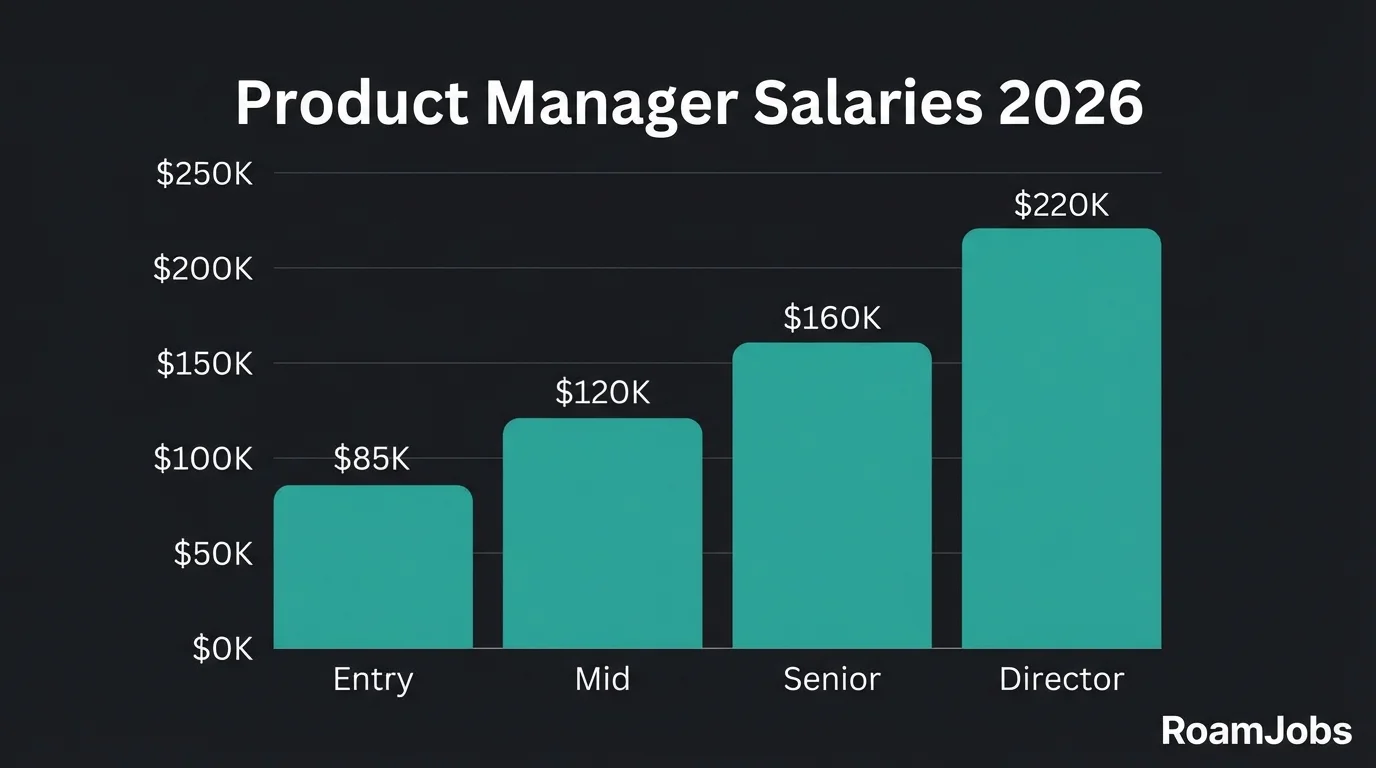
Remote Product Managers own the “what” and “why” of products, driving strategy, roadmap prioritization, and cross-functional execution from anywhere in the world. In 2026, remote PM salaries range from $85,000 to $320,000+ for US-based positions, with compensation varying significantly by seniority, company stage, and product complexity. The role requires a unique combination of strategic thinking, customer empathy, data fluency, and stakeholder management—skills that translate exceptionally well to distributed environments where written communication and async decision-making are paramount. Remote PMs succeed by turning ambiguity into clarity through well-crafted PRDs, ruthless prioritization, and the ability to influence without direct authority across time zones. Whether you’re transitioning from engineering, design, or business roles, or advancing from Associate PM to Director, this guide covers everything you need to land and excel in remote product management.
What Remote Product Managers Actually Do
Product management is often called the “CEO of the product,” but that title can be misleading. PMs don’t have direct authority over anyone—they influence outcomes through clarity of vision, compelling communication, and relentless prioritization. In remote settings, these skills become even more critical as you navigate distributed teams, async workflows, and stakeholders across time zones.
Day-to-Day Responsibilities
Product Strategy and Vision
Remote PMs own the strategic direction of their product or feature area. This means deeply understanding customer problems, market dynamics, and business objectives to define what the product should become. You’ll spend significant time synthesizing user research, analyzing competitive landscapes, and translating company strategy into product direction. In remote environments, this strategic thinking must be documented clearly—your strategy deck and product vision documents become the primary vehicles for alignment when you can’t gather everyone in a room.
Roadmap Planning and Prioritization
The roadmap is your communication tool with the entire organization. Remote PMs build and maintain roadmaps that balance customer needs, business goals, technical constraints, and team capacity. You’ll use frameworks like RICE (Reach, Impact, Confidence, Effort), ICE (Impact, Confidence, Ease), or custom scoring models to prioritize ruthlessly. The remote context requires roadmaps that are self-explanatory—stakeholders should understand your priorities and reasoning without needing a meeting to explain them.
Product Requirements and Specifications
Writing PRDs (Product Requirements Documents), user stories, and specifications is core PM work that becomes even more important remotely. Your written artifacts must be clear enough that engineers in different time zones can implement features without real-time clarification. Great remote PMs obsess over documentation quality—they write PRDs that anticipate questions, include edge cases, and provide enough context for autonomous work.
Stakeholder Management
PMs work across engineering, design, marketing, sales, customer success, and executive teams. Remotely, this cross-functional coordination requires intentional communication: regular status updates, clear decision documentation, and proactive relationship building. You’ll run virtual planning sessions, facilitate async decision-making, and ensure alignment without the benefit of hallway conversations.
User Research and Customer Empathy
Understanding customers drives every product decision. Remote PMs conduct user interviews via video, analyze usage data, synthesize support tickets, and maintain close relationships with customer-facing teams. The remote context actually enables broader research—you can interview customers anywhere without travel, and digital tools make user research more scalable.
Data Analysis and Metrics
Modern PMs are expected to be data-fluent. You’ll define success metrics, build dashboards, analyze experiment results, and use data to inform prioritization. SQL proficiency is increasingly expected, along with familiarity with analytics tools like Amplitude, Mixpanel, or Heap. Remote work amplifies the importance of shared dashboards and self-serve data access.
PM vs Technical PM vs Product Owner
Understanding role distinctions helps you target the right opportunities:
Product Manager focuses on product strategy, user problems, and business outcomes. PMs typically have broader scope than Product Owners and more business focus than Technical PMs. They work across all functions and own the “what” and “why” of the product. Technical depth varies—some PMs have engineering backgrounds while others come from design, business, or non-technical paths.
Technical Product Manager (TPM) specializes in highly technical products: APIs, infrastructure, developer tools, data platforms. TPMs often have engineering backgrounds and work closely with engineering teams on technical architecture decisions. They translate complex technical concepts for business stakeholders and vice versa. TPM salaries typically run 10-20% higher than general PM roles.
Product Owner (PO) is more execution-focused, particularly in agile/scrum environments. POs manage the backlog, write user stories, and work closely with development teams on sprint delivery. They focus on “how” work gets done within sprints. In some organizations, PM and PO are the same person; in others, POs report to PMs and handle tactical execution while PMs focus on strategy.
Why PM Skills Translate Well to Remote
Product management competencies align remarkably well with remote work requirements:
Written communication is already essential for PRDs, specs, and stakeholder updates. Remote work simply amplifies this existing strength.
Async decision-making mirrors how PMs already drive alignment—through documented proposals, structured feedback processes, and clear decisions with rationale.
Self-direction is inherent to PM work. PMs define their own priorities and don’t wait to be told what to do—exactly the mindset required for remote success.
Cross-functional influence transfers directly. If you can align distributed functions in person, you can do it remotely with the right practices.
Customer empathy often improves remotely. Digital research tools and video interviews enable broader customer access than in-person methods.
Seniority Levels and Compensation
Understanding the PM career ladder helps you target appropriate opportunities and plan your progression. Each level brings expanded scope, increased complexity, and higher compensation.
Entry Level / Junior Product Manager
0-2 years experience
Breaking Into Product Management
Entry-level PM roles—often titled Associate Product Manager (APM), Junior PM, or Product Analyst—are highly competitive. These positions are designed for candidates transitioning into product from adjacent roles or recent graduates from top programs. Most companies hiring APMs look for demonstrated product thinking, even without formal PM experience.
Key Skills to Develop
- Product fundamentals: Understanding product discovery, prioritization frameworks, and the product development lifecycle
- User research basics: Conducting user interviews, synthesizing feedback, and developing customer empathy
- Written communication: Writing clear user stories, specs, and status updates
- Data literacy: Basic SQL, understanding metrics, and interpreting analytics
- Stakeholder communication: Presenting to cross-functional teams and receiving feedback constructively
What Companies Expect
- Demonstrated product thinking through case studies, side projects, or current role
- Strong analytical and problem-solving abilities
- Excellent written and verbal communication
- Curiosity about users and willingness to engage with customer problems
- Growth mindset and coachability
Typical Scope
Entry-level PMs typically own a single feature area or work as part of a larger product team learning the craft. You might own a specific user flow, manage smaller experiments, or support a senior PM on a larger product. The focus is learning—absorbing product practices, building relationships, and developing judgment through guided experience.
Compensation Breakdown (US Remote)
Base salaries range $85,000-$115,000, with total compensation reaching $95,000-$135,000 at well-funded companies including bonuses and equity. APM programs at top companies (Google, Meta, Uber) offer higher compensation but are extremely competitive. Geographic adjustments vary—some remote-first companies pay location-agnostic rates while others adjust 15-25% for lower cost-of-living areas.
Breaking In Without PM Experience
The hardest part of the PM career is getting that first role. Proven paths include:
- Internal transitions: Moving from engineering, design, or customer-facing roles within your current company
- APM/RPM programs: Structured programs at larger companies designed for career changers and new grads
- Startup opportunities: Early-stage companies often hire first PMs from non-traditional backgrounds
- Domain expertise: Leveraging deep industry knowledge to land PM roles in that vertical
Mid-Level Product Manager
2-5 years experience
Developing Product Leadership
With 2-5 years of PM experience, you’ve moved beyond learning fundamentals to owning meaningful product scope independently. Mid-level PMs drive features from conception to launch, manage stakeholder relationships, and begin developing product strategy skills.
Key Skills at This Level
- Feature ownership: End-to-end ownership of significant features from discovery through delivery and iteration
- Roadmap development: Building and defending roadmaps with clear prioritization rationale
- Metrics and experimentation: Defining success metrics, designing experiments, and making data-driven decisions
- Cross-functional leadership: Effectively partnering with engineering and design leads
- Remote-specific practices: Mastering async communication, distributed team collaboration, and written decision-making
What Companies Expect
- Track record of shipping features that drove measurable outcomes
- Ability to work independently with limited guidance
- Strong relationships with engineering and design partners
- Growing strategic thinking about product direction
- Proven ability to prioritize effectively and say no to good ideas
Typical Scope
Mid-level PMs own a product area or significant feature set, typically working with a dedicated squad of engineers and designers. You might own user onboarding, a specific product surface, or a key integration. The work involves significant discovery, stakeholder management, and end-to-end delivery responsibility.
Compensation Breakdown (US Remote)
Base salaries reach $125,000-$170,000, with total compensation of $145,000-$220,000 at competitive companies. Equity becomes more significant at this level—expect 0.05-0.15% at startups or meaningful RSU grants at public companies. Annual bonuses of 10-15% are common. Top-tier companies (Stripe, Airbnb, established unicorns) pay at the higher end of these ranges.
Career Development Focus
Mid-level is where you decide whether to specialize (Technical PM, Growth PM, Platform PM) or pursue generalist advancement. Focus on building a track record of measurable impact, developing strategic thinking, and expanding your cross-functional influence. Many PMs at this level pursue formal product education (Reforge, product management certifications) to accelerate growth.
Senior Product Manager
5-8 years experience
Strategic Product Leadership
Senior PMs operate with high autonomy, driving product strategy for significant product areas. You’re expected to identify opportunities proactively, influence company direction, and mentor junior PMs. The role shifts from executing product work to shaping product direction.
Key Skills at This Level
- Product strategy: Developing and articulating product vision that aligns with company strategy
- Complex stakeholder management: Navigating executive stakeholders, cross-functional leadership, and conflicting priorities
- Team leadership: Mentoring junior PMs, leading product pods, and developing others
- Organizational influence: Driving alignment across multiple teams and functions
- Executive communication: Presenting to leadership, managing up, and influencing company direction
What Companies Expect
- Demonstrated ability to drive significant business outcomes
- Track record of leading complex, ambiguous initiatives
- Strong relationships with engineering, design, and business leadership
- Strategic thinking that connects product decisions to company goals
- Ability to operate independently at the executive level
Typical Scope
Senior PMs own major product areas—an entire product line, a platform, or a critical business initiative. You might own 2-4 squads of engineers, work directly with company leadership, and have significant input into team composition and hiring. The work involves substantial strategy development, organizational influence, and long-term planning.
Compensation Breakdown (US Remote)
Base compensation reaches $165,000-$230,000, with total packages of $200,000-$320,000 at top companies. Equity stakes of 0.1-0.3% at startups or substantial RSU grants ($75,000-$150,000+ annually at public companies) become significant wealth-building components. Bonuses of 15-20% reflect strategic impact. Senior PMs at elite companies (Stripe, Figma, Databricks) see total compensation at the high end.
Path to Director
Senior PMs targeting Director roles focus on demonstrating organizational-level impact: building product strategy that influences company direction, developing other PMs, and driving cross-team initiatives. The transition requires shifting from individual product excellence to broader product leadership and people development.
Lead / Director Product
8+ years experience
Product Organization Leadership
Directors and Heads of Product lead product organizations, managing PM teams and owning product strategy for entire business units. At this level, success is measured through team outcomes—the products your PMs ship, the talent you develop, and the strategic direction you set.
Key Skills at This Level
- Product vision: Setting and communicating product vision across the organization
- People leadership: Building, developing, and retaining high-performing PM teams
- Executive partnership: Working with C-suite on company strategy and product direction
- Organizational design: Structuring product teams for optimal outcomes
- Business ownership: P&L accountability, revenue targets, and business metrics
What Companies Expect
- Track record building and leading successful product teams
- Experience shipping products that drove significant business outcomes
- Executive-level communication and influence skills
- Ability to attract and retain top PM talent
- Strategic thinking that shapes company direction
Typical Scope
Directors lead 3-6+ PMs, owning product strategy for major business areas. You might lead all consumer products, the platform team, or the entire product organization at a smaller company. The work involves significant people leadership, executive alignment, and organizational development alongside product strategy.
Compensation Breakdown (US Remote)
Base salaries range $215,000-$320,000, with total compensation reaching $300,000-$500,000+ at well-funded companies. Equity becomes a major compensation component—0.3-1.0% at startups or $150,000-$300,000+ in annual RSU grants at public companies. VP-level roles exceed these ranges significantly, with CPO/VP Product positions at growth companies offering $400,000-$600,000+ total compensation.
Remote Leadership Considerations
Leading distributed product teams requires additional intentionality: building PM culture remotely, ensuring team cohesion across time zones, and maintaining visibility into product work without micromanagement. The best remote product leaders create systems and documentation that enable scaled alignment.
Essential Skills and Tools
Remote product management requires mastering both strategic skills and tactical tools. Your effectiveness depends on how well you leverage these to drive outcomes across distributed teams.
Product Management Tools
Product Management Platforms
Source: RoamJobs 2026 PM Tool Analysis| Tool | Best For | Key Features | Limitations | Pricing |
|---|---|---|---|---|
| Productboard | Product discovery & roadmapping | Customer feedback integration, prioritization | Steeper learning curve | $20/maker/mo |
| Linear | Engineering-focused teams | Speed, clean UX, GitHub integration | Less PM-specific features | $8/user/mo |
| Jira | Enterprise and complex workflows | Highly customizable, extensive integrations | Can become bloated, complex | $7.75/user/mo |
| Notion | Documentation-heavy teams | Flexible, good for PRDs and specs | Not purpose-built for PM workflows | $8/user/mo |
| Asana | Cross-functional visibility | Multiple views, strong collaboration | Less engineering-focused | $10.99/user/mo |
| Coda | Custom workflows | Doc + database flexibility | Requires setup investment | $10/doc maker/mo |
Data compiled from RoamJobs 2026 PM Tool Analysis. Last verified January 2026.
Analytics and Data Tools
Product Analytics Platforms
Source: RoamJobs 2026 Analytics Review| Tool | Best For | Key Strength | Considerations | Pricing |
|---|---|---|---|---|
| Amplitude | Product-led growth | Behavioral analytics, cohort analysis | Requires data engineering setup | Starts free, scales to enterprise |
| Mixpanel | Event-based analytics | User journey tracking, experiments | Can get expensive at scale | Free tier, $25/mo+ |
| Heap | Auto-capture analytics | Retroactive analysis, low setup | Less control over event definitions | Custom pricing |
| Pendo | Product adoption | In-app guidance + analytics | Primarily for B2B SaaS | Custom pricing |
| FullStory | Session replay | Understanding user behavior visually | Privacy considerations | $199/mo+ |
| Looker/Mode | SQL-based analysis | Flexibility for custom analysis | Requires SQL proficiency | Enterprise pricing |
Data compiled from RoamJobs 2026 Analytics Review. Last verified January 2026.
Roadmapping and Prioritization Frameworks
RICE Framework
The most widely used prioritization framework. Score initiatives on Reach (how many users), Impact (how much value per user), Confidence (certainty of estimates), and Effort (team resources required). RICE = (Reach x Impact x Confidence) / Effort. Works well for comparing diverse initiatives with quantifiable metrics.
ICE Framework
Simpler than RICE, scoring on Impact, Confidence, and Ease. Better for early-stage teams or when Reach is similar across initiatives. ICE = Impact x Confidence x Ease. Faster to apply but less rigorous.
Kano Model
Categorizes features by user satisfaction: Must-haves (expected basics), Performance features (more is better), and Delighters (unexpected value). Useful for balancing roadmaps between necessary improvements and differentiating features.
Opportunity Scoring
Maps user importance against current satisfaction to identify opportunities. Features important to users but poorly served today represent the highest-opportunity areas. Particularly useful for mature products seeking differentiation.
Value vs Effort Matrix
Simple 2x2 mapping of value (business impact, user value) against effort (engineering time, complexity). Quick wins (high value, low effort) get prioritized. Strategic projects (high value, high effort) require deliberate investment. Avoid time sinks (low value, high effort).
User Research Methods for Remote PMs
Customer Interviews
Video interviews remain the gold standard for qualitative research. Remote PMs conduct interviews via Zoom, Google Meet, or specialized tools like UserTesting and Lookback. The remote context enables broader geographic reach—you can interview customers anywhere without travel costs.
Survey Research
Tools like Typeform, SurveyMonkey, and Sprig enable scaled quantitative research. Remote PMs use surveys for feature validation, satisfaction measurement, and persona development. In-product surveys (via Pendo, Appcues) capture feedback in context.
Usability Testing
Remote usability testing via UserTesting, Maze, or moderated video sessions reveals how users actually interact with your product. Screen sharing and think-aloud protocols work effectively over video.
Data Analysis
Quantitative research through product analytics complements qualitative methods. Remote PMs analyze usage patterns, funnel metrics, and A/B test results to understand user behavior at scale. SQL proficiency enables custom analysis beyond dashboard metrics.
Communication and Documentation
Written Communication Excellence
Remote PM success hinges on written clarity. Your PRDs, specs, and updates must stand alone without verbal explanation. Invest in writing skills:
- Use clear structure with headers, bullets, and summaries
- Anticipate questions and address them proactively
- Include visual aids (wireframes, diagrams, data) where helpful
- Write for your audience—technical depth for engineers, business context for stakeholders
- Document decisions with rationale, not just outcomes
Async Communication Practices
Master async workflows for remote effectiveness:
- Default to async for information sharing and feedback requests
- Use sync (meetings) only when real-time discussion adds value
- Set clear expectations for response times and urgency levels
- Create single sources of truth that reduce information hunting
- Record important meetings for async consumption
Companies Hiring Remote Product Managers
The remote PM job market spans from early-stage startups to established enterprises. Understanding where to look and what each company type offers helps focus your search effectively.
Remote-First Companies with Strong PM Cultures
GitLab operates fully remote with exceptional documentation culture. Their product management handbook is publicly available, demonstrating how they approach PM work at scale. PMs at GitLab own specific product stages and work closely with engineering counterparts. Strong async culture with location-agnostic compensation for most roles.
Automattic (WordPress, WooCommerce, Tumblr, Day One) pioneered distributed work with 1,900+ employees across 90+ countries. Product leads manage features used by millions. Text-based communication culture—interviews often include a text-based trial project. Annual in-person team meetups complement distributed collaboration.
Zapier built their product organization around remote principles. PMs work on workflow automation products with complex integration challenges. Known for work-life balance and clear documentation. Location-agnostic compensation for US roles.
Buffer exemplifies transparent remote culture, publishing salaries and decision-making processes publicly. Smaller PM team with high-impact opportunities. Strong values alignment in hiring.
Notion expanded remote work significantly and hires PMs for workspace, collaboration, and platform features. Fast-paced environment with startup energy despite significant scale. Strong design culture influences product thinking.
Linear represents remote-first product excellence—their issue tracking tool is built by distributed teams using their own product. Small but highly selective PM team. Exceptional product quality bar.
Figma maintains remote flexibility with PM roles across design tools and developer platform. Strong intersection of design and product thinking. Collaborative culture with emphasis on craft.
Enterprise Companies with Remote PM Programs
Shopify operates “digital by default” with PMs across commerce, payments, and merchant tools. Large product organization with clear career ladders. Location-based pay with broad geographic coverage.
Stripe maintains distributed teams with PM opportunities across payments, infrastructure, and financial products. Exceptionally high bar for product thinking and technical fluency. Competitive compensation with some regional restrictions.
Atlassian offers “Team Anywhere” flexibility for PM roles across Jira, Confluence, Trello, and newer products. Established PM practices with mentorship opportunities. Remote-friendly culture within larger enterprise context.
HubSpot provides @flex arrangements with PM positions across CRM, marketing, sales, and service products. Strong people-first culture with professional development emphasis.
Twilio maintains distributed product teams across communications APIs and customer engagement products. Customer-focused product culture with technical product opportunities.
Datadog hires remote PMs for monitoring, security, and infrastructure observability products. Technical PM opportunities with engineering partnership emphasis. Fast growth with strong product focus.
Startups Actively Hiring Remote PMs
Vercel (Next.js) hires PMs for developer experience and frontend cloud products. Strong technical culture with emphasis on developer tools. Remote-first with global team.
Supabase operates fully remote building their open-source Firebase alternative. Early-stage PM opportunities with significant product scope. Building in public culture.
Loom expanded remote PM hiring for video communication products. Product-led growth focus with strong user empathy requirements.
Miro hires distributed PMs for collaboration canvas products. International team with emphasis on visual collaboration. Growth-stage with increasing PM specialization.
Remote.com builds HR products for distributed teams—PMs work on products solving problems they experience firsthand. Mission-aligned remote work with global perspective.
B2B vs B2C PM Opportunities
B2B Product Management focuses on business customers with longer sales cycles, complex stakeholder relationships, and integration requirements. B2B PMs work closely with sales, customer success, and often interact directly with enterprise customers. Products often have higher revenue per customer but smaller user bases. B2B PM skills include understanding procurement processes, multi-stakeholder influence, and enterprise feature requirements.
B2C Product Management focuses on consumer users with shorter feedback loops, larger user bases, and data-driven experimentation. B2C PMs often work on growth, engagement, and monetization. Products succeed through user acquisition, retention, and viral growth. B2C PM skills include understanding consumer psychology, running experiments at scale, and optimizing funnels.
Many PMs develop expertise in one domain but skills transfer between B2B and B2C with deliberate effort.
Finding Unlisted PM Opportunities
Senior PM positions often never reach job boards. Develop proactive sourcing strategies:
Network Cultivation
- Connect with PMs at target companies on LinkedIn
- Join product management communities (Lenny’s Newsletter Slack, Product Hunt, local PM groups)
- Attend virtual product conferences and engage with speakers
- Maintain relationships with recruiters who specialize in product roles
Targeted Outreach
- Research company product challenges through their public roadmaps and user forums
- Reach out to product leaders with thoughtful observations about their product
- Engage with company blogs and product updates
- Contribute to discussions relevant to target companies
Recruiter Relationships For Director+ roles, build relationships with product-focused recruiters:
- Riviera Partners
- True Search
- Daversa Partners
- Executive recruiters specializing in product leadership
Interview Deep Dive
Remote PM interviews evaluate product sense, execution capability, analytical skills, and cultural fit through multiple rounds. Preparation for each interview type significantly impacts success.
Interview Process Overview
Typical remote PM interviews include:
- Recruiter Screen (30 min): Background, interest, salary expectations
- Hiring Manager Screen (45-60 min): Product experience, role fit, initial product thinking
- Product Sense Case (60 min): “How would you improve X product?” questions
- Execution/Prioritization Case (60 min): Roadmap scenarios, prioritization exercises
- Analytical Interview (45-60 min): Metrics definition, estimation, data interpretation
- Cross-functional Interviews (45-60 min each): Engineering and design partnership
- Leadership/Culture Fit (45-60 min): Behavioral questions, values alignment
Prepare specific examples for each type, emphasizing remote work context where relevant.
Product Sense Questions
What interviewers assess: Product intuition, user empathy, structured thinking, and ability to identify meaningful improvements.
Strong response framework:
- Clarify scope: Ask about target user (job seekers, recruiters, or both), geography, and constraints
- Understand current state: Describe the existing experience and its components
- Identify user pain points: Discuss 3-4 specific problems based on user personas
- Prioritize one focus area: Choose the highest-impact problem to solve
- Propose solutions: Describe 2-3 potential solutions for the chosen problem
- Define success metrics: How you’d measure improvement
- Consider tradeoffs: Discuss implementation challenges or risks
Example structure: “Before diving in, let me clarify—should I focus on the job seeker experience or recruiter side? [Assuming job seeker] I’ll think through this in three parts: understanding the current experience, identifying key pain points, and proposing improvements.
The current job search on LinkedIn involves… [describe]. The main user personas are active job seekers, passive candidates, and career changers, each with different needs.
Key pain points I’ve observed include: irrelevant job recommendations despite detailed profiles, difficulty understanding salary ranges before applying, and overwhelming volume of postings without quality signals…
Given limited resources, I’d focus on the relevance problem because it affects all users and directly impacts the core value proposition. Three potential solutions: improved matching algorithm incorporating application outcomes, more granular filter controls, and salary transparency requirements for postings.
I’d measure success through application completion rate, interview rate per application, and user satisfaction scores.”
What interviewers assess: Strategic thinking, competitive analysis, and ability to make decisions under pressure.
Strong response approach:
- Don’t panic or copy: Acknowledge the competitive move without reactive copying
- Assess the situation: Understand what they launched and how users are responding
- Evaluate your position: What are your unique strengths and differentiation?
- Consider user needs: Do your users actually want these features?
- Develop options: Build, buy, partner, or differentiate through other means
- Make a recommendation: Commit to a direction with reasoning
Key principles to demonstrate:
- Strategic patience—not every competitive move requires response
- User-centricity—what do your users actually need, not just what competitors offer
- Differentiation thinking—how can you win differently rather than play catch-up
- Resource awareness—tradeoffs between building AI features vs. investing elsewhere
What interviewers assess: User empathy, problem discovery, and ability to think from first principles.
Strong response framework:
- Explore the problem space: Who wastes food, why, and what are the consequences?
- Define target users: Specific personas (families, singles, health-conscious consumers)
- Identify root causes: Poor planning, over-buying, forgetting about food, confusion about expiration
- Propose solution concepts: Match solutions to root causes
- Choose one direction: Commit to most impactful approach
- Define MVP scope: Minimum viable version to test core hypothesis
- Discuss go-to-market: How would this product reach users?
Avoid common pitfalls:
- Don’t jump to solutions before understanding the problem
- Don’t design for “everyone”—be specific about target users
- Don’t propose a massive platform—focus on core value proposition
What interviewers assess: Prioritization thinking, stakeholder management, and business judgment.
Decision framework to demonstrate:
- Quantify the ask: What’s the actual engineering cost? What else could be built instead?
- Understand the customer: How strategic is this customer? What’s their revenue contribution?
- Assess broader applicability: Could this feature benefit other customers with modification?
- Evaluate alternatives: Can their need be met differently? Professional services? Workaround?
- Consider precedent: What message does building/not building send to other customers?
- Make a recommendation: Clear decision with reasoning and communication approach
Key principles:
- Single-customer features rarely make sense at scale
- Understanding the underlying need may reveal better solutions
- Sometimes the right answer is “no” with clear reasoning
- Relationship management matters even when declining requests
Execution and Prioritization Questions
What interviewers assess: Prioritization framework application and stakeholder management.
Strong response approach:
- Establish evaluation criteria: Impact, effort, strategic alignment, urgency, dependencies
- Gather information: Quantify impact where possible, estimate effort with engineering
- Apply a framework: RICE, ICE, or custom scoring appropriate to context
- Create transparency: Share methodology and scores with stakeholders
- Make the call: Select top priorities with clear reasoning
- Communicate decisions: Explain what’s included, what’s not, and why
Framework example using RICE: “I’d start by gathering impact estimates for each request—user reach, business value, and confidence level. Then I’d work with engineering to estimate effort. Scoring each feature on RICE would give us a quantitative baseline.
But prioritization isn’t purely mathematical. I’d also consider: strategic themes for the quarter, dependencies between features, stakeholder relationships, and team morale/learning opportunities.
After scoring, I’d share the analysis with stakeholders before finalizing. This creates transparency and surfaces disagreements early. The final roadmap would include our top choices, a ‘maybe’ category, and clear ‘not now’ items with reasoning.”
What interviewers assess: Execution skills, team partnership, and problem-solving under pressure.
Response structure:
- Understand root causes: Why is the team behind? Estimation issues? Scope creep? Technical debt? Personal issues?
- Assess immediate options: Cut scope, extend timeline, add resources, or combination
- Communicate proactively: Update stakeholders before they ask
- Make a recommendation: Clear proposal for path forward
- Prevent recurrence: What process improvements would help?
Key principles:
- Partner with engineering rather than blame
- Protect team from external pressure while addressing issues
- Transparency with stakeholders builds trust even when delivering bad news
- Learning orientation—every miss is an opportunity to improve
What interviewers assess: Understanding of product development lifecycle and cross-functional collaboration.
Comprehensive response covering:
- Discovery: User research, problem validation, competitive analysis
- Definition: PRD writing, success metrics, design partnership
- Design: Wireframes, prototypes, user testing
- Development: Sprint planning, daily engagement, decision support
- Quality: Testing, edge cases, beta programs
- Launch: Release strategy, rollout plan, monitoring
- Iteration: Measuring outcomes, gathering feedback, improving
Remote-specific additions:
- Async design reviews and feedback collection
- Documentation for cross-timezone handoffs
- Video recordings for launch communications
- Clear escalation paths for launch issues
What interviewers assess: Ability to manage up, negotiate scope, and maintain integrity.
Strong response approach:
- Understand the why: What’s driving the request? Customer commitment? Competitive pressure? Board deadline?
- Assess options: Can scope be reduced? Can resources be added? What are the tradeoffs?
- Present options honestly: “We could ship X by that date, but we’d need to cut Y and Z”
- Make a recommendation: Which option balances speed with quality and team sustainability?
- Commit or escalate: Either commit to a feasible plan or clearly explain why the request isn’t possible
Key principles:
- Don’t simply say no—present options and tradeoffs
- Protect team from unrealistic commitments
- Maintain credibility by being honest about what’s achievable
- Understand business context before pushing back
Analytical Questions
What interviewers assess: Metrics thinking, understanding of business models, and ability to define success.
Strong response framework:
- Identify user segments: Riders, drivers, and the platform
- Define success metrics for each segment:
- Riders: Completed rides, NPS, wait time, price satisfaction
- Drivers: Active drivers, earnings per hour, retention
- Platform: Gross bookings, take rate, geographic coverage
- Prioritize key metrics: Focus on 3-5 metrics that matter most
- Discuss leading vs. lagging indicators: Early signals vs. outcome metrics
- Address potential conflicts: When optimizing one metric hurts another
Example metrics framework: “I’d organize metrics around the three key stakeholders: riders, drivers, and the platform business.
For riders, I’d track: completed ride rate (conversion), average wait time (quality), and NPS (satisfaction). Leading indicators would include app opens and ride requests.
For drivers, I’d focus on: active driver count (supply), earnings per hour (value proposition), and driver retention (sustainability).
For the platform: gross bookings and take rate measure business health, while ride balance (matching supply/demand) indicates marketplace efficiency.
The north star metric might be completed rides per active user—it captures both acquisition and engagement. But I’d watch for conflicts: increasing take rate improves platform revenue but could hurt driver retention.”
What interviewers assess: Analytical thinking, hypothesis generation, and problem-solving approach.
Investigation framework:
- Segment the data: Where are signups coming from? Which user types?
- Check conversion funnel: Where are users dropping off before revenue?
- Assess traffic quality: Organic vs. paid? Geographic mix? Device mix?
- Evaluate product changes: Any recent launches that affected signup or revenue?
- Consider external factors: Competitor actions? Market events? Seasonality?
Structured hypothesis list:
- Traffic source changed (lower-quality signups from new channel)
- User mix shifted (more free-tier users, fewer paid converters)
- Pricing or paywall changes affecting conversion
- Product issue blocking conversion to paid
- Geographic expansion to lower-ARPU markets
- Bot or fraudulent signups inflating numbers
What interviewers assess: Structured estimation and quantitative reasoning.
Estimation approach:
- Establish total market size: US population (~330M), internet-connected adults (~250M)
- Estimate addressable market: Music listeners who could pay (~150M)
- Determine penetration rate: What percentage subscribe to paid music (~25-30%)
- Calculate subscriber base: ~40-50M active paid subscribers
- Estimate monthly churn/additions: ~2-3% churn = ~1-1.5M churned
- Add new subscribers: ~1-2M new subscriptions monthly
- Total monthly subscriptions sold: 2-3.5M
Key principles:
- Show your work clearly
- Make reasonable assumptions and state them
- Use round numbers for mental math
- Sanity check against known data points
- Express appropriate uncertainty
Behavioral Questions
What interviewers assess: Track record, ownership, and ability to drive outcomes.
STAR format with PM emphasis:
- Situation: Product context, user problem, business opportunity
- Task: Your specific role and responsibilities
- Action: What you did—research, decisions, stakeholder alignment, execution
- Result: Quantified outcomes, user impact, business results
Strong answers include:
- Clear ownership and decision-making
- Cross-functional collaboration
- Data-driven approach and iteration
- Measurable outcomes tied to business goals
- Honest assessment of what could have been better
What interviewers assess: Stakeholder management, communication, and backbone.
Strong response structure:
- Context: Who was the stakeholder and what did they want?
- Why no was the right answer: Business reasoning, prioritization tradeoffs
- How you communicated: Empathy, clarity, alternatives offered
- Relationship preservation: How you maintained the relationship
- Outcome: What happened and what you learned
Key principles to demonstrate:
- Saying no with data and reasoning, not just opinion
- Offering alternatives when possible
- Empathizing with stakeholder needs while protecting prioritization
- Maintaining relationship despite disagreement
- Following up appropriately
What interviewers assess: Decision-making under uncertainty and judgment.
Strong response includes:
- Context: What decision needed to be made and why data was limited
- Information gathering: What you did to reduce uncertainty
- Framework applied: How you structured the decision
- Risk mitigation: How you reduced downside if wrong
- Outcome and learning: What happened and what you’d do differently
Key principles:
- PMs often decide with imperfect information—waiting for perfect data means waiting forever
- Reversible decisions can be made faster; irreversible decisions need more care
- Reducing uncertainty through quick experiments is often better than analysis paralysis
- Documenting reasoning helps learn from outcomes
What interviewers assess: Engineering partnership and conflict resolution.
Strong response demonstrates:
- Respect for engineering expertise: Technical decisions belong to engineering
- Understanding your role: PMs own the “what,” engineering owns the “how”
- Productive disagreement approach: Seeking to understand before being understood
- Finding common ground: Shared goals and constraints
- Escalation when needed: Appropriate involvement of leadership
Example framework: “When I disagree with engineering, I start by assuming they know something I don’t. I’ll ask questions to understand their reasoning—often they’ve identified constraints or risks I hadn’t considered.
If I still disagree after understanding their perspective, I’ll share my concerns with data or user context they might not have. Usually we can find common ground.
For timeline disagreements specifically, I try to understand what’s driving the estimate. Sometimes the answer is scope reduction; sometimes it’s identifying risks we need to mitigate; sometimes it’s accepting the timeline and adjusting expectations.
The relationship matters more than any single decision. I’d rather lose an argument gracefully than damage the partnership.”
What interviewers assess: Self-awareness, learning orientation, and honesty.
Strong response structure:
- What failed: Be specific and take appropriate ownership
- Why it failed: Root cause analysis without excessive blame-shifting
- Your responsibility: What could you have done differently?
- What you learned: Specific, actionable insights
- How you’ve applied it: Evidence of growth from the failure
Key principles:
- Everyone has failures—the question is how you respond
- Take genuine ownership without excessive self-flagellation
- Show specific learning, not generic platitudes
- Demonstrate that you’ve applied the learning since
What interviewers assess: Remote collaboration skills and cross-functional partnership.
Strong response includes:
- Initial relationship building: How you establish connection with new team members
- Ongoing practices: Regular touchpoints, async collaboration, informal connection
- Trust building: Reliability, follow-through, respecting expertise
- Remote-specific adaptations: Video practices, documentation, time zone awareness
- Conflict resolution: How you handle disagreements remotely
Example practices to mention:
- 1:1s with key cross-functional partners (not just direct reports)
- Generous praise in public channels
- Clear documentation that respects their time
- Informal coffee chats or virtual social time
- Video-first for important conversations
- Following through on commitments reliably
What interviewers assess: Process thinking and remote-specific adaptations.
Strong response covers:
- Discovery phase: Research, problem definition, opportunity assessment
- Definition phase: PRD development, design collaboration, alignment
- Delivery phase: Sprint execution, daily collaboration, decision support
- Launch phase: Rollout, monitoring, iteration
- Remote adaptations: How each phase changes for distributed teams
Remote-specific practices:
- Async-first documentation with sync for alignment
- Written PRDs that don’t require meetings to understand
- Recorded demos for async review
- Clear decision documentation for future reference
- Time-zone-aware scheduling for essential sync moments
What interviewers assess: User empathy and remote research capabilities.
Strong response includes:
- Regular video customer interviews (weekly or bi-weekly cadence)
- Monitoring support tickets and customer feedback channels
- Joining customer success calls and sales demos
- Using in-product surveys and feedback tools
- Analyzing usage data and behavior patterns
- Community engagement (forums, social media, user groups)
- Building relationships with customer-facing teams for ongoing insights
What interviewers assess: Documentation skills and async communication.
Strong response covers:
- Self-sufficiency: PRDs should answer questions before they’re asked
- Clear structure: Consistent format that teams can navigate quickly
- Context inclusion: Business context, user problems, and constraints
- Visual support: Wireframes, diagrams, and examples where helpful
- Living documents: Process for updates and change communication
- Feedback mechanism: How to collect and incorporate input asynchronously
PRD best practices for remote:
- Executive summary at the top for quick scanning
- Clear success metrics and acceptance criteria
- Edge cases and error states documented
- Links to related research and design files
- Change log for version tracking
- Open questions section for async resolution
What interviewers assess: Remote facilitation skills and planning practices.
Strong response includes:
- Pre-work: Share context and expectations before the session
- Tool setup: Collaborative tools (Miro, FigJam, Notion) prepared in advance
- Facilitation approach: Equal participation, breakout rooms, time management
- Documentation: Real-time capture of decisions and action items
- Follow-up: Summary distribution and async feedback collection
- Time zone considerations: Recording sessions, rotating times, async alternatives
Planning session best practices:
- Send agenda and materials 24-48 hours in advance
- Use visual collaboration tools for interactive exercises
- Assign roles (facilitator, note-taker, timekeeper)
- Build in breaks for longer sessions
- Record sessions for those who can’t attend live
- Summarize decisions and next steps in writing afterward
Frequently Asked Questions
How do I find remote product manager jobs?
To find remote product manager jobs, start with specialized job boards like We Work Remotely, Remote OK, and FlexJobs that focus on remote positions. Set up job alerts with keywords like "remote product manager" and filter by fully remote positions. Network on LinkedIn by following remote-friendly companies and engaging with hiring managers. Many product manager roles are posted on company career pages directly, so identify target companies known for remote work and check their openings regularly.
What skills do I need for remote product manager positions?
Remote product manager positions typically require the same technical skills as on-site roles, plus strong remote work competencies. Essential remote skills include excellent written communication, self-motivation, time management, and proficiency with collaboration tools like Slack, Zoom, and project management software. Demonstrating previous remote work experience or the ability to work independently is highly valued by employers hiring for remote product manager roles.
What salary can I expect as a remote product manager?
Remote product manager salaries vary based on experience level, company size, location-based pay policies, and the specific tech stack or skills required. US-based remote positions typically pay market rates regardless of where you live, while some companies adjust pay based on your location's cost of living. Entry-level positions start lower, while senior roles can command premium salaries. Check our salary guides for specific ranges by experience level and geography.
Are remote product manager jobs entry-level friendly?
Some remote product manager jobs are entry-level friendly, though competition can be high. Focus on building a strong portfolio or demonstrable skills, contributing to open source projects if applicable, and gaining any relevant experience through internships, freelance work, or personal projects. Some companies specifically hire remote junior talent and provide mentorship programs. Smaller startups and agencies may be more open to entry-level remote hires than large corporations.
How do I break into product management without PM experience?
Breaking into PM requires demonstrating product thinking without the title. Start by taking on PM-adjacent responsibilities in your current role: lead cross- functional projects, write specs or requirements, analyze metrics, and partner closely with PMs. Build side projects and document your product decisions—this creates a portfolio demonstrating product sense. Target internal transitions when possible; it's significantly easier to move into PM at your current company than to be hired externally. Apply to Associate PM (APM) programs at larger companies designed for career changers. Consider PM roles in your domain of expertise—engineers often succeed in Technical PM roles, marketers in Growth PM, and domain experts in industry-specific products. The path typically takes 6-18 months of deliberate preparation, but persistence pays off.
What's the difference between Product Manager and Technical Product Manager?
Product Managers and Technical PMs share core competencies but differ in technical depth and product focus. General PMs work on user-facing products across industries, focusing on user problems, business outcomes, and cross-functional leadership. Technical depth varies—some PMs have engineering backgrounds while others come from design or business. Technical PMs specialize in highly technical products: APIs, infrastructure, developer tools, data platforms. They often have engineering backgrounds (though not always) and work closely with engineering teams on technical architecture decisions. TPMs translate complex technical concepts for business stakeholders and vice versa. Compensation for TPMs typically runs 10-20% higher than general PM roles, reflecting the specialized expertise. Choose based on your background and interests: TPM if you have technical depth and want to stay close to engineering; general PM if you prefer broader business context and user-facing products.
Do I need to know how to code to be a Product Manager?
You don't need to code, but you do need technical literacy. For Technical PM roles, engineering experience is typically required. For general PM roles, you should be able to: understand technical constraints and tradeoffs, communicate effectively with engineers, read and write basic SQL for data analysis, understand system architecture at a high level, and evaluate technical proposals. Many successful PMs come from non-technical backgrounds (design, business, consulting) but invest in building technical fluency. Resources like CS fundamentals courses, SQL tutorials, and technical book clubs help. The key is respecting engineering expertise while being able to have productive technical discussions—not being able to code production features yourself.
How competitive are remote PM roles?
Remote PM roles are among the most competitive in tech, with popular postings receiving 300-500+ applications. To stand out: (1) Have relevant domain expertise or transferable experience that makes your application distinctive, (2) Demonstrate product thinking through case studies, side projects, or documented work from your current role, (3) Customize every application with company-specific insights showing you've done your research, (4) Get referrals whenever possible—referrals have much higher interview rates than cold applications, (5) Target less obvious companies beyond FAANG—many excellent PM opportunities exist at mid-stage startups and growing companies, (6) Consider adjacent roles (Product Analyst, Associate PM) as entry points that lead to PM careers. The interview process typically spans 5-7 rounds over 4-8 weeks, requiring significant preparation investment.
What's the biggest challenge for remote Product Managers?
The biggest challenge is maintaining influence and alignment without casual in- person interactions. In offices, PMs build relationships through hallway conversations, lunch meetings, and impromptu whiteboard sessions. Remotely, every interaction requires intention. Successful remote PMs compensate through: exceptional written communication that creates clarity without meetings, deliberate relationship building through 1:1s with cross-functional partners, proactive visibility through regular updates and documentation, creating single sources of truth that reduce information hunting, and mastering async decision- making so alignment doesn't require synchronous time. The PMs who struggle remotely often relied on charisma and verbal communication rather than documentation and written clarity.
Should I specialize as a PM (Growth, Platform, B2B) or stay generalist?
Both paths can lead to PM leadership, but they offer different advantages. Generalist PMs develop broad experience across product types, making them versatile and valuable for smaller companies or leadership roles requiring diverse product oversight. They may advance to Head of Product roles where breadth matters. Specialized PMs develop deep expertise that commands premium compensation and enables tackling complex problems in their domain. Growth PMs understand acquisition and retention deeply; Platform PMs understand developer ecosystems; B2B PMs understand enterprise sales and complex stakeholder relationships. Specialization often makes sense mid-career (3-5 years) when you've developed foundational PM skills and discovered your interests. The market rewards both paths—choose based on your interests and target companies' needs.
How do remote PM interviews differ from on-site?
Remote PM interviews are conducted via video and evaluate the same competencies—product sense, execution, analytical thinking, and cultural fit—but with additional emphasis on communication clarity. Interviewers assess how you structure thinking, present cases, and communicate through a screen. Preparation differences: practice presenting product cases on video, ensure your setup (lighting, audio, background) is professional, prepare for async components some companies include (take-home exercises, written assessments). During interviews: use visual aids by sharing your screen when working through cases, take brief pauses to structure your thoughts before answering, and demonstrate the written communication skills that matter for remote work. The interview process may be slightly longer (5-7 rounds over 4-8 weeks) as companies conduct more rounds to compensate for not meeting in person.
What PM tools should I learn before applying to remote PM roles?
Focus on tool categories rather than specific products, as companies use different tools. Essential categories: (1) Project management—Jira, Linear, or Asana; learn at least one deeply, (2) Documentation—Notion, Confluence, or Coda; practice writing clear PRDs and specs, (3) Analytics—Amplitude, Mixpanel, or similar; understand event tracking and funnel analysis, (4) SQL—required at most companies for ad-hoc data analysis, (5) Prototyping—basic Figma skills help you communicate with designers and create quick wireframes, (6) Collaboration—Slack, Loom, and video tools for remote communication. Don't try to learn everything—depth in one tool per category beats superficial knowledge across many. Most companies expect PM candidates to learn their specific tooling on the job; they're hiring for product thinking, not tool expertise.
How do I negotiate salary for a remote PM role?
Remote PM salary negotiation follows similar principles to on-site roles with location-specific considerations. Research market rates using Levels.fyi, Glassdoor, and RoamJobs salary data—remote compensation varies significantly by company philosophy (location-based vs. location-agnostic). Understand the company's approach: some pay SF rates regardless of location, others adjust 10-30% based on cost-of-living. When you receive an offer, express enthusiasm while noting you'd like to discuss compensation. Present market data for comparable roles and articulate your value clearly. Consider total compensation including equity, bonus, and benefits—remote roles may offer additional perks like home office stipends, wellness benefits, or flexible PTO. If location-based pay applies, highlight that your location enables you to be more productive (no commute) and that market rates for remote talent increasingly reflect value delivered rather than location. Be prepared to negotiate on multiple dimensions: base, equity, signing bonus, and title.
Is it better to start as a PM at a startup or large company?
Both offer valuable but different learning experiences. Large companies provide: structured mentorship and PM programs, clear career ladders and promotion criteria, exposure to PM best practices at scale, brand recognition that aids future job searches, and collaboration with experienced PMs. The tradeoff is narrower scope and slower pace. Startups provide: broader responsibility and faster learning, direct customer access and visible impact, exposure to business- building beyond product, and faster progression if the company succeeds. The tradeoff is less mentorship, more chaos, and company risk. Consider your learning style: do you thrive with structure or autonomy? Your career stage: earlier career often benefits from large company training, while mid-career PMs may prefer startup impact. The best path depends on specific opportunities—a great startup with strong PM leadership may be better than a mediocre large company role.
How do I demonstrate PM skills in my current non-PM role?
You can build PM skills without the PM title by taking on PM-adjacent responsibilities. Document your product thinking: write up analyses of products you use, create mock PRDs for features at your company, develop business cases for initiatives. Take on cross-functional projects: volunteer to lead initiatives that span multiple teams, coordinate with different functions, and deliver outcomes. Get closer to customers: join customer calls in any capacity, analyze support tickets, synthesize user feedback. Develop data skills: learn SQL, build dashboards, analyze metrics relevant to your current role. Partner with existing PMs: offer to help with research, documentation, or analysis—build relationships while learning. Create tangible artifacts: a portfolio of product thinking (case studies, PRDs, analyses) matters more than verbal claims. The goal is creating demonstrable evidence of product skills that you can discuss in PM interviews.
How do remote PMs handle time zone differences with global teams?
Successful remote PMs develop time zone strategies that balance collaboration needs with sustainable schedules. Establish core overlap hours: identify 2-4 hours when most team members are available and protect this time for essential sync discussions. Default to async: most communication should be asynchronous; reserve sync time for alignment, complex decisions, and relationship building. Rotate meeting times: don't always burden the same timezone with inconvenient meeting times; rotate fairly across the team. Document extensively: write down decisions, context, and rationale so team members can catch up asynchronously. Use recorded video: Loom and similar tools enable rich communication without synchronous availability. Plan ahead: async workflows require more lead time—build buffer into schedules for timezone latency. Set clear expectations: establish norms for response times during and outside overlapping hours. The key is intentional design of communication patterns rather than forcing everyone into the same synchronous schedule.
Next Steps in Your Remote PM Journey
Landing a remote product manager role requires preparation across multiple dimensions: building PM skills, developing remote-specific capabilities, and positioning yourself effectively in the competitive job market.
If you’re breaking into PM:
- Take on PM-adjacent responsibilities in your current role
- Build a portfolio of product thinking through case studies and mock PRDs
- Learn SQL and develop data analysis capabilities
- Join PM communities and build relationships with practicing PMs
- Target internal transitions or Associate PM programs
If you’re an experienced PM seeking remote roles:
- Update your resume and LinkedIn to emphasize remote work experience
- Prepare specific examples demonstrating async collaboration and distributed team success
- Research target companies’ remote work philosophies and product cultures
- Practice product case interviews on video
- Build relationships with PM-focused recruiters
If you’re a senior PM targeting leadership roles:
- Develop thought leadership through writing or speaking
- Network with VP-level product leaders at target companies
- Articulate your product philosophy and leadership approach
- Prepare for organizational design and people leadership questions
- Consider whether fully remote or flexible arrangements fit your goals
The remote PM market continues to expand as companies recognize that great product leadership doesn’t require physical proximity. For PMs who develop strong written communication, async collaboration skills, and remote-specific practices, exceptional opportunities await—the ability to drive product strategy from anywhere while building products that impact users globally.
Related Resources
Explore these guides to continue developing your remote PM career:
- Remote Product Jobs: Overview of all product career paths including Technical PM, Product Owner, and leadership roles
- Remote Interview Guide: Comprehensive preparation for remote interview processes
- Negotiating Remote Salary: Strategies for maximizing your compensation package
Get Remote PM Career Insights
Weekly curated remote product management opportunities, interview tips, and career advice delivered to your inbox.
Continue Reading
Remote Product Jobs 2026: Complete Guide to PM, TPM & Leadership Careers
The definitive hub for remote product careers. Explore salary data, interview guides, and opportunities across product management, technical PM, product owner, and leadership roles.
Remote Technical Product Manager Jobs: Complete 2026 Career Guide
Everything you need to land a remote technical PM job. APIs, infrastructure, developer tools - salary data, interview questions, and companies hiring.
How to Ace Remote Job Interviews in 2026
Complete guide to preparing for and succeeding in remote job interviews, from technical setup to answering remote-specific questions.
Remote jobs worth opening, every Tuesday
A short weekly list of remote jobs picked for your field, with location limits called out when we can verify them.
Live intake · refreshed every 12 hours
Live openings: remote product manager
Sourced from publisher feeds, not direct employer postings. Links route through
/go/ with the same anti-fraud checks as our curated boards.