Remote Product Owner Jobs: Complete 2026 Career Guide
Everything you need to land a remote product owner job. Agile, backlog management, user stories - salary data, interview questions, and companies hiring.
Updated January 20, 2026 • Verified current for 2026
Remote Product Owners serve as the critical bridge between business stakeholders and development teams in agile environments, with salaries ranging from $75,000 to $250,000 for US-based remote positions in 2026. Unlike Product Managers who focus primarily on strategy and vision, Product Owners concentrate on tactical execution—managing the product backlog, writing user stories, defining acceptance criteria, and ensuring development teams have the clarity they need to deliver value sprint after sprint. In remote and distributed scrum teams, the PO role becomes even more essential because the asynchronous nature of remote work demands exceptionally clear documentation and communication. The most successful remote Product Owners excel at translating business requirements into actionable work items, facilitating agile ceremonies across time zones, and maintaining stakeholder alignment without the luxury of in-person conversations. Whether you’re transitioning from business analysis, project management, or looking to pivot from a Product Manager role, this guide covers everything you need to know about building a successful remote Product Owner career.
What Remote Product Owners Actually Do
The Product Owner role originated in the Scrum framework as the person responsible for maximizing the value of the product and the work of the Development Team. In remote settings, this responsibility takes on additional dimensions as POs must create clarity and alignment across distributed teams who cannot simply walk over to ask a quick question.
Day-to-Day Responsibilities
Product Backlog Management
The product backlog is the Product Owner’s primary artifact—a prioritized list of everything that might be needed in the product. Remote POs spend significant time grooming, refining, and organizing this backlog to ensure the development team always has a clear understanding of what to work on next. This includes:
- Writing and refining user stories with clear acceptance criteria
- Prioritizing items based on business value, dependencies, and team capacity
- Breaking down epics into manageable stories that fit within sprints
- Removing or deprioritizing items that no longer serve business objectives
- Ensuring stories are properly estimated and ready for sprint planning
In remote environments, backlog management becomes documentation-heavy. Every user story must be self-contained enough that a developer in any time zone can pick it up and understand exactly what’s needed without waiting for a synchronous conversation.
Sprint Planning and Ceremonies
Product Owners facilitate key agile ceremonies, ensuring the development team has what they need to succeed:
- Sprint Planning: Presenting the sprint goal and helping the team select backlog items for the upcoming sprint. Remote sprint planning requires exceptional preparation—stories must be thoroughly refined beforehand since real-time clarification is harder.
- Daily Standups: While POs don’t always attend every standup, they stay connected to team progress and blockers. In distributed teams, async standups via Slack or specialized tools often supplement synchronous meetings.
- Sprint Reviews/Demos: Presenting completed work to stakeholders and gathering feedback that feeds back into the backlog.
- Retrospectives: Participating in continuous improvement discussions about team processes and collaboration.
Stakeholder Management
Remote Product Owners spend substantial time communicating with stakeholders across the organization:
- Gathering requirements from business users and translating them into technical specifications
- Managing expectations about delivery timelines and scope
- Communicating progress and blockers to leadership
- Negotiating priorities when stakeholder requests conflict
- Building relationships virtually through regular check-ins and transparent communication
Acceptance and Validation
Before any feature goes live, the Product Owner validates that it meets the defined acceptance criteria:
- Reviewing completed stories against acceptance criteria
- Conducting or coordinating user acceptance testing (UAT)
- Making the final call on whether a story is “done”
- Providing feedback to developers when work needs refinement
- Ensuring quality standards are maintained across releases
Product Owner vs Product Manager: Understanding the Distinction
One of the most common points of confusion in product careers is the distinction between Product Owner and Product Manager. While some organizations use these titles interchangeably, they represent different focuses within the product discipline.
Product Manager Focus:
- Product vision and strategy
- Market research and competitive analysis
- Long-term roadmap planning (quarterly, annual)
- Business case development and ROI analysis
- Cross-functional leadership at the organizational level
- Pricing, positioning, and go-to-market strategy
Product Owner Focus:
- Sprint-level execution and delivery
- Backlog management and prioritization
- User story writing and acceptance criteria
- Working directly with development teams
- Day-to-day decision-making on implementation details
- Validating completed work against requirements
In many organizations—particularly larger enterprises—both roles exist, with Product Managers handling strategy and Product Owners handling execution. In smaller companies or startups, one person often wears both hats. The “Product Owner” title is most common in organizations using Scrum or other agile frameworks, while “Product Manager” tends to be more universal.
For remote work specifically, Product Owner roles can be more accessible for those breaking into product careers because they focus more on process execution and documentation—skills that translate well to distributed environments.
Remote Agile and Distributed Scrum Teams
Working as a Product Owner on a distributed team presents unique challenges and requires adapted practices:
Asynchronous Backlog Refinement
Traditional backlog refinement sessions where the team gathers to discuss stories don’t work when team members span multiple time zones. Remote POs develop practices like:
- Pre-recording story walkthroughs for async review
- Using collaborative documents where team members add questions and comments
- Maintaining detailed documentation that stands alone without verbal explanation
- Running multiple shorter refinement sessions to accommodate different time zones
Time Zone-Aware Ceremonies
Remote POs become experts at scheduling ceremonies that don’t consistently burden any one group:
- Rotating meeting times so different regions take turns with inconvenient hours
- Recording sessions for those who can’t attend live
- Using async tools for certain ceremonies (written retros, async standups)
- Creating clear documentation of all decisions made in meetings
Over-Documentation as a Feature
In remote environments, the Product Owner’s documentation standards must be higher than in co-located teams. Every user story needs:
- Clear business context explaining why this work matters
- Detailed acceptance criteria with testable scenarios
- Design references, mockups, or technical specifications as needed
- Edge cases and error handling requirements
- Links to related stories, dependencies, and background information
The goal is enabling any team member to work on any story without needing to ping the PO for clarification—because that ping might not be answered for 8+ hours.
Seniority Levels and Compensation
Product Owner career progression typically moves from supporting roles through increasing scope and complexity to leadership positions. Understanding each level helps you target appropriate opportunities and negotiate fair compensation.
Entry Level / Junior Product Owner
0-2 years experience
Breaking Into Product Ownership
Entry-level Product Owners typically come from adjacent roles where they’ve developed relevant skills: business analysts who’ve worked with agile teams, project managers transitioning to product, QA engineers who understand the development process intimately, or professionals from customer-facing roles who deeply understand user needs.
Key Skills to Develop
- User story writing: Learning to write stories that are independent, negotiable, valuable, estimable, small, and testable (INVEST criteria)
- Acceptance criteria definition: Creating clear, testable criteria that developers can implement without ambiguity
- Backlog prioritization basics: Understanding frameworks like MoSCoW, value vs. effort matrices, and WSJF (Weighted Shortest Job First)
- Agile fundamentals: Deep understanding of Scrum, Kanban, and agile principles beyond surface-level certification knowledge
- Stakeholder communication: Translating between technical and business language effectively
- Remote collaboration tools: Proficiency with Jira, Azure DevOps, Confluence, and video conferencing platforms
What Companies Expect
- Familiarity with agile methodologies (Scrum Master certification can help but isn’t required)
- Strong written and verbal communication skills
- Analytical thinking and problem-solving ability
- Experience working with development teams in any capacity
- Understanding of the software development lifecycle
- Demonstrated ability to work independently in remote settings
Typical Scope
Junior Product Owners typically work under the guidance of a senior PO or Product Manager, owning a smaller product area or supporting a single scrum team. You might manage the backlog for a specific feature set or internal tool rather than a customer-facing product. Expect significant mentorship and coaching as you develop your skills.
Compensation Breakdown (US Remote)
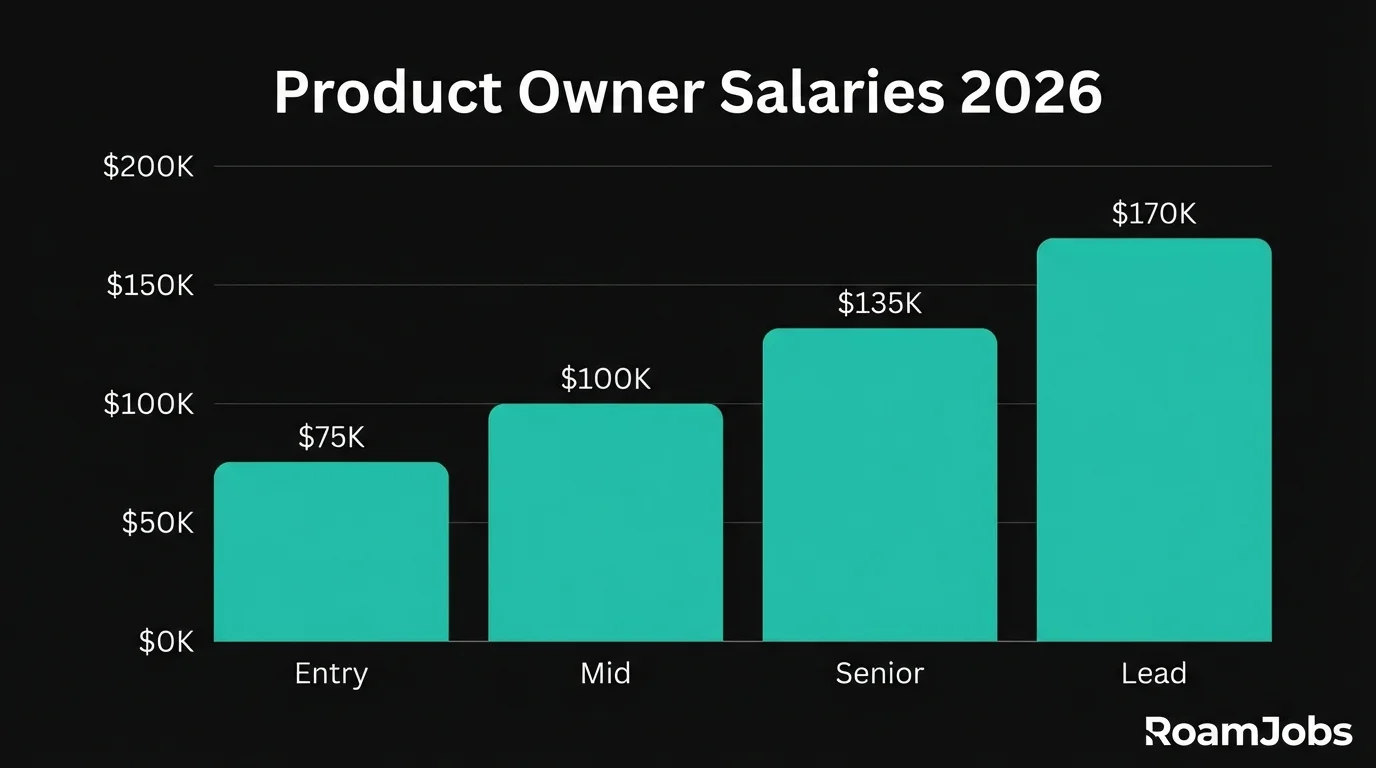
Entry-level remote PO salaries range from $75,000-$100,000 base, with total compensation (including bonus) reaching $80,000-$115,000. Geographic adjustments vary—some remote-first companies pay location-agnostic rates, while others adjust 10-20% for lower cost-of-living areas. Startups may offer lower base salaries with equity upside.
Mid-Level Product Owner
2-5 years experience
Growing Into Full Ownership
With 2-5 years of experience, you’ve managed backlogs through multiple release cycles, navigated stakeholder conflicts, and developed a track record of successful delivery. You’re now expected to operate more independently and take full ownership of product areas.
Key Skills at This Level
- Roadmap contribution: Working with Product Managers to inform quarterly and annual planning based on team capacity and technical constraints
- Stakeholder negotiation: Confidently pushing back on requests that don’t align with priorities and building consensus around difficult decisions
- Technical understanding: Deeper knowledge of your product’s architecture, enabling better story decomposition and dependency management
- Metrics and measurement: Defining and tracking KPIs that demonstrate the value delivered by your team
- Team coaching: Helping less experienced team members understand agile practices and product thinking
- Remote facilitation mastery: Running effective distributed ceremonies and maintaining team engagement across time zones
What Companies Expect
- Proven track record managing product backlogs independently
- Experience delivering features from concept through release
- Ability to write user stories that developers can implement without extensive clarification
- Strong stakeholder relationships and communication skills
- Demonstrated judgment in prioritization decisions
- History of effective remote collaboration
Typical Scope
Mid-level Product Owners own the backlog for one or two scrum teams, managing a meaningful product area or customer-facing feature set. You’re responsible for sprint-level decisions without constant oversight and are expected to escalate appropriately when decisions have broader implications. You may begin mentoring junior POs or helping with hiring.
Compensation Breakdown (US Remote)
Mid-level remote PO salaries range from $105,000-$145,000 base, with total compensation packages of $115,000-$170,000 at growth-stage companies. At this level, you may start seeing meaningful equity grants (0.05-0.15% at startups or RSU packages at public companies). Annual bonuses of 10-15% become more common.
Senior Product Owner
5-8 years experience
Managing Complexity Across Teams
Senior Product Owners handle increased complexity—multiple teams, interconnected product areas, or high-stakes feature development. You’re recognized as an expert in your product domain and trusted to make decisions that impact the broader product and organization.
Key Skills at This Level
- Multi-team coordination: Managing dependencies and priorities across several scrum teams working on related features
- Strategic input: Contributing meaningfully to product strategy discussions, not just executing on decisions made by others
- Organizational influence: Building relationships across departments and influencing decisions without direct authority
- Process improvement: Identifying and implementing improvements to how your teams work together
- Change management: Leading teams through significant product or organizational changes
- Mentoring and coaching: Developing junior POs and helping team members grow in their product understanding
What Companies Expect
- Track record of successful delivery across multiple product releases
- Experience coordinating work across multiple scrum teams
- Strong business acumen and ability to connect tactical work to strategic objectives
- Excellence in stakeholder management at multiple organizational levels
- Demonstrated leadership in remote and distributed team settings
- Ability to influence product direction and organizational decisions
Typical Scope
Senior Product Owners often manage backlogs across 2-4 scrum teams or own complex product areas that span multiple features and user types. You might coordinate the work of other POs on related product areas or serve as the primary PO for the organization’s most important initiatives. Expect regular interaction with leadership and significant influence on roadmap decisions.
Compensation Breakdown (US Remote)
Senior remote PO salaries range from $140,000-$190,000 base, with total compensation packages of $160,000-$240,000 at well-funded companies. Equity stakes become more substantial (0.1-0.25% at startups or significant RSU grants at public companies). Performance bonuses of 15-20% reflect your broader organizational impact.
Lead / Director Product Owner
8+ years experience
Leading Product Ownership Practice
At the Lead or Director level, you’re responsible for how product ownership works across the organization—establishing standards, developing PO talent, and ensuring consistent practices across teams. Some organizations title this role “Lead Product Owner,” “Principal PO,” “Director of Product Ownership,” or fold it into Product Management leadership.
Key Skills at This Level
- PO practice leadership: Establishing standards, templates, and best practices for product ownership across the organization
- People management: Hiring, developing, and performance-managing a team of Product Owners
- Organizational design: Helping structure product teams and define PO responsibilities across the organization
- Executive communication: Presenting to leadership on delivery progress, risks, and resource needs
- Agile transformation: Leading or supporting organizational agile transformations
- Vendor and tool evaluation: Selecting and implementing tools that enable effective product ownership
What Companies Expect
- Extensive experience in product ownership across different contexts (startup, enterprise, various industries)
- Proven ability to develop and mentor other Product Owners
- Track record of improving organizational delivery capability
- Strong executive presence and communication skills
- Strategic thinking about product organization and team structures
- Experience with agile at scale (SAFe, LeSS, or similar frameworks)
Typical Scope
Lead/Director POs oversee 4-8+ Product Owners across multiple product areas. You’re responsible for the overall quality of product ownership practices, not individual backlogs. Your time splits between people management, process improvement, stakeholder management, and strategic input on product direction. You likely report to a VP of Product or similar executive.
Compensation Breakdown (US Remote)
Lead/Director PO salaries range from $175,000-$250,000 base, with total compensation packages of $200,000-$320,000 at established companies. Equity stakes of 0.15-0.4% at startups or substantial RSU grants at public companies become typical. Bonuses of 20-30% reflect your organizational-level impact.
Salary Data Across Regions
Product Owner Salary by Experience & Location
| Level | 🇺🇸 US Remote | 🇪🇺 EU Remote | 🌎 LATAM | 🌏 Asia |
|---|---|---|---|---|
| Entry Level (0-2 yrs) | $75,000 - $100,000 | $50,000 - $68,000 | $28,000 - $48,000 | $22,000 - $42,000 |
| Mid-Level (2-5 yrs) | $105,000 - $145,000 | $70,000 - $98,000 | $45,000 - $72,000 | $38,000 - $65,000 |
| Senior (5-8 yrs) | $140,000 - $190,000 | $95,000 - $135,000 | $68,000 - $110,000 | $55,000 - $95,000 |
| Lead/Director (8+ yrs) | $175,000 - $250,000 | $125,000 - $180,000 | $95,000 - $155,000 | $80,000 - $140,000 |
* Salaries represent base compensation for remote positions. Actual compensation may vary based on company, experience, and specific location within region.
Compensation Trends for Remote Product Owners
Industry variations:
- Enterprise software: Higher base salaries, more structured compensation bands
- Fintech: Premium compensation (10-20% above average) due to complexity and compliance requirements
- Healthcare/Life Sciences: Regulatory knowledge commands premium pay
- Startups: Lower base but higher equity potential; total compensation varies dramatically based on outcome
- Consulting/Agencies: Competitive base with potential for billable hour bonuses
Remote compensation considerations:
- Most companies adjust compensation based on location, with 10-30% variance between high and low cost-of-living areas
- Remote-first companies (GitLab, Zapier, Automattic) more often pay location-agnostic rates
- Contract and consulting PO rates range from $65-$150/hour depending on experience and engagement type
- The shift toward remote has increased competition for PO roles, but also expanded opportunity pools
Skills and Tools for Remote Product Owners
Effective remote Product Owners combine domain expertise, process knowledge, and tool proficiency. Mastering the right tools can dramatically improve your effectiveness in distributed teams.
Agile Project Management Tools
Product Backlog Management Tools
Source: RoamJobs 2026 Tool Analysis| Tool | Best For | Strengths | Limitations | Pricing |
|---|---|---|---|---|
| Jira | Enterprise agile teams | Highly customizable, robust reporting | Steep learning curve, can become bloated | $7.75/user/mo |
| Azure DevOps | Microsoft ecosystem teams | Full ALM suite, strong CI/CD integration | Less intuitive than competitors | $6/user/mo |
| Monday.com | Visual workflow teams | Beautiful UI, easy adoption | Less engineering-specific features | $9/seat/mo |
| ClickUp | All-in-one teams | Feature-rich, good free tier | Can feel overwhelming | Free tier available |
| Linear | Fast-moving startups | Speed, clean UX, keyboard shortcuts | Less customizable than Jira | $8/user/mo |
| Shortcut | Mid-size product teams | Balanced features and usability | Smaller ecosystem | $8.50/user/mo |
Data compiled from RoamJobs 2026 Tool Analysis. Last verified January 2026.
Choosing the right tool: Your backlog management tool should match your organization’s complexity and team preferences. Jira dominates enterprise environments and offers powerful customization for complex workflows. Azure DevOps integrates well if you’re already in the Microsoft ecosystem. Monday.com and ClickUp appeal to teams that want broader work management beyond engineering. Linear has gained significant traction with startups valuing speed and simplicity.
Agile Methodologies Deep Dive
Scrum
The most common framework for Product Owner roles. Scrum prescribes specific ceremonies (Sprint Planning, Daily Standup, Sprint Review, Retrospective), artifacts (Product Backlog, Sprint Backlog, Increment), and roles (Product Owner, Scrum Master, Development Team). As a PO in Scrum:
- You’re responsible for the Product Backlog and its prioritization
- You define the Sprint Goal with the team
- You accept or reject work based on acceptance criteria
- You’re the voice of the customer and business stakeholders
Kanban
A more flexible approach focused on visualizing work, limiting work in progress (WIP), and optimizing flow. Kanban doesn’t prescribe specific roles but POs in Kanban environments:
- Manage the backlog without sprint boundaries
- Focus on continuous prioritization as capacity becomes available
- Track cycle time and throughput metrics
- Optimize the flow of work through the system
SAFe (Scaled Agile Framework)
For large enterprises coordinating multiple agile teams. SAFe introduces additional layers and roles:
- Product Owners work at the team level within Agile Release Trains (ARTs)
- Product Managers work at the ART level, providing strategic guidance
- Additional ceremonies like PI Planning coordinate across teams
- More structured hierarchies for prioritization and decision-making
Scrumban
A hybrid combining Scrum’s structure with Kanban’s flexibility. Useful for teams that want sprint cadences but with more fluid prioritization and WIP limits.
User Story Writing Excellence
User story writing is perhaps the most critical skill for Product Owners. Great user stories enable developers to work independently; poor stories create constant clarification cycles.
The INVEST Criteria:
- Independent: Stories can be developed in any order
- Negotiable: Details can be discussed and refined
- Valuable: Each story delivers value to users or the business
- Estimable: The team can estimate the effort required
- Small: Stories fit within a sprint
- Testable: Clear criteria define when the story is done
User Story Format:
The classic format remains useful: “As a [user type], I want [goal] so that [benefit].”
But the power is in the acceptance criteria. Good acceptance criteria:
- Are written in Given/When/Then format (Gherkin syntax) when possible
- Cover the happy path and key error scenarios
- Are specific enough to test but not so detailed they constrain implementation
- Include non-functional requirements (performance, accessibility) when relevant
Example of Strong vs. Weak Stories:
Weak: “As a user, I want to be able to search.”
Strong: “As a retail customer, I want to search products by keyword so that I can quickly find items I’m interested in purchasing.
Acceptance Criteria:
- Given I am on the homepage, when I enter a search term and click Search, then I see a results page with matching products
- Given my search returns results, when I view the results page, then products are sorted by relevance by default
- Given my search returns no results, when I view the results page, then I see a ‘No products found’ message with suggested alternatives
- Given I search for a term, when results are displayed, then the search completes in under 2 seconds for 95% of queries”
Sprint Planning and Retrospective Facilitation
Remote Sprint Planning Best Practices:
- Pre-work is essential: Stories must be refined before planning. Developers should review stories async and add questions before the ceremony.
- Keep it time-boxed: 2 hours for a 2-week sprint maximum. Break into smaller sessions if needed.
- Use visual collaboration: Tools like Miro or FigJam help create shared understanding of the sprint scope.
- Confirm capacity: Account for PTO, meetings, and other commitments before committing to sprint scope.
- Define a clear sprint goal: Not just a list of stories but a coherent objective the sprint achieves.
Remote Retrospective Facilitation:
- Vary the format: Use different retro formats (Start/Stop/Continue, 4Ls, Mad/Sad/Glad) to keep engagement high.
- Anonymous input: Tools like RetroTool or EasyRetro allow anonymous input, increasing psychological safety.
- Action-oriented: Every retro should produce 1-2 specific actions with owners and due dates.
- Follow up: Start the next retro by reviewing actions from the previous one.
- Include remote-specific topics: Regularly discuss how distributed work is functioning.
Companies Hiring Remote Product Owners
The market for remote Product Owners spans from early-stage startups to Fortune 500 enterprises. Understanding where to look and what different company types offer helps focus your search.
Remote-First Companies with Strong PO Cultures
GitLab operates entirely remotely with their handbook publicly documenting how product ownership works. Product Managers (their term that includes PO responsibilities) work with engineering teams on specific product stages. Known for exceptional documentation culture and async-first communication.
Automattic (WordPress, WooCommerce, Tumblr) has operated distributed since founding. Product leaders manage focused product areas with significant autonomy. Strong writing culture—expect to communicate primarily through text. Annual in-person team meetups provide face time.
Zapier built their product organization around remote work principles. Product teams own specific integration areas or platform capabilities. Known for exceptional work-life balance and clear processes. Often pays location-agnostic rates.
Toptal operates a fully distributed model and regularly hires Product Owners both internally and for client engagements. Good opportunity for those interested in variety across different products and companies.
Deel (global payroll platform) has grown rapidly and maintains distributed product teams across time zones. Fast-paced environment with significant complexity in their compliance-heavy domain.
Remote.com (HR platform for distributed teams) practices what they preach by operating fully remotely. Product Owners work on solving the problems their customers face—remote work enablement.
Enterprise Companies with Remote PO Roles
Salesforce maintains significant remote flexibility with Product Owners across their vast product ecosystem. Structured environment with clear career paths. Large enough to have specialized PO roles for specific product areas.
Microsoft has expanded remote options with Product Owner roles across Azure DevOps, Microsoft 365, and other product lines. Technical products that benefit from POs with development background.
SAP hires remote Product Owners for their enterprise software products. SAFe environment with structured agile practices. Strong European presence with global distribution.
Oracle offers remote Product Owner positions across their cloud and enterprise products. Large organization with opportunities for advancement.
ServiceNow has embraced hybrid/remote work with Product Owner roles across their workflow platform. Fast-growing company with expanding product portfolio.
Atlassian (Jira, Confluence, Trello) operates “Team Anywhere” with distributed Product Owners working on products used by millions of teams. Unique perspective of building tools you use daily.
Growing Tech Companies Hiring Remote POs
Notion has expanded remote hiring with Product Owner opportunities across their documentation and collaboration platform. Fast-growing with startup energy but increasing maturity.
Figma (now Adobe) maintains remote flexibility with PO roles across their design tool ecosystem. Strong design culture with technically sophisticated products.
Canva operates distributed teams with Product Owners across their design platform features. Strong growth trajectory and expanding product scope.
Webflow hires remote Product Owners for their visual web development platform. Technical product requiring POs who understand both design and development.
Airtable maintains distributed product teams with PO opportunities across their no-code platform. Complex product with diverse user needs.
Monday.com (yes, the tool) hires Product Owners for their work management platform. Interesting opportunity to work on the tools of your trade.
HubSpot offers @flex remote arrangements with Product Owner roles across their CRM and marketing platform. Strong people-first culture with development opportunities.
Consulting and Contract Opportunities
Beyond full-time roles, experienced Product Owners can build careers through consulting and contract work:
Consulting Firms with PO Practices:
- Thoughtworks
- Pivotal Labs (VMware Tanzu)
- Slalom
- West Monroe
- Accenture (agile practice)
Contract Platforms:
- Toptal (selective, higher rates)
- Upwork (varying quality, volume)
- Gun.io (tech-focused)
- Working Not Working
- A.Team (curated teams)
Contract PO rates range from $65-$150/hour depending on experience, industry, and engagement complexity. Contract work offers variety and flexibility but requires managing your own benefits, taxes, and business development.
Finding Unlisted Opportunities
Many PO positions, especially senior roles, are never publicly posted. Develop sourcing strategies beyond job boards:
- Network cultivation: Build relationships with Product Managers, Scrum Masters, and engineering leaders at target companies
- LinkedIn optimization: Ensure your profile highlights PO skills and remote experience; engage with product content
- Community involvement: Participate in Product Owner and agile communities (local meetups, online forums, conferences)
- Thought leadership: Writing about product ownership challenges and solutions attracts inbound opportunities
- Recruiter relationships: Build connections with recruiters specializing in product roles
Interview Deep Dive
Remote Product Owner interviews evaluate agile methodology knowledge, tactical execution skills, and communication abilities across multiple rounds. Understanding what hiring managers look for helps you prepare effectively.
Interview Process Overview
Typical remote PO interview processes include:
- Recruiter Screen (30 min): Background, interest, salary expectations
- Hiring Manager Screen (45-60 min): Experience deep dive, agile knowledge assessment
- Case Study/Practical (60 min): Backlog prioritization exercise or user story writing
- Stakeholder Panel (60 min): Cross-functional interviewers assessing collaboration skills
- Technical/Dev Team Interview (30-45 min): Assessment by potential team members
- Leadership Interview (30-45 min): VP or Director assessment of fit and potential
Agile Methodology Questions
What interviewers assess: Your understanding of sprint planning mechanics and ability to adapt agile ceremonies for remote settings.
Strong response structure:
-
Pre-planning preparation: “Before sprint planning, I ensure all stories for consideration are thoroughly refined. This means acceptance criteria are complete, stories are estimated, and developers have had async time to review and add questions. For distributed teams, I share a pre-read document 24-48 hours in advance with proposed sprint candidates and the draft sprint goal.”
-
Time zone accommodation: “With three time zones, I’d schedule the ceremony at a time that’s reasonable for most—accepting that one group might have an early or late meeting. I rotate meeting times across sprints so the burden is shared. For anyone who absolutely can’t attend, I record the session and create a summary document with key decisions.”
-
Ceremony structure: “I start by reviewing the sprint goal and its connection to our quarterly objectives. Then I present the proposed stories in priority order, using screen share with our Jira board. For each story, I confirm the team’s understanding and ask for any concerns. We collectively commit to what we can deliver, with the team having final say on capacity.”
-
Documentation and follow-up: “After the ceremony, I update the sprint backlog with any clarifications discussed and share written notes summarizing commitments, the sprint goal, and any open questions. This gives async participants full context.”
What interviewers assess: Your user story writing skills and ability to create documentation that enables autonomous work.
Strong response elements:
-
Business context: “Every story starts with why this matters—the business problem we’re solving and how it connects to user needs. This helps developers make good decisions when they encounter implementation questions.”
-
Acceptance criteria depth: “I use Given/When/Then format for acceptance criteria because it forces clarity about preconditions, actions, and expected outcomes. I include criteria for the happy path, key error scenarios, and any non-functional requirements like performance expectations.”
-
Visual and technical references: “I link to design mockups, API specifications, or technical documents as needed. For complex features, I might include a short Loom video walking through the expected behavior.”
-
Edge cases and boundaries: “I explicitly document what’s out of scope to prevent scope creep. I note related stories and dependencies so developers understand the broader context.”
-
Definition of Done: “I ensure stories reference our team’s Definition of Done and call out any story-specific quality requirements.”
What interviewers assess: Your stakeholder management skills and ability to make difficult prioritization decisions.
Strong response structure:
-
Context: Describe the competing priorities and the stakeholders involved. Be specific about the business impact of each option.
-
Your decision framework: Explain how you evaluated the options—what data you used, what criteria mattered most, and how you weighed business value, effort, and strategic alignment.
-
Communication approach: Describe how you communicated your decision, including how you acknowledged stakeholder concerns and explained your rationale.
-
Outcome management: Discuss how you maintained the relationship after the decision, addressed any ongoing concerns, and delivered on your commitments.
-
Learning: Reflect on what you learned about navigating prioritization conflicts.
Key principles to demonstrate:
- Data-informed decision-making rather than opinion-based
- Transparency about your rationale and constraints
- Commitment to the decision once made (not constantly revisiting)
- Relationship maintenance even through disagreement
- Willingness to be wrong and adjust based on new information
What interviewers assess: Your understanding of metrics and ability to use data to improve product and team performance.
Strong response elements:
Backlog health metrics:
- “I track backlog size and age—a growing backlog of stale items indicates we’re adding more than we’re closing. I regularly prune items that have been deprioritized for 6+ months.”
- “I monitor the ratio of refined to unrefined stories. Ideally, we have 2-3 sprints of fully refined work ready at any time.”
- “I track story rejection rates—stories that developers push back on during refinement or sprint planning because they’re unclear.”
Delivery effectiveness metrics:
- “Sprint velocity trends help me understand team capacity and predict future delivery, though I’m careful not to use velocity as a performance measure.”
- “I track cycle time—how long it takes from starting a story to completing it—as an indicator of flow efficiency.”
- “Escaped defects and regression rates help me understand whether we’re maintaining quality.”
Value delivery metrics:
- “The most important metrics are business outcomes—did the features we delivered achieve their intended impact? I work with Product Management to define success criteria for major features and track them post-release.”
- “I also gather qualitative feedback from users and stakeholders about whether delivered work met their needs.”
What interviewers assess: Your requirements gathering and translation skills.
Strong response framework:
-
Initial understanding: “First, I seek to understand the underlying need. I ask questions like: What problem are you trying to solve? Who experiences this problem? What happens if we don’t address it? What does success look like?”
-
Documentation and confirmation: “I document my understanding and share it back for confirmation. This written artifact catches misunderstandings early and creates a record of the business need.”
-
Exploration of solutions: “I explore potential approaches without committing to a specific solution too early. I might sketch multiple options with different scope/complexity tradeoffs to understand stakeholder preferences.”
-
Incremental decomposition: “I break the need into smaller increments that can be delivered independently. I work with stakeholders to identify the minimum version that would provide value, then layer additional capabilities.”
-
Validation loop: “I review the resulting user stories with stakeholders to confirm they capture the intent, and with developers to confirm they’re technically feasible and well-defined.”
What interviewers assess: Your ability to diagnose team issues and improve delivery without blame.
Strong response elements:
Diagnosis approach: “First, I’d examine the data to understand patterns. Is it all types of stories or specific categories? Is it the same people or distributed? Are estimates consistently off or are unexpected issues arising?”
Common causes and responses:
- “If estimates are consistently off, we might need to invest more in refinement or adjust our estimation approach. I’d facilitate discussion about what we’re missing during estimation.”
- “If unexpected work is interrupting sprints, we might need to better account for support time or create buffer capacity.”
- “If stories are taking longer because they’re unclear, that’s feedback on my backlog quality—I need to improve story definition.”
- “If external dependencies are blocking completion, we need to better identify and manage dependencies during planning.”
Facilitation not blame: “I approach this through retrospectives and 1:1 conversations, creating psychological safety for honest discussion. The goal is continuous improvement, not finding fault.”
Working with Scrum Master: “I partner with the Scrum Master on process issues. They often have insights into team dynamics and impediments that I might not see directly.”
What interviewers assess: Your understanding of technical debt and ability to balance competing priorities.
Strong response structure:
-
Visibility: “I work with tech leads to make technical debt visible in the backlog—not hidden or separate. This ensures debt gets prioritized alongside other work rather than forgotten.”
-
Business framing: “I help stakeholders understand debt in business terms—slower future development, increased bug risk, reliability concerns. This creates shared understanding of why debt matters.”
-
Allocation approaches: “Some teams allocate a percentage of capacity to debt (e.g., 20%). Others address debt when touching related code. I advocate for intentional debt paydown rather than hoping it happens naturally.”
-
Prioritization criteria: “I prioritize debt that’s actively causing pain—affecting development velocity, reliability, or security. Theoretical debt that isn’t creating problems can often wait.”
-
Integration not separation: “I avoid separate ‘tech debt sprints’ that create artificial divisions. Debt work should flow through normal prioritization, just with appropriate business context.”
What interviewers assess: Your ability to push back professionally and maintain stakeholder relationships.
Strong response framework:
-
Context: Describe the request and why it was problematic (timing, scope, competing priorities, technical feasibility).
-
Your approach:
- Did you seek to understand their underlying need first?
- How did you frame your concerns?
- Did you offer alternatives or just say no?
-
Communication style:
- Were you direct but respectful?
- Did you use data to support your position?
- Did you acknowledge the legitimacy of their need?
-
Outcome: What was the result of the conversation? How was the relationship afterward?
Key principles:
- Never say no without offering alternatives
- Understand the why behind requests before responding
- Use data and objective criteria rather than opinion
- Acknowledge the stakeholder’s perspective and constraints
- Follow up to maintain the relationship
What interviewers assess: Your ability to coordinate across teams in complex environments.
Strong response elements:
Coordination mechanisms:
- “Regular sync meetings between POs on related teams—weekly or bi-weekly depending on coupling”
- “Shared documentation of dependencies, APIs, and integration points”
- “Scrum of Scrums or similar coordination ceremonies”
- “Unified roadmap visibility so teams see how their work connects”
Dependency management:
- “Explicit tracking of cross-team dependencies in the backlog”
- “Early identification of dependencies during refinement”
- “Buffer time in sprint planning for dependency-related risk”
- “Clear ownership and communication channels when dependencies arise”
Remote-specific adaptations:
- “Shared Slack channels for related teams to communicate async”
- “Written documentation of interface agreements and contracts”
- “Recorded decisions and rationale for async team members”
- “Regular check-ins on how coordination is working”
What interviewers assess: Your remote collaboration skills and ability to build relationships virtually.
Strong response elements:
Initial relationship building:
- “I schedule extended 1:1s with each team member early—not just about work, but to understand their background, working style, and communication preferences”
- “I share my own working style, availability, and how I prefer to receive questions and feedback”
- “I look for opportunities for informal connection—virtual coffee chats, optional social activities”
Ongoing collaboration:
- “I maintain consistent availability and response times so the team knows they can count on me”
- “I use video by default for important conversations to build face-to-face connection”
- “I’m explicit about decisions and rationale in writing so everyone has equal access to information”
- “I regularly ask for feedback on how our collaboration is working and what I could do better”
Trust building:
- “I follow through reliably on commitments—consistency builds trust remotely”
- “I’m transparent about constraints, trade-offs, and my own uncertainties”
- “I advocate for the team with stakeholders and leadership”
- “I give credit publicly and address concerns privately”
What interviewers assess: Your ability to navigate conflict and collaborate with technical team members.
Strong response structure:
-
Listen first: “I’d start by genuinely understanding their perspective. What’s driving their disagreement? Do they have information I’m missing? Is there a technical concern that changes the equation?”
-
Share your rationale: “I’d explain my prioritization reasoning transparently—what criteria I used, what stakeholder input I considered, what business context informed the decision.”
-
Find common ground: “Often disagreements stem from different information or perspectives. I’d look for where we agree and where the actual gap is.”
-
Consider adjusting: “If their input reveals something I hadn’t considered, I’m willing to revisit the decision. Good prioritization incorporates technical input.”
-
Commit together: “Once we’ve discussed, we need to commit to a path forward—even if there’s still disagreement. I’d confirm they can support the decision even if they don’t fully agree.”
-
Follow up: “I’d check in afterward to see how things went and whether the decision was right. If they were correct, I’d acknowledge it.”
What interviewers assess: Your data-informed approach to product ownership and understanding of agile metrics.
Valuable metrics to discuss:
Flow metrics:
- “Cycle time tells me how long work takes from start to finish—useful for predicting delivery and identifying bottlenecks”
- “Throughput shows how much we complete per time period—useful for capacity planning”
- “Work in progress (WIP) helps identify when teams are overloaded and multitasking”
Quality metrics:
- “Defect escape rate shows bugs that reach production—indicates testing and definition quality”
- “Story rework rate shows stories that need revision after completion—indicates acceptance criteria clarity”
Business metrics:
- “Feature adoption tells us if what we built is being used”
- “User feedback and satisfaction indicate whether we’re solving real problems”
- “Impact metrics tied to specific features show actual value delivered”
Anti-patterns to mention:
- “I avoid using velocity to compare teams or as a performance measure—it’s for planning, not evaluation”
- “I don’t optimize for metrics at the expense of outcomes—completing more stories doesn’t matter if they don’t deliver value”
What interviewers assess: Your onboarding skills and ability to transfer knowledge virtually.
Strong response elements:
Documentation foundation:
- “I maintain comprehensive product documentation that new team members can review async—product vision, user personas, architecture overview, current roadmap”
- “I keep a ‘start here’ document specifically for new team members with key resources and context”
Structured onboarding:
- “I schedule dedicated onboarding sessions to walk through the product, backlog, and current priorities”
- “I assign a backlog ‘buddy’—an experienced team member who can answer questions and pair on early work”
- “I start new team members on well-defined stories with clear context before moving to more ambiguous work”
Ongoing support:
- “I check in frequently during the first weeks to answer questions and provide context”
- “I explicitly invite questions and create psychological safety for asking ‘basic’ questions”
- “I gather feedback on the onboarding experience to improve for future hires”
What interviewers assess: Your user empathy and research practices in remote settings.
Strong response elements:
Remote research methods:
- “I schedule regular user interviews via video call—even 2-3 per month maintains connection to user needs”
- “I review customer support tickets and feedback to understand pain points at scale”
- “I participate in or watch recordings of usability testing sessions”
- “I analyze product usage data to understand behavior patterns”
Proxy connections:
- “I maintain close relationships with customer-facing teams—support, success, sales—who interact with users daily”
- “I attend or review recordings of sales calls and demos to hear how users respond to our product”
- “I participate in customer advisory boards or beta user communities”
Staying grounded:
- “I use our own product regularly to experience it from the user perspective”
- “I read all feedback that comes through in-product surveys or feedback mechanisms”
- “I share user insights with the team regularly to keep everyone connected to user needs”
What interviewers assess: Your understanding of what enables PO success and your thoughtfulness about role fit.
Questions to discuss asking:
Role clarity:
- “How is the Product Owner role distinguished from Product Manager here?”
- “What decisions does the PO make independently vs. need approval for?”
- “How much authority does the PO have over backlog prioritization?”
Team structure:
- “How many teams will I support? How distributed are they?”
- “What’s the relationship between PO and Scrum Master?”
- “How does the team currently run agile ceremonies?”
Stakeholder dynamics:
- “How do stakeholders typically engage with the backlog? Can they add items directly?”
- “How are conflicts between stakeholder priorities resolved?”
- “What’s the escalation path when there’s disagreement on priorities?”
Support and growth:
- “How does the organization support PO development and growth?”
- “What does the career path look like for Product Owners here?”
- “How are POs evaluated and given feedback?”
What interviewers assess: Your ability to adapt and make trade-off decisions under pressure.
Strong response structure:
-
Assessment: “First, I assess the unexpected work—is it truly urgent? What’s the business impact of not addressing it immediately vs. waiting until next sprint?”
-
Trade-off decision: “If the work is genuinely urgent, I work with the team to identify what can be removed from the sprint commitment to make room. The sprint goal may need adjustment.”
-
Stakeholder communication: “I communicate with stakeholders about the impact—what we’re deprioritizing to handle the urgent work and why.”
-
Process learning: “In retrospective, I explore why this wasn’t anticipated. Was it truly unforeseeable or could we improve our planning? Should we build buffer capacity for unexpected work?”
Key principles:
- “Protect the team from constant mid-sprint changes—urgency should be the exception, not the norm”
- “Scope out before adding in—don’t just pile on more work”
- “Document the decision for transparency”
- “Learn from patterns—if mid-sprint changes are frequent, the process needs adjustment”
What interviewers assess: Your understanding of good acceptance criteria and judgment about appropriate detail level.
Strong response elements:
Purpose of acceptance criteria:
- “Acceptance criteria define what ‘done’ looks like for a story—they’re the contract between PO and team about what we’re building”
- “Good criteria enable developers to work independently and testers to verify completeness”
Level of detail guidance:
- “Detailed enough that there’s no ambiguity about whether the criteria are met”
- “Not so detailed that they prescribe implementation or prevent creative solutions”
- “Cover the happy path, key error scenarios, and edge cases that matter”
- “Include non-functional requirements (performance, accessibility) when relevant”
Format preferences:
- “I prefer Given/When/Then format because it forces clarity about context, action, and outcome”
- “I use numbered lists for complex criteria to ensure nothing is missed”
- “I reference external documents (designs, specs) rather than duplicating content”
Adaptation by story type:
- “Straightforward stories might need only 2-3 criteria”
- “Complex features might need 8-10 criteria covering multiple scenarios”
- “Technical/infrastructure stories might have criteria focused on measurable outcomes rather than user behavior”
What interviewers assess: Your self-awareness about technical limitations and ability to work effectively with developers.
Strong response elements:
Demonstrating respect:
- “I respect technical expertise and defer to developers on implementation decisions”
- “I ask questions to understand rather than prescribing solutions”
- “I acknowledge what I don’t know rather than pretending”
Adding value where you can:
- “I bring clarity about user needs and business context that developers may not have”
- “I make prioritization decisions so developers can focus on building”
- “I handle stakeholder management so the team isn’t constantly interrupted”
- “I write clear stories that reduce ambiguity and wasted effort”
Continuous learning:
- “I invest in understanding our technology at a conceptual level—architecture, constraints, trade-offs”
- “I ask developers to explain technical concepts and actively learn from them”
- “I attend technical discussions to build context even when I can’t contribute deeply”
Building trust:
- “I follow through reliably on commitments”
- “I advocate for technical needs with stakeholders”
- “I don’t override technical judgment on implementation details”
What interviewers assess: Your organizational skills and ability to manage complexity.
Strong response elements:
Organization strategies:
- “I use epics or themes to group related stories for easier navigation”
- “I maintain a clear hierarchy: epics contain features, features contain stories”
- “I use labels or tags for cross-cutting concerns (technical debt, bug, specific user type)”
Prioritization tiers:
- “Not everything needs precise prioritization. I maintain tiers: current sprint candidates (refined, prioritized), next 2-3 sprints (roughly prioritized), later (captured but not prioritized)”
- “Only the top tier needs detailed refinement—items further out will likely change”
Backlog hygiene:
- “Regular grooming sessions to review and clean the backlog”
- “Items deprioritized for 6+ months get reviewed and often removed”
- “I archive rather than delete to maintain history”
Stakeholder communication:
- “I maintain a simplified view for stakeholders focused on what’s coming next”
- “I don’t share the full backlog complexity—it overwhelms non-PO stakeholders”
Frequently Asked Questions
Frequently Asked Questions
What's the difference between Product Owner and Product Manager career paths?
Product Owner and Product Manager represent related but distinct career paths. Product Owners focus on execution—backlog management, user stories, sprint-level prioritization—and often work within agile frameworks like Scrum. Product Managers focus on strategy—vision, roadmap, market research, go-to-market. In many organizations, POs report to or work alongside PMs. Career progression typically moves from PO to Senior PO to Lead PO, or POs transition to PM roles by taking on more strategic responsibilities. Some professionals prefer staying in PO roles because they enjoy the execution focus and close collaboration with development teams. Neither path is inherently better—it depends on whether you prefer tactical execution or strategic planning.
Is Scrum Master certification valuable for Product Owners?
Scrum Master certification (CSM, PSM) can be helpful but isn't required for Product Owner roles. Understanding Scrum deeply is essential, and certification demonstrates baseline knowledge. However, most hiring managers care more about practical experience than certification. Product Owner-specific certifications (CSPO, PSPO) are more directly relevant and signal commitment to the PO discipline. Certifications matter more for: breaking into your first PO role, working at companies that require them (often enterprise), and consulting engagements. They matter less for: senior roles where experience speaks louder, startups focused on outcomes over process, and companies that don't use Scrum. If you're investing in certification, consider combining Scrum training with practical portfolio-building.
How do remote agile ceremonies differ from in-person ceremonies?
Remote agile ceremonies require more preparation, clearer facilitation, and different tools than in-person equivalents. Sprint Planning remotely needs pre-work—stories must be refined beforehand since real-time clarification is harder. Use visual collaboration tools (Miro, FigJam) for shared understanding. Daily Standups are often shorter remotely or done asynchronously via Slack or standup bots. Video standups help maintain team connection but must be time-boxed strictly. Sprint Reviews work well remotely when the demo environment is properly set up. Practice screen sharing beforehand. Record sessions for stakeholders who can't attend. Retrospectives require more facilitation remotely—use tools that enable anonymous input (RetroTool, EasyRetro) to increase psychological safety. The biggest difference is documentation—remote ceremonies must produce written artifacts since participants can't rely on shared memory of in-person discussion.
How do I break into Product Ownership without prior PO experience?
Breaking into Product Ownership typically happens through adjacent roles or internal transitions. Common entry paths include: Business Analysts who've worked with agile teams already write requirements and understand the SDLC—emphasize story writing and stakeholder management skills. Project Managers transitioning to product focus more on facilitation and delivery than schedule management. QA Engineers who understand what makes requirements testable and clear. Customer-facing roles (support, success) who deeply understand user needs. Developers who want to move closer to the business side. To position yourself: learn Scrum and agile fundamentals thoroughly, practice writing user stories and acceptance criteria, get certified (CSPO or PSPO) to demonstrate commitment, look for internal opportunities to shadow or support existing POs, and consider smaller companies where you can take on PO responsibilities without the title first.
What makes Product Owner roles different in enterprise vs startup environments?
Enterprise Product Owners work in more structured environments with established processes, larger teams, and complex stakeholder landscapes. Expect: defined career ladders and compensation bands, more specialized scope (owning a specific feature area), formal processes for prioritization and approval, scaled agile frameworks (SAFe, LeSS) coordinating multiple teams, and slower decision-making but more stability. Startup Product Owners wear more hats with less formal structure. Expect: broader scope across more product areas, more strategic involvement alongside tactical execution, faster decision-making and more autonomy, less process and documentation (for better and worse), and higher impact visibility but less job security. Neither is objectively better—enterprises offer stability and career development while startups offer breadth and rapid growth. Many POs move between both environments throughout their careers.
How do I handle disagreements between the development team and stakeholders?
Handling disagreements is a core PO skill. When developers and stakeholders conflict, your role is translator and mediator. First, understand both perspectives genuinely—what's driving each position? Technical concerns often have business implications stakeholders don't see. Business urgency often has context developers lack. Translate between the groups by explaining technical constraints in business terms and business needs in technical context. Look for creative solutions—can scope be reduced to address technical concerns while meeting business needs? Can timeline flexibility reduce technical risk? Make the decision transparent—if you must choose one perspective over another, explain your reasoning to both parties. Document the decision and rationale. Follow up after delivery to see if the right trade-off was made—this builds credibility for future decisions. Never throw either group under the bus to the other.
What tools should a remote Product Owner master?
Remote Product Owners need proficiency across several tool categories. Backlog management (master at least one): Jira (most common in enterprise), Azure DevOps (Microsoft shops), Linear or Shortcut (startups), Monday.com or ClickUp (broader work management). Documentation: Confluence or Notion for product documentation and requirements, Loom for asynchronous video explanations, Miro or FigJam for visual collaboration and workshop facilitation. Communication: Slack or Teams for team and stakeholder communication, Zoom or Google Meet for ceremonies and meetings. Analytics: Basic SQL for data access, product analytics tools (Amplitude, Mixpanel, Pendo), dashboarding tools (Looker, Tableau, Mode). Diagramming: Lucidchart, Whimsical, or draw.io for flows and architectures. You don't need to master every tool, but strong proficiency in one tool per category is expected.
How do remote Product Owners handle time zone challenges?
Time zone management is essential for remote POs. Practical strategies include: identify overlapping hours with your team(s) and protect that time for synchronous collaboration. Rotate meeting times across sprints so no group is consistently burdened with early/late calls. Use asynchronous alternatives where possible—async standups, written refinement comments, recorded updates. Document everything—meetings that exclude some team members must produce written summaries. Build buffer time into processes for response latency across time zones. Set explicit expectations about response times during and outside overlapping hours. Consider workload when assigning stories—developers in isolated time zones may need more self-contained work with fewer dependencies. Some POs adjust their schedules periodically to overlap better with distant teams. The key is intentionality—time zones don't manage themselves.
What's the typical career progression for Product Owners?
Product Owner career progression typically follows this path: Associate/Junior PO (0-2 years) supporting senior POs and learning the discipline with limited scope. PO/Mid-Level (2-5 years) owning the backlog for one or two scrum teams independently. Senior PO (5-8 years) managing complex product areas, multiple teams, and mentoring junior POs. Lead/Principal PO (8+ years) establishing PO practices, managing PO teams, and influencing product organization strategy. Some POs transition to Product Management for more strategic scope, or to Scrum Master/Agile Coach roles for more process focus. Others move into Product Operations, focusing on the systems and tools that enable product teams. Director/VP of Product typically requires PM experience or combined PO/PM background. The path isn't strictly linear—lateral moves to different industries, company sizes, or product domains are common and valuable for broadening experience.
How do I demonstrate Product Owner skills in interviews without direct PO experience?
Demonstrating PO skills without the title requires highlighting transferable experience and showing product thinking. From any role, identify examples of: writing requirements or specifications, prioritizing work or requests, translating between technical and non-technical stakeholders, working with development teams on delivery, and making decisions about scope or trade-offs. Create a portfolio of sample work: write user stories for a product you use, create a sample backlog with prioritization rationale, and document how you would improve a product you're familiar with. Prepare for case studies by practicing backlog prioritization exercises and stakeholder scenario responses. Demonstrate product knowledge by articulating opinions about products you use—what works, what doesn't, what you'd change. Show remote work competency through clear written communication in your application and thoughtful async responses during the interview process.
Should I specialize in a specific industry or stay generalist as a Product Owner?
Both specialization and generalism have advantages for Product Owners. Specialization benefits include: deeper domain expertise makes you more valuable in that industry, easier to demonstrate credibility and understand user needs, certain industries (healthcare, finance) pay premiums for domain knowledge, and you build valuable networks within your specialty. Generalist benefits include: broader opportunity pool and flexibility to move between industries, diverse experience provides fresh perspectives, and less risk if your specialized industry declines. A common approach is T-shaped development: broad agile and product skills with depth in one or two industries. Early career, explore different domains to discover your interests. Mid-career, consider developing expertise where you've found strong fit. The 'best' choice depends on your interests, risk tolerance, and career goals.
How much technical knowledge do Product Owners really need?
Product Owners need enough technical knowledge to be effective partners with development teams, but not necessarily coding ability. Essential technical literacy includes: understanding your product's architecture at a conceptual level, knowing how changes in one area might affect others, being able to estimate relative complexity (not precise hours) of different approaches, understanding technical debt and its implications, and speaking the basic vocabulary of your technology stack. You should be able to ask good questions about technical decisions and understand the answers. You don't need to: write production code, make detailed architectural decisions, or be the most technical person in the room. The required depth varies by product—a PO for a developer tools company needs more technical depth than a PO for a consumer app. Build technical knowledge continuously by asking developers to explain concepts, reading technical documentation, and attending design reviews.
Remote Product Owner Career Checklist
Remote Product Owner Job Search Preparation
- 1 Master agile fundamentals beyond certification
Understand Scrum, Kanban, and scaled frameworks deeply enough to discuss trade-offs and adaptations
- 2 Build a portfolio of user story writing samples
Create example stories with acceptance criteria for products you know well
- 3 Practice backlog prioritization frameworks
Be able to explain and apply MoSCoW, WSJF, value vs. effort, and other prioritization methods
- 4 Develop proficiency in at least one major agile tool
Jira, Azure DevOps, or Linear—be able to demonstrate competency in interviews
- 5 Prepare case study responses
Practice stakeholder management scenarios, prioritization exercises, and sprint planning simulations
- 6 Optimize your LinkedIn for remote PO keywords
Highlight agile experience, backlog management, user stories, and remote collaboration
- 7 Get certified if transitioning from another role
CSPO or PSPO certification signals commitment to the PO discipline
- 8 Demonstrate remote work competency
Highlight async communication skills, documentation practices, and distributed team experience
- 9 Build a target company list
Research 20-30 companies hiring remote POs that match your industry and company-size preferences
- 10 Prepare questions that demonstrate product thinking
Ask about product strategy, team structure, stakeholder dynamics, and PO success metrics
Continue Your Remote Product Journey
Remote Product Owner roles offer an accessible entry point into product careers with strong compensation and growing demand. The key to success is combining agile execution excellence with the documentation and communication skills that enable distributed teams to thrive.
Next steps based on your situation:
If you’re breaking into Product Ownership:
- Build foundational agile knowledge through courses and certification
- Practice user story writing and seek feedback
- Look for internal opportunities to support existing POs
- Apply to associate or junior PO roles at growing companies
If you’re an experienced PO seeking remote roles:
- Update your resume to emphasize remote collaboration experience
- Prepare specific examples of distributed team success
- Research target companies’ remote work philosophies
- Network with POs at remote-first organizations
If you’re a senior PO targeting leadership:
- Develop experience mentoring and developing other POs
- Build skills in agile transformation and process improvement
- Network at the Director/VP level for opportunities
- Consider whether you want to stay in PO leadership or transition to PM
The remote Product Owner market continues to expand as organizations recognize that effective agile execution doesn’t require physical co-location. For POs who develop strong documentation habits, master async communication, and build credibility with distributed teams, exceptional opportunities await.
Related Resources
Explore these related guides to continue building your remote product career:
- Remote Product Jobs: Overview of all remote product roles including PM, TPM, and leadership positions
- Remote Product Manager Jobs: Deep dive into the strategic PM role and how it differs from PO
- Remote Interview Guide: Comprehensive preparation for remote interview processes
Get Remote Product Owner Career Insights
Weekly curated remote Product Owner opportunities, agile best practices, and career advice delivered to your inbox.
Frequently Asked Questions
How do I find remote product owner jobs?
To find remote product owner jobs, start with specialized job boards like We Work Remotely, Remote OK, and FlexJobs that focus on remote positions. Set up job alerts with keywords like "remote product owner" and filter by fully remote positions. Network on LinkedIn by following remote-friendly companies and engaging with hiring managers. Many product owner roles are posted on company career pages directly, so identify target companies known for remote work and check their openings regularly.
What skills do I need for remote product owner positions?
Remote product owner positions typically require the same technical skills as on-site roles, plus strong remote work competencies. Essential remote skills include excellent written communication, self-motivation, time management, and proficiency with collaboration tools like Slack, Zoom, and project management software. Demonstrating previous remote work experience or the ability to work independently is highly valued by employers hiring for remote product owner roles.
What salary can I expect as a remote product owner?
Remote product owner salaries vary based on experience level, company size, location-based pay policies, and the specific tech stack or skills required. US-based remote positions typically pay market rates regardless of where you live, while some companies adjust pay based on your location's cost of living. Entry-level positions start lower, while senior roles can command premium salaries. Check our salary guides for specific ranges by experience level and geography.
Are remote product owner jobs entry-level friendly?
Some remote product owner jobs are entry-level friendly, though competition can be high. Focus on building a strong portfolio or demonstrable skills, contributing to open source projects if applicable, and gaining any relevant experience through internships, freelance work, or personal projects. Some companies specifically hire remote junior talent and provide mentorship programs. Smaller startups and agencies may be more open to entry-level remote hires than large corporations.
Continue Reading
Remote Product Manager Jobs: Complete 2026 Career Guide
Everything you need to land a remote product manager job. Strategy, roadmapping, stakeholder management - salary data, interview questions, and companies hiring.
Remote Technical Product Manager Jobs: Complete 2026 Career Guide
Everything you need to land a remote technical PM job. APIs, infrastructure, developer tools - salary data, interview questions, and companies hiring.
Remote Product Jobs 2026: Complete Guide to PM, TPM & Leadership Careers
The definitive hub for remote product careers. Explore salary data, interview guides, and opportunities across product management, technical PM, product owner, and leadership roles.
Land Your Remote Job Faster
Get the latest remote job strategies, salary data, and insider tips delivered to your inbox.