Remote Technical Product Manager Jobs: Complete 2026 Career Guide
Everything you need to land a remote technical PM job. APIs, infrastructure, developer tools - salary data, interview questions, and companies hiring.
Updated January 20, 2026 • Verified current for 2026
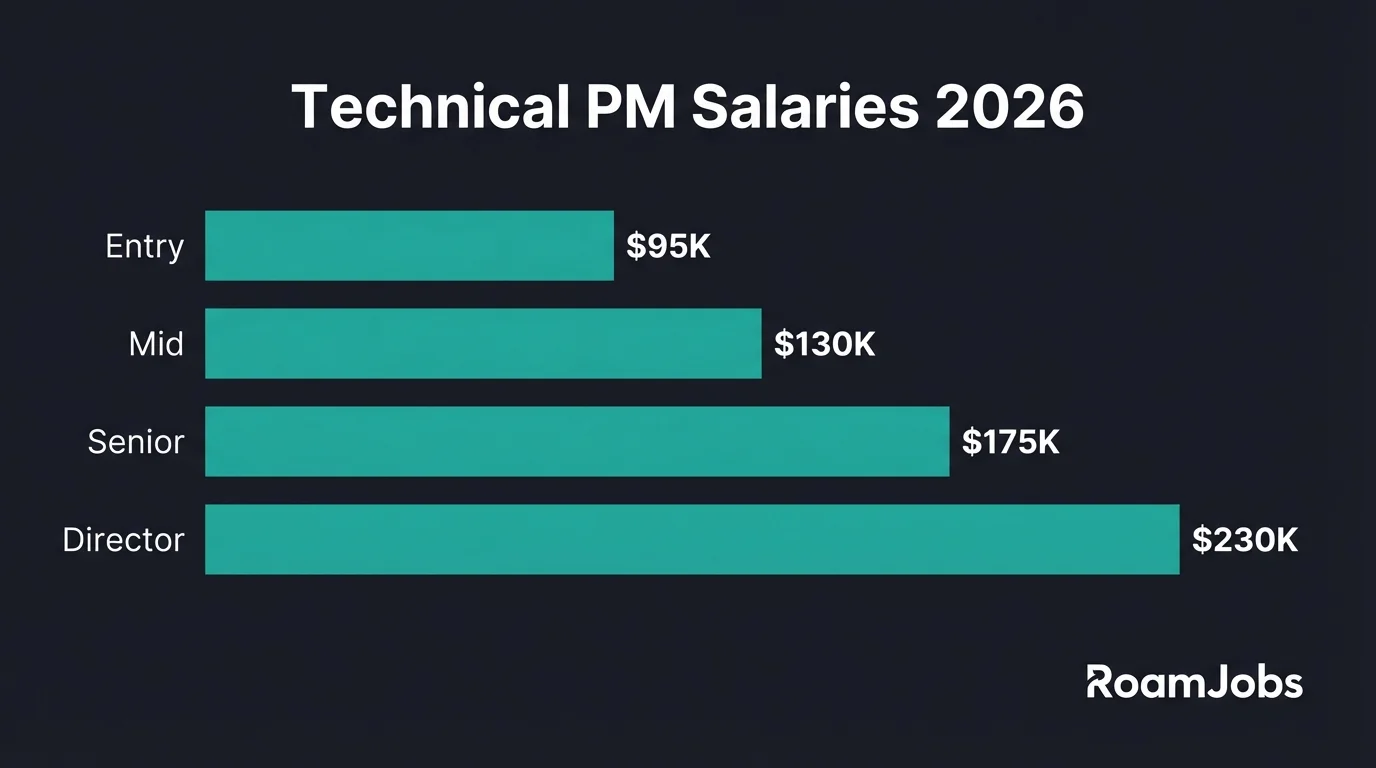
Remote Technical Product Managers (TPMs) bridge the gap between engineering and business, owning products that require deep technical understanding—APIs, infrastructure, developer tools, and platform services. In 2026, remote TPM salaries range from $95,000 to $350,000+ for US-based positions, with the highest compensation at developer tools companies and platform teams at major tech firms. Unlike general product managers who focus primarily on user experience and business outcomes, TPMs work directly with engineering teams on architecture decisions, API design, system scalability, and technical debt prioritization. The role requires genuine technical credibility—most TPMs have software engineering backgrounds or computer science degrees—combined with product sense and stakeholder management skills. Remote TPM roles are particularly well-suited for distributed work because the artifacts of the role (technical specifications, API documentation, architecture diagrams) are inherently written and asynchronous. Success requires translating complex technical concepts for business stakeholders, making trade-off decisions that balance engineering constraints with product requirements, and driving alignment across engineering, design, and business teams without the benefit of hallway conversations or whiteboard sessions.
What Remote Technical Product Managers Actually Do
Technical Product Managers occupy a unique position at the intersection of engineering leadership and product strategy. While general PMs focus on user problems and business outcomes, TPMs own products where the technical implementation IS the product—developer APIs, cloud infrastructure, internal platforms, and technical tools.
Day-to-Day Responsibilities
API Strategy and Developer Experience
TPMs at developer-facing companies spend significant time on API design, documentation standards, and developer experience optimization. This includes defining API contracts, working with engineering on versioning strategies, ensuring backwards compatibility, and monitoring API adoption metrics. You’ll review API specifications, provide feedback on endpoint design, and balance developer ergonomics with system constraints.
Infrastructure Roadmap Planning
For platform and infrastructure TPMs, roadmap planning involves understanding system architecture, capacity planning, and technical debt implications. You’ll work with engineering leadership on migration strategies, deprecation timelines, and platform evolution. This requires understanding distributed systems, scalability patterns, and operational concerns that wouldn’t appear in consumer product roadmaps.
Technical Specification Writing
TPMs produce highly technical product requirements documents that go beyond user stories. Technical specs include system design considerations, API contracts, data models, performance requirements, and integration patterns. These documents serve as contracts between product and engineering, requiring precision that general PRDs don’t demand.
Engineering Partnership
Unlike general PMs who collaborate with engineering, TPMs partner deeply with engineers on technical decisions. You’ll participate in architecture reviews, contribute to technical design discussions, and sometimes prototype solutions. The relationship is more peer-to-peer than the traditional PM-engineering dynamic.
Technical Debt Prioritization
Platform and infrastructure TPMs often own technical debt backlogs alongside feature work. This requires understanding code quality implications, maintenance costs, and system reliability impacts. You’ll make prioritization decisions that balance short-term delivery pressure against long-term system health.
Stakeholder Translation
A critical TPM skill is translating between technical and business contexts. You’ll explain infrastructure investments to executives who care about business outcomes, and translate business requirements into technical constraints that engineering teams can execute against. This bidirectional translation happens constantly throughout the day.
TPM vs PM vs Engineering Manager
Understanding the distinctions between these roles helps you target the right opportunity and prepare appropriately for interviews.
Technical Product Manager (TPM)
TPMs own product strategy and execution for technical products. They’re accountable for what gets built and why, working closely with engineering on how. TPMs have product authority—they define requirements, prioritize backlogs, and drive roadmaps. Technical depth is required but the role is fundamentally product-focused, not engineering-focused.
Key characteristics:
- Owns product vision, strategy, and roadmap for technical products
- Accountable for product outcomes (adoption, performance, reliability)
- Works with engineering but doesn’t manage engineers
- Requires technical credibility without being the implementer
- Career path leads to product leadership
Product Manager (PM)
General PMs own user-facing products where the value proposition is primarily about user experience and business outcomes rather than technical implementation. While all PMs need technical literacy, general PMs can succeed without deep technical expertise because their products don’t require it.
Key differences from TPM:
- User and business outcomes focus over technical implementation
- Less involvement in architecture and system design decisions
- Technical literacy required, deep expertise optional
- Broader scope of stakeholders (marketing, sales, customer success)
- Products measured by user metrics rather than technical metrics
Engineering Manager (EM)
EMs own people management for engineering teams. They’re accountable for team health, engineer development, and delivery execution. EMs work closely with product managers but don’t own product strategy—they own the people and processes that execute the strategy.
Key differences from TPM:
- People management is the primary responsibility
- Owns team health, hiring, and performance management
- Accountable for delivery execution, not product strategy
- Works with PM on what to build, owns how it gets built
- Career path leads to engineering leadership
Types of Technical PM Roles
The TPM category encompasses several distinct specializations, each with different technical requirements and career trajectories.
Platform TPM
Platform TPMs own internal platforms that other engineering teams build upon—authentication systems, data platforms, deployment infrastructure, and shared services. The “customers” are internal engineers, requiring deep understanding of developer workflows and engineering productivity.
Typical responsibilities:
- Internal platform strategy and roadmap
- Developer experience for internal tools
- Platform adoption and migration planning
- Cross-team technical coordination
- Self-service and automation priorities
Infrastructure TPM
Infrastructure TPMs work on the foundational systems that power applications—databases, networking, compute resources, and operational tooling. These roles exist at cloud providers and companies with significant infrastructure needs.
Typical responsibilities:
- Infrastructure capacity and scaling
- Reliability and performance optimization
- Cost optimization and resource efficiency
- Migration and modernization planning
- Operational excellence initiatives
Developer Tools TPM
Developer tools TPMs own products that software engineers use to write, test, deploy, and monitor code—IDEs, CI/CD systems, observability tools, and development frameworks. These roles combine product sense with deep understanding of software development workflows.
Typical responsibilities:
- Developer workflow optimization
- Tool adoption and integration strategy
- Developer productivity metrics
- API and SDK product management
- Developer community engagement
API Product Manager
API PMs own external-facing APIs as products—the APIs that third-party developers use to integrate with a platform. This role requires understanding both the technical implementation and the developer experience, treating APIs as products with their own lifecycle.
Typical responsibilities:
- API design and versioning strategy
- Developer documentation and onboarding
- API adoption metrics and developer success
- Partner integration planning
- API monetization and pricing
Internal Tools TPM
Internal tools TPMs own software that employees use to do their jobs—admin dashboards, workflow automation, internal applications. While less externally visible, these roles have significant impact on organizational efficiency.
Typical responsibilities:
- Internal workflow optimization
- Tool consolidation and standardization
- Cross-functional requirements gathering
- Integration with external systems
- Change management and adoption
Seniority Levels and Compensation
Understanding the progression from entry-level to director helps you target appropriate opportunities and plan your career development.
Entry Level / Junior Technical PM
0-2 years experience
Transitioning into Technical Product Management
Entry-level TPM roles are relatively rare—most companies expect some combination of engineering experience and product exposure. However, paths exist for recent graduates with strong technical backgrounds and engineers making early career transitions.
Common Entry Paths
From Software Engineering (1-3 years) Engineers with 1-3 years of experience who’ve demonstrated product thinking can transition to junior TPM roles. Look for internal transfers, APM programs, or smaller companies willing to invest in development.
From Technical PM Programs Companies like Google, Facebook, and Microsoft have Associate Product Manager (APM) programs that place some participants in technical PM tracks. These competitive programs provide structured training and mentorship.
From Technical Adjacent Roles Technical writers, developer advocates, and solutions engineers sometimes transition to TPM roles by demonstrating product thinking alongside their technical skills.
Skills to Develop
- Technical fundamentals: System design basics, API concepts, database fundamentals
- Product basics: Roadmapping, prioritization frameworks, stakeholder management
- Technical communication: Spec writing, documentation, technical presentations
- Cross-functional collaboration: Working with engineering, design, and business teams
- Remote work skills: Async communication, written documentation, self-direction
What Companies Expect
- Computer science degree or equivalent technical background
- Some software development experience or strong technical aptitude
- Demonstrated product thinking through projects or prior roles
- Strong written and verbal communication skills
- Willingness to learn both product and technical skills rapidly
Typical Scope
Junior TPMs typically support senior TPMs on specific features or own small, well-defined product areas. Expect significant mentorship and guidance rather than autonomous ownership. Success at this level means building technical credibility while developing product skills.
Compensation (US Remote)
Base salary ranges from $95,000-$125,000, with total compensation reaching $110,000-$150,000 when including equity and bonuses at competitive companies. Startups may offer lower base with equity upside. Geographic adjustments vary by company policy.
Mid-Level Technical PM
2-5 years experience
Developing Technical Product Expertise
Mid-level TPMs have established both technical credibility and product management fundamentals. You can own significant product areas independently while continuing to develop strategic skills under senior guidance.
Skills at This Level
- Deep technical understanding: Architecture patterns, system design, technical debt assessment
- Product ownership: End-to-end feature ownership, roadmap contribution, metrics definition
- Stakeholder management: Working with engineering leads, cross-functional partners, executives
- Technical specification: Detailed technical PRDs, API specifications, integration requirements
- Remote-specific skills: Running effective remote meetings, async decision-making, distributed collaboration
What Companies Expect
- Track record of successful technical product delivery
- Ability to work independently with periodic guidance
- Strong engineering relationships and technical credibility
- Experience with the specific technical domain (APIs, infrastructure, etc.)
- Proven remote collaboration and communication skills
Typical Scope
Mid-level TPMs own significant features or product areas—an API product line, a platform capability, or a technical tool. You’ll drive the roadmap for your area while aligning with broader product strategy. Expect to manage 1-3 engineers’ worth of work and collaborate across multiple engineering teams.
Career Development Focus
This stage determines your specialization path. Focus on developing deep expertise in your technical domain (APIs, infrastructure, developer tools) while building strategic product skills. Consider whether you want to pursue individual contributor growth or eventually move toward product leadership.
Compensation (US Remote)
Base salary ranges from $140,000-$185,000, with total compensation reaching $170,000-$240,000 at well-funded startups and public companies. Equity becomes increasingly significant—expect 0.05-0.15% at startups or substantial RSU grants at larger companies. Annual bonuses of 10-15% are common.
Senior Technical PM
5-8 years experience
Leading Technical Product Strategy
Senior TPMs own major product areas and significantly influence technical strategy. You operate with high autonomy, making architectural recommendations and driving alignment across engineering, product, and business leadership.
Skills at This Level
- Technical architecture influence: Contributing to system design decisions, platform strategy
- Strategic product leadership: Multi-quarter roadmaps, platform vision, market positioning
- Executive communication: Presenting to leadership, influencing company strategy
- Cross-team coordination: Driving alignment across multiple engineering and product teams
- Mentorship: Developing junior TPMs and PMs, raising team capability
What Companies Expect
- Demonstrated impact on major technical products
- Ability to influence engineering architecture and strategy
- Strong executive presence and communication skills
- Track record of successful complex technical initiatives
- Experience mentoring and developing others
Typical Scope
Senior TPMs own major product areas—an entire API platform, a critical infrastructure system, or a core developer tool. You might influence multiple engineering teams and work directly with engineering directors and VPs. Strategic decisions about technical direction fall within your scope.
Architecture and Technical Strategy
At this level, you’re expected to contribute meaningfully to technical decisions. This doesn’t mean writing code, but it means understanding trade-offs well enough to advocate for the right technical choices, challenge engineering proposals constructively, and represent technical reality in business discussions.
Compensation (US Remote)
Base salary ranges from $180,000-$250,000, with total compensation reaching $230,000-$350,000 at competitive companies. Equity grants of 0.1-0.3% at startups or $150,000-$250,000+ annual RSU grants at public companies are common. Bonuses range from 15-25% of base.
Lead / Director Technical Product
8+ years experience
Platform and Product Leadership
Director-level TPMs or Heads of Technical Product own entire product lines, platform strategies, or technical product organizations. You’re defining the vision for technical products and building the teams that execute it.
Skills at This Level
- Platform vision: Multi-year technical product strategy, platform architecture direction
- Product organization leadership: Building and leading TPM teams
- Executive partnership: Working with C-suite on technical product strategy
- Business model ownership: Pricing, monetization, and business case development
- Industry influence: Speaking, writing, and representing the company externally
What Companies Expect
- Track record building and scaling technical products
- Ability to hire, develop, and lead technical PM teams
- Executive-level strategic thinking and communication
- Deep industry expertise and external credibility
- Proven ability to drive significant business outcomes through technical products
Typical Scope
Directors own entire technical product lines (all APIs, the platform organization, developer experience) with teams of TPMs reporting to them. You’ll work directly with VP/C-level engineering and product leadership on company strategy. Platform investment decisions at the company level fall within your influence.
Building Technical Product Teams
At this level, your impact is increasingly through others. You’ll hire, develop, and mentor TPMs while establishing the practices and culture for technical product management at the company. Building a high-functioning TPM team becomes a primary responsibility.
Compensation (US Remote)
Base salary ranges from $235,000-$350,000, with total compensation reaching $350,000-$500,000+ at well-funded companies. Equity stakes of 0.3-0.8% at startups or $250,000-$400,000+ annual RSU grants at public companies reflect organizational impact. Bonuses range from 20-40% of base.
Essential Skills and Technical Knowledge
Remote TPMs need a combination of technical depth, product skills, and distributed work capabilities. Understanding what to develop helps you prepare for opportunities and succeed in the role.
Technical Concepts Every TPM Should Know
Core Technical Concepts for TPMs
Source: RoamJobs TPM Skills Analysis 2026| Concept | What It Means | Why TPMs Need It | Learning Priority |
|---|---|---|---|
| REST APIs | Architectural style for web services using HTTP methods | Foundational for most TPM roles | Essential |
| GraphQL | Query language for APIs enabling flexible data fetching | Growing adoption in modern platforms | High |
| Microservices | Architecture splitting applications into small services | Impacts platform decisions and dependencies | Essential |
| Event-Driven Architecture | Systems communicating through asynchronous events | Critical for scalable platform design | High |
| Database Fundamentals | SQL vs NoSQL, indexing, data modeling basics | Required for data platform decisions | Essential |
| Authentication/OAuth | Protocols for identity verification and authorization | Core to API security decisions | High |
| Rate Limiting | Controlling API request frequency per user/time | Essential for API product management | High |
| Caching Strategies | Storing frequently accessed data for faster retrieval | Performance and cost optimization | Medium |
| CI/CD Pipelines | Automated build, test, and deployment workflows | Developer tools TPM requirement | High |
| Observability | Logs, metrics, and traces for system understanding | Platform reliability decisions | Medium |
Data compiled from RoamJobs TPM Skills Analysis 2026. Last verified January 2026.
Technical Tools and Platforms
Tools TPMs Should Know
Source: RoamJobs TPM Tools Survey 2026| Category | Common Tools | TPM Usage | Learning Depth |
|---|---|---|---|
| API Documentation | Swagger/OpenAPI, Postman, ReadMe | Daily use for spec review | Deep |
| Project Management | Jira, Linear, Asana, Shortcut | Backlog management and tracking | Deep |
| Documentation | Confluence, Notion, GitBook | Spec writing and knowledge sharing | Deep |
| Diagramming | Miro, Lucidchart, Excalidraw | Architecture and flow documentation | Medium |
| Analytics | Amplitude, Mixpanel, Datadog | Product metrics and monitoring | Medium |
| Communication | Slack, Loom, Zoom | Remote collaboration essentials | Deep |
| Version Control | GitHub, GitLab, Bitbucket | Reviewing changes and specs | Medium |
| Cloud Platforms | AWS, GCP, Azure | Understanding infrastructure options | Conceptual |
| SQL/Data Tools | SQL, Looker, Metabase | Data analysis and metrics | Medium |
Data compiled from RoamJobs TPM Tools Survey 2026. Last verified January 2026.
System Design Understanding
TPMs don’t need to design systems themselves, but must understand design trade-offs well enough to contribute to discussions and make informed product decisions.
Scalability Patterns
Understand horizontal vs vertical scaling, load balancing approaches, and database sharding concepts. You’ll make product decisions that have scalability implications—knowing when a feature request creates scaling challenges helps you make better trade-offs.
Reliability and Availability
Know the difference between uptime, availability, and reliability. Understand SLOs, SLAs, and error budgets. TPMs often define reliability requirements and need to understand the engineering cost of different reliability targets.
Data Architecture
Understand when to use SQL vs NoSQL databases, event streaming vs batch processing, and data lake vs data warehouse architectures. Data platform TPMs need deeper expertise, but all TPMs benefit from data architecture literacy.
Security Fundamentals
Know authentication patterns (OAuth, JWT, API keys), authorization models, and common security vulnerabilities. Security considerations should inform product decisions from the beginning, not be added later.
API Design and Developer Experience
API-focused TPMs need deep expertise in API design principles and developer experience optimization.
API Design Principles
- Consistency: Naming conventions, error formats, and patterns should be predictable
- Versioning: Understand breaking vs non-breaking changes and versioning strategies
- Documentation: API documentation is the product—invest in quality
- Error Handling: Clear, actionable error messages improve developer experience
- Rate Limiting: Balance resource protection with developer experience
Developer Experience (DX) Metrics
- Time to First Call: How quickly can a developer make their first successful API call?
- Documentation Engagement: Which docs are most viewed, where do developers get stuck?
- Support Tickets: What questions indicate documentation or design gaps?
- Adoption Funnel: Where do developers drop off in the integration process?
- Developer NPS: How likely are developers to recommend your API?
Technical Debt and Infrastructure Decisions
Platform and infrastructure TPMs spend significant time on technical debt and infrastructure investment decisions.
Technical Debt Assessment
- Quantifying debt: Estimating maintenance cost, incident frequency, velocity impact
- Prioritization frameworks: Balancing debt paydown against feature development
- Migration planning: Sequencing major technical transitions
- Stakeholder communication: Explaining technical investment to non-technical leaders
Infrastructure Investment Decisions
- Build vs buy: Evaluating make/buy/partner decisions for platform capabilities
- Migration ROI: Justifying infrastructure modernization investments
- Capacity planning: Forecasting growth and infrastructure needs
- Cost optimization: Balancing performance, reliability, and cost
Remote-Specific TPM Skills
Remote technical product management requires additional skills beyond traditional TPM competencies.
Asynchronous Technical Communication
- Writing specs that engineers can implement without synchronous clarification
- Creating architecture diagrams and documentation that stand alone
- Recording technical walkthroughs for async consumption
- Managing technical discussions across time zones
Remote Technical Alignment
- Running effective remote architecture reviews
- Building consensus on technical decisions without whiteboard sessions
- Facilitating technical discussions via video and document comments
- Creating written decision records that capture context and rationale
Distributed Stakeholder Management
- Building relationships with engineering teams you may never meet in person
- Maintaining visibility into technical work without micromanagement
- Communicating technical strategy to executives across time zones
- Coordinating releases and launches across distributed teams
Companies Hiring Remote Technical PMs
The remote TPM job market spans developer tools companies, platform teams at tech giants, and infrastructure-focused startups. Understanding where to look helps focus your search.
Developer Tools and Infrastructure Companies
These companies build products for developers, making technical product management central to their business.
Stripe builds financial infrastructure requiring TPMs who understand APIs, payment systems, and developer experience. Remote roles available with some geographic restrictions. Extremely high technical bar in interviews.
Twilio provides communication APIs requiring TPMs for voice, messaging, and contact center products. Strong remote culture with TPMs across multiple product lines. Developer experience is a core competency.
Datadog offers observability tools requiring TPMs who understand monitoring, metrics, and developer workflows. Growing remote TPM team across infrastructure and application monitoring products.
PlanetScale builds serverless database infrastructure requiring TPMs who understand database systems, developer workflows, and platform scaling. Fully remote with small, high-impact TPM team.
Vercel powers frontend development requiring TPMs for deployment infrastructure, edge computing, and developer experience. Remote-friendly with TPMs working on Next.js and platform products.
Supabase provides Firebase alternatives requiring TPMs for database, authentication, and storage products. Fully remote startup building open-source infrastructure products.
Render offers cloud platform services requiring TPMs for compute, databases, and deployment products. Growing remote team focused on developer experience.
Railway builds deployment infrastructure requiring TPMs who understand developer workflows and platform services. Small, remote-first team.
Linear creates issue tracking requiring TPMs who understand developer workflows and productivity tools. Remote-first with high design and engineering standards.
Postman provides API development tools requiring TPMs for API design, testing, and collaboration features. Remote roles for API platform products.
Platform Teams at Tech Companies
Large tech companies have platform and infrastructure teams that hire TPMs for internal and external technical products.
GitLab operates fully remote with TPMs across DevOps platform products—CI/CD, security, planning tools. Exceptional documentation and async culture. Technical depth required.
Atlassian offers Team Anywhere flexibility with TPMs for Jira, Confluence, and developer tool products. Large platform requiring both internal and external TPMs.
Shopify operates digital-by-default with TPMs for commerce platform, storefront APIs, and developer tools. Large e-commerce platform with significant technical complexity.
HubSpot provides @flex arrangements with TPMs for CRM platform, integrations, and developer ecosystem. Growing platform requiring API and integration TPMs.
Notion hires remote TPMs for API platform, integrations, and infrastructure products. Fast-growing with increasing technical product complexity.
Figma (Adobe) maintains remote flexibility with TPMs for plugin platform, API products, and developer tools. Design tool with growing developer ecosystem.
MongoDB offers remote TPM roles for database products, Atlas platform, and developer tools. Database company with significant technical product needs.
Cloudflare hires TPMs for edge computing, security, and developer platform products. Infrastructure company with remote opportunities.
Fastly provides edge cloud services requiring TPMs for CDN, compute, and security products. Remote roles for infrastructure products.
Airtable offers remote TPM positions for platform, API, and integration products. Growing low-code platform with developer ecosystem.
Startups with Strong Remote TPM Cultures
Earlier-stage companies often offer more scope and faster growth for TPMs willing to take startup risk.
Temporal builds workflow orchestration requiring TPMs who understand distributed systems and developer experience. Remote-first with strong engineering culture.
Airbyte provides data integration tools requiring TPMs for connector platform and sync infrastructure. Open-source company with remote team.
Dagster offers data orchestration requiring TPMs who understand data engineering workflows. Remote-friendly data infrastructure startup.
Prisma builds database tools requiring TPMs for ORM and database platform products. Developer tools company with remote culture.
Hasura provides GraphQL APIs requiring TPMs for API platform and data access products. Remote-first with GraphQL expertise needed.
Finding Unlisted Opportunities
Many senior TPM roles aren’t publicly posted. Develop sourcing strategies beyond job boards:
Network Building
- Connect with engineering and product leaders at target companies
- Engage with developer advocates who can make introductions
- Attend virtual DevRel and platform conferences
- Contribute to open-source projects from companies you’d like to join
Content Presence
- Write about technical product management topics
- Speak at product or engineering conferences
- Build a portfolio of technical product work
- Engage thoughtfully with company technical blogs
Recruiter Relationships
- Build relationships with technical recruiting firms
- Engage with recruiters who specialize in product roles
- Be responsive and helpful even when not actively looking
- Ask for referrals to other opportunities
Interview Deep Dive
TPM interviews evaluate technical depth, product thinking, and remote work capability. Understanding the process helps you prepare effectively.
Interview Process Overview
Typical remote TPM interviews include:
- Recruiter Screen (30 min): Background, interest, salary expectations, remote work experience
- Hiring Manager Screen (45-60 min): Experience deep dive, role fit, technical background
- Technical Assessment (60 min): System design, technical problem-solving, API design
- Product Case (60 min): Product sense, prioritization, metrics, strategy
- Cross-Functional Interview (45-60 min): Engineering and design collaboration
- Leadership Interview (45 min): Executive assessment, cultural fit
- Reference Checks: Technical and product references
Prepare specific examples demonstrating technical depth and product impact.
Technical Product Questions
What interviewers assess: Understanding of API lifecycle management, developer experience, and technical trade-offs.
Strong response structure:
- Clarify scope: What kind of API, expected change frequency, developer audience
- Evaluate options: URL versioning, header versioning, query parameter versioning
- Consider trade-offs: Developer experience, caching, documentation complexity
- Recommend approach with rationale
- Address migration and deprecation strategy
Key points to cover:
- Breaking vs non-breaking change definitions
- Deprecation timeline and communication strategy
- Backward compatibility requirements
- Documentation and SDK implications
- Monitoring for version adoption
Example framework: “For a public API with a large developer ecosystem, I’d recommend URL path versioning (v1, v2) because it’s the most discoverable for developers and works well with documentation. However, the versioning strategy depends on how frequently we expect breaking changes and our commitment to long-term support. Let me walk through the trade-offs and then discuss our migration approach…”
What interviewers assess: Ability to make trade-off decisions with incomplete information and balance stakeholder needs.
Strong response structure:
- Gather more context: Urgency of customer request, severity of tech debt impact
- Quantify trade-offs: Revenue impact, velocity impact, risk assessment
- Consider hybrid approaches: Can we do some of both?
- Make recommendation with clear rationale
- Address stakeholder communication
Key points to demonstrate:
- Framework for evaluating technical debt (maintenance cost, incident frequency, velocity impact)
- Customer relationship and revenue considerations
- Engineering team input and buy-in
- Long-term vs short-term trade-offs
- Clear decision-making process
What interviewers assess: Incident response thinking, technical troubleshooting approach, cross-functional coordination.
Strong response structure:
- Initial assessment: Severity, scope, customer impact
- Investigation approach: Logs, metrics, recent changes
- Communication: Stakeholder updates, status page, customer outreach
- Resolution coordination: Working with engineering on fix
- Post-incident: Root cause analysis, prevention measures
Key points to cover:
- TPM role in incidents (coordination, communication, not debugging)
- Metrics and monitoring you’d examine
- Stakeholder communication timing and content
- Post-incident review process
- Product implications of reliability issues
What interviewers assess: Understanding of developer-facing metrics and product analytics.
Strong response structure:
- Define success at different levels: Business, adoption, engagement
- Identify key metrics for each level
- Discuss data collection and measurement approach
- Address leading vs lagging indicators
- Connect metrics to product decisions
Key metrics to discuss:
- Adoption: Time to first API call, activation rate, MAU
- Engagement: API calls per user, feature adoption, retention
- Developer experience: Time to integrate, support ticket volume, documentation usage
- Business: Revenue per developer, expansion rate, churn
- Quality: Error rates, latency, availability
What interviewers assess: System design understanding from a product perspective, not pure engineering.
Strong response structure:
- Clarify requirements: API type, user segments, business model
- Product considerations: Developer experience, tier differentiation, abuse prevention
- System design overview: Token bucket, sliding window, distributed considerations
- User-facing design: Error messages, headers, documentation
- Monetization: How rate limits tie to pricing tiers
Key product considerations:
- Developer experience of hitting limits (clear errors, headers with remaining quota)
- Tier differentiation and upgrade path
- Burst handling vs sustained limits
- Fairness across different use cases
- Self-service quota monitoring and alerts
What interviewers assess: Understanding of API lifecycle, developer relations, and change management.
Strong response structure:
- Assess current state: Usage patterns, customer impact, migration complexity
- Define timeline: Notice period, migration support window, sunset date
- Migration support: Documentation, tools, customer success
- Communication plan: Announcement, reminders, escalation
- Technical approach: Graceful degradation, monitoring, support
Key considerations:
- Minimum notice period (typically 12-24 months for major versions)
- Migration complexity and support resources
- High-value customer individual outreach
- Monitoring migration progress
- Contingency planning for slow migration
What interviewers assess: Practical trade-off thinking for API product development.
Strong response approach:
- Assess market timing pressure vs API quality importance
- Identify which API decisions are hardest to change later
- Propose MVP API scope that allows iteration
- Discuss beta/early access approaches
- Plan for learning and iteration
Key principles to demonstrate:
- Some decisions (URL structure, authentication) are hard to change
- Others (response fields, optional parameters) are easier to evolve
- Beta programs can buy time for learning
- Clear versioning strategy enables future changes
- Documentation investment pays off long-term
Behavioral Questions
What interviewers assess: Technical credibility, influence skills, engineering partnership.
Strong response structure:
- Context: What was the recommendation and your concern
- Investigation: How you validated your perspective
- Approach: How you raised the concern constructively
- Resolution: What decision was made and why
- Outcome: The result and relationship impact
Key principles to demonstrate:
- Respect for engineering expertise while having own perspective
- Data-driven approach to concerns
- Collaborative problem-solving rather than confrontation
- Willingness to be wrong and learn
- Maintaining relationship through disagreement
What interviewers assess: Communication skills and ability to bridge technical and business contexts.
Strong response structure:
- Context: What concept and why it mattered to stakeholders
- Audience assessment: What did they need to understand
- Communication approach: Analogies, visuals, progressive disclosure
- Outcome: Did they understand and what decisions resulted
Key approaches to mention:
- Using business-relevant analogies
- Starting with impact before diving into details
- Visual aids and diagrams
- Checking for understanding
- Follow-up documentation for reference
What interviewers assess: Self-awareness, learning orientation, and accountability.
Strong response structure:
- Context: The decision and why it seemed right at the time
- What went wrong: Honest assessment of the failure
- Your responsibility: What you could have done differently
- Lessons learned: Specific changes you made afterward
- Application: How you’ve applied the learning since
Key principles:
- Take genuine ownership without deflecting
- Be specific about what you learned
- Show actual behavior change
- Demonstrate resilience and growth orientation
What interviewers assess: Self-awareness about TPM role and approach to engineering relationships.
Strong response elements:
- Technical preparation before discussions
- Asking good questions rather than pretending to know
- Following through on commitments reliably
- Being present in technical discussions and reviews
- Respecting engineering expertise and constraints
- Building relationships through consistent collaboration
Remote-specific practices:
- Thorough spec writing that anticipates questions
- Active participation in async technical discussions
- Video presence in important meetings
- Regular 1:1s with engineering leads
- Written documentation of technical decisions
What interviewers assess: Problem-solving, negotiation skills, and trade-off thinking.
Strong response structure:
- Understand both sides deeply: What’s driving the requirement, what’s the constraint
- Explore alternatives: Are there different solutions that meet the need?
- Evaluate trade-offs: What’s the cost of different approaches?
- Facilitate decision: Bring stakeholders together with clear options
- Document and communicate: Ensure alignment on the path forward
Key principles:
- Genuine curiosity about engineering constraints
- Creative problem-solving for alternatives
- Clear communication of trade-offs
- Decision-making that considers all perspectives
- Follow-through on chosen approach
What interviewers assess: Product process and technical communication skills.
Strong response structure:
- Problem definition: User need, business goal, success metrics
- Research phase: Competitive analysis, technical feasibility, stakeholder input
- Drafting: Structure, technical requirements, edge cases
- Review process: Engineering feedback, stakeholder alignment
- Iteration: Incorporating feedback, finalizing
Key spec elements to mention:
- Clear problem statement and success metrics
- Technical requirements and constraints
- API contracts or data models where relevant
- Edge cases and error handling
- Dependencies and risks
- Testing and rollout approach
What interviewers assess: Commitment to technical growth and practical learning approaches.
Approaches to discuss:
- Reading engineering blogs and technical content
- Participating in architecture reviews and design discussions
- Building small prototypes or internal tools
- Taking online courses for new technologies
- Attending technical conferences and meetups
- Learning from engineers through pairing and shadowing
Key principle: You don’t need to maintain coding skills, but you need to stay current with concepts and patterns relevant to your product domain.
What interviewers assess: Decision-making under uncertainty, risk management.
Strong response structure:
- Context: What decision and what information was missing
- Assessment: What did you know vs not know
- Approach: How you made progress with available information
- Risk mitigation: How you managed the uncertainty
- Outcome: What happened and what you learned
Key principles:
- Sometimes decisions can’t wait for perfect information
- Identify what’s most important to know
- Make reversible decisions where possible
- Build in checkpoints to validate assumptions
- Communicate uncertainty to stakeholders
What interviewers assess: Technical debt management framework and prioritization skills.
Strong response framework:
- Assess impact: Engineering velocity, reliability, security, maintenance cost
- Estimate effort: Size of fix, risk of change, dependencies
- Calculate ROI: Impact/effort ratio for comparison
- Consider timing: Natural opportunities (related feature work, team availability)
- Balance with features: Allocate percentage of capacity to debt
Key factors to mention:
- Velocity impact (how much does this slow us down?)
- Incident frequency (does this cause outages?)
- Security risk (does this create vulnerabilities?)
- Maintenance burden (how much time does this consume?)
- Future blocking (does this prevent important future work?)
What interviewers assess: Self-awareness, conflict resolution, relationship building.
Strong response approach:
- Seek to understand their perspective—is there validity?
- Assess your own technical gaps honestly
- Have a direct conversation about concerns
- Clarify decision rights and collaboration approach
- Build credibility through demonstrated competence over time
Key principles:
- Don’t be defensive—seek to understand
- Be honest about what you know and don’t know
- Clarify that TPM decisions are about product, not technical implementation
- Build trust through consistent collaboration
- Ask for help learning where you have gaps
What interviewers assess: Learning approach and self-direction.
Strong response structure:
- Documentation review: Architecture docs, PRDs, technical specs
- Stakeholder conversations: Engineering, design, customers
- Hands-on exploration: Using the product, reading code if helpful
- Industry context: Competitive landscape, industry trends
- Knowledge synthesis: Document learning for future reference
Remote-specific approaches:
- Scheduled 1:1s with key engineering and product stakeholders
- Recorded video explanations from team members
- Self-service access to documentation and dashboards
- Async Q&A channels for ongoing questions
- Regular check-ins to validate understanding
What interviewers assess: Developer experience understanding and communication skills.
Strong response elements:
- Start with developer goals, not product features
- Provide quick start that gets to first success fast
- Use real, working code examples
- Address common errors and troubleshooting
- Organize by task, not by feature
- Maintain and update documentation continuously
Key principles:
- Documentation is the product for developers
- Test documentation with real developers
- Track documentation usage and gaps
- Invest in documentation like you invest in features
- Developer feedback should drive documentation priorities
What interviewers assess: Project management, cross-functional coordination, risk management.
Strong response structure:
- Context: What migration, why it mattered, what made it complex
- Planning: How you broke down the work and identified risks
- Coordination: How you aligned across teams and stakeholders
- Execution: How you managed the actual rollout
- Outcome: Results and lessons learned
Key elements to cover:
- Stakeholder alignment and communication
- Risk identification and mitigation
- Rollback planning
- Progress tracking and transparency
- Post-migration validation
What interviewers assess: Practical trade-off thinking about technical architecture.
Strong response framework:
- Assess actual scaling needs vs projected needs
- Identify decisions that are hard to change later
- Find minimum viable scalability for current stage
- Build in extension points for future scaling
- Plan for when to revisit and invest further
Key principles:
- Premature optimization is often waste
- Some decisions are harder to change than others
- Understand your actual growth trajectory
- Build for 10x, not 100x, when uncertain
- Revisit scaling decisions as you learn
What interviewers assess: Stakeholder management and prioritization skills.
Strong response approach:
- Understand each team’s needs and urgency
- Assess alignment with platform strategy and roadmap
- Evaluate trade-offs explicitly
- Communicate decisions transparently with rationale
- Look for solutions that serve multiple needs
Key principles:
- Transparent prioritization process builds trust
- Say no clearly with rationale, not vague delays
- Look for common patterns across requests
- Balance strategic platform investment with team needs
- Build relationships to ease prioritization conversations
What interviewers assess: Understanding of developer ecosystem roles and collaboration.
Strong response elements:
- DevRel as source of developer feedback and insights
- Collaboration on documentation and onboarding
- Joint planning for launches and announcements
- Feedback loop from developer community
- Shared metrics for developer success
Key collaboration areas:
- Early access to roadmap for DevRel content planning
- Developer feedback synthesis and prioritization
- Launch coordination and messaging alignment
- Developer event and conference planning
- Community issue triage and prioritization
What interviewers assess: Business acumen and ability to communicate technical value.
Strong response structure:
- Define the problem and current state cost
- Quantify the investment and timeline
- Project the benefits (velocity, reliability, cost savings)
- Calculate ROI and payback period
- Address risks and alternatives
Key elements to include:
- Current cost of the problem (engineering time, incidents, opportunity cost)
- Investment required (engineering time, infrastructure cost)
- Expected benefits with metrics
- Comparison to alternatives (do nothing, alternative solutions)
- Risk factors and mitigation approach
What interviewers assess: Product judgment, ability to reflect on success factors.
Strong response structure:
- Context: What the product was and why it mattered
- Your role: What you specifically contributed
- Challenges: What made it difficult
- Success factors: What drove the positive outcome
- Metrics: How you measured success
- Reflection: What you learned
Key elements to highlight:
- Technical decisions that enabled success
- Cross-functional collaboration
- Customer or developer impact
- Iterative improvement approach
- Measurable outcomes
What interviewers assess: Internal customer management and requirements gathering.
Strong response approach:
- Identify key stakeholder teams and their use cases
- Conduct structured discovery (interviews, observations)
- Synthesize patterns across teams
- Validate requirements and priorities
- Communicate roadmap and gather ongoing feedback
Key practices:
- Treat internal teams as customers with real needs
- Look for common patterns, not just individual requests
- Balance customization against platform consistency
- Build feedback mechanisms for ongoing input
- Communicate roadmap and trade-offs transparently
Frequently Asked Questions
Frequently Asked Questions
How technical do I need to be for a TPM role? Do I need to be able to code?
TPM roles require significant technical depth but not production coding. You should understand system design, API concepts, and technical trade-offs well enough to contribute meaningfully to architecture discussions and make informed product decisions. Most TPMs have engineering backgrounds or computer science degrees, but the key is technical credibility—can you ask good questions, understand engineering constraints, and evaluate technical proposals? Some interviews include technical assessments (system design, API design, technical problem-solving), but these assess understanding rather than implementation ability. You should be able to read code and understand technical documentation, even if you're not writing production code. The required depth varies by role—infrastructure TPMs need more technical background than internal tools TPMs.
How do I transition from software engineering to technical product management?
The engineering-to-TPM transition is the most common path into technical PM roles. Start by taking on PM-adjacent responsibilities in your current engineering role: leading project coordination, writing specs, owning technical roadmaps, or working closely with product on requirements. Express interest to your manager and look for internal TPM opportunities—internal transfers are easier than external hiring. Build product skills through resources like Inspired, Cracking the PM Interview, and product management courses. When interviewing, emphasize your technical credibility while demonstrating product thinking—show that you understand the shift from implementation to strategy. Consider smaller companies or startups where you can take on hybrid roles, or apply to APM programs that value engineering backgrounds. The transition typically takes 6-12 months of intentional preparation.
What's the difference between a Technical PM and a Product Manager who works on technical products?
The distinction is somewhat fuzzy and varies by company, but generally: Technical PMs own products where the technical implementation IS the product—APIs, infrastructure, developer tools, platforms. The users are often developers, and the product decisions require deep technical understanding. General PMs who work on technical products (like a PM on a database company's marketing website) work on products that happen to be at technical companies but don't require the same technical depth. TPMs are expected to contribute to architecture discussions, understand system design trade-offs, and have technical credibility with engineering teams. They often come from engineering backgrounds and maintain technical skills. The compensation is typically 10-15% higher for TPM roles reflecting the specialized skill set.
Is it better to stay in engineering or move to technical product management?
Neither path is objectively better—it depends on what you enjoy and where you want your career to go. Consider TPM if you: enjoy influencing what gets built more than building it yourself, are energized by stakeholder conversations and strategy discussions, want to work at the intersection of technology and business, and are comfortable with ambiguity and indirect influence. Stay in engineering if you: love deep technical problem-solving and implementation, prefer clear success metrics (code works or it doesn't), want to maintain cutting-edge technical skills, and prefer direct ownership of outcomes. TPMs often have more organizational influence but less direct control. Senior engineers often have comparable or higher compensation to senior TPMs. Many people try both and discover a preference—it's possible to move between the tracks.
Do TPM interviews include coding assessments?
It depends on the company and specific role, but many TPM interviews include some form of technical assessment. This rarely involves production coding but might include: system design discussions (design a rate limiting system, design a caching layer), API design exercises (design an API for a given use case), technical problem-solving (how would you investigate this issue), or light coding/pseudo-code (write a function to parse this data). Companies like Google and Meta often include technical screens that test algorithmic thinking, though less rigorously than engineering interviews. Developer tools and infrastructure companies tend to have more technical interviews than enterprise software companies. Prepare by reviewing system design fundamentals, API design principles, and basic data structures—you want to demonstrate technical credibility even if you're not implementing solutions.
How do remote TPM roles differ from on-site TPM roles?
Remote TPM roles require more emphasis on written communication and async collaboration. Your technical specs, architecture documentation, and stakeholder updates need to stand alone without real-time explanation. You'll run architecture reviews and planning sessions via video instead of whiteboard sessions. Building engineering relationships requires more intentionality since you can't have hallway conversations. The core TPM skills are the same, but remote execution demands: exceptional written specs that engineers can implement without questions, effective remote facilitation for technical discussions, proactive communication since you're not visible in an office, and async-first processes for cross-timezone collaboration. The upside is that TPM work is well-suited to remote—the artifacts (specs, docs, diagrams) are inherently written and shareable.
What are the highest-paying TPM roles and companies?
The highest TPM compensation typically comes from: (1) Senior TPM roles at major tech companies (Google, Meta, Amazon, Microsoft) with total compensation reaching $350K-$450K+ for L6/Staff level, (2) Platform and infrastructure TPMs at developer tools companies (Stripe, Twilio, Datadog) where technical depth commands premium compensation, (3) Director+ roles at well-funded startups with significant equity, and (4) TPMs at fintech companies where the combination of technical and domain expertise is rare. Compensation varies significantly by seniority—the gap between mid-level and director can be 2-3x. Geographic adjustments affect some remote roles, but many developer tools companies offer location-agnostic pay. The highest absolute compensation comes from established public companies, while the highest potential upside comes from equity-heavy startup packages.
How do I demonstrate technical credibility in TPM interviews without an engineering background?
If you're coming from a non-engineering background, you need to demonstrate technical learning and credibility through alternative evidence: (1) Side projects that show technical implementation or understanding, (2) Technical certifications or coursework (cloud certifications, system design courses), (3) Technical writing samples (documentation, technical blog posts), (4) Previous roles that required technical depth (technical writing, solutions engineering, technical support), (5) Clear articulation of technical concepts during interviews showing genuine understanding. Be honest about your background while demonstrating growth—interviewers respect candidates who acknowledge gaps and show learning ability. Focus on roles that match your technical depth level, and consider internal transitions where your domain expertise compensates for lighter technical background.
What's the career path for Technical Product Managers? Can TPMs become executives?
TPMs have clear paths to product leadership and can absolutely become executives. The typical progression is: Junior TPM to TPM to Senior TPM to Group/Principal TPM to Director of Product to VP of Product to CPO. Along the way, you might specialize in platform/infrastructure or broaden to general product leadership. Many successful CPOs started as TPMs—the technical credibility helps in technical organizations. Alternative paths include: moving to engineering leadership (TPM to Engineering Manager to Director), starting companies (technical product understanding is valuable for founders), or moving to technical advisory/consulting roles. The key to advancement is demonstrating increasing scope of impact—from feature to product to product line to organization.
How do I evaluate whether a TPM role is right for my technical depth?
Assess role fit by examining: (1) The technical domain—do you have relevant experience or strong interest?, (2) Interview process—does the technical assessment match your preparation level?, (3) Team structure—will you work with technical leads who complement your skills?, (4) Job description language—does it emphasize implementation knowledge or strategic thinking?, (5) Hiring manager conversation—do they seem concerned about your technical background? Be honest with yourself about gaps while recognizing that TPM technical depth varies widely. Infrastructure and platform TPMs need the most technical background. Developer tools TPMs need strong developer empathy. Internal tools TPMs can succeed with lighter technical depth. When in doubt, target roles slightly below your technical capability to build credibility before stretching.
Should I get a technical PM certification or additional education?
Technical PM certifications (like those from Product School) can be helpful for career changers who need structured learning and networking, but they carry less weight with experienced hiring managers than demonstrated experience. More valuable investments include: system design courses if you lack engineering background, cloud certifications (AWS, GCP) if you'll work on infrastructure products, API design courses for developer platform roles, and MBA programs only if you're targeting business-heavy roles at traditional companies. The most valuable credential is a track record of successful technical product work. If you're already in a TPM role, invest in on-the-job learning and building a portfolio of shipped products rather than collecting certifications.
How do I handle imposter syndrome about my technical depth as a TPM?
Imposter syndrome is common for TPMs, especially those without engineering backgrounds. Key strategies: (1) Remember that your job is product decisions, not engineering implementation—you're not supposed to know everything, (2) Ask genuine questions rather than pretending to understand—engineers respect intellectual honesty, (3) Build relationships with engineers who can be thought partners on technical questions, (4) Invest in continuous technical learning to gradually fill gaps, (5) Document your wins and the unique value you bring (stakeholder management, product sense, prioritization), (6) Recognize that senior engineers also have knowledge gaps in areas outside their specialty. The best TPMs are confident about their product skills while humble about their technical limitations.
Related Resources and Next Steps
Remote technical product management offers exceptional career opportunities for those who combine technical depth with product sense and distributed work capabilities. The market continues to grow as more companies recognize the value of specialized technical product leadership.
If you’re transitioning from engineering:
- Take on PM-adjacent responsibilities in your current role
- Build product skills through courses and reading
- Target internal TPM opportunities or hybrid roles
- Prepare for interviews that blend technical and product questions
If you’re an experienced PM seeking TPM roles:
- Deepen technical knowledge through courses and self-study
- Target products that align with your existing technical exposure
- Build relationships with engineers who can be references
- Be honest about technical gaps while demonstrating learning ability
If you’re an experienced TPM seeking remote roles:
- Update your portfolio to emphasize remote collaboration wins
- Research target companies’ technical stacks and products
- Prepare examples of async technical leadership
- Network with TPMs at remote-first companies
Related Guides
Explore these related resources to continue your remote TPM career journey:
- Remote Product Jobs: Overview of all product career paths including PM, TPM, and Product Owner
- Remote Engineering Jobs: Engineering career paths that complement or precede TPM roles
- Remote Interview Guide: Comprehensive preparation for remote interview processes
- Negotiating Remote Salary: Strategies for maximizing TPM compensation packages
Get Remote Technical PM Opportunities
Weekly curated remote TPM jobs at developer tools, platform teams, and infrastructure companies delivered to your inbox.
Frequently Asked Questions
How do I find remote technical product manager jobs?
To find remote technical product manager jobs, start with specialized job boards like We Work Remotely, Remote OK, and FlexJobs that focus on remote positions. Set up job alerts with keywords like "remote technical product manager" and filter by fully remote positions. Network on LinkedIn by following remote-friendly companies and engaging with hiring managers. Many technical product manager roles are posted on company career pages directly, so identify target companies known for remote work and check their openings regularly.
What skills do I need for remote technical product manager positions?
Remote technical product manager positions typically require the same technical skills as on-site roles, plus strong remote work competencies. Essential remote skills include excellent written communication, self-motivation, time management, and proficiency with collaboration tools like Slack, Zoom, and project management software. Demonstrating previous remote work experience or the ability to work independently is highly valued by employers hiring for remote technical product manager roles.
What salary can I expect as a remote technical product manager?
Remote technical product manager salaries vary based on experience level, company size, location-based pay policies, and the specific tech stack or skills required. US-based remote positions typically pay market rates regardless of where you live, while some companies adjust pay based on your location's cost of living. Entry-level positions start lower, while senior roles can command premium salaries. Check our salary guides for specific ranges by experience level and geography.
Are remote technical product manager jobs entry-level friendly?
Some remote technical product manager jobs are entry-level friendly, though competition can be high. Focus on building a strong portfolio or demonstrable skills, contributing to open source projects if applicable, and gaining any relevant experience through internships, freelance work, or personal projects. Some companies specifically hire remote junior talent and provide mentorship programs. Smaller startups and agencies may be more open to entry-level remote hires than large corporations.
Continue Reading
Remote Product Manager Jobs: Complete 2026 Career Guide
Everything you need to land a remote product manager job. Strategy, roadmapping, stakeholder management - salary data, interview questions, and companies hiring.
Remote Product Jobs 2026: Complete Guide to PM, TPM & Leadership Careers
The definitive hub for remote product careers. Explore salary data, interview guides, and opportunities across product management, technical PM, product owner, and leadership roles.
Remote Jobs for Product Managers 2026: Land Your Next PM Role
Guide to finding remote product management positions, from resume tips to case study interviews.
Land Your Remote Job Faster
Get the latest remote job strategies, salary data, and insider tips delivered to your inbox.