Remote VP of Product & CPO Jobs: Complete 2026 Career Guide
Everything you need to land a remote product leadership job. Strategy, team building, executive communication - salary data, interview questions, and companies hiring.
Updated January 20, 2026 • Verified current for 2026
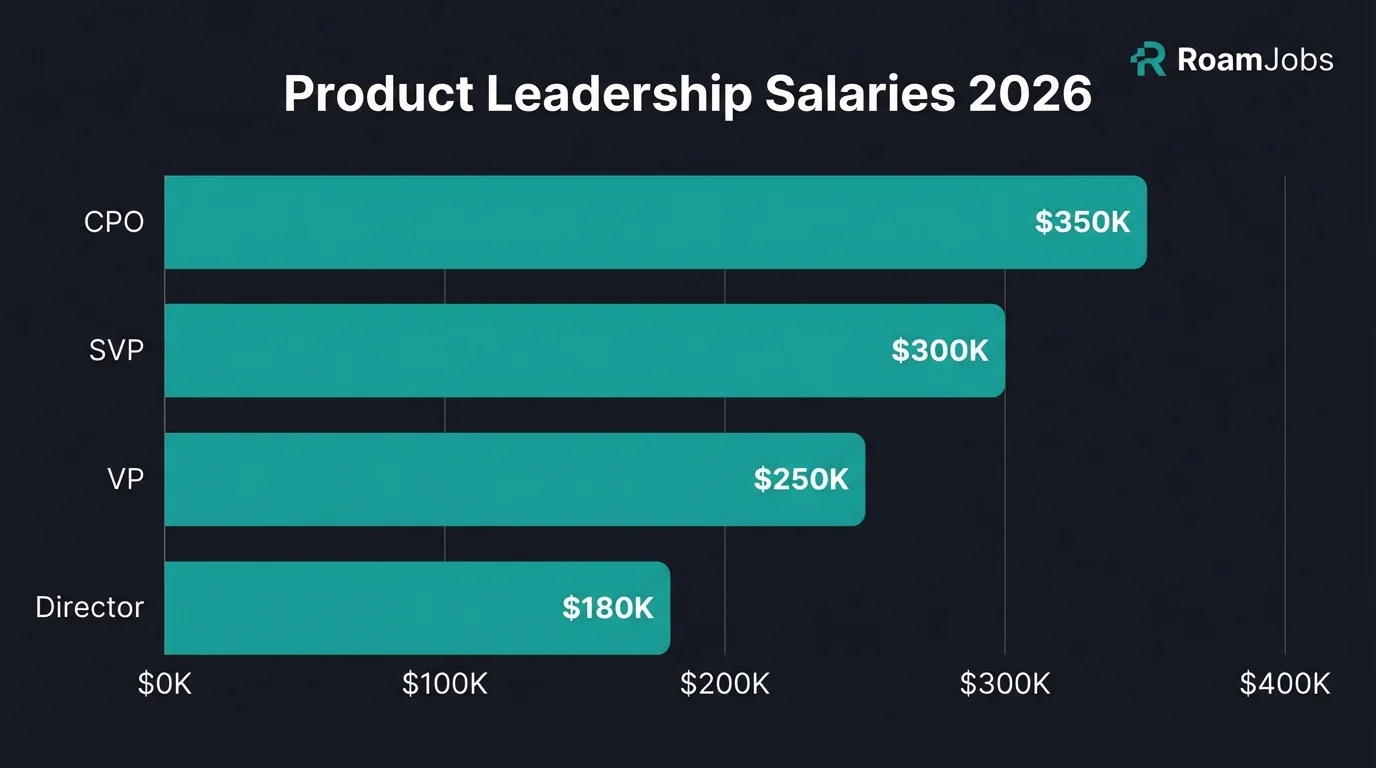
Remote product leadership roles—VP of Product, Chief Product Officer (CPO), and Head of Product—represent the pinnacle of product management careers, with total compensation ranging from $200,000 to $600,000+ for US-based positions. These executives own product vision, build and scale product organizations, drive company strategy at the board level, and ensure product excellence across distributed teams. In 2026, remote product leadership has become increasingly common as companies recognize that strategic product thinking transcends physical location. The role demands mastery of several disciplines: crafting compelling product vision that aligns stakeholders across time zones, building world-class PM teams without in-person mentorship, communicating with boards and investors asynchronously, and maintaining product velocity in distributed environments. Success requires demonstrating not just product excellence but executive presence—the ability to influence company direction, manage P&L responsibility, and represent product at the highest organizational levels while working remotely.
What Remote Product Leaders Actually Do
Product leadership at the VP and CPO level differs fundamentally from individual product management. While PMs own features and products, product executives own product organizations, company strategy, and market positioning. Remote product leaders must accomplish all of this while building culture and alignment across distributed teams.
Day-to-Day Responsibilities
Vision and Strategy Ownership
Product leaders define where the company is heading from a product perspective. This means developing multi-year product vision, identifying market opportunities, making portfolio-level prioritization decisions, and ensuring all product work ladders up to strategic goals. Remote leaders must communicate this vision with exceptional clarity since they cannot rely on hallway conversations or in-person charisma to align stakeholders.
Building and Scaling Product Organizations
Hiring, developing, and retaining excellent product managers is arguably the most important job of a product leader. This includes defining PM career ladders, establishing hiring bars, creating growth frameworks, and ensuring the organization has the talent needed to execute the strategy. Remote product leaders face unique challenges in assessing PM candidates virtually, onboarding new PMs without in-person shadowing, and developing talent through video-based mentorship.
Executive Alignment and Communication
Product leaders work constantly with the CEO, board, and fellow executives to shape company direction. This involves presenting product strategy to the board, aligning with the CTO on technical direction, partnering with the CFO on investment decisions, and collaborating with the CMO on go-to-market strategy. Remote executives must excel at async communication, executive presentations over video, and building trust without in-person relationship building.
Board Communication and Investor Relations
CPOs and senior VPs often present to boards and participate in investor meetings. They translate product strategy into business terms, explain market positioning, and demonstrate how product investments drive company value. Remote leaders must be particularly skilled at creating compelling materials that communicate strategy without real-time explanation.
Cross-Functional Leadership
Product leaders ensure alignment between product, engineering, design, marketing, sales, and customer success. They resolve cross-functional conflicts, establish processes for collaboration, and ensure the entire company moves in the same direction. In remote settings, this requires exceptional documentation, clear decision-making frameworks, and deliberate relationship building across functions.
P&L and Business Responsibility
Senior product leaders often own business metrics—revenue, retention, expansion, and profitability for their product lines. They make investment decisions, allocate resources across products, and are accountable for business outcomes. This accountability requires disciplined measurement, clear communication of results, and executive-level judgment about tradeoffs.
VP Product vs CPO vs Head of Product
Understanding title distinctions helps you target appropriate opportunities:
Head of Product is typically the most senior product person at early-stage companies (Series A-B) with smaller product teams (3-15 PMs). The Head of Product often remains hands-on with product work while building the initial product organization. Compensation ranges from $200,000-$350,000, often with significant equity (0.5-2.0%). This role suits experienced senior PMs making their first leadership move or directors seeking broader scope at a smaller company.
VP of Product leads product organizations at growth-stage or larger companies, typically managing 15-50+ PMs across multiple product lines. VPs focus more on organizational leadership than hands-on product work, though they remain deeply involved in strategic decisions. They usually report to the CEO or CPO. Compensation ranges from $265,000-$450,000 with meaningful equity (0.3-1.5% at private companies). This role requires proven ability to build and scale product teams.
Chief Product Officer (CPO) is the most senior product executive, typically at larger companies (Series C+ or public). CPOs own all product activities, sit on the executive team, and often have board-level visibility. They focus primarily on strategy, organization building, and executive alignment. Compensation ranges from $400,000-$600,000+ with substantial equity or RSU grants. CPO roles require demonstrated success leading large product organizations and influencing company strategy.
Senior VP of Product exists at large companies where multiple VPs report to an SVP who reports to the CPO or CEO. SVPs typically own major product domains (e.g., SVP of Platform Products, SVP of Consumer Products) and manage VP-level leaders. Compensation falls between VP and CPO levels.
Leading Remote Product Organizations
Remote product leadership requires adapting traditional leadership practices for distributed environments:
Vision Communication at Scale
In-office leaders can repeat the product vision casually—in all-hands, at lunch, in hallway conversations. Remote leaders must be far more deliberate. This means comprehensive vision documentation, regular video updates, async Q&A forums, and repeated communication through multiple channels. The best remote product leaders create artifacts that travel—vision documents, strategy decks, and recorded presentations that can be consumed asynchronously and shared throughout the organization.
Building Culture Without Physical Presence
Product culture—how decisions are made, how teams collaborate, what excellence looks like—normally develops through observation and osmosis. Remote leaders must explicitly define and document culture, create rituals that reinforce it, and model desired behaviors in visible ways. This might include documenting decision-making frameworks, creating PM onboarding programs, establishing recognition practices, and scheduling regular team events (virtual and in-person).
Developing PM Talent Remotely
Developing product managers traditionally involves shadowing, real-time feedback, and observation. Remote leaders must create structured development programs: regular 1:1s with development focus, explicit feedback frameworks, stretch assignments with clear coaching, peer learning programs, and access to external development resources. The best remote product leaders maintain development as a visible priority despite distance.
Maintaining Strategic Alignment
With distributed teams working across time zones, maintaining strategic alignment requires constant attention. Remote product leaders establish clear planning rhythms, document strategic context thoroughly, create forums for alignment discussions, and use tools that make strategy visible to everyone. The goal is ensuring every PM understands how their work connects to company strategy without requiring synchronous communication.
Seniority Levels and Compensation
Understanding the progression from Director through CPO helps you plan your career trajectory and target appropriate opportunities.
Lead / Director Product
8-12 years experience
Your First Product Leadership Role
Directors of Product represent the entry point into product leadership. You’ve typically managed individual PMs for 2-4 years as a Group PM or Senior PM and are now taking on broader organizational responsibility. Director roles exist at larger companies with established product organizations or at growth-stage startups needing to build out their PM teams.
Key Skills to Develop
- Hiring and talent assessment: You’ll be responsible for building your team, which means developing expertise in evaluating PM candidates and making strong hiring decisions.
- Manager development: Beyond managing PMs, you’re now developing PM managers and creating growth paths for your team.
- Strategic planning: Contributing to product strategy beyond your immediate product area and thinking portfolio-level about resource allocation.
- Executive communication: Presenting to leadership, influencing peers, and representing product in cross-functional discussions.
- Organizational design: Structuring teams for optimal delivery, deciding when to specialize or generalize, and evolving team structures as the company grows.
What Companies Expect
- Track record of managing PM teams (typically 3-8 PMs) with demonstrated success in hiring, developing, and retaining talent
- Product outcomes: features shipped, metrics moved, user problems solved under your leadership
- Cross-functional effectiveness working with engineering directors and design leads
- Strategic thinking demonstrated through product direction you’ve set and roadmaps you’ve owned
- Remote-specific: experience leading distributed PMs or strong track record with async communication
Typical Scope
Directors typically manage 6-15 PMs across 2-4 teams or product areas. You might own an entire product line (e.g., Director of Marketplace Products) or a functional domain (e.g., Director of Growth Product). You’ll have Group PMs or Senior PMs reporting to you who manage individual teams, while you focus on organizational health and strategic direction.
Compensation Breakdown (US Remote)
Base salaries range $170,000-$225,000, with total compensation reaching $200,000-$275,000 when including equity and bonus. Startup equity typically ranges 0.15-0.5%, while public company RSU grants might add $50,000-$100,000 annually. Annual bonuses of 15-25% are common at this level.
Path to VP
Directors aspiring to VP roles focus on expanding scope, demonstrating strategic impact, and building executive relationships. Key transitions include owning larger product areas, taking on P&L responsibility, and showing ability to influence company strategy beyond product.
VP / Executive Product
10-15 years experience
Owning Product Organizations
VPs of Product lead significant product organizations, typically managing Directors and owning multiple product lines or the entire product function at smaller companies. This is the level where you’re truly shaping company direction through product, not just executing within a defined strategy.
Key Skills at This Level
- Organization building at scale: Designing product org structures, establishing PM practices across the company, and scaling teams through hyper-growth.
- Executive partnership: Working as a peer with the CTO, CMO, and other executives to shape company strategy, not just product strategy.
- Board-level communication: Some VP roles include board presentations, requiring ability to communicate product strategy in business and investment terms.
- P&L ownership: Many VPs own business metrics for their product lines—revenue, retention, expansion—and must make investment decisions accordingly.
- Strategic planning: Leading annual and multi-year planning processes, making portfolio-level resource allocation decisions, and balancing short-term execution with long-term vision.
What Companies Expect
- Proven success building and scaling product organizations (typically from 10 to 30+ PMs)
- Demonstrated strategic impact on company outcomes beyond product execution
- Executive presence and communication skills for C-suite and potentially board interactions
- Strong track record developing product leaders (Directors, Group PMs)
- Experience navigating organizational complexity and cross-functional challenges
- Remote-specific: success leading distributed product teams, ability to build culture and alignment remotely
Typical Scope
VPs typically manage 15-50 PMs organized under 3-6 Directors, owning multiple product lines or the entire product function. At larger companies, you might be VP of a specific domain (VP of Platform, VP of Consumer Products). At growth-stage companies, you might be the senior-most product leader reporting to the CEO.
Compensation Breakdown (US Remote)
Base salaries range $220,000-$300,000, with total compensation reaching $265,000-$350,000 at growth-stage companies and $350,000-$450,000 at well-funded or public companies. Equity stakes of 0.3-1.0% at private companies or substantial RSU grants ($100,000-$200,000+ annually) at public companies. Bonuses of 20-35% of base are typical.
Key Transitions at This Level
The VP level is where you decide whether to pursue CPO/executive track or remain as a senior VP. CPO paths require demonstrating executive-level impact—influencing company strategy, building exceptional organizations, and earning trust of boards and investors. Some excellent VPs prefer remaining in strong VP roles rather than taking on the full executive scope of CPO positions.
Senior VP Product
12-18 years experience
Managing Multiple Product Domains
Senior VPs of Product exist at larger companies where multiple VPs report to an SVP who reports to the CPO or CEO. This level involves managing VP-level leaders and owning broad product domains.
Key Skills at This Level
- Managing executives: Your direct reports are VPs who themselves manage large organizations. Developing executive talent requires different skills than developing individual contributors or managers.
- Portfolio strategy: Making decisions about resource allocation across major product areas, managing investments at the portfolio level, and balancing competing priorities.
- Enterprise influence: At large companies, SVPs navigate complex organizational dynamics, building coalitions and driving change across massive organizations.
- Market and competitive strategy: Setting market positioning, competitive response, and strategic direction at the portfolio level.
- Executive team partnership: Working as a senior member of the executive team, influencing company-wide decisions beyond product.
What Companies Expect
- Track record managing VP-level product leaders
- Experience with portfolio-level strategy and resource allocation
- Success scaling product organizations through multiple growth phases
- Executive presence suitable for board-level visibility
- Deep domain expertise in relevant product areas
- Remote-specific: proven ability to lead large distributed product organizations
Typical Scope
SVPs manage 3-6 VPs leading 50-150+ PMs across major product domains. At a company like Salesforce, this might be SVP of Sales Cloud Products. At a company like Airbnb, SVP of Host Products. The role requires balancing significant strategic responsibility with supporting VPs who run their own large organizations.
Compensation Breakdown (US Remote)
Base salaries range $280,000-$380,000, with total compensation reaching $340,000-$450,000 at private companies and potentially exceeding $500,000 at large public companies with substantial equity. Equity stakes of 0.5-1.5% at private companies or RSU grants of $150,000-$300,000+ annually at public companies.
VP / Executive Chief Product Officer
15+ years experience
C-Suite Product Leadership
Chief Product Officers represent the apex of product careers—full executive responsibility for all product activities, C-suite membership, and board-level visibility. CPOs shape company strategy, own product organization outcomes, and represent product at the highest levels.
Key Skills at This Level
- Executive leadership: Functioning as a peer to the CEO, CTO, CFO, and other C-suite executives. Contributing to company strategy beyond product.
- Board communication: Regular board presentations, investor communications, and representing product to shareholders and stakeholders.
- Organizational transformation: Driving major changes in product approach, culture, or structure to achieve strategic goals.
- M&A and strategic partnerships: Evaluating acquisitions, driving product integration, and managing strategic partnerships.
- Public presence: External representation through speaking, press, and industry presence that reinforces company positioning.
What Companies Expect
- Proven track record as VP or SVP building exceptional product organizations
- Demonstrated impact on company strategy and business outcomes
- Executive presence and communication skills for board and investor interactions
- Experience navigating company-defining decisions and transformations
- Strong reputation in the product community and relevant industries
- Remote-specific: success building world-class remote product organizations, ability to maintain executive presence and influence without physical presence
Typical Scope
CPOs own entire product organizations—potentially 50-200+ PMs across all product areas. They set product strategy, own product OKRs, manage the product leadership team, and represent product at the executive and board level. At some companies, CPOs also own adjacent functions like design or product marketing.
Compensation Breakdown (US Remote)
Base salaries range $350,000-$500,000, with total compensation reaching $420,000-$600,000+ when including equity and bonus. CPO equity stakes at private companies typically range 0.5-2.5%, representing significant ownership. At public companies, RSU grants can exceed $300,000-$500,000 annually. Bonuses of 30-50% of base are common, sometimes with additional incentives tied to company performance.
The CPO Decision
Not every VP should pursue CPO roles. The CPO position involves significant political navigation, board accountability, and organizational responsibility that some excellent product leaders find less satisfying than hands-on product work. Consider whether you’re energized by executive leadership or whether a strong VP role with more product focus suits you better.
Essential Skills and Leadership Tools
Product leadership requires mastering frameworks and tools that enable strategic thinking, organizational alignment, and executive decision-making—especially in distributed environments.
Strategic Planning Frameworks
Strategic Planning Frameworks for Product Leaders
Source: RoamJobs 2026 Product Leadership Analysis| Framework | Best For | Strengths | Time Horizon | Complexity |
|---|---|---|---|---|
| OKRs | Quarterly alignment | Measurable outcomes, alignment | Quarterly to Annual | Medium |
| North Star Metric | Company-wide focus | Simplicity, focus | Multi-year | Low |
| MECE Roadmapping | Portfolio prioritization | Comprehensive coverage | Annual | High |
| Jobs-to-be-Done | Market positioning | Customer-centric strategy | Multi-year | Medium |
| Three Horizons | Innovation portfolio | Balancing core and new | Multi-year | Medium |
| Strategy Maps | Executive communication | Visual strategy alignment | Annual | Medium |
Data compiled from RoamJobs 2026 Product Leadership Analysis. Last verified January 2026.
OKRs (Objectives and Key Results): The dominant framework for product organization alignment. Product leaders set company and product-level OKRs, cascade them through the organization, and use them to drive quarterly and annual planning. Remote leaders rely heavily on OKRs because they create explicit alignment that doesn’t depend on informal communication.
North Star Metric: Identifying the single metric that best captures the value you create for customers. Product leaders use North Star Metrics to focus entire organizations, make tradeoff decisions, and communicate strategy simply. Examples include Airbnb’s “Nights Booked” or Spotify’s “Time Spent Listening.”
Three Horizons: Balancing investment across core business (Horizon 1), adjacent opportunities (Horizon 2), and transformational innovation (Horizon 3). CPOs use this framework for portfolio-level resource allocation decisions.
Team Leadership Tools
Team Leadership and Collaboration Tools
Source: RoamJobs 2026 Tool Analysis| Tool | Best For | Key Features | Remote Value | Pricing |
|---|---|---|---|---|
| Notion | Strategy documentation | Flexible docs, databases | Very High | $10/user/mo |
| Confluence | Enterprise documentation | Integration with Atlassian | High | $6/user/mo |
| Productboard | Product planning | Roadmap visualization | Very High | $20/user/mo |
| Lattice | Performance management | Goals, reviews, feedback | Very High | $11/user/mo |
| 15Five | Continuous feedback | Weekly check-ins | Very High | $4/user/mo |
| Donut | Team connection | Random 1:1 pairing | High | $3/user/mo |
Data compiled from RoamJobs 2026 Tool Analysis. Last verified January 2026.
Documentation Platforms: Remote product leaders need robust documentation systems. Notion has become the default for product organizations, enabling strategy docs, team wikis, meeting notes, and decision logs in one place. The key is establishing documentation culture—making written communication the norm rather than the exception.
Performance Management: Tools like Lattice and 15Five help remote leaders maintain visibility into team health, run structured feedback cycles, and track goals. Product leaders use these to ensure distributed teams stay aligned and engaged.
Roadmapping Tools: Productboard, Aha!, and similar tools help communicate product direction across the organization. Remote leaders rely on these tools for visibility since stakeholders can’t walk by and see what teams are working on.
Building Product Vision and Strategy
Crafting Compelling Vision
Product vision at the leadership level differs from product-level vision. You’re articulating where the company is heading, not just where a product is going. Effective product visions:
- Connect to customer problems and market opportunities
- Create alignment without being overly prescriptive
- Inspire teams while remaining grounded in reality
- Travel well across the organization (easy to repeat and understand)
Remote leaders must be especially skilled at vision communication because they can’t rely on charisma or in-person presence. Vision must be captured in documents, videos, and presentations that work asynchronously.
Strategic Planning Processes
Product leaders typically run annual and quarterly planning processes that align the organization around priorities. Remote planning requires:
- Clear input templates and timelines shared in advance
- Async opportunities for teams to propose and discuss priorities
- Synchronous sessions for alignment decisions (with excellent facilitation)
- Comprehensive documentation of decisions and rationale
- Follow-up communication to ensure alignment lands
Portfolio Management
CPOs and senior VPs make portfolio-level decisions: how much to invest in core products versus new opportunities, when to sunset products, how to balance customer segments. These decisions require frameworks for evaluation, clear criteria, and ability to communicate difficult tradeoffs.
Hiring and Developing PM Talent
Building World-Class PM Teams
Product leaders are ultimately judged by the quality of their organizations. Building excellent PM teams requires:
- Clear PM job architecture with defined levels and expectations
- Strong hiring process that identifies product excellence
- Development programs that grow PMs through the career ladder
- Performance management that reinforces expectations
- Retention focus through compelling work and growth opportunities
Remote PM Hiring
Evaluating PM candidates remotely requires assessing product sense, communication skills, and remote work capability simultaneously. Product leaders establish:
- Structured interview processes with clear rubrics
- Case studies and exercises that reveal product thinking
- Written components that assess async communication
- References specifically addressing remote work patterns
- Trial periods or projects when appropriate
PM Development at Scale
Developing PMs without in-person mentorship requires deliberate programs:
- PM onboarding with clear milestones and support
- Regular 1:1s focused on development, not just status
- Peer learning programs (PM critique groups, reading clubs)
- External development (conferences, courses, coaching)
- Stretch assignments with explicit growth goals
Executive Communication and Board Presentations
Communicating with Executives
Product leaders must translate product thinking into business language that resonates with executives who don’t have product backgrounds. This means:
- Leading with business outcomes, not product features
- Using frameworks executives understand (market share, competitive position, ROI)
- Being concise—executives have limited time and attention
- Anticipating questions and concerns
- Building relationships that create trust for harder conversations
Board Presentations
CPOs and senior VPs often present to boards. Effective board communication requires:
- Understanding what board members care about (company value, risk, market position)
- Presenting strategy in terms of investment thesis and competitive advantage
- Using metrics that boards understand (revenue, retention, market share)
- Being honest about challenges while maintaining confidence
- Creating materials that can be consumed asynchronously (board members often review materials before meetings)
Remote Executive Presence
Building executive presence remotely requires intentional effort:
- Professional video setup (lighting, audio, background)
- Confident, clear communication on camera
- Strong written communication for async contexts
- Consistent follow-through on commitments
- Proactive relationship building with peers and executives
Companies Hiring Remote Product Leaders
The remote product leadership market includes established remote-first companies, traditional companies with remote executive roles, and startups building remote product organizations.
Remote-First Companies with Product Leadership Opportunities
GitLab has operated fully remote since founding with their entire management playbook publicly documented. Product leadership roles exist across their DevOps platform, with VPs managing distributed PM teams globally. GitLab emphasizes transparent decision-making, async communication, and results-based evaluation. Compensation is competitive with location-adjusted pay.
Automattic (WordPress, WooCommerce, Tumblr) has been distributed since 2005 with 2,000+ employees globally. Product leadership roles span multiple products serving hundreds of millions of users. Automattic emphasizes writing culture, autonomy, and long-term thinking. They have VP and Director roles across their product portfolio.
Zapier built their product organization around remote work principles. Product leadership roles focus on their automation platform, serving millions of users. Known for exceptional documentation and transparent culture. VPs and Directors manage distributed PM teams across time zones.
Webflow operates remote-first with product leadership roles across their visual web development platform. They’ve built sophisticated no-code/low-code products requiring strong product leadership. Director and VP opportunities exist for experienced leaders.
Notion expanded remote options significantly and hires product leaders for their productivity platform. The company has experienced rapid growth, creating VP and Director opportunities. Strong emphasis on product quality and design excellence.
Linear operates fully remote with a small, highly impactful product team. While their PM team is small, they hire exceptional talent for leadership roles. Known for product quality and developer experience focus.
Remote.com builds products for distributed work and practices what they preach with remote product leadership. VP and Director roles span their global employment platform. Strong alignment between product and company mission.
Deel has grown rapidly in the global payroll and compliance space with remote product leadership opportunities. Directors and VPs manage teams building products for international employment. Fast-paced environment with significant growth.
Traditional Companies with Remote Product Leadership
Shopify went “digital by default” with product leadership roles across their commerce platform. VPs and Directors manage distributed PM teams building for millions of merchants. Large product organization with clear career paths. Location-based pay but broad geographic coverage.
Stripe maintains distributed product teams with leadership opportunities across payments infrastructure. Senior product leaders manage teams across their financial technology platform. Exceptional compensation with some regional restrictions. Known for high bar in hiring.
Atlassian offers “Team Anywhere” flexibility with product leadership across Jira, Confluence, and Trello. Mature product organization with established leadership practices. VP and Director roles span multiple product lines.
HubSpot provides @flex remote options with product leadership across their CRM and marketing platform. Strong people-first culture with development opportunities. Directors and VPs lead distributed PM teams.
Coinbase committed to remote-first with product leadership across cryptocurrency and blockchain products. VPs manage teams spanning trading, security, and platform. Fast-paced environment with crypto-focused compensation.
Twilio maintains distributed product leadership across communications APIs and platforms. Directors and VPs lead PM teams for developer-focused products. Strong customer focus and technical depth.
Finding Executive Opportunities
Many product leadership positions are never publicly posted. Develop sourcing strategies beyond job boards:
Executive Recruiters
For VP and CPO roles, build relationships with recruiters specializing in product leadership:
- Riviera Partners (strong in product leadership)
- True Search
- Daversa Partners
- Greylock Talent (for portfolio companies)
- Various boutique firms specializing in product
Executive recruiters work on retained searches for senior roles—having established relationships surfaces opportunities you’d never find otherwise.
Network Cultivation
Build relationships with:
- Other product leaders who can refer you
- VCs who can introduce you to portfolio companies
- Board members who serve on multiple companies
- CEOs at companies in your target stage/sector
Direct Outreach
Research companies you’d want to lead product for:
- Connect with CEOs and founders on LinkedIn
- Engage thoughtfully with company product blogs
- Attend events where target company leaders speak
- Build reputation through writing and speaking
Executive Presence
Make yourself findable:
- Complete LinkedIn profile emphasizing leadership scope
- Thought leadership through writing or speaking
- Board advisory roles that expand network
- Industry involvement that raises profile
Evaluating Remote Leadership Opportunities
When considering remote product leadership roles, assess:
Remote Culture Maturity
- How long has the company operated remotely?
- What systems exist for remote leadership effectiveness?
- How do other remote executives describe the culture?
- What’s the time zone distribution of teams you’d manage?
Executive Team Dynamics
- How does the CEO work with remote executives?
- What’s the communication pattern among executives?
- How are remote leaders included in strategic decisions?
- Are there in-person executive gatherings?
Board Expectations
- How does the board interact with remote executives?
- What’s expected for board presentations?
- Is there flexibility in board meeting attendance?
Organizational Scope
- What’s the size and structure of the product organization?
- What’s the relationship with engineering and design leadership?
- What decisions are centralized versus distributed?
- What resources exist for organizational support?
Interview Deep Dive
Remote product leadership interviews evaluate strategic thinking, leadership capability, executive presence, and cultural fit through extensive processes.
Interview Process Overview
Typical remote product leadership interview processes include:
- Executive Recruiter Screen (30-45 min): Background, motivation, compensation expectations
- CEO or Hiring Executive Screen (45-60 min): Strategic fit, leadership philosophy
- Strategic Case Study (60-90 min): Product strategy problem-solving
- Leadership Deep Dive (60 min): Team building, organizational design
- Cross-Functional Interviews (2-3 sessions): CTO, CMO, CFO, or other executives
- Board Member Interview (30-45 min, for CPO roles): Executive presence, strategic thinking
- Team Interviews (60 min): Meeting potential direct reports
- Reference Calls: Extensive references including 360 feedback
Prepare specific examples for each interview type, tailored to remote context.
Strategy and Vision Questions
What interviewers assess: Your strategic thinking process, stakeholder engagement approach, and ability to develop compelling vision.
Strong response structure:
- Discovery phase: understanding market, customers, competitive landscape, company capabilities
- Stakeholder engagement: how you’d involve CEO, board, executives, customers
- Framework application: how you’d structure the vision development
- Communication: how you’d roll out and socialize the vision
- Iteration: how you’d refine based on feedback and changing conditions
Key elements to include:
- Customer and market research as foundation
- Alignment with company mission and business strategy
- Involvement of key stakeholders in development
- Clear communication and cascade plan
- Mechanisms for maintaining and updating vision
Remote-specific considerations:
- How you’d gather input across distributed stakeholders
- Documentation approach for vision artifacts
- Async communication of vision across organization
- Tools for maintaining visibility to vision
What interviewers assess: Your onboarding approach, diagnostic capability, and prioritization framework.
90-day framework:
First 30 days (Listen and Learn):
- 1:1s with every PM and product leader
- Meetings with cross-functional executives
- Customer and user conversations
- Review of product metrics, roadmaps, and recent decisions
- Understanding of organizational dynamics and challenges
Days 30-60 (Diagnose and Align):
- Synthesis of findings and identification of themes
- Alignment conversations with CEO and executives
- Identification of quick wins and urgent issues
- Beginning to develop strategic hypotheses
- Building relationships and trust
Days 60-90 (Prioritize and Act):
- Developing strategic priorities and sharing with leadership
- Implementing quick wins that build credibility
- Beginning organizational improvements if needed
- Establishing regular communication rhythms
- Setting foundation for longer-term changes
Remote-specific elements:
- Scheduling 1:1s across time zones
- Building relationships through video when you can’t meet in person
- Documenting findings comprehensively for async sharing
- Establishing communication patterns early
What interviewers assess: Your strategic analysis capability, business acumen, and decision-making framework.
Evaluation framework:
Market Assessment:
- Market size, growth, and dynamics
- Competitive landscape and positioning opportunities
- Customer needs and willingness to pay
- Regulatory and compliance considerations
Strategic Fit:
- Alignment with company mission and vision
- Leverage of existing capabilities and assets
- Potential for sustainable competitive advantage
- Impact on core business (distraction risk)
Execution Requirements:
- Capabilities needed (build, buy, partner)
- Resource requirements and timeline
- Organizational implications
- Risk factors and mitigation
Financial Analysis:
- Investment required
- Revenue potential and timeline
- Impact on company financials
- Comparison with alternative investments
Recommendation approach:
- Clear recommendation with rationale
- Key assumptions and risks
- Suggested next steps if proceeding
- Criteria for success and exit conditions
What interviewers assess: Your ability to make difficult tradeoffs, communicate hard decisions, and manage stakeholder impact.
Strong response structure:
- Context: the portfolio situation and competing priorities
- Analysis: how you evaluated the tradeoff
- Decision process: stakeholders involved and how you reached the decision
- Communication: how you announced and explained the decision
- Outcome: results and any adjustments
Key elements to demonstrate:
- Rigorous analytical approach to comparison
- Stakeholder involvement appropriate to decision scope
- Clear communication of rationale
- Handling of disappointed stakeholders
- Follow-through on implementation
- Willingness to revisit if circumstances changed
What interviewers assess: Your understanding of go-to-market strategy and organizational design.
Response framework:
Understanding the models:
- PLG: product drives acquisition, conversion, expansion through self-serve
- SLG: sales team drives enterprise deals with product supporting
- Hybrid: combining both models for different segments or motions
Organizational considerations:
- Dedicated PLG product team focused on self-serve experience
- Enterprise product team supporting sales with features and customization
- Platform team serving both motions
- Growth team spanning both with experimentation focus
Balance factors:
- Customer segment needs and buying patterns
- Company stage and growth priorities
- Resource constraints and focus
- Metric frameworks for each motion
Key principles:
- Clear ownership of each motion
- Shared platform and infrastructure
- Metrics that capture full customer journey
- Regular coordination between teams
Leadership and Team Building Questions
What interviewers assess: Your change management approach and ability to improve organizational health.
Turnaround framework:
Immediate actions (weeks 1-4):
- Listen extensively before making changes
- Identify quick wins to build credibility and morale
- Address any urgent performance issues
- Establish communication rhythms and transparency
Diagnostic phase (weeks 2-6):
- Understand root causes of performance issues
- Identify organizational strengths to build on
- Assess talent and determine who’s in the right role
- Map stakeholder perceptions and relationship issues
Stabilization (weeks 4-12):
- Implement quick wins and communicate progress
- Begin addressing systemic issues
- Make necessary personnel changes if required
- Build the leadership team you need
Transformation (months 3-6+):
- Implement longer-term organizational improvements
- Establish new culture and expectations
- Build development programs
- Measure progress and adjust
Remote-specific considerations:
- Building trust quickly without in-person interaction
- Communicating change through async channels
- Maintaining morale during transformation
- Creating visibility into progress
What interviewers assess: Your management practices and development focus for leaders.
1:1 approach for leaders:
Cadence and format:
- Weekly or bi-weekly 1:1s of 45-60 minutes
- Video-based for relationship building
- Shared agenda with both parties contributing
Content areas:
- Team health and organizational issues
- Strategic challenges and decisions
- Cross-functional dynamics
- Their development and career
- Information sharing and alignment
Development focus:
- Coaching on leadership challenges
- Feedback on their management approach
- Creating growth opportunities
- Helping them develop their own leaders
Key principles:
- Focus on their success, not just information extraction
- Coach rather than solve their problems for them
- Create space for difficult conversations
- Model the leadership behaviors you want to see
What interviewers assess: Your commitment to and approach for building diverse teams.
Framework for D&I in product organizations:
Hiring practices:
- Diverse candidate slates required for all roles
- Structured interviews with bias reduction
- Diverse interview panels
- Partnerships with organizations reaching underrepresented groups
- Removing unnecessary requirements that limit pools
Culture and retention:
- Inclusive meeting practices (especially important remotely)
- Sponsorship programs for underrepresented PMs
- Safe channels for raising concerns
- Visible leadership commitment
- Addressing issues when they arise
Advancement:
- Clear, objective promotion criteria
- Ensuring diverse PMs get visibility and stretch opportunities
- Development programs reaching all team members
- Monitoring advancement metrics for equity
Measurement:
- Tracking representation at all levels
- Monitoring inclusion through surveys
- Regular review of metrics with leadership
- Accountability for improvement
What interviewers assess: Your ability to make difficult people decisions and handle them professionally.
Strong response structure:
- Context: the situation and why it wasn’t working
- Process: how you reached the decision
- Execution: how you handled the separation
- Aftermath: how you supported the team and maintained continuity
- Reflection: what you learned
Key elements:
- Clear documentation of issues and feedback given
- Reasonable opportunity for improvement
- Decision made with appropriate input
- Professional, compassionate execution
- Team communication and support
- Process improvement based on learning
What to avoid:
- Blaming the person excessively
- Suggesting it was a surprise to them
- Showing insufficient humanity in the process
- Not taking responsibility for your role
What interviewers assess: Your approach to organizational alignment in remote settings.
Cascade framework:
Strategy documentation:
- Clear, written strategy documents that travel well
- Visual frameworks that communicate priorities
- Decision logs that explain rationale
- Regular updates as strategy evolves
Communication rhythms:
- All-hands or product all-hands for broad communication
- Leadership team meetings for alignment
- Team-level discussions to contextualize
- Async Q&A for questions and concerns
Enabling alignment:
- Clear connection between team work and strategy
- OKRs that ladder to strategic priorities
- Regular check-ins on alignment
- Forums for surfacing misalignment
Feedback loops:
- Mechanisms for bottom-up input
- Regular strategy review and update
- Measurement of alignment effectiveness
- Adjustment based on what’s working
What interviewers assess: Your approach to executive relationship building without physical presence.
Relationship building practices:
Structured touchpoints:
- Regular 1:1s with key peers (CTO, CMO especially)
- Executive team meetings with active participation
- Cross-functional planning sessions
Informal connection:
- Virtual coffee chats or informal video calls
- Participation in executive team social activities
- Finding opportunities for non-work conversation
Proactive collaboration:
- Seeking input on product decisions affecting their areas
- Offering support on their priorities
- Joint problem-solving on cross-functional challenges
- Celebrating shared wins
In-person when possible:
- Prioritizing executive team offsites
- Meeting in person when travel aligns
- Building deeper relationships when together
Key principles:
- Relationships require investment, especially remotely
- Proactive communication builds trust
- Finding win-win collaborations strengthens partnerships
- Being reliable and following through is essential
What interviewers assess: Your operational excellence and planning discipline.
Planning framework:
Annual planning:
- Strategic priorities set by leadership (informed by product input)
- Product strategy aligned to company direction
- Resource allocation across product areas
- High-level roadmap with major initiatives
- OKRs set for the year (with quarterly breakdowns)
Quarterly planning:
- Review of previous quarter outcomes
- Adjustment based on learnings and changes
- Detailed commitment for upcoming quarter
- Dependencies and risks identified
- Team-level OKRs finalized
Continuous planning:
- Regular roadmap updates as information changes
- Sprint-level execution within quarterly framework
- Mechanisms for adjusting when priorities shift
- Balance between commitment and flexibility
Remote-specific practices:
- Async input gathering before synchronous sessions
- Clear templates and timelines
- Documentation of decisions for those who can’t attend
- Follow-up communication ensuring alignment
What interviewers assess: Your ability to influence upward while maintaining productive relationships.
Response framework:
Understanding their perspective:
- What’s driving the CEO’s interest in this direction?
- What information or context do they have that you might not?
- What are their concerns about alternative approaches?
Building your case:
- Gather data and evidence supporting your view
- Frame in terms of company success, not just product concerns
- Anticipate objections and address them
- Consider alternatives that might address their underlying goals
Having the conversation:
- Choose appropriate timing and setting
- Present your perspective clearly and professionally
- Listen to their response and reasoning
- Seek to understand before pushing back
- Be open to changing your mind if their reasoning is sound
After the decision:
- If they agree, move forward with alignment
- If they disagree, commit to their direction and execute well
- If it’s truly a values violation, consider your options carefully
- Document learning for future situations
Key principles:
- Disagree and commit is essential for executives
- Your job is to give your best counsel, not to always win
- Preserving the relationship matters for long-term effectiveness
- Knowing when something is a resignation issue versus a disagreement
What interviewers assess: Your ability to assess team effectiveness beyond activity metrics.
High-performance indicators:
Outcome metrics:
- Are they moving the metrics that matter?
- Are they learning and improving from data?
- Are they solving customer problems effectively?
Execution quality:
- Are they shipping consistently and predictably?
- Is the quality of what they ship high?
- Are they managing scope and commitments well?
Team health:
- Is morale and engagement high?
- Is there healthy debate and collaboration?
- Are people growing and developing?
- Is retention strong?
Strategic alignment:
- Is the work clearly connected to strategy?
- Are they making good prioritization decisions?
- Are they avoiding rabbit holes and distractions?
Cross-functional effectiveness:
- Do they collaborate well with engineering and design?
- Are stakeholders satisfied with the partnership?
- Do they influence and align effectively?
Red flags for “just busy”:
- High output metrics but unclear outcomes
- Constant fire-fighting without improvement
- Team burnout and turnover
- Stakeholder frustration despite activity
- Work that doesn’t connect to strategy
What interviewers assess: Your conflict resolution skills and organizational design judgment.
Resolution approach:
Understanding the conflict:
- Meet with each leader individually to understand their perspective
- Identify the underlying interests beyond positions
- Understand historical context and relationship dynamics
- Assess whether this is a people issue or structural issue
Structural analysis:
- Is there an optimal organizational answer?
- What are the tradeoffs of different structures?
- Are there ways to clarify boundaries without major restructuring?
Facilitated resolution:
- Bring leaders together to discuss
- Focus on shared goals and customer value
- Work toward agreement on boundaries
- Document decisions clearly
Decision if needed:
- If they can’t agree, make the decision yourself
- Communicate rationale clearly
- Support both leaders in moving forward
- Monitor for continued friction
Key principles:
- Address conflicts promptly before they escalate
- Look for structural solutions to structural problems
- Don’t let strong performers become organizational blockers
- Model the collaboration you expect
What interviewers assess: Your commitment to customer-centricity and practical approach to staying grounded.
Staying connected practices:
Direct customer contact:
- Regular customer calls or visits (monthly minimum)
- Participation in customer advisory boards
- Joining sales or success calls periodically
- Reading customer feedback and support tickets
User research engagement:
- Attending or reviewing user research regularly
- Participating in usability testing occasionally
- Understanding user data and behavior patterns
- Ensuring organization prioritizes research
Team leverage:
- Creating culture where teams share customer insights
- Regular team presentations on customer learnings
- Customer quotes and stories in communications
- Celebrating customer-focused decisions
Systematic input:
- Product analytics dashboards for visibility
- NPS and satisfaction tracking
- Customer health metrics review
- Competitive and market monitoring
Key principles:
- Senior leaders lose touch easily—must be intentional
- Direct contact supplements but doesn’t replace team insights
- Customer focus must be modeled visibly
- Data and stories both matter
What interviewers assess: Your cross-functional philosophy and organizational design thinking.
Partnership philosophy:
Collaboration model:
- PM owns “what” and “why,” Design owns “how it looks/feels/works”
- Both contribute to “what” through discovery
- Strong partnership on user problems and solutions
- Respect for each discipline’s expertise
Organizational considerations:
- Design reporting to CPO vs. separate Head of Design
- Embedded designers vs. centralized design team
- Design system and consistency approaches
- Research ownership and collaboration
Working relationship practices:
- Joint discovery and research
- Regular PM-Design syncs
- Shared understanding of user problems
- Design involved early, not handed specs
- Mutual feedback and iteration
Key principles:
- Best products come from PM-Design partnership
- Neither discipline should “own” the other
- Clear roles with collaborative overlap
- Investment in relationship health
What interviewers assess: Your self-awareness, learning orientation, and how you handle mistakes.
Strong response structure:
- The decision: what you decided and why it seemed right
- The outcome: what actually happened and how you realized the mistake
- The impact: consequences of the wrong decision
- Your response: how you handled the situation once you recognized the error
- The learning: what you took away and how it changed your approach
Key elements:
- Genuine ownership without excessive self-criticism
- Clear analysis of what went wrong
- Specific learnings, not generic platitudes
- Evidence of changed behavior afterward
- Appropriate scale for the seniority level
What to avoid:
- Blaming others or circumstances
- Minimizing the mistake
- Not showing genuine learning
- Picking something too trivial
What interviewers assess: Your technical judgment and partnership with engineering.
Technical debt philosophy:
Understanding the tradeoff:
- Tech debt has real costs: velocity, reliability, team morale
- Features have real value: revenue, users, market position
- Neither should always win—it’s about balance
Decision framework:
- How is tech debt impacting velocity and reliability?
- What’s the cost of addressing it now versus later?
- What features would be delayed?
- What’s the risk of continued accumulation?
Product role:
- Understanding tech debt impact on product outcomes
- Including tech debt in planning conversations
- Advocating for sustainable pace
- Not overriding engineering on purely technical decisions
Best practices:
- Regular tech debt allocation (15-20% is common)
- Including tech debt in roadmap visibility
- Connecting debt to business impact
- Celebrating debt reduction alongside features
Key principles:
- Product leaders should care about tech debt
- Decision should involve engineering judgment
- Sustainable pace matters for long-term success
- Debt shouldn’t be invisible in planning
What interviewers assess: Your change management and communication skills.
Communication approach:
Preparation:
- Align with CEO and executives on messaging
- Brief key stakeholders individually before broad announcement
- Prepare comprehensive materials addressing obvious questions
- Anticipate concerns and prepare responses
The announcement:
- Clear explanation of what’s changing and why
- Honest acknowledgment of what this means for current work
- Vision for where this leads
- What’s staying the same (stability points)
- Timeline and next steps
Follow-up communication:
- Q&A forums for questions
- Manager briefings for cascade conversations
- Written documentation for reference
- Regular updates on transition progress
Supporting the transition:
- Clear direction for teams on changing work
- Support for people impacted by changes
- Quick wins to build momentum
- Adjustment as needed based on feedback
Remote-specific considerations:
- Video announcement for personal connection
- Comprehensive written materials for async consumption
- Multiple channels for questions
- Extra effort to monitor sentiment
What interviewers assess: Your evaluation criteria and self-awareness about fit.
Questions to discuss asking:
About the role and company:
- What does success look like in this role at 1 year? 3 years?
- What’s the biggest challenge the product organization faces?
- How does the CEO see the product function’s role?
- What’s the company’s appetite for risk and experimentation?
About remote leadership:
- How do remote executives stay connected and aligned?
- What’s the expectation for in-person presence?
- How does the board interact with remote executives?
- What time zones are the teams distributed across?
About organizational context:
- What’s the relationship between product and engineering leadership?
- What organizational changes are anticipated?
- How are product decisions made at the executive level?
- What resources exist for building the product organization?
About personal fit:
- What leadership styles have been successful here?
- What led to the opening—growth, departure, transformation?
- What’s the feedback on product leadership historically?
- How does the company handle disagreement at the executive level?
What interviewers assess: Your ambition, judgment about pace, and understanding of the opportunity.
Response framework:
Caveat appropriately:
- Acknowledge you’d need to learn more before committing to specifics
- Express that goals would be developed collaboratively with CEO/board
First-year priorities typically include:
- Understanding the business, customers, and market deeply
- Building relationships with executives and stakeholders
- Assessing and strengthening the product organization
- Developing or refining product strategy
- Establishing planning and execution rhythms
- Quick wins that build credibility and momentum
- Foundation for longer-term transformation
Balance showing ambition with realism:
- Significant progress is expected in year one
- But transformation takes time
- Early wins build credibility for bigger changes
- Listen-first approach prevents early missteps
Remote-specific elements:
- Establishing communication patterns
- Building distributed team culture
- Creating visibility and alignment mechanisms
- Developing strong relationships without physical presence
Frequently Asked Questions
Frequently Asked Questions
What's the typical path to becoming a VP of Product or CPO?
The most common path to product leadership follows: PM → Senior PM → Group PM/Lead PM → Director of Product → VP of Product → CPO. This typically takes 12-18 years from first PM role to VP level. However, paths vary significantly. Some product leaders come from engineering or design backgrounds. Others take faster paths at high-growth startups where they can grow with the company. The key milestones are: (1) demonstrating product excellence as an IC, (2) proving ability to lead and develop other PMs, (3) showing strategic impact beyond your immediate product area, and (4) developing executive presence and communication skills. For VP roles, companies want to see you've built and scaled teams of 10+ PMs. For CPO roles, they want evidence of organizational impact at scale (50+ PMs) and executive-level influence.
How do I demonstrate executive presence when working remotely?
Executive presence remotely requires intentional development across several dimensions: (1) Visual presence—invest in professional video setup with good lighting, audio, and background. Look directly at camera when speaking. Dress appropriately for your company culture. (2) Communication clarity—structure your thinking clearly, speak with confidence, and avoid filler words. Practice presentations until they feel natural. (3) Written excellence—your async communication must be clear, concise, and compelling. Documents should be polished, emails should be well-structured. (4) Consistent reliability—follow through on commitments without fail. Be on time for meetings. Respond predictably. (5) Calm confidence—handle difficult situations with composure. Don't let stress show inappropriately. (6) Strategic thinking—demonstrate that you think about the business broadly, not just product narrowly. The key is that remote executive presence must be more intentional since you can't rely on physical charisma.
What equity should I expect in a VP or CPO role at a startup?
Equity varies significantly by company stage and role scope. At seed-stage companies, a first product hire who's effectively VP might receive 1-3% equity. At Series A, VPs typically receive 0.5-1.5%. At Series B, 0.3-0.75% is common. At Series C+, 0.15-0.4% is typical. CPO roles command premiums—often 50-100% higher than VP ranges at the same stage. These are initial grants; additional grants are common every 2-3 years. Key factors affecting equity: whether you're the first/founding product leader, company valuation, your competing offers, and negotiation. Always evaluate equity realistically—understand the strike price, vesting schedule, cliff, and exercise windows. Consider scenarios at different exit valuations. For most candidates, optimizing for the right opportunity matters more than maximizing initial equity, since executive success drives additional grants.
How do I build and maintain remote product culture at scale?
Building remote product culture requires explicit effort that would happen implicitly in-office: (1) Document your culture—write down how product decisions are made, what excellence looks like, how teams collaborate. If it's not written, it's not culture. (2) Establish rituals—product all-hands, demo days, wins celebrations, retrospectives. Rituals create shared experience. (3) Model the culture—your behavior defines culture more than your words. If you value async work, work async. If you value feedback, give and receive it publicly. (4) Hire for culture—screen for cultural fit alongside product skills. Onboard with culture emphasis. (5) Reinforce constantly—recognize behaviors that embody culture, address behaviors that don't. Use all-hands and communications to reinforce. (6) Enable informal connection—create spaces for non-work conversation, virtual social events, and relationship building. (7) Gather periodically—in-person team events are powerful for culture building. Even 2-3 times per year makes a difference.
What are the biggest challenges of remote product leadership compared to in-office?
Remote product leadership presents distinct challenges: (1) Building executive relationships without in-person time—you can't grab coffee, read body language, or have hallway conversations. Relationships require more deliberate effort. (2) Maintaining visibility into team health—you can't walk the floor and sense when something's wrong. You need explicit systems for understanding morale and engagement. (3) Developing talent remotely—mentorship and coaching are harder without observation and real-time feedback. Development programs must be more structured. (4) Creating alignment at scale—strategy communication that would happen through osmosis must be explicit and repeated through multiple channels. (5) Assessing PM performance—without observing PMs in meetings and conversations, you rely more on artifacts and outcomes. (6) Maintaining your own energy—executive roles are demanding, and remote work can be isolating. Self-care becomes more important. The good news: all challenges are solvable with intentionality, and remote leadership offers advantages in flexibility, focus time, and work-life integration.
Should I take a Head of Product role at a startup or a Director role at a larger company?
This decision depends on your goals and risk tolerance. Head of Product at a startup offers: broader scope and faster learning, potential for significant equity upside, opportunity to build from scratch, direct CEO relationship, and title/experience that accelerates your path. Risks include: less structure and mentorship, company risk (startups fail), potentially lower base compensation, and wearing many hats beyond product. Director at a larger company offers: more stability and established practices, mentorship from experienced leaders, clearer career path, stronger resume credibility, and typically higher guaranteed compensation. Risks include: smaller scope, slower pace, more politics, and less equity upside. If you're optimizing for learning and can afford risk, startup Head of Product accelerates growth. If you want stability or need specific skill development, larger company Director might be better. Consider also: at a startup, you'll build the playbook; at a larger company, you'll learn established playbooks. Both experiences are valuable at different career stages.
How do I handle board presentations as a remote product leader?
Board presentations require specific preparation: (1) Understand board composition—what backgrounds do members have? What are their priorities? What questions do they typically ask? (2) Align with CEO beforehand—ensure your message fits the broader narrative and anticipate concerns. (3) Lead with business impact—boards care about revenue, market position, competitive advantage. Frame product in these terms. (4) Be concise—board time is limited. Get to the point quickly and have detail ready for questions. (5) Prepare for remote delivery—excellent video setup, practiced presentation, reliable technology. (6) Handle questions confidently—it's okay to say 'I'll follow up' for detailed questions, but demonstrate command of the material. (7) Send materials in advance—boards often review materials before meetings. Well-prepared materials make the meeting more productive. (8) Follow up thoroughly—answer open questions promptly after the meeting. For remote boards, the prep materials are especially important since board members may have less real-time interaction with you.
What's the right span of control for product leaders at different levels?
Span of control varies by role and organizational design: Directors typically manage 4-8 direct reports who are senior PMs or Group PMs leading individual teams. VPs typically manage 4-7 Directors or senior leaders, indirectly overseeing 15-50+ PMs total. CPOs manage 3-6 VPs or senior leaders, indirectly overseeing the entire product organization. Key factors: (1) Seniority of reports—senior leaders need less management time. (2) Organizational stability—periods of change require more involvement. (3) Your other responsibilities—heavy strategic or board work reduces management capacity. (4) Remote dynamics—some leaders find remote management requires more time per report. Warning signs of too much span: you can't have meaningful 1:1s with reports, you don't understand what your teams are working on, or you're constantly context-switching. Warning signs of too little: you're micromanaging, teams don't have enough autonomy, or you're becoming a bottleneck.
How important is industry experience for remote product leadership roles?
Industry experience importance varies by company and situation. When it matters most: regulated industries (fintech, healthtech, edtech) where domain knowledge accelerates effectiveness; complex technical domains (infrastructure, developer tools) where understanding users is hard without background; industries with unique dynamics (marketplaces, gaming) where pattern recognition helps. When it matters less: consumer products where user empathy can be built; horizontal products (productivity, communication) serving diverse industries; early-stage companies valuing fresh perspectives. Many product leaders successfully transition across industries, especially when: (1) they have transferable product skills, (2) they invest heavily in learning the new domain, (3) the company has domain experts they can partner with, and (4) the product challenges are more universal than domain-specific. For VP/CPO roles, companies often prioritize leadership and organizational capability over industry experience, assuming you can learn the domain faster than a domain expert can develop leadership skills.
How do I negotiate a remote product leadership package effectively?
Executive compensation negotiation requires understanding all components: (1) Base salary—research ranges through levels.fyi, Glassdoor, and executive recruiter conversations. Know your market value. (2) Equity—understand the grant size, strike price (for options), vesting schedule, and refresh policy. Model scenarios at different valuations. (3) Bonus—target bonus percentage and achievement likelihood based on company history. (4) Sign-on—common for executives to cover foregone compensation or relocation. (5) Benefits—review health insurance, 401k matching, and professional development budgets. Negotiation approach: (1) Get the full offer before negotiating. (2) Express enthusiasm while raising concerns. (3) Use competing offers as leverage when available. (4) Prioritize what matters most to you. (5) Consider total compensation, not just base. (6) Get everything in writing. Remote-specific considerations: ensure equipment/home office budget, understand travel expectations and reimbursement, and clarify any geographic compensation adjustments. Don't negotiate so aggressively that you damage the relationship before starting.
What separates great remote product leaders from good ones?
Great remote product leaders distinguish themselves through: (1) Communication excellence—they write with exceptional clarity, present compellingly on video, and ensure their vision travels throughout the organization without requiring their presence. (2) Organizational building—they attract, develop, and retain exceptional PMs. Their organizations are known for PM talent. (3) Strategic impact—they shape company direction beyond product, influencing business strategy and market positioning. (4) Execution consistency—their teams ship reliably and move the metrics that matter. Good ideas become shipped products. (5) Cultural leadership—they create product cultures that people want to be part of, with clear values and strong engagement. (6) Cross-functional effectiveness—they're trusted partners to engineering, design, and go-to-market leaders. Collaboration is genuine, not performative. (7) Adaptability—they adjust strategy and organization as conditions change, rather than rigidly following plans. (8) Remote mastery—they've developed systems and practices that make remote leadership effective, and they help others do the same. Great leaders make these things look natural, but they result from years of intentional development.
How do I know if I'm ready for a CPO role versus staying at VP level?
Assess readiness across several dimensions: (1) Organizational scope—have you led organizations of 40+ PMs successfully? CPO roles typically require demonstrated ability to scale. (2) Executive partnership—do you work effectively with C-suite peers and contribute to company strategy beyond product? CPOs must be full executives, not just senior product people. (3) Board readiness—are you comfortable presenting to and engaging with board members? Many CPO roles include board exposure. (4) Business acumen—do you understand the business deeply beyond product? Revenue models, unit economics, market dynamics, competitive positioning. (5) Leadership energy—CPO roles are demanding. Do you have the energy and motivation for full executive responsibility? (6) Risk tolerance—CPO roles often carry more accountability and shorter tenures than VP roles. Are you prepared for that exposure? If you're strong on all dimensions and energized by the prospect, you're likely ready. If you have gaps, VP roles can help you develop. Some excellent product leaders intentionally stay at VP level for better work-life balance or preference for more hands-on product work.
Related Resources
Explore these related guides to continue building your remote product leadership capabilities:
- Remote Product Jobs Hub: Overview of the entire remote product landscape including all specializations
- Remote Product Manager Jobs: Deep dive into core PM roles and career paths
- Remote Engineering Manager Jobs: Understanding your engineering leadership counterparts
- Negotiating Remote Salary: Strategies for maximizing your compensation package
Next Steps in Your Product Leadership Journey
Landing a remote product leadership role requires positioning yourself as an executive who can lead organizations, shape strategy, and build culture without physical presence.
If you’re a Director targeting VP roles:
- Seek opportunities to expand scope and strategic influence
- Build executive relationships and visibility
- Document your organizational impact and team building success
- Develop board-level communication skills through practice
If you’re a VP targeting CPO roles:
- Demonstrate company-wide strategic impact beyond product
- Build relationships with boards through advisory roles or board observer experience
- Develop thought leadership through writing and speaking
- Network at the CPO level to understand role expectations
If you’re considering remote product leadership:
- Assess your remote leadership capabilities honestly
- Build systems and practices for distributed team leadership
- Develop async communication excellence
- Create visibility and presence without physical proximity
Remote product leadership offers exceptional opportunity for those who can demonstrate strategic vision, organizational excellence, and executive presence from anywhere. The companies building the future are increasingly distributed, and they need product leaders who can thrive in that environment.
Get Remote Product Leadership Insights
Weekly curated remote product executive opportunities, leadership insights, and career advice delivered to your inbox.
Frequently Asked Questions
How do I find remote product leadership jobs?
To find remote product leadership jobs, start with specialized job boards like We Work Remotely, Remote OK, and FlexJobs that focus on remote positions. Set up job alerts with keywords like "remote product leadership" and filter by fully remote positions. Network on LinkedIn by following remote-friendly companies and engaging with hiring managers. Many product leadership roles are posted on company career pages directly, so identify target companies known for remote work and check their openings regularly.
What skills do I need for remote product leadership positions?
Remote product leadership positions typically require the same technical skills as on-site roles, plus strong remote work competencies. Essential remote skills include excellent written communication, self-motivation, time management, and proficiency with collaboration tools like Slack, Zoom, and project management software. Demonstrating previous remote work experience or the ability to work independently is highly valued by employers hiring for remote product leadership roles.
What salary can I expect as a remote product leadership?
Remote product leadership salaries vary based on experience level, company size, location-based pay policies, and the specific tech stack or skills required. US-based remote positions typically pay market rates regardless of where you live, while some companies adjust pay based on your location's cost of living. Entry-level positions start lower, while senior roles can command premium salaries. Check our salary guides for specific ranges by experience level and geography.
Are remote product leadership jobs entry-level friendly?
Some remote product leadership jobs are entry-level friendly, though competition can be high. Focus on building a strong portfolio or demonstrable skills, contributing to open source projects if applicable, and gaining any relevant experience through internships, freelance work, or personal projects. Some companies specifically hire remote junior talent and provide mentorship programs. Smaller startups and agencies may be more open to entry-level remote hires than large corporations.
Continue Reading
Remote Product Jobs 2026: Complete Guide to PM, TPM & Leadership Careers
The definitive hub for remote product careers. Explore salary data, interview guides, and opportunities across product management, technical PM, product owner, and leadership roles.
Senior Remote Jobs 2026: Advancing Your Remote Career
Guide for senior professionals seeking remote positions including leadership roles and compensation negotiation.
Remote Executive Jobs 2026: C-Suite & VP Positions
Guide to landing remote executive positions including search strategies, compensation, and leading distributed organizations.
Land Your Remote Job Faster
Get the latest remote job strategies, salary data, and insider tips delivered to your inbox.