Remote Design Manager Jobs: Complete 2026 Career Guide
Everything you need to land a remote design manager job. Leading distributed design teams - salary data, interview questions, and companies hiring.
Updated January 20, 2026 • Verified current for 2026
Remote Design Managers lead distributed design teams, combining people management with design strategy to build high-performing creative organizations. With salaries ranging from $120K to $350K for US-based remote positions, this leadership role demands excellence in hiring, mentorship, design critique facilitation, and cross-functional collaboration—all executed across time zones without in-person interaction. The unique challenge of remote design management lies in maintaining team cohesion, fostering creative culture, and ensuring design quality when your team is spread across the globe. Success requires mastering async communication, building trust through virtual 1:1s, and creating systems that enable designers to do their best work independently. This comprehensive guide covers everything from transitioning out of IC work to landing director-level positions at remote-first companies, including 20+ interview questions with detailed answers, salary breakdowns by seniority, and strategies for building exceptional remote design teams.
What Does a Remote Design Manager Actually Do?
Remote Design Managers occupy a unique position at the intersection of design excellence and people leadership. Unlike individual contributors who focus on shipping designs, managers are responsible for the output and growth of their entire team. In a remote context, this responsibility becomes both more challenging and more critical.
Day-to-Day Responsibilities
People management and development
The core of design management is helping designers grow. In a remote environment, this means conducting regular 1:1 video calls with each direct report—typically weekly for 30-60 minutes. These conversations cover project progress, career development, skill growth, and personal wellbeing. Remote managers must be intentional about building relationships that would develop naturally in an office setting.
Design reviews and critique facilitation
Remote Design Managers run design reviews that maintain quality standards across the team. This involves facilitating async feedback through tools like Figma comments and Loom videos, as well as synchronous critique sessions via video call. The manager ensures feedback is constructive, actionable, and aligned with product and business goals.
Hiring and team building
Building a distributed design team requires a different approach than in-office hiring. Remote Design Managers develop job descriptions, screen portfolios, conduct video interviews, and evaluate candidates’ ability to work autonomously. They also focus on team composition—ensuring the right mix of skills, seniority levels, and time zone coverage.
Strategy and stakeholder management
Design Managers represent their team’s work to leadership, product, and engineering partners. They translate business objectives into design strategy, advocate for resources, and ensure design has a seat at the table for key decisions. In remote companies, this requires strong written communication and proactive relationship building.
Process and systems
Remote design teams need clear processes to function effectively. Managers establish workflows for design handoff, feedback cycles, design system governance, and project prioritization. They select and implement tools that enable async collaboration and maintain design quality.
Design Manager vs Design Lead vs Head of Design
Understanding the hierarchy helps clarify the Design Manager role:
Design Lead - A senior individual contributor who provides technical and creative direction on projects. Design Leads focus on the work itself—establishing design direction, mentoring on craft, and ensuring quality. They may not have direct reports or people management responsibilities.
Design Manager - Responsible for a team of designers (typically 3-8 direct reports). The focus shifts from personal output to team output. Design Managers own hiring, performance reviews, career development, and team health. They may still contribute to design work but their primary impact is through others.
Head of Design / Design Director - Manages multiple design managers or a larger design organization. Focuses on design strategy, organizational structure, executive relationships, and design culture across the company. Less involved in individual project reviews, more focused on systems and leadership.
VP of Design / Chief Design Officer - Executive-level role responsible for design across the entire organization. Sets vision, builds the leadership team, manages large budgets, and represents design at the highest levels of the company.
The Unique Challenges of Remote Design Leadership
Leading designers remotely introduces challenges that don’t exist in co-located teams:
Maintaining creative energy without a studio environment
Physical design studios foster spontaneous collaboration, visual inspiration, and creative energy. Remote managers must intentionally create virtual spaces that spark creativity—through design challenges, inspiration channels, virtual whiteboarding sessions, and team rituals.
Building trust without hallway conversations
Trust develops naturally through daily in-person interactions. Remote managers must be more intentional—using video calls for face time, being transparent about decisions, following through on commitments, and creating opportunities for non-work connection.
Ensuring visibility of design work
In an office, stakeholders walk by and see work in progress. Remotely, design can become invisible. Managers must create systems for showcasing work—regular design showcases, documented design decisions, and proactive communication about the team’s contributions.
Supporting mental health and preventing burnout
Remote work blurs boundaries between work and life. Design work, which is inherently draining, becomes more so without the natural breaks of commuting and office interaction. Managers must actively monitor for burnout and model healthy work habits.
Facilitating feedback across time zones
Real-time feedback is limited when team members are 8-12 hours apart. Managers must build systems for async feedback that maintain quality and momentum without creating bottlenecks.
Seniority Levels and Salary Breakdown
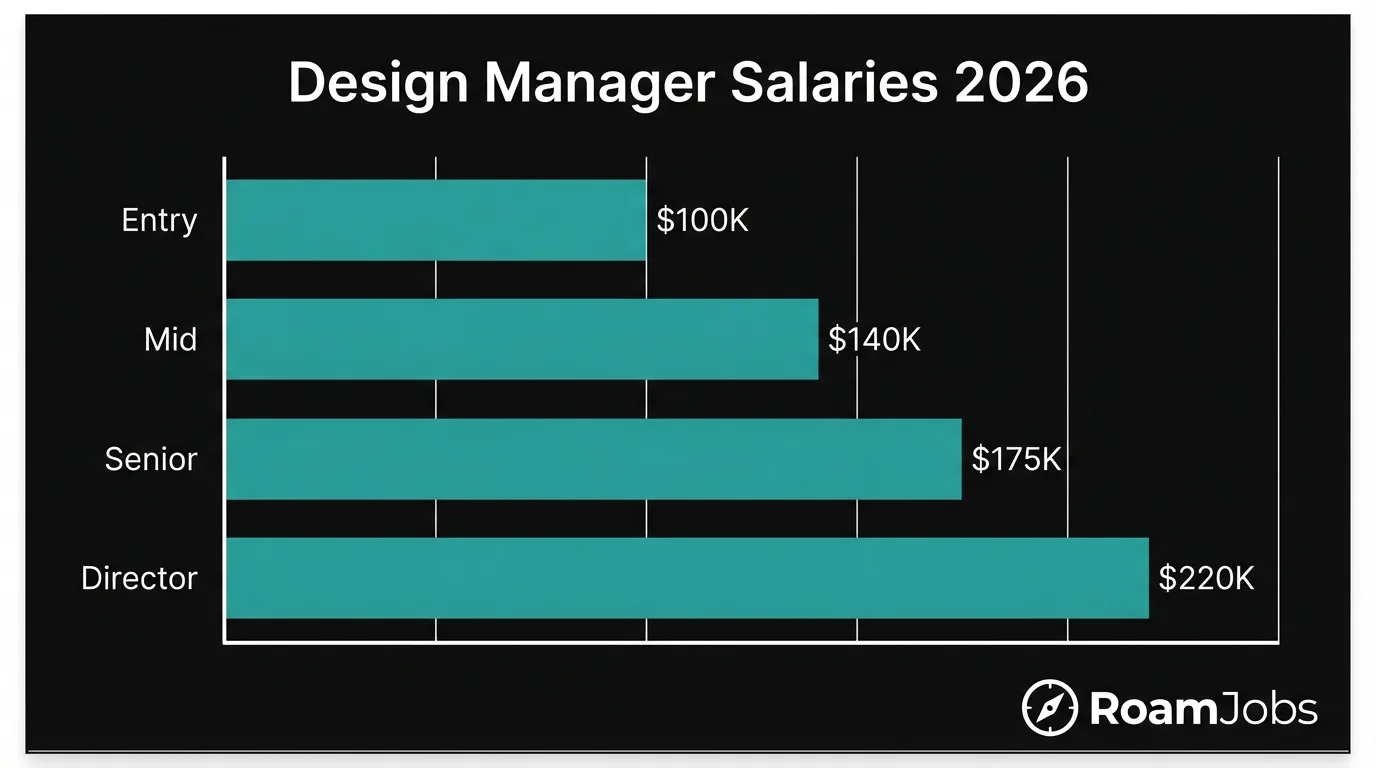
Design management compensation varies significantly based on experience level, company size, and geographic pay philosophy. These figures represent remote positions with US-based companies.
Design Manager Salary by Experience & Location
| Level | 🇺🇸 US Remote | 🇪🇺 EU Remote | 🌎 LATAM | 🌏 Asia |
|---|---|---|---|---|
| First-time Manager (0-2 yrs mgmt) | $120,000 - $155,000 | $80,000 - $110,000 | $55,000 - $85,000 | $45,000 - $75,000 |
| Experienced Manager (2-4 yrs mgmt) | $155,000 - $200,000 | $105,000 - $145,000 | $75,000 - $115,000 | $65,000 - $100,000 |
| Senior Manager (4-7 yrs mgmt) | $195,000 - $265,000 | $135,000 - $190,000 | $100,000 - $155,000 | $85,000 - $140,000 |
| Director+ (7+ yrs mgmt) | $250,000 - $350,000 | $175,000 - $250,000 | $130,000 - $200,000 | $115,000 - $185,000 |
* Salaries represent base compensation for remote positions. Actual compensation may vary based on company, experience, and specific location within region.
Entry Level / Junior Design Manager
0-2 years management experience experience
Transitioning from Individual Contributor to Manager
The leap from senior designer to first-time manager is one of the most significant career transitions in design. Many designers underestimate how different the job really is—your success is no longer measured by your own designs but by the growth and output of your team.
Key skills for first-time remote managers:
- Running effective 1:1 meetings that balance project updates with career development
- Giving constructive feedback that improves work without demoralizing designers
- Learning to delegate and resist the urge to “fix” designs yourself
- Building trust with direct reports you’ve never met in person
- Managing your own time as meetings consume most of your calendar
- Navigating the political landscape of cross-functional relationships
- Setting clear expectations and holding team members accountable
Common challenges in the first year:
First-time remote managers often struggle with letting go of design work. The temptation to jump into Figma and “help” is strong, but it undermines your team’s growth and ownership. You must shift your identity from “person who designs” to “person who builds designers.”
Another common struggle is underestimating the emotional labor of management. Designers bring their challenges, frustrations, and career anxieties to you. Processing these conversations while maintaining your own equilibrium requires deliberate emotional management.
How to land your first remote design management role:
Most first-time managers are promoted internally after demonstrating leadership qualities as a senior IC. To position yourself for this transition, seek opportunities to mentor junior designers, lead design initiatives, facilitate critiques, and take on hiring responsibilities. Document your impact on others’ growth.
For external first-time manager roles, emphasize any leadership experience: leading projects, mentoring, facilitating workshops, or managing freelancers. Companies hiring external first-time managers typically want evidence of leadership aptitude even without formal management experience.
What companies look for:
- Strong IC track record (typically 5+ years of design experience)
- Evidence of mentoring or developing other designers
- Communication skills that translate to written async environments
- Emotional intelligence and empathy
- Willingness to learn and adapt management approach
Mid-Level Design Manager
2-4 years management experience experience
Growing as a Manager and Scaling Your Team
Experienced Design Managers have navigated the initial transition and developed a management style. At this level, you’re expected to handle more complex challenges: growing your team, managing performance issues, and influencing design strategy.
Key skills for experienced remote managers:
- Hiring effectively and building team capacity
- Managing underperformers and making difficult personnel decisions
- Developing senior designers who may want to become managers themselves
- Contributing to design strategy beyond your immediate team
- Building relationships with senior stakeholders (VPs, C-level)
- Navigating organizational change and ambiguity
- Creating scalable processes as the team grows
- Balancing time across larger teams (often 5-8 direct reports)
Growth and hiring expertise:
At this level, you’ll likely be responsible for growing your team. This means developing job descriptions, building diverse candidate pipelines, running effective interview processes, and making hiring decisions. Remote hiring requires strong portfolio evaluation skills and the ability to assess candidates’ remote work readiness through video interviews.
You’ll also need to think about team composition: what skills are missing? What seniority mix is optimal? How do time zones affect collaboration? Experienced managers build teams intentionally rather than just filling headcount.
Performance management:
Not every hire works out, and experienced managers must handle performance issues directly. This includes setting clear expectations, documenting concerns, creating performance improvement plans, and—when necessary—making the decision to part ways. These conversations are harder remotely but equally important.
Developing future managers:
Some of your senior designers will want to move into management. Experienced managers identify these individuals, create opportunities for them to practice leadership skills, and provide coaching on the transition. Building the next generation of design leaders is a key responsibility at this level.
Salary considerations:
Experienced managers often see significant salary growth as they prove their ability to scale teams. Companies pay premium for managers who can hire effectively and retain strong designers. Performance bonuses and equity become more significant portions of total compensation.
Senior Design Manager
4-7 years management experience experience
Managing Multiple Teams and Organizational Impact
Senior Design Managers often oversee multiple pods or product areas, potentially managing other managers in addition to individual contributors. The scope expands from team output to organizational design and cross-functional influence.
Key skills for senior remote managers:
- Managing managers and developing leadership skills in others
- Organizational design—structuring teams for effectiveness
- Design strategy that spans multiple products or business units
- Executive presence and communication with C-level stakeholders
- Budget management and resource allocation
- Cross-functional leadership with Product and Engineering counterparts
- Building design culture across a larger organization
- Navigating organizational politics and driving change
Managing managers:
Leading other managers requires a different skill set than managing ICs. You’re coaching on leadership, helping managers navigate difficult situations, and ensuring consistency across teams. Your 1:1s focus less on individual project details and more on team health, manager development, and strategic alignment.
Organizational design:
Senior managers think about how teams are structured. Should designers be centralized or embedded? How do you balance specialization with flexibility? What’s the right ratio of managers to ICs? These decisions significantly impact design effectiveness and require understanding of both design work and organizational dynamics.
Design strategy at scale:
At this level, you’re contributing to design strategy that affects the entire product or company. This means understanding business goals deeply, translating them into design priorities, and ensuring your teams are working on the highest-impact problems. You represent design in executive planning processes.
Building culture remotely:
Senior managers are culture carriers. In a remote environment, you must be intentional about the culture you want to create—how designers collaborate, how feedback is given, how success is celebrated. This requires both modeling behaviors and creating systems that reinforce cultural values.
Career paths from senior manager:
Senior managers typically advance to Director roles (leading larger organizations), VP roles (executive leadership), or pivot to executive positions at smaller companies. Some choose to return to IC work at the principal/staff level, bringing management perspective to senior design roles.
Lead / Director Design Manager
7+ years management experience experience
Executive Design Leadership
Directors and above are executive leaders responsible for design across significant portions of the organization. The role is as much about organizational leadership as design leadership, requiring business acumen, executive communication, and strategic vision.
Key skills for director+ remote leaders:
- Building and leading large design organizations (20+ designers)
- Executive team membership and board-level communication
- Design vision that drives company strategy
- Building design leadership bench strength
- M&A integration and organizational transformation
- Budget ownership and ROI articulation
- External brand building and industry presence
- Crisis management and organizational resilience
Organizational scope:
Directors typically lead 20-50+ designers through multiple layers of management. Success at this level requires building a strong leadership team and creating systems that scale. You’re removed from individual design decisions but responsible for the quality and impact of all design work.
Executive partnership:
At the director+ level, you’re a peer to VPs of Product and Engineering, not a function reporting into them. This requires executive presence, business fluency, and the ability to influence without authority. You represent design in company strategy discussions and fight for resources and organizational attention.
Design as competitive advantage:
Executive design leaders articulate how design creates business value. This means connecting design quality to metrics executives care about: revenue, retention, market differentiation, and efficiency. You’re constantly translating between design language and business language.
Building the function:
Directors build the design organization itself: hiring philosophy, career ladders, compensation strategy, tools and systems, design operations. These decisions shape the designer experience and the organization’s ability to attract and retain talent.
External presence:
At this level, you represent the company’s design brand externally. This includes speaking at conferences, publishing thought leadership, recruiting through personal networks, and building relationships with the broader design community. Your personal brand becomes intertwined with the company’s design reputation.
Compensation at the top:
Director+ compensation packages include significant equity components, often 30-50% of total compensation. Base salaries plateau, but total compensation continues to grow through equity grants, bonuses, and other incentives. Remote director roles at top companies can exceed $400K in total compensation.
Essential Skills and Tools for Remote Design Managers
Remote design management requires mastery of both management fundamentals and the tools that enable distributed work. This section covers the core competencies and technology stack for effective remote design leadership.
Management Tools Comparison
Design Management Tools Comparison
Source: RoamJobs Design Management Survey 2026| Tool | Primary Use | Best For | Price | Remote Rating |
|---|---|---|---|---|
| Figma | Design collaboration | Real-time design work and feedback | Free-$45/user | Essential |
| 15Five | Performance management | 1:1s, feedback, reviews, engagement | $4-14/user | Excellent |
| Lattice | People management | Goals, reviews, compensation, engagement | $11+/user | Excellent |
| Culture Amp | Engagement surveys | Team health, pulse surveys, analytics | Custom pricing | Excellent |
| Loom | Async video | Design walkthroughs, feedback, announcements | Free-$15/user | Essential |
| Notion | Documentation | Design wikis, meeting notes, processes | Free-$15/user | Excellent |
| Miro | Visual collaboration | Workshops, brainstorming, mapping | Free-$16/user | Excellent |
| Donut | Team building | Random coffee chats, introductions | $49-199/mo | Very Good |
| Range | Check-ins | Daily standups, team updates | $6-12/user | Very Good |
| Greenhouse | Recruiting | Job postings, pipeline, interviews | Custom pricing | Excellent |
| Lever | Recruiting | Candidate management, scheduling | Custom pricing | Excellent |
Data compiled from RoamJobs Design Management Survey 2026. Last verified January 2026.
Design Critique Facilitation
Running effective design critiques remotely is one of the most important skills for design managers. The challenges are significant: reading body language through video, managing turn-taking, ensuring quiet voices are heard, and maintaining energy through a screen.
Structured critique frameworks for remote teams:
Design critiques need more structure in remote settings than in-person. Establish clear protocols: the designer presents for a set time, viewers hold questions until the end, feedback follows a specific format (what’s working, questions, suggestions). Use tools like FigJam for silent brainstorming before discussion.
Async vs. sync critique balance:
Not all feedback requires real-time conversation. Build a culture where initial feedback happens asynchronously through Figma comments and Loom videos. Reserve synchronous time for complex discussions, creative exploration, and relationship building. A typical ratio might be 70% async, 30% sync feedback.
Managing feedback quality:
Remote critique can devolve into surface-level comments or unconstructive criticism. Train your team to give feedback that’s specific, actionable, and connected to goals. Model good feedback behavior and redirect conversations that become unproductive.
Inclusive critique practices:
Remote critiques can favor extroverts and native English speakers. Create structures that give everyone voice: written reflection before discussion, round-robin feedback, anonymous input options. Pay attention to who’s participating and actively invite quieter team members to share.
Hiring and Interviewing
Building remote design teams requires a refined approach to hiring. You can’t rely on in-person chemistry or observe candidates in a studio environment. Every signal must come through video calls, portfolios, and written communication.
Portfolio evaluation for remote roles:
Look beyond visual execution to assess remote readiness: How well does the candidate explain their process in writing? Do case studies stand alone or require verbal explanation? Is there evidence of async collaboration? Strong remote candidates produce portfolios that communicate effectively without a presenter.
Video interview best practices:
Structure interviews to assess communication skills and remote work patterns. Ask candidates to walk through their portfolio—how clearly do they present? Include exercises that simulate remote collaboration: async feedback on a design problem, written response to a scenario, collaborative whiteboarding session.
Assessing remote work readiness:
Probe for experience and aptitude with distributed work. How have they handled time zone challenges? What’s their approach to async communication? How do they maintain focus working from home? Look for self-awareness about remote work challenges and strategies to address them.
Interview process design:
A typical remote design manager interview process:
- Recruiter screen (30 min) - Background, expectations, logistics
- Hiring manager intro (45 min) - Experience deep-dive, role fit
- Portfolio presentation (60 min) - Case studies, process, impact
- Design exercise (take-home or live) - Problem-solving approach
- Leadership scenarios (60 min) - Management philosophy, situations
- Cross-functional interviews (2-3 x 45 min) - Partner relationships
- Executive/skip-level (45 min) - Strategic thinking, culture fit
Performance Management
Remote performance management requires more documentation and explicit communication than in-office management. Without daily observation, you must create systems for understanding performance and providing feedback.
Goal setting and OKRs:
Establish clear, measurable goals for each team member. In a remote environment, goals create alignment when you can’t adjust direction through hallway conversations. Review goals regularly (monthly or quarterly) and adjust based on business changes.
Continuous feedback:
Don’t save feedback for formal reviews. Build a culture of continuous feedback through 1:1s, async messages, and real-time recognition. Remote teams need more explicit positive feedback—the subtle signals of approval that happen naturally in offices don’t translate to distributed work.
Performance reviews:
Structure reviews around documented performance data rather than recency bias or subjective impressions. Collect feedback from cross-functional partners and direct reports. Conduct review conversations over video with adequate time for discussion.
Managing underperformance:
Address performance issues early and directly. Document concerns, set clear expectations, and provide support for improvement. Remote managers sometimes avoid difficult conversations—don’t let geographic distance become an excuse for delayed feedback.
Remote Team Building
Building team cohesion without physical proximity requires intentional effort and creative approaches.
Virtual team rituals:
Establish regular touchpoints that bring the team together: weekly team meetings, design share sessions, monthly retrospectives, quarterly celebrations. These rituals create rhythm and belonging in distributed work.
Non-work connection:
Create space for relationship building beyond work topics. Virtual coffee chats, team games, interest-based channels, and optional social events help team members know each other as people. Tools like Donut automate random pairing for informal conversations.
In-person gatherings:
Most successful remote teams meet in person periodically—quarterly, bi-annually, or annually. These gatherings accelerate relationship building and create shared experiences. Use in-person time for activities that benefit from physical presence: workshops, strategy sessions, celebration.
Onboarding new team members:
Remote onboarding requires extra attention. Create comprehensive documentation, assign onboarding buddies, schedule introductions across the team, and increase 1:1 frequency during the first months. New hires should feel connected before they’ve ever met teammates in person.
Remote Design Manager Skills Assessment
- 1 Can facilitate effective design critiques over video
Structure discussions, manage participation, ensure actionable feedback
- 2 Comfortable giving direct feedback asynchronously
Written feedback that's clear, constructive, and well-received
- 3 Experienced with remote hiring and portfolio evaluation
Assess candidates without in-person interaction
- 4 Strong 1:1 meeting skills adapted for video
Build relationships and have difficult conversations remotely
- 5 Can build team culture without physical presence
Create rituals, foster connection, maintain energy
- 6 Proficient with async collaboration tools
Figma, Loom, Notion, and team communication platforms
- 7 Able to manage performance through documentation
Goal setting, continuous feedback, formal reviews
- 8 Skilled at stakeholder management across time zones
Build relationships with partners you rarely see synchronously
- 9 Experience with organizational design decisions
Team structure, hiring plans, career frameworks
- 10 Self-aware about remote work challenges and solutions
Model healthy behaviors, prevent burnout, maintain boundaries
Companies Hiring Remote Design Managers
The landscape of remote design management opportunities continues to expand. These companies actively hire remote design leaders and have established track records of distributed design team success.
Fully Remote / Remote-First Companies
GitLab - The benchmark for remote work documentation and culture. GitLab’s design organization operates across 65+ countries with exceptional async practices. They hire Design Managers who can thrive in their all-remote environment with comprehensive written communication. Strong emphasis on documentation and transparency.
Automattic (WordPress, WooCommerce, Tumblr) - One of the original distributed companies with 1,900+ employees worldwide. Design leadership positions work across their portfolio of products. Known for thoughtful async culture and annual “Grand Meetups” that bring the company together.
Zapier - Workflow automation platform with a fully distributed team of 500+. Design Managers lead teams working on complex product challenges. Four-day workweek (Fridays off) and strong work-life balance culture. Excellent compensation and benefits.
Buffer - Social media management platform famous for transparency (publicly shared salaries). Small but impactful design team. Design leadership roles focus on product design with emphasis on thoughtful, user-centered approach.
Doist (Todoist, Twist) - Productivity tools company that practices what they preach about async work. Design-led organization where design leadership has significant influence. Strong values around work-life balance and sustainable pace.
InVision - Design tools company (Freehand, DSM) with fully distributed team. Deep understanding of design needs having built tools for designers. Design management roles span product and design systems.
Remote-First Tech Companies
Shopify - “Digital by default” e-commerce platform. Large design organization with management opportunities across multiple product areas. Competitive compensation with some location-based adjustments. Strong design culture and systems.
Figma - The design tool most remote teams depend on. Distributed team with design leadership positions. Dog-food their own product for collaboration. Excellent for design managers who want to shape the tools designers use.
Canva - Visual design platform with growing remote presence, particularly in North America and Europe. Design management roles span product design, brand, and design systems. Strong design culture with emphasis on accessibility.
Atlassian - “Team Anywhere” policy allows work from most countries. Design management opportunities across Jira, Confluence, Trello, and other products. Large, established design organization with career growth paths.
Webflow - Visual web development platform with strong design DNA. Design leadership roles shape both the product and how customers create with it. Remote-friendly culture with emphasis on design excellence.
Companies with Strong Remote Design Teams
HubSpot - CRM platform with “@flex” work arrangements allowing remote, office, or hybrid. Design management positions across their suite of products. Strong career development programs and leadership training.
Notion - Productivity workspace with high design standards. Design leadership roles focus on maintaining quality while scaling. Competitive compensation and strong design culture.
Linear - Issue tracking tool known for exceptional design quality. Small design team with management opportunity. High bar for design craft and attention to detail.
Discord - Communication platform with remote-friendly policies. Design management roles span consumer product, platform features, and safety. Large, active user base with complex design challenges.
Vercel - Frontend cloud platform (creators of Next.js). Design leadership positions shape developer tools and experiences. Strong engineering culture with design having significant influence.
Supabase - Open-source Firebase alternative with fully remote team. Design leadership opportunity in rapidly growing company. Building in the open with strong community focus.
Finding Unlisted Design Management Opportunities
Many design management roles are filled through networks before being posted publicly. To access these opportunities:
Build relationships with design leaders
Connect with design leaders at companies you admire. Engage genuinely with their content, attend their talks, and build relationships over time. When positions open, you’ll be top of mind.
Join design leadership communities
Communities like ADPList, Design Leadership Forum, and various Slack groups connect design managers. These communities often share opportunities before public posting and provide referral pathways.
Work with specialized recruiters
Design-focused recruiting firms like IDEO U, BASIC/DEPT, and others specialize in design leadership placement. Building relationships with these recruiters provides access to confidential searches.
Target companies before roles are posted
Identify companies where you’d want to lead design. Follow their job boards, but also reach out to design leaders there directly. Express interest in future opportunities and stay connected. When a role opens, you’ll have a head start.
Consider fractional or advisory roles
Some companies need design leadership but aren’t ready for a full-time hire. Fractional CDO or design advisor roles provide entry points that can evolve into permanent positions. These arrangements are increasingly common in remote work.
Interview Deep Dive: Questions and Answers
Design manager interviews assess leadership ability, design judgment, stakeholder skills, and remote work readiness. Prepare for these common questions with thoughtful, specific answers.
Leadership Philosophy and Approach
How to answer: Articulate a clear, authentic management philosophy rather than generic platitudes. Connect your philosophy to specific practices and explain how remote work shapes your approach.
Strong answer structure:
- State your core philosophy (servant leadership, coaching mindset, etc.)
- Give a specific example of that philosophy in action
- Explain how remote work affects your approach
- Describe systems you’ve built to implement your philosophy remotely
Example: “I believe my job is to remove obstacles and create conditions where designers can do their best work. In practice, that means understanding each person’s goals and challenges, then actively working to address them. Remotely, I’ve adapted by increasing 1:1 frequency, creating more documentation so information is accessible, and building async feedback channels so people don’t wait for me to unblock them. For example, I created a ‘manager office hours’ doc where anyone can add questions, and I record video responses that the whole team can access.”
How to answer: This tests your ability to have difficult conversations and make tough decisions. Be honest about the challenge while demonstrating fairness and professionalism.
Strong answer structure:
- Describe the situation and performance issues specifically
- Explain the feedback and support you provided
- Walk through your decision-making process
- Share the outcome and what you learned
Example: “I had a mid-level designer who consistently missed deadlines and produced work that required significant revision. In a remote setting, I had to be especially clear about expectations since I couldn’t observe their daily work. I documented concerns, had direct conversations in our 1:1s, and created a 30-day performance plan with specific, measurable goals. I provided extra support including daily check-ins and pairing with a senior designer. Ultimately, they didn’t improve, and we parted ways. What I learned was the importance of addressing issues early—remote work can let problems fester because you’re not seeing someone struggle in person.”
How to answer: Show that you think about your team’s career growth and have a deliberate approach to developing future leaders.
Strong answer structure:
- Describe how you identify leadership potential
- Explain opportunities you create for practice
- Share how you coach on management skills
- Give a specific success story
Example: “I look for designers who naturally mentor others, take ownership beyond their projects, and show curiosity about how the team operates. For those who express interest in management, I create graduated opportunities: leading a project with a junior designer, running design critiques, participating in hiring, and eventually managing an intern or junior hire with my coaching. I pair these experiences with explicit conversations about what they’re learning and what management really involves. Recently, I developed a senior designer through this process who’s now a strong manager leading her own team at another company.”
Remote Work and Distributed Teams
How to answer: Demonstrate intentionality about culture-building with specific practices you’ve implemented or would implement.
Strong answer structure:
- Acknowledge the challenge of remote culture
- Describe specific rituals and practices
- Explain how you create space for non-work connection
- Share results or feedback from your team
Example: “Remote culture requires deliberate design—it doesn’t happen by accident. I’ve built several practices: weekly team meetings that start with personal check-ins, a monthly ‘design share’ where we present work-in-progress to each other, and optional ‘virtual coffee’ sessions where we talk about anything except work. I also use Donut to randomly pair team members for informal chats. The key is creating multiple touchpoints so relationships develop over time. Feedback from my team indicates they feel more connected than their friends at other remote companies, which I measure through quarterly engagement surveys.”
How to answer: Show deep thinking about the mechanics of remote critique and how to maintain quality feedback.
Strong answer structure:
- Describe your critique structure and cadence
- Explain async vs. sync components
- Share how you ensure feedback quality
- Address challenges like participation and energy
Example: “I run a two-phase critique process. First, designers share work in Figma with a Loom walkthrough explaining context, constraints, and specific feedback requests. Team members leave async comments addressing those questions. Then we have a 30-minute sync session to discuss themes from comments and explore divergent opinions. This structure respects time zones, gives everyone space to think, and focuses sync time on high-value discussion. I’ve found it produces more thoughtful feedback than real-time-only critique because people aren’t performing—they’re genuinely engaging with the work.”
How to answer: Show practical experience with distributed teams and creative solutions to time zone constraints.
Strong answer structure:
- Acknowledge the real challenges of time zones
- Share specific strategies you’ve used
- Explain how you balance fairness across the team
- Describe tools and async practices that help
Example: “I’ve managed teams spanning US, Europe, and Asia-Pacific—16 hours of time zone spread. The key is accepting that synchronous time is precious and building everything else async. We rotate meeting times so no one always has the inconvenient slot. I hold 1:1s in overlapping hours but use Loom for announcements and updates. Design feedback happens primarily through Figma comments with optional sync discussion. I document everything extensively so no one is disadvantaged by when they work. The biggest learning was being explicit about response time expectations—not everyone needs to be available for everything.”
Design Leadership and Strategy
How to answer: Demonstrate thinking beyond vanity metrics to meaningful measures of design impact.
Strong answer structure:
- Address both output and outcome metrics
- Include team health and growth measures
- Connect to business impact
- Acknowledge the difficulty of measuring design
Example: “I measure on three levels. First, team health: engagement scores, retention, growth conversations, and feedback from cross-functional partners. A struggling team can’t produce great work. Second, design quality: consistency with our system, accessibility scores, and subjective quality assessments through critique. Third, business impact: how our designs perform on the metrics that matter—conversion, retention, NPS, task completion. The challenge is attribution—design is rarely the only variable—so I focus on trends over time rather than single data points, and I document the hypotheses behind design decisions so we can learn from outcomes.”
How to answer: Show your ability to influence stakeholders and navigate organizational dynamics.
Strong answer structure:
- Describe the situation and what you were advocating for
- Explain your approach to building the case
- Share how you navigated organizational dynamics
- Describe the outcome and what you learned
Example: “Our company was planning a major platform migration without dedicated design resources—engineering wanted to rebuild functionality exactly as-is. I believed this was a missed opportunity to address long-standing UX debt. I built the case by documenting user pain points with data from support tickets and usability testing, then quantified the cost of those issues in customer churn. I found allies in Product who shared concerns and presented a joint proposal for a design-led migration that addressed critical UX issues. The outcome was approval for dedicated design resources on the migration and a process for prioritizing UX improvements. The lesson: influence comes from alignment with business goals and building coalitions.”
How to answer: Show your diagnostic approach and ability to lead through challenging situations.
Strong answer structure:
- Describe your initial approach to understanding the situation
- Explain how you’d build trust with the team
- Share strategies for improving morale and clarity
- Discuss how you’d measure progress
Example: “First, I’d listen. One-on-one conversations with every team member to understand their experience, concerns, and what they need. I’d also talk to cross-functional partners to understand how the team is perceived. I wouldn’t make big changes immediately—trust takes time, especially in a demoralized team. Then I’d focus on quick wins: clear up ambiguity where possible, remove obvious obstacles, and celebrate small victories. I’d be transparent about what I’m learning and what I’m working on. Over time, I’d work on larger structural issues like role clarity, process improvements, and strategy alignment. I’d measure progress through team feedback, engagement surveys, and ultimately through the quality of work and retention.”
Stakeholder Management and Cross-Functional Collaboration
How to answer: Demonstrate mature stakeholder skills and ability to collaborate through conflict.
Strong answer structure:
- Acknowledge that disagreement is normal and healthy
- Describe your approach to understanding different perspectives
- Explain how you seek resolution
- Share a specific example
Example: “Disagreement with PM is inevitable and often productive—we’re representing different perspectives that both matter. My approach starts with understanding their position fully: What data or constraints are driving their view? Often, apparent disagreements dissolve when we understand each other’s reasoning. When we still disagree, I try to find shared ground: what are we both trying to achieve? Can we test our hypotheses? If we can’t resolve it, I escalate appropriately rather than letting it fester. Recently, a PM wanted to ship a feature I believed would confuse users. We agreed to A/B test both approaches, and the data supported a hybrid solution neither of us had originally proposed.”
How to answer: Show proactive approach to elevating design’s influence in the organization.
Strong answer structure:
- Acknowledge that design influence must be earned
- Describe how you build credibility
- Explain your communication approach with executives
- Share results from your efforts
Example: “Design influence isn’t automatic—it comes from consistently delivering value and communicating in language leadership understands. I make sure design is visible: regular showcases of work and impact, sharing user insights that inform strategy, and connecting design improvements to business metrics. I invest in relationships with executives, understanding their priorities and concerns so I can frame design contributions accordingly. I also prepare my team to represent design well in cross-functional settings. Over time, this builds trust, and design gets included in earlier stages of strategic conversations rather than being handed requirements to execute.”
Hiring and Team Building
How to answer: Demonstrate structured thinking about portfolio evaluation with specific criteria.
Strong answer structure:
- Describe what you look for in portfolio structure
- Explain how you assess craft and process
- Share how you evaluate remote readiness
- Mention red flags you watch for
Example: “I evaluate portfolios in three passes. First, quick scan: Is it clear, organized, and easy to navigate? This is itself a design test. Second, deep dive into 2-3 case studies: Do they show process and impact, not just final designs? Is the narrative clear without verbal explanation—crucial for remote work. Third, craft assessment: Does the visual and interaction design demonstrate skill appropriate for the level? For remote specifically, I look for evidence of async collaboration, written communication quality, and self-direction. Red flags include case studies that are all visuals, no process; claims of impact without specifics; and work that looks impressive but doesn’t seem to have shipped.”
How to answer: Show genuine commitment to diversity with practical approaches.
Strong answer structure:
- Articulate why diversity matters for design specifically
- Describe concrete practices you’ve implemented
- Address challenges honestly
- Share results or lessons learned
Example: “Diversity matters for design because we’re designing for diverse users. Homogeneous teams have blind spots that lead to products that don’t work for everyone. I build diversity through intentional sourcing—going beyond standard channels to reach candidates from different backgrounds. I structure interviews to reduce bias: standardized questions, diverse interview panels, and evaluation criteria defined before seeing candidates. I’m transparent about our team’s current composition and goals. Remote work actually helps—we can hire talent from anywhere, not just expensive tech hubs. My current team spans 4 continents and includes people from non-traditional design backgrounds who bring valuable perspective.”
Situational and Problem-Solving
How to answer: Show diagnostic approach and balanced handling of performance issues.
Strong answer structure:
- Ask clarifying questions to understand the situation
- Describe your diagnostic approach
- Explain how you’d address root causes
- Share how you’d balance individual support with team needs
Example: “First, I’d want to understand why. In a 1:1, I’d explore: Are deadlines unrealistic? Are there unclear requirements causing rework? Are there personal challenges affecting their work? Is this a skills gap or a motivation issue? The solution depends on the cause. If deadlines are unrealistic, that’s a process problem I need to fix. If there are personal challenges, I’d offer support and flexibility. If it’s a skills gap, we’d work on development. If deadlines are fair and they’re simply not meeting commitments, we’d set clear expectations and monitor progress. Throughout, I’d communicate with engineering to set expectations and protect the working relationship while I address the issue.”
How to answer: Show ability to push back constructively while respecting organizational dynamics.
Strong answer structure:
- Acknowledge the request and underlying goals
- Ask clarifying questions
- Present your concerns with data
- Propose alternatives
Example: “I’d start by understanding the goal: Why 3 months? What’s driving urgency? What does ‘redesign’ mean—visual refresh, UX overhaul, or complete rebuild? This context shapes my response. If the timeline is truly unrealistic, I’d present a clear case: Here’s what we can accomplish in 3 months, here’s what a full redesign requires, here are the risks of rushing. I’d propose alternatives: Maybe we can address the most critical issues in 3 months and plan a phased redesign. Or maybe there’s a different approach that meets the underlying goal. The key is being a problem-solver, not a blocker—while being honest about constraints so leadership can make informed decisions.”
How to answer: Demonstrate conflict resolution skills and ability to maintain team health.
Strong answer structure:
- Describe your approach to understanding the conflict
- Explain how you’d facilitate resolution
- Address impact on the broader team
- Share how you’d prevent future issues
Example: “First, I’d meet with each person individually to understand their perspective without the other present. People often feel unheard in conflicts. I’d look for the root cause: Is this a disagreement about work, a personality clash, or built-up resentment from past issues? Then I’d bring them together for a facilitated conversation focused on shared goals and specific behaviors rather than personalities. I’d set clear expectations about professional collaboration regardless of personal feelings. For the broader team, I’d address any impact without throwing anyone under the bus. Long-term, I’d think about whether structural changes—like different project assignments—could reduce friction while maintaining productivity.”
How to answer: Show prioritization skills and ability to have difficult conversations about resources.
Strong answer structure:
- Describe your approach to assessing capacity and demand
- Explain how you’d prioritize
- Share how you’d communicate constraints
- Propose solutions beyond just asking for headcount
Example: “First, I’d quantify the gap: What’s our actual capacity? What’s the demand? Where are the constraints? Then I’d prioritize ruthlessly with stakeholder input: What work is truly critical? What’s the cost of not doing certain projects? With clear prioritization, I’d communicate transparently: Here’s what we can do, here’s what we can’t, here are the tradeoffs. I’d also look for efficiency gains: Are there low-value activities we can stop? Can we create systems (like design system components) that scale our impact? Sometimes the answer is headcount, and I’d build that case with data. But often there are creative solutions that don’t require waiting for new hires.”
Manager-Specific Technical Questions
How to answer: Show intentionality about maintaining design skills and knowledge.
Strong answer structure:
- Acknowledge the challenge honestly
- Describe specific practices you maintain
- Explain how you leverage your team
- Share how you balance depth vs. breadth
Example: “This is a real challenge—calendar full of meetings doesn’t leave much time for learning. I maintain connection through several practices: attending our design critiques to see current work and approaches, doing occasional hands-on projects when it makes sense, and dedicating time weekly to reading and exploring tools. I’ve accepted that I won’t be as deep on craft as my ICs, and that’s okay—that’s their job now. I focus on staying current enough to evaluate work and provide useful feedback, and I lean on my team to push the craft forward. I also invest in conferences and design leadership communities where I learn from peers facing similar challenges.”
How to answer: Show sophisticated thinking about design systems as a management tool.
Strong answer structure:
- Articulate your philosophy on design systems
- Explain how you balance standardization and flexibility
- Describe governance approaches
- Share how you’ve implemented this in practice
Example: “I see design systems as a multiplier for design teams—they free designers from reinventing basic patterns so they can focus on harder problems. But overly rigid systems can stifle innovation and make products feel generic. My approach is ‘strong foundations, flexible application’: core components and patterns should be consistent, but there’s room for exploration on new features and experiences. I establish clear governance: what’s in the system, how to propose additions, when to deviate. The system should evolve based on team input, not become a bureaucratic constraint. In practice, I’ve found that designers appreciate well-built systems because they reduce tedious work and let them focus on interesting problems.”
Frequently Asked Questions
Frequently Asked Questions
How do I transition from individual contributor to design manager in a remote environment?
The IC to manager transition requires building leadership evidence before the title. In remote settings, this means actively seeking mentorship opportunities, documenting your impact on others' growth, leading projects with junior designers, facilitating remote design critiques, and participating in hiring processes. Express your interest in management to your current manager and ask for stretch assignments. Many remote companies are open to internal promotions since you already understand the culture. When pursuing external management roles without formal management experience, emphasize leadership activities you've undertaken, mentoring relationships, and examples of improving team processes or culture. The key differentiator is demonstrating you can create impact through others, not just through your own designs.
Can I maintain my design skills as a manager, or should I accept becoming less technical?
Expect your hands-on design time to decrease significantly—most managers spend 70-80% of their time on people, process, and stakeholder work. Rather than fighting this, reframe your relationship with craft. Stay connected through participating in critiques, occasional hands-on projects when strategically appropriate, and continuous learning. Your role shifts from being the best designer to enabling others to do their best work. You'll maintain design judgment for evaluating work, but execution skills may atrophy. Many experienced managers find this tradeoff worthwhile—your impact multiplies through your team. If maintaining deep craft is essential to your identity, consider pursuing the IC track (Staff/Principal Designer) rather than management.
How do I run effective 1:1s with remote team members I've never met in person?
Remote 1:1s require more intentionality than in-office conversations. Start with video on to build face-to-face connection. Begin meetings with personal check-ins before diving into work—remote workers have fewer opportunities for casual connection. Use a shared document for ongoing 1:1 notes so both parties can add topics between meetings. Ask open-ended questions and give space for responses—video lag can make conversations feel awkward if you fill silences. Periodically discuss career goals, not just immediate projects. Be explicit about providing feedback rather than assuming it's communicated through context. Consider varying the format occasionally—walking 1:1s via phone, virtual coffee without agenda, or async 1:1s through written exchange. The goal is building a relationship and trust that would develop naturally in an office but requires effort remotely.
What's the biggest mistake new remote design managers make?
The most common mistake is continuing to design instead of managing. New managers often jump into Figma to 'help' their team, which feels productive but undermines team growth and ownership. Your job now is developing designers, not doing design. Other common mistakes include: under-communicating (remote teams need more context, not less), avoiding difficult conversations (distance makes it easy to defer), neglecting team culture (it doesn't happen automatically remotely), and trying to manage exactly how you were managed (remote requires adapted approaches). The shift from individual contributor to manager is a fundamental identity change—success is no longer measured by your output but by your team's growth and output.
How do I build a strong design culture in a fully remote team?
Remote design culture requires explicit, intentional cultivation rather than organic development. Define and document the culture you want: How do you give feedback? How do you celebrate success? What behaviors do you value? Create rituals that reinforce culture: weekly design shares, critique sessions, retrospectives, and celebrations. Build channels for non-work connection through virtual social events and interest-based conversations. Model the behaviors you want to see—culture comes from leadership. Make space for creative exploration beyond production work through hackathons, design challenges, and learning time. Hire for culture contribution by assessing how candidates will add to your culture. Measure culture health through engagement surveys and team feedback. Remember that culture is constantly evolving—stay attuned to team dynamics and adjust practices as the team grows.
How do I handle design critiques when my team is spread across drastically different time zones?
Time zone spread requires moving critique primarily to async formats. Use Figma for design presentation with clear annotations explaining context, constraints, and specific feedback requests. Add Loom video walkthroughs for complex work. Set expectations for feedback windows (e.g., 24-48 hours for initial feedback). Use FigJam or Miro for async brainstorming and synthesis. Reserve limited synchronous time for discussions that benefit from real-time dialogue—resolving divergent opinions, exploring creative alternatives, or building relationships. Rotate any synchronous meetings so no time zone always has the inconvenient slot. Document decisions and rationale thoroughly so those who missed the discussion can understand outcomes. This async-first approach often produces better feedback than purely synchronous critique because people have time to think before responding.
What should I look for when evaluating remote design manager job opportunities?
Assess the company's remote maturity: How long have they been distributed? Are leadership roles remote or is it an office with remote ICs? What's the time zone policy? Understand the design organization structure: Who does the role report to? How is design regarded in the company? What's the growth trajectory? Evaluate compensation philosophy: location-based or location-agnostic pay? Equity structure? Ask about team health indicators: retention, engagement, recent changes. Inquire about in-person gatherings: frequency, purpose, budget. Look for red flags: recent leadership departures, 'we're figuring out remote,' or unrealistic expectations about availability across time zones. The best remote opportunities come from companies that have intentionally designed for distributed work, not those treating remote as a cost-cutting measure or pandemic accommodation.
How do remote design manager salaries compare to on-site positions?
Remote design manager salaries vary significantly based on company philosophy. Remote-first companies like GitLab and Automattic often pay location-agnostic salaries benchmarked to expensive markets (SF/NYC), which can be very competitive for managers living in lower cost-of-living areas. Large tech companies typically adjust salaries 15-40% based on location. Some companies (Shopify, Atlassian) use zone-based systems with multiple tiers. For director+ levels, equity becomes a significant portion of total compensation—sometimes 30-50%—making the equity structure and vesting schedule as important as base salary. When comparing offers, consider total compensation including equity, bonus potential, benefits (healthcare, retirement), and perks (equipment budget, learning stipend, travel for meetups). The best remote positions often match or exceed on-site compensation while providing lifestyle flexibility.
Is it harder to get promoted as a remote design manager?
Promotion in remote environments depends heavily on company culture. In remote-first companies with strong async documentation and objective evaluation, promotion paths are often clearer and more equitable than in-office environments where visibility and relationships have outsized influence. However, in hybrid companies or those newer to remote work, remote managers can face 'proximity bias' where on-site leaders are favored for advancement. To mitigate this: ensure your work and impact are visible through documentation and regular updates, build relationships with senior leaders through video calls and written communication, seek feedback on your growth trajectory, and discuss advancement expectations explicitly with your manager. If you sense remote employees are disadvantaged for promotion, this is valuable information about the company's remote maturity and may influence your career decisions.
How should I think about managing designers I'm more skilled than versus those who are better designers than me?
Both situations are normal and require different approaches. For designers less skilled than you: resist the urge to do their work. Your job is developing them, not demonstrating your abilities. Use critique and coaching to help them grow. Give them space to make and learn from mistakes on non-critical work. For designers more skilled than you: embrace it. Your job isn't to be the best designer—it's to help each person do their best work. These senior designers often need help with career growth, organizational navigation, or expanding influence rather than craft coaching. Ask how you can support them. Be genuine about learning from their expertise. The trap is tying your worth as a manager to your design skills. Management is a different skill set entirely—you can be an excellent manager regardless of where you rank on craft compared to your team.
What are the signs that I might not be suited for management and should stay on the IC track?
Consider staying IC if: you derive primary satisfaction from hands-on design work and feel frustrated when meetings prevent it; you find 1:1s and performance conversations draining rather than energizing; you struggle with the slow pace of developing people compared to the immediate gratification of shipping designs; organizational politics feel exhausting rather than interesting; or you measure your impact by what you personally created rather than what your team achieved. These aren't weaknesses—they indicate your strengths and interests lie in deep individual contribution. The Staff/Principal IC track offers growth, compensation, and influence without people management. Be honest with yourself about what energizes you. Many excellent designers have become mediocre managers because they didn't realize management was a different job entirely, not a promotion from design.
How do I prepare for the design exercise or case study portion of a manager interview?
Manager interviews often include exercises testing leadership judgment rather than design execution. Common formats: a case study where you analyze a team's situation and propose solutions; a role-play where you have a difficult conversation with a direct report; a presentation on how you'd build or transform a design team; or a portfolio presentation focused on leadership impact rather than craft. Preparation should include: developing clear frameworks for common management situations (performance issues, team conflicts, resource constraints); preparing stories that demonstrate leadership competencies; practicing articulating your management philosophy; and being ready to discuss how you'd approach the specific challenges this company and team face. Unlike design exercises, there's often no single 'right' answer—interviewers are evaluating your thinking process, communication clarity, and whether your approach fits their culture.
Related Guides and Next Steps
Design management is a rewarding career path for designers ready to multiply their impact through developing others and shaping design organizations. As you pursue remote design manager opportunities, these related resources will help you prepare:
For aspiring managers:
- Remote Design Jobs: Complete Hub - Understand the full landscape of design careers
- Remote Interview Guide - Master video interview fundamentals
- Remote Portfolio Best Practices - Showcase leadership impact in your portfolio
For experienced managers:
- Negotiating Remote Salary - Maximize compensation for leadership roles
- Remote Job Offer Evaluation - Assess opportunities comprehensively
- Executive Remote Jobs - Advance to director and VP levels
For understanding the remote landscape:
- Where to Find Remote Jobs - Discover design leadership opportunities
- Remote-First vs Hybrid Companies - Understand different remote models
- Questions to Ask Remote Employers - Evaluate remote maturity
The remote design management market continues to grow as companies recognize that design leadership can thrive in distributed environments. With thoughtful preparation, authentic leadership development, and persistence in your search, you can build a rewarding career leading design teams from anywhere in the world.
Get the Remote Design Manager Career Guide
Weekly curated remote design leadership jobs, management insights, and career advice delivered to your inbox.
Frequently Asked Questions
How do I find remote design manager jobs?
To find remote design manager jobs, start with specialized job boards like We Work Remotely, Remote OK, and FlexJobs that focus on remote positions. Set up job alerts with keywords like "remote design manager" and filter by fully remote positions. Network on LinkedIn by following remote-friendly companies and engaging with hiring managers. Many design manager roles are posted on company career pages directly, so identify target companies known for remote work and check their openings regularly.
What skills do I need for remote design manager positions?
Remote design manager positions typically require the same technical skills as on-site roles, plus strong remote work competencies. Essential remote skills include excellent written communication, self-motivation, time management, and proficiency with collaboration tools like Slack, Zoom, and project management software. Demonstrating previous remote work experience or the ability to work independently is highly valued by employers hiring for remote design manager roles.
What salary can I expect as a remote design manager?
Remote design manager salaries vary based on experience level, company size, location-based pay policies, and the specific tech stack or skills required. US-based remote positions typically pay market rates regardless of where you live, while some companies adjust pay based on your location's cost of living. Entry-level positions start lower, while senior roles can command premium salaries. Check our salary guides for specific ranges by experience level and geography.
Are remote design manager jobs entry-level friendly?
Some remote design manager jobs are entry-level friendly, though competition can be high. Focus on building a strong portfolio or demonstrable skills, contributing to open source projects if applicable, and gaining any relevant experience through internships, freelance work, or personal projects. Some companies specifically hire remote junior talent and provide mentorship programs. Smaller startups and agencies may be more open to entry-level remote hires than large corporations.
Continue Reading
Remote Design Jobs 2026: Complete Guide to UX, UI, Product & Brand Careers
The definitive hub for remote design careers. Explore salary data, interview guides, and opportunities across UX, UI, product design, research, and design management.
Senior Remote Jobs 2026: Advancing Your Remote Career
Guide for senior professionals seeking remote positions including leadership roles and compensation negotiation.
Remote Jobs for Designers 2026: UX, UI, Product, and More
Complete guide to finding remote design positions including portfolio tips, interview prep, and salary expectations.
Land Your Remote Job Faster
Get the latest remote job strategies, salary data, and insider tips delivered to your inbox.