Remote Product Designer Jobs: Complete 2026 Career Guide
Everything you need to land a remote product designer job. End-to-end design from research to visual - salary data, interview questions, and companies hiring.
Updated January 20, 2026 • Verified current for 2026
Remote Product Designers are generalists who own the entire design process from user research to visual polish. With salaries ranging from $65,000 to $270,000 depending on experience and company size, Product Design has become the most in-demand remote design specialization in 2026. Unlike UX Designers who focus primarily on research and wireframes, or UI Designers who specialize in visual design, Product Designers combine both disciplines to deliver complete, shippable features. This end-to-end ownership makes Product Designers exceptionally well-suited for remote work because they can independently drive projects forward without constant handoffs. Remote Product Designers typically work closely with Product Managers and Engineers, translating business requirements into user-centered designs while balancing technical constraints. The role requires strong skills in user research, wireframing, visual design, prototyping, and design systems, plus excellent communication abilities for asynchronous collaboration. Companies increasingly prefer Product Designers because they reduce coordination overhead and can own features from conception to launch, making this the most versatile and sought-after design role in the remote job market.
What Does a Remote Product Designer Actually Do?
Product Design sits at the intersection of user experience, visual design, and business strategy. Remote Product Designers are responsible for understanding user needs, creating solutions, and delivering polished designs that engineers can implement. The role has evolved significantly in distributed work environments, with async communication and self-direction becoming essential skills.
Day-to-Day Responsibilities
A typical week for a remote Product Designer involves a diverse mix of activities spanning the entire design process. Understanding this breadth helps you evaluate whether this generalist role matches your interests and strengths.
User Research and Discovery
Remote Product Designers regularly conduct user research to inform their design decisions. This includes scheduling and running user interviews via video call, creating and analyzing surveys, reviewing product analytics and user feedback, synthesizing research findings into actionable insights, and presenting research to stakeholders. Unlike dedicated UX Researchers, Product Designers typically conduct lighter-weight research focused on specific feature questions rather than broad strategic research initiatives.
Ideation and Wireframing
Once you understand the problem, the ideation phase begins. Product Designers create low-fidelity wireframes to explore solutions, facilitate remote workshops using tools like FigJam, develop user flows and information architecture, collaborate with PMs to define requirements and scope, and iterate quickly based on feedback. This phase emphasizes speed and exploration over visual polish, testing multiple approaches before committing to a direction.
Visual Design and Prototyping
Product Designers transform wireframes into polished, production-ready designs. This involves creating high-fidelity mockups in Figma, building interactive prototypes for user testing and stakeholder review, applying and contributing to design systems, ensuring accessibility and responsive design, and documenting design specifications for engineers. The visual design phase requires strong aesthetic skills plus practical understanding of implementation constraints.
Collaboration and Handoff
Remote Product Designers spend significant time collaborating with cross-functional partners. Daily or weekly syncs with Product Managers to align on priorities, design reviews with other designers for feedback, engineering collaboration during implementation, QA support to ensure design intent is preserved, and stakeholder presentations to build alignment. Effective async communication distinguishes great remote Product Designers from those who struggle with distributed work.
Design System Contribution
As you gain seniority, design system work becomes increasingly important. Product Designers identify patterns that should become components, document usage guidelines, collaborate with Design Systems teams (or own the system at smaller companies), ensure consistency across product surfaces, and advocate for design system adoption.
Product Designer vs UX Designer vs UI Designer
Understanding the distinctions between these roles helps you position yourself appropriately and target the right opportunities.
Product Designer: The Full-Stack Generalist
Product Designers own the complete design process for their features or product areas. They conduct research, create wireframes, design interfaces, build prototypes, and collaborate through implementation. The role requires breadth across UX and UI skills, though most Product Designers have a slight lean toward one area. Product Designers are most common at startups and mid-size companies where efficiency demands generalists who can deliver complete solutions.
UX Designer: The Research and Structure Specialist
UX Designers focus on the research, strategy, and structural aspects of design. They conduct deeper user research, create user flows and information architecture, and typically hand off wireframes to UI Designers or Product Designers for visual polish. UX Designers excel at understanding user needs and defining the right problems to solve. This role is more common at larger companies with specialized design teams.
UI Designer: The Visual and Interaction Specialist
UI Designers specialize in visual design, interaction patterns, and polish. They receive wireframes or requirements and create beautiful, functional interfaces. UI Designers have strong skills in typography, color theory, iconography, and micro-interactions. Like UX Design, pure UI Design roles are more common at larger companies with specialized teams.
Why Product Design Dominates Remote Hiring
Remote companies strongly prefer Product Designers for several reasons. First, reduced coordination overhead means one designer owns a feature end-to-end rather than requiring handoffs between UX and UI specialists. Second, faster iteration cycles result from a single designer moving from research through implementation without waiting for handoffs. Third, better async work happens because Product Designers can independently drive projects forward. Fourth, startup prevalence in remote work means that the companies most likely to be fully remote (startups and tech companies) prefer generalist roles. Finally, cost efficiency for smaller teams means one senior Product Designer often delivers more value than separate UX and UI specialists.
Salary Breakdown by Seniority Level
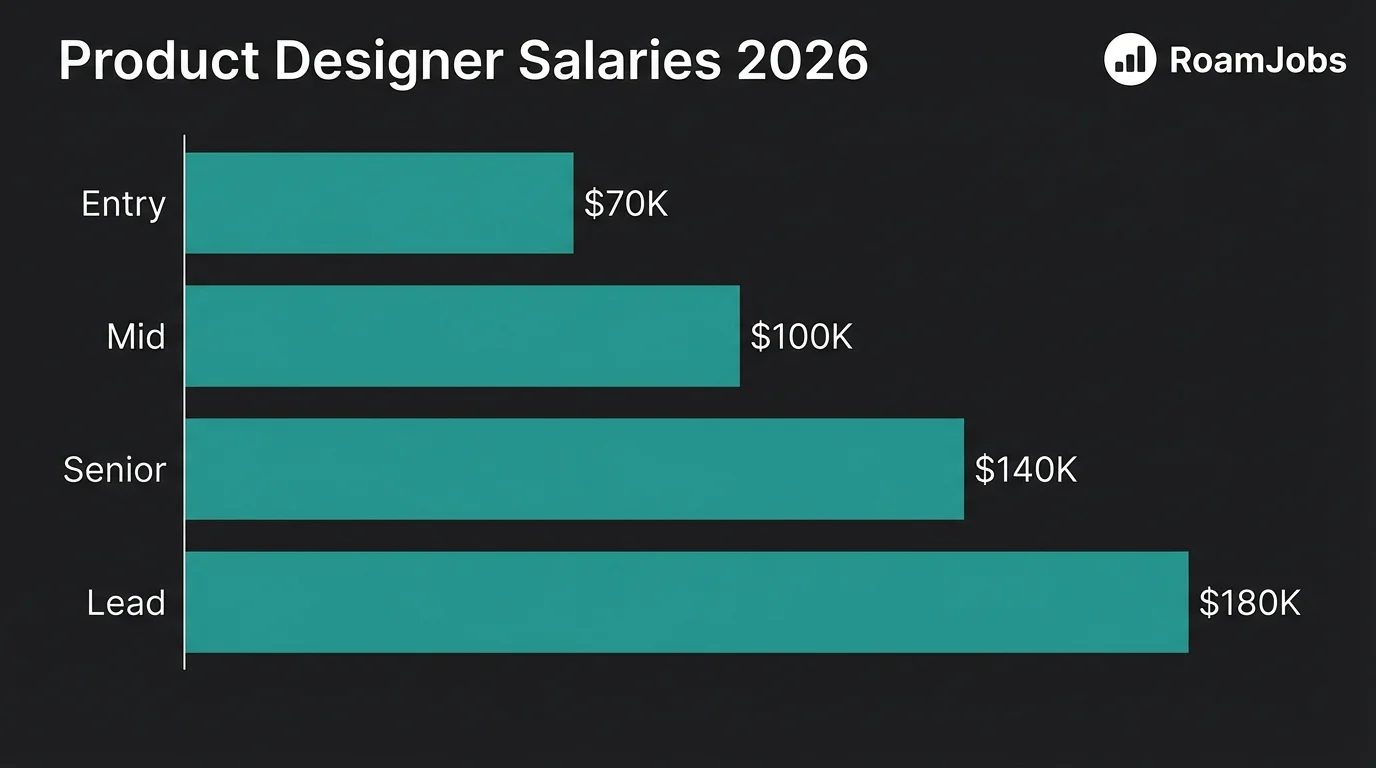
Remote Product Designer compensation varies dramatically based on experience, company size, and geographic location. These figures represent remote positions with US-based companies, the most competitive segment of the market.
Product Design Salary by Experience & Location
| Level | 🇺🇸 US Remote | 🇪🇺 EU Remote | 🌎 LATAM | 🌏 Asia |
|---|---|---|---|---|
| Entry Level (0-2 yrs) | $65,000 - $90,000 | $42,000 - $62,000 | $22,000 - $45,000 | $18,000 - $38,000 |
| Mid-Level (2-5 yrs) | $100,000 - $140,000 | $65,000 - $95,000 | $42,000 - $75,000 | $35,000 - $65,000 |
| Senior (5-8 yrs) | $140,000 - $195,000 | $92,000 - $135,000 | $68,000 - $110,000 | $55,000 - $95,000 |
| Staff/Principal (8+ yrs) | $185,000 - $270,000 | $125,000 - $190,000 | $95,000 - $155,000 | $82,000 - $140,000 |
* Salaries represent base compensation for remote positions. Actual compensation may vary based on company, experience, and specific location within region.
Entry Level / Junior Product Designer
0-2 years experience
What Companies Expect at Entry Level
Entry-level Product Designers are expected to execute well-defined design tasks with guidance from senior team members. You should be able to create wireframes and mockups in Figma, follow established design patterns, participate in user research sessions, incorporate feedback effectively, and communicate your design decisions clearly.
Core Skills to Develop
Design Fundamentals
- Visual design principles (typography, color, spacing, hierarchy)
- Basic user research methods (interviews, usability testing)
- Information architecture and user flow creation
- Responsive design across devices
- Accessibility fundamentals (WCAG basics)
Tool Proficiency
- Figma for design and prototyping (essential)
- Basic understanding of design systems and components
- FigJam or Miro for remote collaboration
- Prototyping tools for interaction design
Remote Work Skills
- Clear written communication for async collaboration
- Time management without direct supervision
- Proactive status updates and visibility
- Comfort with video calls and remote presentations
Portfolio Expectations
Entry-level portfolios should include 3-5 case studies demonstrating your design process. Include bootcamp projects, redesign concepts, or personal projects that show problem identification, research (even lightweight research), iteration, and final solutions. Focus on process documentation over visual polish alone. Companies want to see how you think through problems, not just beautiful mockups.
How to Stand Out
Build projects that solve real problems for real users. Contributing to open-source projects, volunteering for nonprofits, or creating tools that address genuine needs demonstrates initiative and practical experience. Document your process thoroughly, as your case studies prove you can communicate asynchronously. Consider specializing slightly in an industry (fintech, healthcare, e-commerce) to differentiate yourself from generic portfolios.
Mid-Level Product Designer
2-5 years experience
What Companies Expect at Mid-Level
Mid-level Product Designers own features end-to-end with minimal supervision. You should independently drive the design process from research through handoff, collaborate effectively with PMs and engineers, contribute to design critiques and team processes, mentor junior designers informally, and demonstrate measurable impact on product metrics.
Skills That Define Mid-Level
Design Execution Excellence
- Conducting and synthesizing user research independently
- Creating comprehensive design solutions for complex features
- Building interactive prototypes for testing and stakeholder buy-in
- Contributing meaningfully to design systems
- Balancing user needs with business requirements and technical constraints
Cross-Functional Collaboration
- Partnering with PMs to define requirements and scope
- Working with engineers to understand constraints and optimize solutions
- Presenting designs to stakeholders and incorporating feedback
- Facilitating remote design reviews and workshops
- Building relationships across functions despite distance
Strategic Thinking
- Understanding how your work connects to product and company goals
- Making trade-off decisions with limited information
- Identifying design opportunities beyond assigned projects
- Advocating for user needs in product discussions
Portfolio Expectations
Mid-level portfolios should demonstrate ownership and impact. Include 4-6 case studies with clear problem statements, your specific contributions (especially important if you worked on a team), measurable outcomes (metrics like conversion improvements, task completion rates, user satisfaction), and evidence of iteration based on feedback or data. Show cross-functional collaboration and how you navigated constraints.
Career Growth Considerations
Mid-level is the critical junction for Product Designers. You need to decide whether to pursue the IC track toward Senior/Staff or develop management skills for a leadership path. Both are viable for remote work, but the IC track is generally more straightforward remotely. Focus on developing either deep craft expertise (IC path) or people and process skills (management path).
Senior Product Designer
5-8 years experience
What Companies Expect at Senior Level
Senior Product Designers are force multipliers who elevate their teams. You should lead design for complex product areas or initiatives, define design direction and quality standards, mentor other designers formally and informally, drive cross-functional alignment on design decisions, and contribute to design team culture and processes.
Skills That Define Senior Level
Design Leadership
- Setting design vision for your product area
- Making high-stakes design decisions with confidence
- Establishing quality standards and holding the team accountable
- Representing design in executive and cross-functional forums
- Influencing product strategy beyond individual features
Advanced Craft
- Deep expertise in either UX or UI (with strong skills in both)
- Sophisticated understanding of design systems architecture
- Ability to design for edge cases, error states, and complex scenarios
- Creating designs that scale across platforms and use cases
- Expertise in accessibility and inclusive design
Organizational Impact
- Improving design processes and workflows
- Building design culture in remote environments
- Hiring and evaluating design candidates
- Contributing to design team strategy
- Identifying and driving design initiatives across teams
Portfolio Expectations
Senior portfolios should demonstrate leadership and strategic impact. Include 4-5 detailed case studies that show initiative leadership (you defined the direction, not just executed), organizational impact (improved processes, influenced strategy), mentorship and collaboration (how you elevated others), complex problem-solving (navigating ambiguity and constraints), and quantified business outcomes (revenue impact, user growth, efficiency gains).
Remote-Specific Challenges
Senior Product Designers face unique remote challenges. Building influence without physical presence requires exceptional communication skills. Creating design culture across time zones demands intentional effort. Mentoring remotely requires structured approaches like regular one-on-ones and documented feedback. Successful senior remote designers over-index on visibility, documentation, and proactive relationship-building.
Lead / Director Product Designer
8+ years experience
What Companies Expect at Staff/Principal Level
Staff and Principal Product Designers are organizational leaders who shape design strategy company-wide. You should define design vision across multiple product areas, solve the most ambiguous and complex design challenges, establish design principles and standards, represent design at the executive level, and drive design excellence across the organization.
Skills That Define Staff/Principal Level
Strategic Design Leadership
- Defining multi-year design vision and roadmap
- Solving problems that span multiple teams or products
- Making architectural design decisions with long-term implications
- Building alignment across design, product, and engineering leadership
- Anticipating future design challenges and preparing the organization
Organizational Influence
- Shaping company product strategy through design perspective
- Building and maintaining design culture at scale
- Evangelizing design thinking across the organization
- Representing the company externally (conferences, recruiting, thought leadership)
- Influencing hiring standards and career frameworks
Technical Excellence
- Deep expertise that others seek out for guidance
- Ability to solve problems no one else can solve
- Creating frameworks and tools that scale design effectiveness
- Pushing the boundaries of design craft in your domain
- Mentoring senior designers toward staff-level growth
Portfolio Expectations
Staff/Principal portfolios demonstrate organizational impact and thought leadership. Include 3-4 comprehensive case studies showing organizational transformation (how you changed how design works), strategic initiatives (multi-quarter or multi-year efforts you led), industry impact (work that influenced practices beyond your company), and leadership philosophy (your approach to design and how you scale it).
Career Path Options
At Staff/Principal level, career paths diverge significantly. Some designers pursue VP/CDO tracks requiring people management and executive skills. Others remain deep ICs as Distinguished Designers or Fellows. Remote-first companies often have stronger IC tracks because they emphasize output over presence. Consider which path aligns with your strengths and interests when evaluating opportunities at this level.
Essential Skills and Tools for Remote Product Designers
Success as a remote Product Designer requires mastering both design craft and the tools that enable distributed collaboration. This section covers the essential skills and tools you need to excel.
Design Tools Comparison
Essential Product Design Tools
Source: RoamJobs 2026 Design Tools Survey| Tool | Primary Use | Remote Importance | Learning Curve | Market Demand |
|---|---|---|---|---|
| Figma | Design & Prototyping | Essential | Medium | Required |
| FigJam | Workshops & Planning | High | Low | Strong |
| Maze | Usability Testing | High | Low | Growing |
| Loom | Async Presentations | Essential | Very Low | Strong |
| Notion | Documentation | High | Medium | Strong |
| Dovetail | Research Repository | Medium | Medium | Growing |
| Principle | Advanced Animation | Low | High | Niche |
| Framer | Advanced Prototyping | Medium | High | Growing |
Data compiled from RoamJobs 2026 Design Tools Survey. Last verified January 2026.
Figma Mastery for Remote Work
Figma has become the default tool for remote Product Design teams. Beyond basic design skills, remote Product Designers need to master collaboration features that enable effective async work.
Advanced Figma Skills for Remote Work
Component architecture understanding is essential. You should know how to create flexible, maintainable components that scale across products. This includes auto-layout proficiency for responsive designs, variant systems for component states and sizes, slots and instance swapping for flexible components, and component documentation for team adoption.
Prototyping expertise separates good remote designers from great ones. Master interactive prototypes that demonstrate complex flows, smart animate for smooth transitions, conditional logic for realistic prototypes, and device-specific prototyping for testing.
Collaboration features enable effective remote work. Understand commenting and feedback workflows, branching for parallel work streams, design review and approval processes, and developer handoff with inspect mode.
Design System Skills
Remote Product Designers increasingly need design system expertise, even if they do not own the system. Key skills include consuming and extending existing systems, creating tokens for color, typography, and spacing, documenting component usage guidelines, and identifying patterns that should become components.
Research Skills for Product Designers
Unlike dedicated UX Researchers, Product Designers conduct lightweight, focused research to inform specific design decisions. Master these methods to strengthen your work.
Generative Research Methods
User interviews are the foundation of product design research. Remote Product Designers should know how to plan and conduct remote interviews effectively, synthesize findings into actionable insights, identify patterns across multiple interviews, and communicate research findings to stakeholders.
Evaluative Research Methods
Usability testing helps validate design decisions. Key skills include planning moderated and unmoderated remote tests, using tools like Maze, UserTesting, or Lookback, analyzing results to identify issues, and prioritizing findings based on severity and frequency.
Data-Informed Design
Product Designers should be comfortable with quantitative data. Understand basic analytics tools (Amplitude, Mixpanel, Google Analytics), formulating hypotheses based on data, measuring design impact through metrics, and combining qualitative and quantitative insights.
Cross-Functional Collaboration Skills
Remote Product Designers spend significant time collaborating with non-designers. These skills determine your effectiveness and influence.
Working with Product Managers
Product Managers are your closest collaborators. Effective partnerships require understanding PM priorities and constraints, contributing to roadmap planning and prioritization, co-creating requirements and success metrics, balancing user needs with business goals, and communicating design progress and blockers clearly.
Working with Engineers
Engineering collaboration determines whether your designs ship successfully. Key skills include understanding technical constraints and possibilities, creating specs that engineers can implement accurately, participating in implementation reviews and QA, building trust through consistent, feasible designs, and learning basic frontend concepts (HTML, CSS, responsive design).
Stakeholder Communication
Remote designers must advocate for design decisions asynchronously. Master structured written arguments for design choices, recording video walkthroughs for complex proposals, presenting designs in meetings effectively, receiving and incorporating feedback gracefully, and escalating disagreements constructively.
Remote Work Skills
Beyond design skills, remote Product Designers need specific competencies for distributed work.
Async Communication Excellence
Most remote design work happens asynchronously. Develop clear written explanations of design decisions, self-documenting designs with annotations, effective use of Loom for video walkthroughs, knowing when to go async vs. sync, and documentation that anticipates questions.
Self-Management
Without office structure, self-management becomes critical. Practice managing your own schedule and priorities, maintaining productivity without supervision, setting boundaries between work and personal life, staying visible without being present, and seeking feedback proactively.
Building Remote Relationships
Design influence requires relationships, which are harder to build remotely. Invest in informal relationship-building, participating in team rituals and social activities, building cross-functional connections intentionally, finding mentors and sponsors in distributed environments, and creating your own visibility.
Companies Actively Hiring Remote Product Designers
The remote Product Design job market is robust across company sizes and industries. This section highlights companies with strong remote design cultures and active hiring.
Remote-First Design Leaders
Figma - The design tool company practices what they preach with a distributed design team. Product Designers work on the core editor, design systems features, FigJam, and enterprise products. Exceptional design culture with high standards. Competitive compensation with location-agnostic pay philosophy.
Automattic (WordPress, WooCommerce, Tumblr) - Pioneer of distributed work with 1,900+ employees across 96 countries. Product Designers own significant product areas with high autonomy. Strong async culture with annual team meetups. Excellent work-life balance.
GitLab - Gold standard for remote documentation and processes. Design team works on developer tools with complex UX challenges. Transparent company with public handbook. Strong design system culture.
Zapier - Workflow automation platform with excellent remote culture. Product Designers tackle complex interaction patterns for connecting applications. Known for work-life balance and thoughtful design processes.
Buffer - Transparent, values-driven company with 4-day workweek. Smaller design team with high impact. Focus on social media management tools. Strong product design culture.
Notion - Productivity workspace with exceptional design quality. Distributed team working on complex editing and collaboration features. Design-led company with high standards.
Linear - Issue tracking tool known for exceptional design craft. Small, senior team building beautifully designed developer tools. High standards with significant individual impact.
Remote-First Tech Companies
Shopify - “Digital by default” e-commerce platform with large design team. Product Designers work across merchant tools, checkout, and platform features. Strong design system (Polaris). Competitive compensation.
Stripe - Financial infrastructure with exceptional design standards. Remote-first with employees in 40+ countries. Product Designers tackle complex payment flows and developer experience. Competitive pay.
Vercel - Frontend platform (creators of Next.js) with distributed team. Product Designers work on deployment, collaboration, and developer experience. Design-forward culture.
Webflow - Visual web development platform with strong design culture. Product Designers work on the visual editor, CMS, and collaboration features. Design-led company.
Canva - Visual design platform with growing remote presence. Product Designers work on editing tools, templates, and collaboration features. Strong growth trajectory.
Enterprise Companies with Remote Design Teams
HubSpot - CRM platform with @flex work arrangements. Product Designers work across marketing, sales, and service hubs. Large design team with good career progression.
Atlassian - Makers of Jira and Confluence with “Team Anywhere” policy. Product Designers tackle complex productivity and collaboration challenges. Strong design system culture.
Twilio - Cloud communications platform with remote-friendly engineering and design culture. Product Designers work on developer experience and communication tools.
Datadog - Cloud monitoring platform with hybrid remote options. Product Designers tackle complex data visualization and developer tools challenges.
Finding Unlisted Opportunities
Many remote Product Design roles are never publicly posted. Access hidden opportunities through networking in design communities, engaging with designers at target companies on Twitter/LinkedIn, attending remote design meetups and conferences, contributing to open source design projects, building a public presence through writing or speaking, and direct outreach to design leaders at companies you admire.
Design Communities for Networking
ADPList provides mentorship connections with design leaders. Dribbble offers community engagement and job listings. Design Twitter and Bluesky have active communities where designers share work. Slack communities like Designer Hangout and Figma Community offer direct connections. Remote-specific communities like We Work Remotely Discord provide targeted networking.
Remote Product Design Interview Process
Remote Product Design interviews are comprehensive, typically spanning 5-7 rounds over 3-6 weeks. Understanding each phase helps you prepare effectively.
Interview Structure Overview
Round 1: Recruiter Screen (30-45 minutes)
The recruiter evaluates basic fit and logistics. Expect questions about your background and interest in the role, remote work experience and preferences, salary expectations and timeline, and high-level portfolio discussion.
Round 2: Hiring Manager Screen (45-60 minutes)
The hiring manager assesses design experience and potential fit. Prepare for deeper portfolio discussion of 1-2 projects, questions about your design process, discussion of remote work approach, and initial assessment of collaboration skills.
Round 3: Portfolio Deep Dive (60-90 minutes)
You present 2-3 case studies to designers and/or cross-functional partners. This is your primary opportunity to demonstrate your design thinking, process, and communication skills. Expect detailed questions about your decisions and trade-offs.
Round 4: Design Challenge (2-8 hours + presentation)
Most companies include a design exercise. This may be a take-home project (typically 4-8 hours), a live whiteboard session (60-90 minutes), or a combination of both. The challenge evaluates your problem-solving process, not just the final output.
Round 5-6: Cross-Functional Interviews (45-60 minutes each)
You meet with PMs, engineers, and other stakeholders. These interviews assess collaboration skills, how you handle feedback, and cultural fit. Prepare examples of cross-functional partnerships.
Round 7: Final Round / Leadership (45-60 minutes)
Senior leadership evaluates strategic thinking and cultural alignment. Prepare for questions about your career goals, design philosophy, and how you handle challenges.
Interview Questions and Answers
How to answer: Structure your response around the full design lifecycle while highlighting your specific contributions and decision-making. Use a clear framework: Problem, Research, Ideation, Design, Testing, Iteration, Launch, and Impact.
Strong answer approach:
- Start with the business context and problem statement
- Explain how you conducted research (methods, key insights)
- Walk through ideation and how you explored solutions
- Show key design decisions and the reasoning behind them
- Discuss how you tested and iterated
- Share measurable outcomes and learnings
What interviewers evaluate: Process rigor, decision-making quality, ability to communicate clearly, and evidence of impact.
How to answer: Use the STAR framework (Situation, Task, Action, Result) while demonstrating diplomatic communication and user advocacy. Show that you can disagree productively while maintaining relationships.
Strong answer approach:
- Set up the situation and what was at stake
- Explain your perspective and the evidence supporting it
- Describe how you communicated your position
- Share the resolution (even if you did not “win”)
- Highlight what you learned and how you maintain the relationship
What interviewers evaluate: Communication skills, ability to advocate for users, collaborative problem-solving, emotional intelligence.
How to answer: Demonstrate pragmatism while showing commitment to user-centered design. Explain how you balance speed with gathering necessary insights.
Strong answer approach:
- Acknowledge this is common in product design
- Describe lightweight research methods you use (competitor analysis, analogous experiences, quick user conversations)
- Explain how you use assumptions explicitly and plan to validate them
- Discuss designing for measurability so you can learn post-launch
- Share an example of successfully navigating ambiguity
What interviewers evaluate: Pragmatism, research instincts, comfort with ambiguity, learning orientation.
How to answer: Be honest about a real failure while demonstrating accountability, learning, and growth. Avoid blaming others or making excuses.
Strong answer approach:
- Describe the project and your role clearly
- Explain what you expected vs. what happened
- Take appropriate ownership for the outcome
- Detail what you learned from the experience
- Show how you applied those learnings subsequently
What interviewers evaluate: Self-awareness, accountability, learning orientation, honesty.
How to answer: Demonstrate self-management skills essential for remote work. Show that you can make prioritization decisions independently while keeping stakeholders informed.
Strong answer approach:
- Explain your framework for prioritization (impact, urgency, dependencies)
- Describe how you communicate priorities to stakeholders
- Discuss how you handle changing priorities
- Share tools or systems you use to stay organized
- Give a specific example of successful prioritization
What interviewers evaluate: Self-management, communication, strategic thinking, organizational skills.
How to answer: This tests your real-time design thinking. Structure your approach while asking clarifying questions and thinking aloud.
Strong answer approach:
- Start by asking clarifying questions about users, goals, constraints
- Articulate your understanding of the problem
- Propose a high-level approach and rationale
- Discuss what research you would want to conduct
- Sketch rough concepts (if whiteboarding) or describe them verbally
- Identify key decisions and how you would validate them
- Acknowledge trade-offs and open questions
What interviewers evaluate: Problem-solving process, ability to think on your feet, questioning skills, design judgment.
How to answer: Show that you value feedback while demonstrating discernment about when to push back versus when to incorporate.
Strong answer approach:
- Express genuine appreciation for feedback as a growth tool
- Explain how you separate feedback on the work from personal feelings
- Describe how you evaluate and prioritize feedback
- Discuss when and how you push back constructively
- Share an example of feedback that significantly improved your work
What interviewers evaluate: Emotional intelligence, growth mindset, collaboration skills, discernment.
How to answer: Demonstrate that you understand engineering perspectives and invest in cross-functional relationships, especially important for remote work.
Strong answer approach:
- Express respect for engineering expertise and constraints
- Explain how you involve engineers early in design process
- Describe how you create implementation-friendly designs
- Discuss how you handle technical feasibility concerns
- Share an example of a strong engineering partnership
What interviewers evaluate: Cross-functional collaboration, respect for other disciplines, practical design approach.
How to answer: Demonstrate systems thinking and ability to create scalable solutions. This question is more common for mid-level and senior roles.
Strong answer approach:
- Describe the challenge and its scope
- Explain your approach to analyzing the problem
- Walk through the solution and rationale
- Discuss how you gained adoption and buy-in
- Share the impact on team efficiency or product consistency
What interviewers evaluate: Systems thinking, technical design skills, ability to scale solutions, influence skills.
How to answer: Show that accessibility is integrated into your process, not an afterthought. Demonstrate knowledge of specific accessibility considerations.
Strong answer approach:
- Explain your philosophy on inclusive design
- Describe specific accessibility practices in your process (color contrast, keyboard navigation, screen reader considerations)
- Discuss tools you use to evaluate accessibility
- Share how you advocate for accessibility with stakeholders
- Give an example of improving accessibility in a project
What interviewers evaluate: Technical knowledge, user empathy, attention to detail, values alignment.
How to answer: Demonstrate that you understand and embrace async communication, which is essential for remote Product Design.
Strong answer approach:
- Share your experience with distributed teams
- Explain your async communication practices (documentation, Loom, written updates)
- Describe how you maintain visibility without being present
- Discuss how you handle time zone differences
- Share specific examples of successful async collaboration
What interviewers evaluate: Remote work readiness, communication skills, self-management, adaptability.
How to answer: Demonstrate sophisticated thinking about design trade-offs. Show that you can advocate for users while being pragmatic about constraints.
Strong answer approach:
- Acknowledge that this tension is inherent to product design
- Explain your framework for evaluating trade-offs
- Describe how you advocate for user needs
- Discuss how you understand and respect business and technical constraints
- Share an example of successfully navigating a complex trade-off
What interviewers evaluate: Business acumen, pragmatism, user advocacy, strategic thinking.
How to answer: Demonstrate strong communication skills and understanding of stakeholder management, critical for remote design work.
Strong answer approach:
- Explain how you tailor presentations to different audiences
- Describe your structure for design presentations
- Discuss how you anticipate and address concerns
- Share how you handle pushback or questions
- Give an example of a successful stakeholder presentation
What interviewers evaluate: Communication skills, stakeholder management, presentation ability, influence.
How to answer: Show genuine curiosity and commitment to growth. Be specific about your learning sources and recent growth areas.
Strong answer approach:
- Share specific resources you follow (newsletters, designers, publications)
- Describe recent skills you have developed
- Explain how you apply learnings to your work
- Discuss community involvement (meetups, mentorship, writing)
- Show enthusiasm for continuous learning
What interviewers evaluate: Growth mindset, curiosity, self-direction, industry awareness.
How to answer: Demonstrate ability to deliver quality work under constraints while making smart trade-offs.
Strong answer approach:
- Set up the situation and constraints clearly
- Explain how you scoped and prioritized
- Describe what you cut and why
- Share the outcome and quality of the work
- Discuss what you learned about working under pressure
What interviewers evaluate: Time management, prioritization, quality standards, stress management.
How to answer: Demonstrate that you have researched the product while being thoughtful and humble about critiques of their work.
Strong answer approach:
- Acknowledge that you are seeing it from outside without full context
- Share 2-3 specific, actionable observations
- Explain the reasoning behind your suggestions
- Ask questions to understand constraints you might not know
- Position suggestions as hypotheses to test, not definitive answers
What interviewers evaluate: Preparation, design thinking, humility, communication skills.
How to answer: Demonstrate thorough discovery process and understanding of what information you need to design effectively.
Strong answer approach:
- Explain your framework for discovery questions
- Cover key areas: users, goals, constraints, success metrics, timeline
- Discuss how you prioritize which questions to ask first
- Share how you handle situations with incomplete information
- Give an example of a question that significantly changed your approach
What interviewers evaluate: Process rigor, strategic thinking, communication, thoroughness.
How to answer: Demonstrate influence skills critical for senior roles and remote work where authority is less visible.
Strong answer approach:
- Describe the situation and why influence was needed
- Explain your strategy for building support
- Detail specific actions you took
- Share the outcome and how alignment was achieved
- Reflect on what worked and what you would do differently
What interviewers evaluate: Influence skills, strategic thinking, communication, leadership potential.
How to answer: Show that you think beyond deliverables to outcomes. Demonstrate familiarity with design metrics and data-informed iteration.
Strong answer approach:
- Explain your philosophy on measuring design success
- Describe specific metrics you track (task completion, user satisfaction, business outcomes)
- Discuss how you set up measurement before launch
- Share how you use data to iterate and improve
- Give an example of data informing design decisions
What interviewers evaluate: Outcome orientation, analytical skills, continuous improvement mindset.
How to answer: Demonstrate leadership skills and investment in others’ growth. This question is particularly important for senior and staff roles.
Strong answer approach:
- Share your philosophy on mentorship
- Describe specific mentoring experiences
- Explain how you adapt to different mentees’ needs
- Discuss how you provide constructive feedback
- Share the outcomes of your mentorship
What interviewers evaluate: Leadership skills, communication, empathy, growth mindset.
Design Challenge Best Practices
Design challenges are a critical component of Product Design interviews. Here is how to approach them effectively.
Take-Home Projects
For take-home challenges, manage your time carefully. Respect the stated time limit (usually 4-8 hours). Spend the first 20% understanding the problem and planning. Document your process as you go. Leave time for polish and presentation preparation. Prepare to discuss trade-offs and what you would do with more time.
Live Whiteboard Sessions
For live design exercises, focus on process over polish. Think aloud throughout the exercise. Ask clarifying questions before diving in. Start with the problem space, not solutions. Sketch multiple concepts before refining. Discuss trade-offs explicitly. Stay calm under time pressure.
Presentation Tips
Whether presenting take-home work or live exercises, structure your presentation clearly. Start with problem understanding and key insights. Walk through your process logically. Explain your decisions and trade-offs. Anticipate questions and address them proactively. End with next steps and open questions.
Frequently Asked Questions
Frequently Asked Questions
Should I specialize in UX or UI, or stay a generalist Product Designer?
For remote work, staying a generalist Product Designer is typically the stronger career choice. Remote companies prefer designers who can own features end-to-end, reducing coordination overhead. However, you should develop a specialty strength within your generalist skill set. Most Product Designers lean slightly toward either UX (stronger in research, flows, and information architecture) or UI (stronger in visual design, interaction, and polish). This 'T-shaped' profile combines breadth across the design process with depth in one area. For career growth to Staff/Principal levels, deeper expertise in one area becomes more important while maintaining generalist capabilities.
Do remote Product Designers need to know how to code?
Coding is not required for remote Product Design roles, but understanding frontend fundamentals significantly improves your effectiveness. You should understand HTML/CSS basics to create feasible designs, responsive design principles, how designs translate to code (components, states, properties), and basic technical constraints and possibilities. Some Product Designers learn React or other frameworks to build prototypes or contribute to design systems, but this is optional and role-dependent. Focus first on design excellence, then consider learning code if it interests you or if your target companies value it.
Is it harder to get a Product Design job at a startup or a large company?
Both present challenges, but in different ways. Startups typically have fewer applicants per role but look for specific experience alignment and cultural fit. They often prefer candidates who can immediately contribute without extensive onboarding. Large companies receive more applications but have structured processes designed to evaluate candidates consistently. They may be more willing to train and develop junior talent. For remote roles specifically, startups are more likely to be fully remote but may have less structured remote practices. Large companies with remote policies often have better established remote infrastructure. Consider your experience level, work style preferences, and career goals when targeting company size.
How deep should my portfolio case studies be for Product Design roles?
Product Design portfolios should include 4-6 comprehensive case studies demonstrating end-to-end design process. Each case study should include clear problem statement and business context, your research approach and key insights, design exploration and iteration, final designs with rationale for key decisions, measurable outcomes and impact, and reflection on learnings. Depth matters more than breadth. A strong case study might be 1,500-2,500 words with supporting visuals. Include enough detail that readers understand your thinking process, not just your final designs. For senior roles, emphasize strategic thinking, organizational impact, and leadership.
How do I transition from graphic design to remote Product Design?
Transitioning from graphic design to Product Design is common but requires intentional effort. Start by learning UX fundamentals through courses (Google UX Certificate, Coursera, or similar). Build 3-5 product design case studies showing full process, not just final visuals. Master Figma including prototyping and collaboration features. Gain practical experience through freelance projects, volunteer work, or speculative redesigns. Emphasize transferable skills: visual design, typography, brand thinking, attention to detail. Position your visual design strength as an asset while demonstrating UX competency. The transition typically takes 3-6 months of focused learning and portfolio building.
What is the difference between remote and hybrid Product Design roles?
Remote roles allow you to work from anywhere without regular office visits. Hybrid roles require some office presence (typically 2-3 days per week or quarterly gatherings). For Product Designers, the main differences are collaboration style (async vs. in-person), relationship building approach, and geographic constraints. Fully remote roles offer maximum flexibility but require stronger async communication skills. Hybrid roles may offer easier collaboration but limit where you can live. When evaluating opportunities, clarify expectations: required office days, time zone restrictions, travel requirements, and whether remote is truly supported or merely tolerated.
How important is industry experience for remote Product Design roles?
Industry experience matters more for some domains than others. Regulated industries (healthcare, fintech, insurance) often prefer candidates with domain knowledge due to compliance complexity. Enterprise B2B products benefit from understanding business workflows and stakeholder dynamics. Consumer products generally value design skills over industry experience. For remote roles, relevant industry experience can differentiate you from a large applicant pool. If you lack industry experience, demonstrate transferable skills and rapid learning ability. Consider targeting adjacent industries or roles that value your existing expertise while building new domain knowledge.
What salary should I expect if I am outside the US working for a US company remotely?
Compensation for international remote workers varies significantly by company philosophy. Some companies (like GitLab and Zapier) pay location-agnostic salaries based on expensive markets, providing premium compensation for those in lower cost-of-living areas. Others adjust salaries based on local market rates, sometimes 30-50% lower than US rates. A third group pays a globally competitive rate that falls between these approaches. When evaluating opportunities, research the company's compensation philosophy, ask directly about how location affects pay, and consider total compensation including benefits, equity, and cost-of-living adjustments. Even with location adjustments, US company salaries are often higher than local alternatives.
How do I build a portfolio without real work experience?
You can build a strong portfolio without traditional employment through several approaches. Redesign projects involve improving existing products with full case studies. Speculative projects address real problems you identify in the world. Volunteer work for nonprofits provides real users and constraints. Open source design contributes to projects that need design help. Personal projects that solve problems you personally experience demonstrate initiative. Side projects or freelance work, even small projects, provide real-world experience. Each project should demonstrate full design process: problem definition, research (even lightweight), ideation, design, and reflection. Quality and depth matter more than whether the project was paid professional work. Focus on 4-6 strong case studies rather than many shallow ones.
What are the biggest challenges of remote Product Design work?
Remote Product Design presents unique challenges you should prepare for. Building influence without physical presence requires exceptional communication skills. Collaborating with PMs and engineers asynchronously demands clear documentation and proactive communication. Maintaining visibility and demonstrating value requires intentional effort. Avoiding isolation and building relationships needs conscious investment in connection. Getting timely feedback on designs may take longer in async environments. Successful remote Product Designers develop strong practices for visibility (regular updates, documented work), relationship building (informal connections, proactive communication), and async collaboration (self-explanatory designs, video walkthroughs). These skills can be learned and developed over time.
Should I accept a lower salary for a fully remote Product Design role?
This depends on your priorities and the specific opportunity. Consider total compensation including equity, benefits, and perks. Factor in savings from remote work (commute, food, wardrobe, potentially housing costs). Evaluate career growth potential and learning opportunities. Consider work-life balance and flexibility value. Compare to alternatives including hybrid and local options. Many candidates accept modestly lower base salaries for remote roles due to lifestyle benefits and savings, but be cautious about significant pay cuts that could affect long-term earning potential. Remote-first companies increasingly pay competitively to attract talent, so significant discounts may indicate company financial health issues or undervaluation of design.
How do I demonstrate remote work skills in my application if I have not worked remotely before?
You can demonstrate remote readiness without formal remote experience. Highlight any distributed collaboration such as working with remote colleagues, clients, or collaborators. Show async communication skills through your portfolio, detailed case studies, and clear documentation that demonstrates written communication ability. Describe self-management and autonomy in previous roles. Share remote work practices you have developed such as home office setup, communication tools proficiency, and time management approaches. Mention any freelance or side project work done independently. In interviews, discuss specific plans for remote work success, demonstrate knowledge of remote best practices, and show enthusiasm for distributed work. Your portfolio itself is evidence of your communication skills because clear case studies prove you can explain your work asynchronously.
Related Design Career Guides
Product Design connects to a broader ecosystem of design specializations. Explore these related guides to understand how Product Design fits within the design career landscape and identify adjacent opportunities.
Design Hub Guide
The Remote Design Jobs guide provides a comprehensive overview of all remote design specializations, including UX Design, UI Design, UX Research, Brand Design, and Design Management. Use this hub to compare roles and understand the full landscape of remote design careers.
UX Design Guide
If you are particularly interested in the research and strategy side of design, explore the Remote UX Designer Jobs guide. UX Design roles focus more deeply on user research, information architecture, and usability, with less emphasis on visual design execution.
UI Design Guide
If visual design and interaction craft are your primary strengths, the Remote UI Designer Jobs guide explores opportunities focused on visual design excellence, design systems, and interface polish.
Building Your Remote Design Presence
The Remote Portfolio guide provides detailed guidance on creating portfolios that demonstrate remote work readiness. Strong portfolios are essential for remote Product Design roles, where your case studies prove both design skills and communication abilities.
Interview Preparation
The Remote Interview guide covers best practices for succeeding in video interviews, which are standard for remote Product Design hiring. Learn how to present your portfolio effectively, handle design challenges, and demonstrate cultural fit remotely.
Salary Negotiation
Once you receive offers, the Negotiating Remote Salary guide helps you maximize compensation. Remote Product Design roles often have unique compensation considerations including location-based adjustments and equity packages.
Next Steps: Launching Your Remote Product Design Career
Remote Product Design offers exceptional career opportunities for designers who can demonstrate both craft excellence and remote work readiness. The combination of high demand, competitive salaries, and work flexibility makes this one of the most attractive remote career paths in 2026.
Immediate actions to take:
-
Audit your portfolio - Ensure you have 4-6 end-to-end case studies demonstrating research, design, and measurable impact. Your portfolio proves both your design skills and your async communication abilities.
-
Master Figma collaboration features - Beyond basic design skills, practice with branching, commenting, prototyping, and developer handoff. These skills are essential for remote design work.
-
Build your target company list - Research 20-30 companies with strong remote design cultures. Understand their products, design teams, and interview processes.
-
Develop your remote work narrative - Prepare specific examples of self-management, async communication, and independent problem-solving, even if from non-work contexts.
-
Start applying strategically - Quality over quantity. Customize applications for each role, referencing specific aspects of the company’s product and design culture.
-
Practice your case study presentation - Record yourself presenting your top 2-3 case studies. Refine until you can clearly communicate your process and decisions in 15-20 minutes each.
Remote Product Design is not just about working from anywhere. It is about accessing global opportunities, joining teams building products used by millions, and designing a career that fits your life. The skills you develop as a remote Product Designer, from async communication to self-direction, will serve you throughout your career.
Get the Remote Product Design Career Guide
Weekly curated remote Product Design jobs, portfolio tips, and interview advice delivered to your inbox. Join 15,000+ designers building remote careers.
Frequently Asked Questions
How do I find remote product designer jobs?
To find remote product designer jobs, start with specialized job boards like We Work Remotely, Remote OK, and FlexJobs that focus on remote positions. Set up job alerts with keywords like "remote product designer" and filter by fully remote positions. Network on LinkedIn by following remote-friendly companies and engaging with hiring managers. Many product designer roles are posted on company career pages directly, so identify target companies known for remote work and check their openings regularly.
What skills do I need for remote product designer positions?
Remote product designer positions typically require the same technical skills as on-site roles, plus strong remote work competencies. Essential remote skills include excellent written communication, self-motivation, time management, and proficiency with collaboration tools like Slack, Zoom, and project management software. Demonstrating previous remote work experience or the ability to work independently is highly valued by employers hiring for remote product designer roles.
What salary can I expect as a remote product designer?
Remote product designer salaries vary based on experience level, company size, location-based pay policies, and the specific tech stack or skills required. US-based remote positions typically pay market rates regardless of where you live, while some companies adjust pay based on your location's cost of living. Entry-level positions start lower, while senior roles can command premium salaries. Check our salary guides for specific ranges by experience level and geography.
Are remote product designer jobs entry-level friendly?
Some remote product designer jobs are entry-level friendly, though competition can be high. Focus on building a strong portfolio or demonstrable skills, contributing to open source projects if applicable, and gaining any relevant experience through internships, freelance work, or personal projects. Some companies specifically hire remote junior talent and provide mentorship programs. Smaller startups and agencies may be more open to entry-level remote hires than large corporations.
Continue Reading
Remote Design Jobs 2026: Complete Guide to UX, UI, Product & Brand Careers
The definitive hub for remote design careers. Explore salary data, interview guides, and opportunities across UX, UI, product design, research, and design management.
Remote UX Designer Jobs: Complete 2026 Career Guide
Everything you need to land a remote UX designer job. User research, wireframing, usability testing - salary data, interview questions, and companies hiring.
Remote UI Designer Jobs: Complete 2026 Career Guide
Everything you need to land a remote UI designer job. Visual design, design systems, interfaces - salary data, interview questions, and companies hiring.
Land Your Remote Job Faster
Get the latest remote job strategies, salary data, and insider tips delivered to your inbox.