Remote Product Marketing Jobs: The Complete 2026 Guide to PMM Careers
Everything you need to land a remote product marketing manager job. Master positioning, launches, competitive intelligence, and sales enablement. Salary data, interview questions, and top companies hiring PMMs.
Updated January 20, 2026 • Verified current for 2026
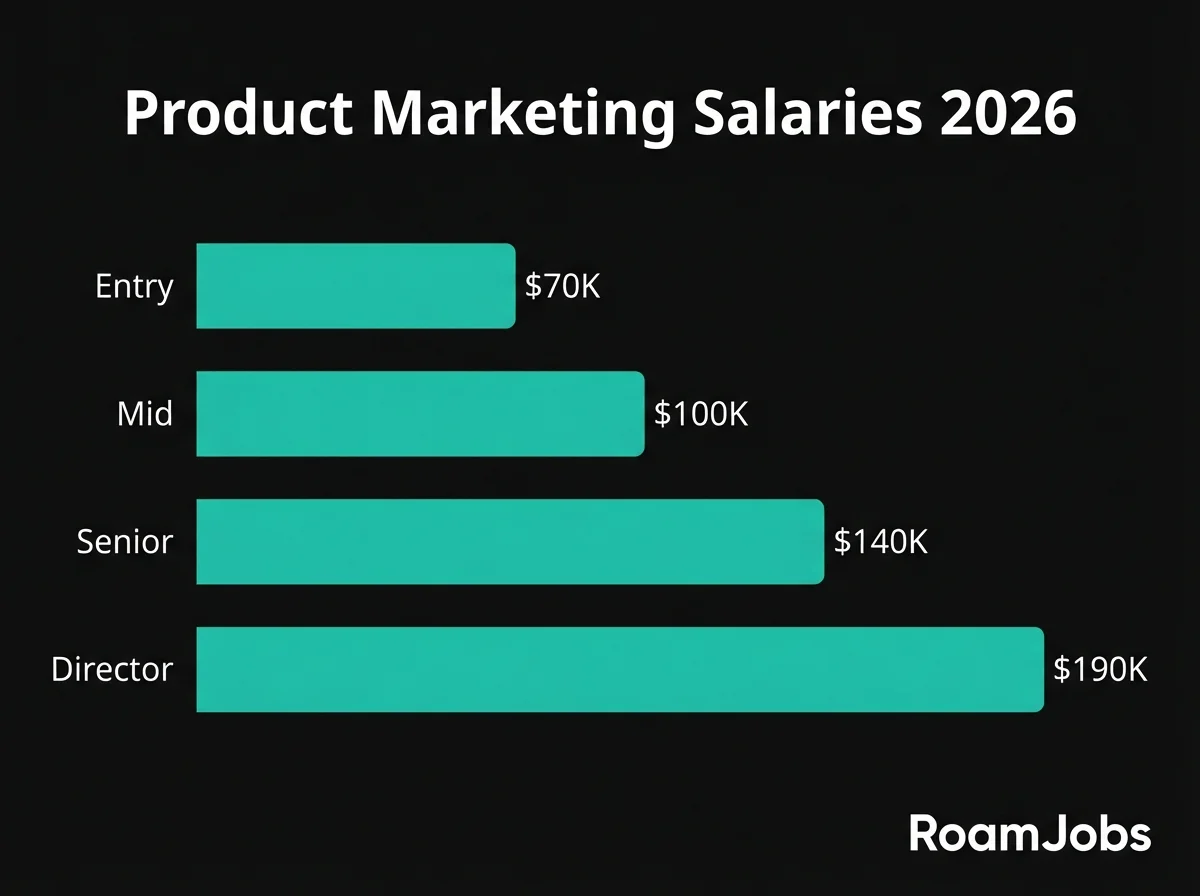
Remote Product Marketing Managers (PMMs) are strategic marketers who own product positioning, go-to-market launches, competitive intelligence, and sales enablement. With salaries ranging from $70,000 to $265,000 for US-based remote roles, Product Marketing has become one of the highest-paying marketing specializations in 2026. PMMs serve as the bridge between product, marketing, and sales teams, translating complex product capabilities into compelling market narratives that drive customer acquisition and retention. The role is exceptionally well-suited for remote work because it relies heavily on written communication, strategic documentation, and cross-functional alignment—all activities that thrive in async environments. Remote PMMs typically spend their time crafting positioning frameworks, developing launch playbooks, conducting competitive analysis, creating sales collateral, and enabling go-to-market teams across multiple time zones.
What Does a Remote Product Marketing Manager Actually Do?
Product Marketing sits at the intersection of product strategy, market understanding, and go-to-market execution. Unlike demand generation or content marketing roles that focus on driving traffic and leads, PMMs own the strategic foundation that makes all other marketing efforts effective. Understanding this distinction is crucial for targeting the right opportunities and succeeding in interviews.
The Four Pillars of Product Marketing
1. Positioning and Messaging
Positioning is the foundation of everything a PMM does. It defines how your product is perceived in the market relative to alternatives. Remote PMMs develop positioning frameworks that articulate what the product does, who it serves, what makes it different, and why customers should care. This work requires deep customer understanding, competitive awareness, and the ability to distill complex capabilities into clear, compelling narratives.
Messaging extends positioning into specific communications for different audiences and contexts. PMMs create messaging hierarchies that cascade from high-level value propositions down to feature-level benefits. This includes website copy, sales scripts, email templates, and campaign messaging. Strong messaging is consistent across channels while adapting to specific audiences and use cases.
2. Product Launches
Product launches are the most visible PMM deliverable. Remote PMMs orchestrate cross-functional launch efforts, coordinating product, engineering, marketing, sales, customer success, and support teams. This involves defining launch tiers and go-to-market strategies, creating launch timelines and coordinating dependencies, developing launch assets including positioning documents, sales enablement materials, and marketing collateral, enabling internal teams before external announcements, and measuring launch success against defined metrics.
The best PMMs treat launches as ongoing processes rather than single events, with pre-launch building anticipation, launch day execution, and post-launch optimization and expansion.
3. Competitive Intelligence
Understanding the competitive landscape is essential for effective positioning and sales enablement. Remote PMMs build and maintain competitive intelligence programs that track competitor movements, analyze competitive positioning, create battlecards for sales teams, develop competitive responses and objection handling, and inform product roadmap priorities based on market gaps.
This work requires systematic monitoring, analytical thinking, and the ability to translate competitive insights into actionable guidance for sales and product teams.
4. Sales Enablement
PMMs ensure sales teams have the knowledge, tools, and content to effectively sell the product. This includes creating sales playbooks and training materials, developing case studies and customer proof points, building demo scripts and presentation templates, providing competitive battlecards and objection handling, and supporting key deals with custom positioning.
Effective sales enablement requires understanding the sales process, building relationships with sales teams, and continuously iterating based on field feedback.
Day-to-Day Responsibilities
A typical week for a remote PMM varies significantly based on company stage, product maturity, and current priorities. However, most weeks include a mix of strategic and tactical work.
Strategic Activities
Customer research through interviews, surveys, and data analysis informs positioning and product decisions. Competitive monitoring keeps you current on market movements. Cross-functional planning with product and sales ensures alignment on priorities and go-to-market strategies. Positioning refinement based on market feedback and performance data keeps messaging sharp.
Tactical Activities
Content creation for sales enablement, marketing campaigns, and product documentation. Launch execution coordinating multiple workstreams and stakeholders. Sales support through deal-specific positioning, competitive responses, and win/loss analysis. Internal communication through status updates, stakeholder presentations, and documentation.
Remote-Specific Practices
Remote PMMs develop strong async communication habits. This includes writing detailed positioning documents that can be understood without explanation, recording video walkthroughs of launches and enablement materials, building relationships with sales teams despite physical distance, and maintaining visibility into product and engineering activities.
Salary Breakdown by Seniority Level
Remote Product Marketing Manager compensation varies significantly based on experience, company stage, and industry. These figures represent remote positions with US-based companies across different seniority levels.
Product Marketing Manager Salary by Experience & Location
| Level | 🇺🇸 US Remote | 🇪🇺 EU Remote | 🌎 LATAM | 🌏 Asia |
|---|---|---|---|---|
| Entry Level (0-2 yrs) | $70,000 - $95,000 | $48,000 - $68,000 | $25,000 - $48,000 | $20,000 - $42,000 |
| Mid-Level (2-5 yrs) | $105,000 - $145,000 | $72,000 - $102,000 | $45,000 - $78,000 | $38,000 - $68,000 |
| Senior (5-8 yrs) | $145,000 - $200,000 | $98,000 - $140,000 | $68,000 - $115,000 | $58,000 - $98,000 |
| Director (8+ yrs) | $185,000 - $265,000 | $125,000 - $188,000 | $92,000 - $155,000 | $78,000 - $138,000 |
* Salaries represent base compensation for remote positions. Actual compensation may vary based on company, experience, and specific location within region.
Entry Level / Junior Product Marketing Manager
0-2 years experience
What Companies Expect at Entry Level
Entry-level PMMs, sometimes called Associate Product Marketing Managers or PMM Associates, are expected to execute defined PMM tasks with guidance from senior team members. You should be able to conduct competitive research and synthesize findings, write clear marketing copy and sales content, support product launches by coordinating tasks, assist with sales enablement content creation, and analyze campaign and launch performance metrics.
Core Skills to Develop
Marketing Fundamentals
- Understanding of B2B marketing funnels and customer journeys
- Basic positioning and messaging principles
- Familiarity with marketing metrics and analytics
- Content creation for various channels and audiences
- Project coordination and stakeholder management
Research and Analysis
- Competitive intelligence gathering and synthesis
- Customer interview skills and insight extraction
- Market research methodologies
- Data analysis using spreadsheets and basic SQL
- Win/loss analysis fundamentals
Communication Skills
- Clear, concise writing for different audiences
- Presentation development and delivery
- Cross-functional collaboration basics
- Documentation habits for async work
- Active listening and feedback incorporation
How to Break Into PMM
Entry-level PMM roles are competitive because the function attracts candidates from multiple backgrounds. The most common entry paths include transitioning from sales or customer success roles where you understand customer needs firsthand, moving from content marketing or demand gen into more strategic work, graduating from MBA programs with marketing concentrations, transitioning from product management into market-facing work, and starting in PMM associate or rotational marketing programs.
To stand out, build evidence of PMM skills through side projects. Analyze a product’s positioning and write a positioning document. Create competitive battlecards for a product you know well. Develop a launch plan for a hypothetical feature. Document customer research findings from interviews you conduct.
Mid-Level Product Marketing Manager
2-5 years experience
What Companies Expect at Mid-Level
Mid-level PMMs own specific product areas or market segments end-to-end. You should independently develop positioning and messaging for your products, lead launches with minimal supervision, build and maintain competitive intelligence programs, create comprehensive sales enablement programs, and demonstrate measurable impact on pipeline and revenue.
Skills That Define Mid-Level
Strategic Ownership
- Developing positioning frameworks from customer insights
- Creating messaging architectures for complex products
- Prioritizing launch activities based on business impact
- Building relationships with product and sales leadership
- Contributing to company-wide marketing strategy
Execution Excellence
- Managing complex, cross-functional launches
- Creating comprehensive sales enablement programs
- Building scalable competitive intelligence processes
- Developing customer proof points and case studies
- Measuring and optimizing go-to-market performance
Cross-Functional Leadership
- Influencing product roadmap through market insights
- Partnering with demand gen on campaign strategy
- Enabling sales teams on new products and positioning
- Coordinating with customer success on expansion messaging
- Building alignment across marketing sub-functions
Portfolio and Evidence Building
Mid-level PMMs should document their impact through specific launch outcomes (adoption metrics, revenue impact), positioning work that changed market perception, sales enablement programs with measurable results, competitive intelligence that influenced deals, and customer research that shaped product direction.
In interviews, be prepared to present detailed case studies of launches you led, positioning frameworks you developed, and measurable business impact you drove.
Senior Product Marketing Manager
5-8 years experience
What Companies Expect at Senior Level
Senior PMMs are strategic leaders who drive significant business impact and elevate their teams. You should define PMM strategy for major product areas or segments, lead high-stakes launches with company-wide visibility, mentor junior PMMs and influence team development, drive cross-functional alignment at leadership levels, and demonstrate clear revenue and pipeline impact.
Skills That Define Senior Level
Strategic Leadership
- Setting PMM vision and strategy for your area
- Making high-stakes positioning decisions with confidence
- Representing marketing in executive forums
- Influencing company strategy through market insights
- Building PMM processes and playbooks that scale
Advanced Craft
- Deep expertise in positioning methodologies
- Sophisticated understanding of B2B buying processes
- Ability to handle complex, multi-product positioning
- Creating frameworks that junior PMMs can apply
- Expertise in go-to-market strategy and execution
Organizational Impact
- Improving PMM processes and workflows
- Building PMM culture in remote environments
- Hiring and evaluating PMM candidates
- Contributing to marketing team strategy
- Identifying and driving PMM initiatives across teams
Remote-Specific Challenges
Senior remote PMMs face unique challenges around influence and visibility. Building executive relationships without physical presence requires exceptional communication skills. Creating alignment across product, sales, and marketing functions demands intentional effort and strong documentation. Mentoring remote junior PMMs requires structured approaches and regular touchpoints. Successful senior remote PMMs over-index on visibility, documentation, and proactive relationship-building across time zones.
Lead / Director Product Marketing Manager
8+ years experience
What Companies Expect at Director Level
Directors of Product Marketing lead PMM functions or major segments, combining strategic vision with team leadership. You should define PMM strategy across the organization, build and lead high-performing PMM teams, drive go-to-market strategy at the executive level, establish PMM processes that scale with company growth, and demonstrate clear, measurable business impact.
Skills That Define Director Level
Team Leadership
- Building and developing PMM teams remotely
- Setting team vision, goals, and operating rhythms
- Hiring exceptional PMM talent in a competitive market
- Creating career paths and growth opportunities
- Fostering PMM culture across distributed teams
Executive Partnership
- Partnering with CPO, CRO, and CMO on strategy
- Representing PMM in board and investor discussions
- Driving alignment on go-to-market priorities
- Influencing company positioning and market strategy
- Building credibility with executive stakeholders
Operational Excellence
- Creating PMM processes that scale
- Establishing metrics and accountability frameworks
- Building efficient launch and enablement operations
- Managing PMM budget and resources
- Driving continuous improvement in PMM effectiveness
Career Path Considerations
At the Director level, career paths diverge significantly. Some PMMs pursue VP of Marketing or CMO tracks, requiring broader marketing leadership skills. Others move into VP of Product Marketing, deepening PMM expertise. Product Marketing also enables transitions to General Manager or Chief Product Officer roles, leveraging market understanding and cross-functional experience. Remote-first companies often have strong individual contributor tracks at Staff or Principal levels for those who prefer strategic influence without people management.
Essential Skills and Tools for Remote PMMs
Success as a remote Product Marketing Manager requires mastering both strategic PMM craft and the tools that enable distributed collaboration. This section covers the essential skills and tools you need to excel.
PMM Tools Comparison
Essential Product Marketing Tools
Source: RoamJobs 2026 PMM Tools Survey| Tool | Primary Use | Remote Importance | Learning Curve | Market Demand |
|---|---|---|---|---|
| Notion | Documentation & Wiki | Essential | Medium | Required |
| Dovetail | Research Repository | High | Medium | Growing |
| Gong | Sales Intelligence | Essential | Low | Strong |
| Klue | Competitive Intelligence | High | Medium | Growing |
| Crayon | Competitive Intelligence | High | Medium | Growing |
| Confluence | Documentation | High | Medium | Strong |
| Highspot | Sales Enablement | High | Medium | Strong |
| Seismic | Sales Enablement | High | Medium | Strong |
| Loom | Async Video | Essential | Very Low | Strong |
| Figma | Collaboration | Medium | Medium | Growing |
Data compiled from RoamJobs 2026 PMM Tools Survey. Last verified January 2026.
Tool Deep Dives
Notion for PMM Documentation
Notion has become the default tool for PMM documentation and collaboration. Remote PMMs use Notion to create positioning documents and messaging frameworks, build launch command centers with all stakeholders, maintain competitive intelligence databases, develop sales enablement hubs with searchable content, and document customer research and insights.
Mastering Notion’s database features, templates, and collaboration capabilities significantly improves your effectiveness as a remote PMM. Learn to create linked databases for launch tracking, build templates for repeatable PMM deliverables, and structure information for async consumption.
Dovetail for Research Management
Dovetail helps PMMs organize and synthesize customer research. Use it to store and tag customer interview recordings and transcripts, identify patterns across multiple research sessions, share insights with product and sales teams, and build a searchable repository of customer knowledge.
For remote PMMs who cannot easily share research findings in person, Dovetail provides a structured way to make insights accessible to stakeholders across time zones.
Gong for Sales Intelligence
Gong records and analyzes sales calls, providing PMMs with invaluable insight into how positioning resonates with customers. Remote PMMs use Gong to understand how sales reps pitch the product, identify common objections and competitive mentions, analyze win/loss patterns across deals, and test messaging effectiveness in real conversations.
Access to Gong transforms PMM work by providing direct visibility into sales conversations without attending calls live, which is especially valuable for remote PMMs.
Competitive Intelligence Platforms
Klue and Crayon are the leading competitive intelligence platforms. They help PMMs track competitor website changes and announcements, aggregate competitive news and social mentions, build and distribute battlecards to sales teams, and measure competitive win rates and trends.
For remote PMMs building competitive programs, these tools reduce manual monitoring effort and ensure sales teams have current competitive information.
Highspot and Seismic for Sales Enablement
Sales enablement platforms help PMMs deliver content to sales teams effectively. Use them to organize and distribute sales collateral, track content usage and effectiveness, deliver training and certification programs, and ensure sales teams have the latest approved content.
Remote PMMs particularly benefit from these platforms because they provide visibility into how sales teams use enablement materials, enabling data-driven content optimization.
Core PMM Skills
Positioning Excellence
Positioning is the foundational PMM skill. Master positioning methodologies like April Dunford’s “Obviously Awesome” framework, Geoffrey Moore’s positioning statement structure, and the Jobs-to-be-Done framework. Understand how to differentiate based on unique capabilities, customer segments, competitive alternatives, and value delivered. Practice developing positioning for different market contexts and competitive situations.
Customer Research
Strong PMMs deeply understand their customers. Develop skills in conducting customer interviews that uncover real needs and motivations, analyzing survey data to identify patterns, synthesizing research into actionable insights, building customer personas and journey maps, and validating positioning through customer feedback.
Written Communication
Remote PMM success depends heavily on writing skills. You need to write positioning documents that clearly articulate product value, create sales enablement content that helps reps close deals, develop messaging that resonates across different audiences, document launches and processes for async consumption, and communicate strategy and updates to stakeholders.
Cross-Functional Influence
PMMs must influence without direct authority. Build skills in aligning product teams on go-to-market strategy, enabling sales teams on new positioning and products, coordinating marketing teams on campaign execution, building relationships with customer success on expansion messaging, and navigating organizational dynamics remotely.
Core Skills Every Remote PMM Needs
- 1 Positioning frameworks — ability to develop differentiated, compelling product positioning
- 2 Customer research — conducting interviews and synthesizing insights into actionable recommendations
- 3 Competitive intelligence — systematic monitoring and analysis of competitive landscape
- 4 Sales enablement — creating content and training that helps sales teams win deals
- 5 Launch management — orchestrating cross-functional go-to-market execution
- 6 Written communication — clear, compelling writing for various audiences and purposes
- 7 Async collaboration — effective remote work using documentation and video tools
- 8 Data analysis — measuring and optimizing go-to-market performance
Companies Actively Hiring Remote PMMs
The remote PMM job market is robust across company stages and industries. These companies are known for strong PMM functions and active remote hiring.
Remote-First PMM Leaders
GitLab - The gold standard for remote PMM work. GitLab’s public handbook documents their PMM processes extensively, providing insight into how world-class remote PMM functions operate. PMMs own positioning for specific product areas and work closely with product and sales teams. Exceptional async culture with comprehensive documentation practices.
Zapier - Automation platform with excellent remote culture. PMMs drive go-to-market for integrations and platform capabilities. Known for work-life balance and thoughtful marketing processes. Small team with high impact opportunities.
Automattic (WordPress, WooCommerce, Tumblr) - Pioneer of distributed work. PMMs work across diverse product portfolio. Strong async culture with annual team meetups. Excellent work-life balance and autonomy.
Webflow - Visual web development platform with design-forward culture. PMMs work on positioning the no-code platform and driving adoption. Strong growth trajectory with significant market opportunity.
Notion - Productivity workspace with exceptional product quality. PMMs help position the platform across different use cases and customer segments. Design-led company with high standards.
Buffer - Transparent, values-driven company with 4-day workweek. Smaller marketing team with PMMs owning significant scope. Strong product marketing culture focused on positioning social media management tools.
B2B SaaS Leaders
HubSpot - CRM and marketing platform with @flex work arrangements. Large PMM team across multiple product lines. Strong career progression opportunities and excellent PMM processes.
Salesforce - Enterprise CRM with established remote PMM roles. PMMs work on specific clouds or product areas. Large team with diverse opportunities and strong training programs.
Atlassian - Makers of Jira and Confluence with “Team Anywhere” policy. PMMs tackle complex B2B positioning for productivity and collaboration tools. Strong product marketing culture.
Stripe - Financial infrastructure with exceptional PMM team. Remote-first with employees in 40+ countries. PMMs work on positioning payment products and developer experience. Premium compensation.
Twilio - Cloud communications platform with remote-friendly culture. PMMs own go-to-market for communication APIs and developer tools. Strong technical PMM focus.
Datadog - Cloud monitoring platform with hybrid remote options. PMMs position technical products for DevOps and engineering audiences. Growing team with significant market opportunity.
High-Growth Startups
Linear - Issue tracking tool known for exceptional product quality. Small team building developer-focused products. High standards with significant individual impact.
Vercel - Frontend platform with distributed team. PMMs work on positioning for developers and engineering teams. Design-forward, product-led company.
Figma (Adobe) - Design tool company with strong PMM function. PMMs work on positioning design collaboration tools. Excellent design and product culture.
Airtable - Flexible database platform with remote-first culture. PMMs position the platform across different use cases and industries. Growing team with diverse opportunities.
Canva - Visual design platform with growing remote presence. PMMs work on positioning across different customer segments and use cases. Strong growth trajectory.
Top Companies Hiring Remote PMMs
Source: Company career pages, January 2026| Company | Remote Policy | PMM Team Size | Notable Benefits |
|---|---|---|---|
| GitLab | Fully remote | 15-20 | Transparent culture, public handbook |
| Zapier | Fully remote | 5-10 | No meetings Wednesdays, strong async |
| HubSpot | Remote-first | 40+ | Unlimited PTO, sabbaticals |
| Stripe | Remote-first | 25-30 | Premium compensation, equity |
| Notion | Hybrid-flexible | 10-15 | Product-led culture, competitive equity |
| Webflow | Remote-first | 10-15 | Equity, wellness stipend |
| Atlassian | Team Anywhere | 30+ | Flexible location, strong culture |
| Buffer | Fully remote | 3-5 | 4-day week, transparent salaries |
| Automattic | Fully remote | 10-15 | Open vacation, global team |
| Linear | Remote-first | 2-4 | Small team, high impact |
| Datadog | Hybrid-flexible | 20-25 | Strong growth, technical focus |
| Twilio | Remote-friendly | 15-20 | Developer-focused, technical PMM |
| Airtable | Remote-first | 10-15 | Learning budget, growth stage |
| Canva | Remote-friendly | 15-20 | Equity, flexible work |
| Vercel | Remote-first | 5-8 | Developer tools, design-forward |
Data compiled from Company career pages, January 2026. Last verified January 2026.
Where to Find Remote PMM Jobs
Specialized Job Boards
- Product Marketing Alliance Job Board - PMM-specific listings
- We Work Remotely - Strong marketing category
- Remotive - Marketing-specific filters
- FlexJobs - Curated remote marketing roles
Company Career Pages
- Target companies directly through their career pages
- Many remote PMM roles are not posted on job boards
- Set up alerts for companies you want to work at
Networking and Communities
- Product Marketing Alliance Slack community
- PMM-focused LinkedIn groups
- Twitter/X PMM community (#productmarketing)
- Former colleague referrals
Remote PMM Interview Process
Remote PMM interviews are comprehensive, typically spanning 5-6 rounds over 3-5 weeks. Understanding each phase helps you prepare effectively and demonstrate your PMM capabilities.
Interview Structure Overview
Round 1: Recruiter Screen (30-45 minutes)
The recruiter evaluates basic fit and logistics. Expect questions about your PMM background and experience, remote work experience and preferences, salary expectations and timeline, and high-level discussion of why you are interested in the role.
Round 2: Hiring Manager Screen (45-60 minutes)
The hiring manager assesses PMM experience and potential fit. Prepare for deeper discussion of your PMM experience and approach, questions about positioning, launches, and competitive work, discussion of remote work style and preferences, and initial assessment of strategic thinking.
Round 3: Positioning or Launch Case Study (60-90 minutes)
Most PMM interviews include a case exercise. This may be a live positioning exercise for a hypothetical product, a take-home assignment to develop positioning or a launch plan, or a presentation of a past project with detailed Q&A. The case evaluates your strategic thinking, positioning methodology, and communication skills.
Round 4: Cross-Functional Interviews (45-60 minutes each)
You meet with product managers, sales leaders, and other stakeholders. These interviews assess how you collaborate with product teams, how you enable and support sales, cultural fit and communication style, and your ability to influence without authority.
Round 5: Final Round / Leadership (45-60 minutes)
Senior leadership evaluates strategic thinking and alignment. Prepare for questions about PMM strategy and vision, how you approach building PMM functions, and alignment with company values and culture.
Interview Questions and Answers
How to answer: Demonstrate your positioning methodology while showing strategic thinking about differentiation in competitive markets.
Strong answer approach:
- Start by understanding the customer deeply: who they are, what problems they face, what alternatives they use today
- Analyze the competitive landscape to identify positioning white space
- Identify unique capabilities or approaches that competitors cannot easily replicate
- Develop a positioning framework: target customer, category, key differentiator, proof points
- Test positioning with customers and iterate based on feedback
- Translate positioning into messaging for different audiences and channels
What interviewers evaluate: Positioning methodology, customer-centric thinking, competitive awareness, strategic differentiation.
How to answer: Show your launch methodology while demonstrating cross-functional leadership and attention to detail.
Strong answer approach:
- Define launch tier and objectives based on product significance and business goals
- Develop positioning and messaging foundation before tactical planning
- Create cross-functional launch plan with clear owners and timelines
- Build enablement for sales, customer success, and support teams
- Coordinate marketing activities: content, campaigns, PR, analyst relations
- Establish success metrics and measurement approach
- Execute launch with clear communication and coordination
- Measure results and document learnings for future launches
What interviewers evaluate: Launch methodology, cross-functional coordination, attention to detail, results orientation.
How to answer: Demonstrate systematic thinking about competitive intelligence while showing how insights drive action.
Strong answer approach:
- Identify key competitors and categorize by threat level and type
- Establish monitoring systems: website changes, news, social, customer feedback
- Create competitive profiles covering positioning, strengths, weaknesses, pricing
- Build battlecards that help sales teams win competitive deals
- Establish regular update cadence and distribution process
- Measure impact through competitive win rates and sales feedback
- Feed insights into product roadmap and positioning refinement
What interviewers evaluate: Systematic approach, practical application, sales enablement mindset, measurable impact.
How to answer: Use the STAR framework to show adaptability, customer-centricity, and data-driven decision-making.
Strong answer approach:
- Describe the original positioning and the rationale behind it
- Explain what market feedback indicated the positioning was not working
- Detail the research you conducted to understand the issue
- Describe the new positioning approach and how you developed it
- Explain how you implemented the change across channels and teams
- Share the results and impact of the positioning shift
What interviewers evaluate: Adaptability, customer-centricity, data-driven thinking, execution skills.
How to answer: Demonstrate understanding of PMM metrics while showing business acumen and results orientation.
Strong answer approach:
- Acknowledge that PMM impact can be difficult to attribute directly
- Discuss leading indicators: message testing results, sales confidence, content engagement
- Cover lagging indicators: pipeline influence, win rates, competitive win rates, deal velocity
- Explain how you tie PMM work to business outcomes
- Describe your approach to attribution and measurement frameworks
- Share specific examples of how you measured past work
What interviewers evaluate: Business acumen, measurement sophistication, results orientation, honest assessment of attribution challenges.
How to answer: Show collaborative problem-solving while demonstrating you can advocate for market perspective.
Strong answer approach:
- Describe the situation and what was at stake
- Explain your perspective and the market evidence supporting it
- Detail how you communicated your position constructively
- Describe how you worked together to find the best path forward
- Share the outcome and what you learned from the experience
- Emphasize maintaining the relationship regardless of outcome
What interviewers evaluate: Cross-functional collaboration, conflict resolution, market advocacy, relationship management.
How to answer: Demonstrate understanding of sales needs and practical enablement approaches.
Strong answer approach:
- Start by understanding the sales process and what reps need to succeed
- Develop core enablement materials: positioning guide, battlecards, objection handling
- Create training programs tailored to different learning styles and time constraints
- Build resources that are easily searchable and accessible
- Establish feedback loops to understand what is working and what is not
- Measure enablement effectiveness through sales feedback and performance metrics
- Continuously iterate based on field feedback and competitive changes
What interviewers evaluate: Sales empathy, practical approach, enablement methodology, continuous improvement mindset.
How to answer: Show systematic approach to market monitoring while demonstrating intellectual curiosity.
Strong answer approach:
- Describe your regular monitoring routine: news sources, social media, analyst reports
- Explain how you track competitors: website monitoring, product updates, job postings, customer feedback
- Discuss how you synthesize trends and share insights with stakeholders
- Share specific examples of trends you identified early and how you acted on them
- Demonstrate genuine curiosity about your market and industry
What interviewers evaluate: Intellectual curiosity, systematic approach, industry awareness, proactive communication.
How to answer: Demonstrate customer-centric mindset and practical research skills.
Strong answer approach:
- Explain your philosophy on customer research as foundation for PMM work
- Describe methods you use: interviews, surveys, win/loss analysis, customer data
- Discuss how you synthesize research into actionable insights
- Share how you share research with product, sales, and marketing teams
- Give examples of research that significantly influenced your positioning or strategy
What interviewers evaluate: Customer-centricity, research methodology, synthesis skills, influence through insights.
How to answer: Demonstrate remote work maturity and practical async collaboration skills.
Strong answer approach:
- Explain your async communication practices: documentation, video updates, written summaries
- Describe how you build relationships with remote colleagues
- Discuss tools and processes you use for cross-timezone collaboration
- Share how you handle time-sensitive coordination across time zones
- Give examples of successful remote collaboration from your experience
What interviewers evaluate: Remote work readiness, async communication skills, relationship building, practical experience.
How to answer: Demonstrate sophisticated positioning thinking for complex products.
Strong answer approach:
- Start by understanding the different use cases and the customers behind each
- Identify whether to position broadly or develop use-case-specific positioning
- Analyze competitive alternatives for each use case
- Develop a positioning hierarchy: umbrella positioning with use-case variants
- Create messaging that connects use cases while addressing specific needs
- Discuss trade-offs between unified and segmented positioning approaches
What interviewers evaluate: Strategic sophistication, positioning methodology, customer segmentation thinking, trade-off awareness.
How to answer: Be honest about a real failure while demonstrating accountability, learning, and growth.
Strong answer approach:
- Describe the launch and your role clearly
- Explain what went wrong and why
- Take appropriate ownership for the outcome
- Detail what you learned from the experience
- Show how you applied those learnings to subsequent launches
- Demonstrate resilience and growth mindset
What interviewers evaluate: Self-awareness, accountability, learning orientation, resilience.
How to answer: Demonstrate strategic prioritization skills essential for remote PMM work.
Strong answer approach:
- Explain your framework for prioritization: business impact, effort, dependencies
- Describe how you communicate priorities to stakeholders
- Discuss how you handle urgent requests that conflict with planned work
- Share tools or systems you use to manage competing demands
- Give specific examples of prioritization decisions you have made
What interviewers evaluate: Strategic thinking, stakeholder management, self-management, communication skills.
How to answer: Demonstrate your PMM philosophy and what you believe drives exceptional outcomes.
Strong answer approach:
- Share your perspective on what makes PMM work exceptional
- Discuss the importance of deep customer understanding
- Explain how great PMM connects to business outcomes, not just deliverables
- Highlight the importance of cross-functional influence and partnership
- Describe the role of continuous learning and iteration
- Give examples of great PMM work you have seen or done
What interviewers evaluate: PMM philosophy, strategic thinking, standards of excellence, self-awareness.
How to answer: Demonstrate understanding of sales dynamics and practical relationship-building approaches.
Strong answer approach:
- Acknowledge the challenge of building sales relationships remotely
- Describe how you demonstrate value through useful enablement and insights
- Explain your approach to joining sales calls and learning from the field
- Discuss how you respond to sales feedback and requests
- Share how you maintain visibility and accessibility despite distance
- Give examples of strong sales relationships you have built remotely
What interviewers evaluate: Sales empathy, practical approach, relationship building, remote work skills.
How to answer: Demonstrate practical knowledge of PMM tools while showing flexibility.
Strong answer approach:
- Acknowledge that tool selection depends on company stage and needs
- Describe tools for documentation and collaboration (Notion, Confluence)
- Discuss competitive intelligence tools (Klue, Crayon, Gong)
- Cover sales enablement platforms (Highspot, Seismic)
- Explain research and insights tools (Dovetail, user research platforms)
- Highlight async communication tools essential for remote work (Loom)
- Show willingness to adapt to existing tools and processes
What interviewers evaluate: Practical knowledge, flexibility, remote work awareness, tool sophistication.
How to answer: Show collaborative problem-solving while maintaining strategic integrity.
Strong answer approach:
- Start by understanding the sales perspective and what is driving the request
- Investigate whether sales feedback reveals a real positioning gap
- Distinguish between messaging that needs updating and situational adaptation
- Describe how you would work with sales to find the right approach
- Explain when you would update messaging versus coach on existing messaging
- Emphasize partnership and shared goals with sales teams
What interviewers evaluate: Sales partnership, strategic thinking, flexibility, communication skills.
How to answer: Demonstrate strategic perspective on PMM influence while showing respect for product ownership.
Strong answer approach:
- Explain that PMM brings unique market perspective to roadmap discussions
- Describe how PMM should inform roadmap through competitive insights, customer research, and market trends
- Discuss the balance between influencing and supporting product decisions
- Share examples of how you have influenced roadmap through market insights
- Acknowledge that product ultimately owns roadmap while PMM provides input
- Emphasize collaborative partnership over territorial boundaries
What interviewers evaluate: Strategic influence, cross-functional collaboration, market perspective, organizational awareness.
How to answer: Show practical approaches to developing expertise and creating credible technical messaging.
Strong answer approach:
- Acknowledge the challenge while demonstrating you have addressed it
- Describe how you learn about technical products: working with engineers, studying documentation, using the product
- Explain how you translate technical capabilities into customer benefits
- Discuss how you validate technical accuracy with subject matter experts
- Share examples of technical products you have successfully positioned
- Show intellectual curiosity and commitment to understanding deeply
What interviewers evaluate: Learning ability, collaboration with technical teams, translation skills, intellectual curiosity.
How to answer: Demonstrate sophisticated thinking about measurement while being honest about attribution challenges.
Strong answer approach:
- Acknowledge that enablement ROI is difficult to measure directly
- Describe leading indicators: sales confidence scores, content usage, training completion
- Discuss lagging indicators: win rates, deal velocity, competitive win rates, time to productivity for new reps
- Explain how you would establish baselines and measure improvement
- Share how you would gather qualitative feedback alongside quantitative metrics
- Be honest about attribution challenges while showing commitment to measurement
What interviewers evaluate: Business acumen, measurement sophistication, practical approach, honest assessment of limitations.
Career Paths for Product Marketing Managers
Product Marketing offers multiple advancement paths depending on your interests and strengths. Understanding these paths helps you make informed decisions about skill development and opportunities.
The PMM Leadership Track
PMM Associate → PMM → Senior PMM → PMM Director → VP Product Marketing → CMOThis path deepens PMM expertise while adding leadership responsibility. PMM Directors typically manage teams of 3-10 PMMs and own PMM strategy for significant product areas. VPs of Product Marketing lead entire PMM functions and partner with executive leadership on go-to-market strategy. Some VPs of Product Marketing advance to CMO roles, adding demand generation, brand, and marketing operations to their scope.
Key skills to develop: People management, executive communication, strategic planning, budget management, organizational design.
The Cross-Functional Track
PMM to VP Marketing
PMMs who want broader marketing scope can pursue VP Marketing roles, adding demand generation, content, brand, and marketing operations. This path is common at smaller companies where marketing leadership requires breadth across functions.
PMM to Chief Product Officer
Product Marketing’s deep customer understanding and market perspective makes it a strong foundation for product leadership. PMMs who develop product management skills can pursue CPO tracks, owning product strategy and execution.
PMM to General Manager
The combination of product, marketing, and sales understanding makes PMMs well-suited for General Manager roles, owning P&L for specific products or business units. This path is common in larger companies with multiple product lines.
The Expert Individual Contributor Track
Senior PMM → Staff PMM → Principal PMM → Distinguished PMMNot all PMMs want to manage people. Remote-first companies increasingly offer strong individual contributor tracks for those who want to stay hands-on. Staff and Principal PMMs often own the most strategic positioning challenges, mentor other PMMs without managing them directly, and drive PMM craft across the organization.
Key skills to develop: Deep positioning expertise, thought leadership, mentorship, organizational influence.
Skills That Enable Career Transitions
| Transition | Key Skills to Develop |
|---|---|
| PMM to VP Marketing | Demand gen fundamentals, brand strategy, marketing operations, budget management |
| PMM to CPO | Product management, technical understanding, roadmap planning, engineering partnership |
| PMM to GM | P&L management, sales leadership, operations, business strategy |
| PMM to CMO | Full marketing mix, executive presence, board communication, company strategy |
Frequently Asked Questions
Frequently Asked Questions
What is the difference between Product Marketing and Product Management?
Product Marketing and Product Management are complementary functions that work closely together but have distinct focuses. Product Managers own what gets built, making decisions about features, roadmap, and product strategy based on user needs and business goals. Product Marketing Managers own how products go to market, developing positioning, enabling sales, and driving adoption. PMs are more internally focused (building the right product), while PMMs are more externally focused (bringing the product to market effectively). Both require deep customer understanding, but PMs translate that into product decisions while PMMs translate it into market strategy. In practice, the best outcomes happen when PM and PMM partner closely, with PM informing PMM on product capabilities and PMM informing PM on market needs and competitive dynamics.
Can I become a PMM without an MBA?
Absolutely. While some PMMs have MBAs, many successful PMMs come from other backgrounds. Common paths into PMM include transitioning from sales or customer success where you understand customer needs firsthand, moving from content marketing or demand gen into more strategic work, transitioning from product management into market-facing roles, and starting in PMM associate programs or rotational marketing roles. The key skills—positioning, customer research, cross-functional collaboration, and communication—can be developed through experience and self-study. Focus on building evidence of these skills through your work, side projects, or volunteer opportunities. An MBA can accelerate your path but is not required for PMM success.
How technical do I need to be for B2B SaaS PMM roles?
The required technical depth varies by product and company. Developer tools and infrastructure products require more technical understanding than business applications. However, you do not need to be an engineer. You should be able to understand your product's technical capabilities at a conceptual level, translate technical features into customer benefits, have credible conversations with technical stakeholders, and learn technical concepts quickly when needed. Many successful PMMs in technical companies come from non-technical backgrounds and develop sufficient technical understanding through working closely with engineering and product teams. Intellectual curiosity and willingness to learn matter more than existing technical credentials.
What makes remote PMM work different from in-office PMM work?
Remote PMM work requires stronger documentation and async communication skills. In-office PMMs can rely on hallway conversations and informal alignment; remote PMMs must be more intentional about communication and relationship-building. Key differences include more written communication and documentation, scheduled relationship-building rather than organic interaction, heavier reliance on tools like Loom for explaining complex concepts, more structured processes for cross-functional alignment, and greater emphasis on self-direction and proactive communication. Remote PMM work is highly compatible with the function because most PMM deliverables are documented (positioning docs, launch plans, enablement materials). The biggest challenge is often building relationships with sales teams who may be more accustomed to in-person interaction.
How do I build a PMM portfolio without confidential work experience?
While traditional portfolios are less common in PMM than design, you can demonstrate PMM skills through several approaches. Create positioning analyses for products you admire or use, showing your methodology. Develop competitive battlecards for a product category you know well. Write a launch plan for a hypothetical product or feature. Document customer research insights from interviews you conduct. Write about PMM frameworks and approaches on LinkedIn or a personal blog. In interviews, you can discuss your work conceptually without revealing confidential details. Focus on your process, approach, and learnings rather than specific deliverables. Many companies also use case studies in interviews, giving you opportunities to demonstrate skills on hypothetical scenarios.
Should I specialize in a specific industry or stay a generalist PMM?
Both approaches can work, depending on your interests and career goals. Industry specialization (fintech, healthcare, developer tools) can command premium compensation and make you a stronger candidate for roles in that industry. It also allows you to develop deeper expertise and relationships. Generalist experience provides more flexibility and transferable skills that work across industries. The positioning and go-to-market fundamentals are similar regardless of industry. A balanced approach is to develop expertise in one or two industries while maintaining transferable skills. If you are early in your career, gaining diverse experience helps you discover what you enjoy. As you advance, some specialization often emerges naturally based on your experience and interests.
How important is sales experience for PMM roles?
Sales experience is valuable but not required for PMM roles. Former sales professionals bring strong customer empathy, understanding of the buying process, and credibility with sales teams. However, many successful PMMs come from other backgrounds and develop sales understanding through close partnership with sales teams. If you lack sales experience, invest in understanding the sales process, joining sales calls (via Gong or live), conducting win/loss analyses, and building strong relationships with sales leaders. Some PMMs find that their external perspective (not having been in sales) helps them create enablement that works for buyers, not just sellers.
What is the career ceiling for Product Marketing?
Product Marketing offers multiple paths to senior leadership. The PMM-specific path leads to VP of Product Marketing and potentially Chief Marketing Officer. PMM skills also transfer well to Chief Product Officer (leveraging customer and market understanding), General Manager (combining product, marketing, and sales perspective), and CEO of product-led companies. At the individual contributor level, Staff and Principal PMM roles offer senior compensation without people management. The career ceiling depends more on your ambition, skill development, and opportunities than inherent limitations of the function. Product Marketing's cross-functional nature provides broad business exposure that opens many doors.
How do I negotiate salary for a remote PMM role?
Remote PMM salary negotiation follows similar principles to other roles, with some remote-specific considerations. Research market rates using RoamJobs, Levels.fyi, Glassdoor, and Product Marketing Alliance salary data. Understand the company's compensation philosophy: do they pay location-agnostic rates or adjust for geography? Quantify your impact: pipeline influenced, launches delivered, sales enabled. Be prepared to discuss your location and whether it affects compensation. Consider total compensation including equity, benefits, and remote work perks. If the company offers below-market rates, understand why before negotiating (early-stage, non-tech industry, location adjustment). Emphasize the value you bring regardless of location, and be prepared to walk away from significantly below-market offers.
What certifications or courses are valuable for PMM careers?
The most valuable PMM education comes from the Product Marketing Alliance, which offers certifications in core PMM skills, competitive intelligence, positioning, and other specializations. Reforge offers excellent programs for growth-stage PMMs. Pragmatic Institute provides foundational product marketing training. Books like 'Obviously Awesome' by April Dunford, 'Crossing the Chasm' by Geoffrey Moore, and 'Positioning' by Al Ries and Jack Trout are essential reading. However, certifications matter less than demonstrated skills and impact. Focus on building real experience and results rather than collecting credentials. Certifications can be useful for career changers establishing PMM credibility or for developing specific skills gaps.
Next Steps: Launching Your Remote PMM Career
Remote Product Marketing offers exceptional career opportunities for marketers who can demonstrate strategic thinking, customer empathy, and cross-functional leadership. The combination of high demand, competitive salaries, and remote work flexibility makes PMM one of the most attractive marketing specializations in 2026.
Immediate actions to take:
-
Assess your current skills against the core PMM competencies outlined in this guide. Identify your strongest areas and the gaps you need to address.
-
Build evidence of PMM skills through your current work or side projects. Develop positioning documents, competitive analyses, or launch plans that demonstrate your methodology.
-
Study positioning methodologies through books like “Obviously Awesome” and courses from Product Marketing Alliance. Positioning is the foundational PMM skill.
-
Target companies with strong remote PMM cultures. Research companies like GitLab, Zapier, and others listed in this guide to understand their PMM practices and open roles.
-
Prepare for case-based interviews by practicing positioning exercises and launch planning scenarios. Be ready to demonstrate your thinking process, not just your conclusions.
-
Build relationships in PMM communities through Product Marketing Alliance, LinkedIn, and other professional networks. Many PMM roles are filled through referrals.
Remote Product Marketing is not just about working from anywhere. It is about joining teams that value strategic thinking, customer understanding, and the ability to drive business impact through effective go-to-market execution. The skills you develop as a remote PMM—positioning, cross-functional leadership, and async communication—will serve you throughout your career.
Related guides to explore:
Return to the Remote Marketing Jobs hub to explore other marketing specializations and compare career paths across the marketing function.
Get the Remote PMM Career Kit
Weekly curated remote Product Marketing jobs, interview prep guides, positioning frameworks, and salary data delivered to your inbox. Join 12,000+ PMMs building remote careers.
Frequently Asked Questions
How do I find remote product marketing jobs?
To find remote product marketing jobs, start with specialized job boards like We Work Remotely, Remote OK, and FlexJobs that focus on remote positions. Set up job alerts with keywords like "remote product marketing" and filter by fully remote positions. Network on LinkedIn by following remote-friendly companies and engaging with hiring managers. Many product marketing roles are posted on company career pages directly, so identify target companies known for remote work and check their openings regularly.
What skills do I need for remote product marketing positions?
Remote product marketing positions typically require the same technical skills as on-site roles, plus strong remote work competencies. Essential remote skills include excellent written communication, self-motivation, time management, and proficiency with collaboration tools like Slack, Zoom, and project management software. Demonstrating previous remote work experience or the ability to work independently is highly valued by employers hiring for remote product marketing roles.
What salary can I expect as a remote product marketing?
Remote product marketing salaries vary based on experience level, company size, location-based pay policies, and the specific tech stack or skills required. US-based remote positions typically pay market rates regardless of where you live, while some companies adjust pay based on your location's cost of living. Entry-level positions start lower, while senior roles can command premium salaries. Check our salary guides for specific ranges by experience level and geography.
Are remote product marketing jobs entry-level friendly?
Some remote product marketing jobs are entry-level friendly, though competition can be high. Focus on building a strong portfolio or demonstrable skills, contributing to open source projects if applicable, and gaining any relevant experience through internships, freelance work, or personal projects. Some companies specifically hire remote junior talent and provide mentorship programs. Smaller startups and agencies may be more open to entry-level remote hires than large corporations.
Continue Reading
Remote Marketing Jobs 2026: Complete Guide to Content, SEO, Paid Ads & Growth
The definitive hub for remote marketing careers. Explore salary data, interview guides, and opportunities across content marketing, SEO, paid ads, growth, product marketing, email marketing, and social media roles.
Remote Product Jobs 2026: Complete Guide to PM, TPM & Leadership Careers
The definitive hub for remote product careers. Explore salary data, interview guides, and opportunities across product management, technical PM, product owner, and leadership roles.
Remote Marketing Jobs 2026: Digital, Content, Growth & More
Find remote marketing positions across specializations with tips for portfolio, interviews, and salary negotiation.
Land Your Remote Job Faster
Get the latest remote job strategies, salary data, and insider tips delivered to your inbox.