Remote Email Marketing Jobs: The Complete 2026 Career Guide
Everything you need to land a remote email marketing job. Lifecycle marketing, automation, deliverability, and segmentation - salary data, interview questions, and companies hiring.
Updated January 20, 2026 • Verified current for 2026
Remote Email Marketing professionals design, execute, and optimize email campaigns that drive customer engagement, retention, and revenue throughout the entire customer lifecycle. With salaries ranging from $50,000 to $185,000 depending on experience and specialization, email marketing remains one of the highest-ROI channels in digital marketing, consistently delivering $36-42 for every $1 spent. Email marketers who master automation platforms like Klaviyo, Customer.io, or Braze, understand deliverability best practices, and can build sophisticated segmentation strategies are in high demand at e-commerce companies, SaaS businesses, and agencies worldwide.
What Does a Remote Email Marketer Actually Do?
Email marketing has evolved far beyond simple newsletter blasts. Modern email marketers are strategic lifecycle architects who design automated customer journeys, optimize for inbox placement, and use data-driven segmentation to deliver personalized experiences at scale. The role combines technical platform expertise with creative copywriting and analytical rigor.
Core Responsibilities
Remote email marketers own the entire email channel from strategy through execution. Understanding the breadth of responsibilities helps you assess whether this career path aligns with your skills and interests.
Lifecycle Marketing and Automation
The heart of modern email marketing is building automated journeys that engage customers at every stage. Email marketers design welcome sequences that onboard new subscribers, cart abandonment flows that recover lost revenue, post-purchase sequences that encourage reviews and repeat purchases, win-back campaigns that re-engage dormant customers, and trigger-based emails that respond to specific user behaviors. This work requires understanding customer psychology, mapping user journeys, and translating business goals into automated email sequences.
Campaign Strategy and Execution
Beyond automation, email marketers plan and execute promotional campaigns, product launches, and seasonal initiatives. This involves calendar planning and campaign scheduling, coordinating with product and creative teams on messaging, A/B testing subject lines, send times, and content, writing compelling copy that drives action, and analyzing results to inform future campaigns.
Segmentation and Personalization
Effective email marketing depends on sending the right message to the right person. Email marketers build segmentation strategies based on demographics, behavior, and preferences, create personalized content blocks that adapt to each recipient, use dynamic content to customize emails at scale, design preference centers that let subscribers control their experience, and balance personalization with privacy considerations.
Deliverability Management
Getting emails into inboxes rather than spam folders is a technical discipline unto itself. Email marketers monitor sender reputation across ISPs and email clients, manage authentication protocols like SPF, DKIM, and DMARC, clean and maintain healthy subscriber lists, troubleshoot deliverability issues when they arise, and stay current on email provider policy changes.
Analytics and Optimization
Data drives email marketing decisions. Marketers track open rates, click rates, conversion rates, and revenue attribution, build dashboards that surface actionable insights, identify trends and opportunities through data analysis, run experiments to continuously improve performance, and report on channel performance to stakeholders.
Why Email Marketing Thrives Remotely
Email marketing is exceptionally well-suited for remote work for several reasons.
Async-Compatible Work
Most email marketing tasks can be done independently without real-time collaboration. Building automations, writing copy, and analyzing data do not require synchronous meetings. This makes email marketing ideal for distributed teams working across time zones.
Clear Metrics and Deliverables
Email marketing success is easily measured through concrete metrics: open rates, click rates, revenue generated. Remote managers can evaluate performance without physical oversight because the work speaks for itself.
Platform-Based Workflow
Email work happens primarily within platforms like Klaviyo, Mailchimp, or Customer.io. These tools have built-in collaboration features, version history, and approval workflows that facilitate remote teamwork.
Creative Independence
Email marketers often have significant autonomy over their channel. You can experiment with subject lines, test new automation flows, and try different segmentation approaches without extensive approval processes. This independence suits remote work well.
Salary Breakdown by Seniority Level
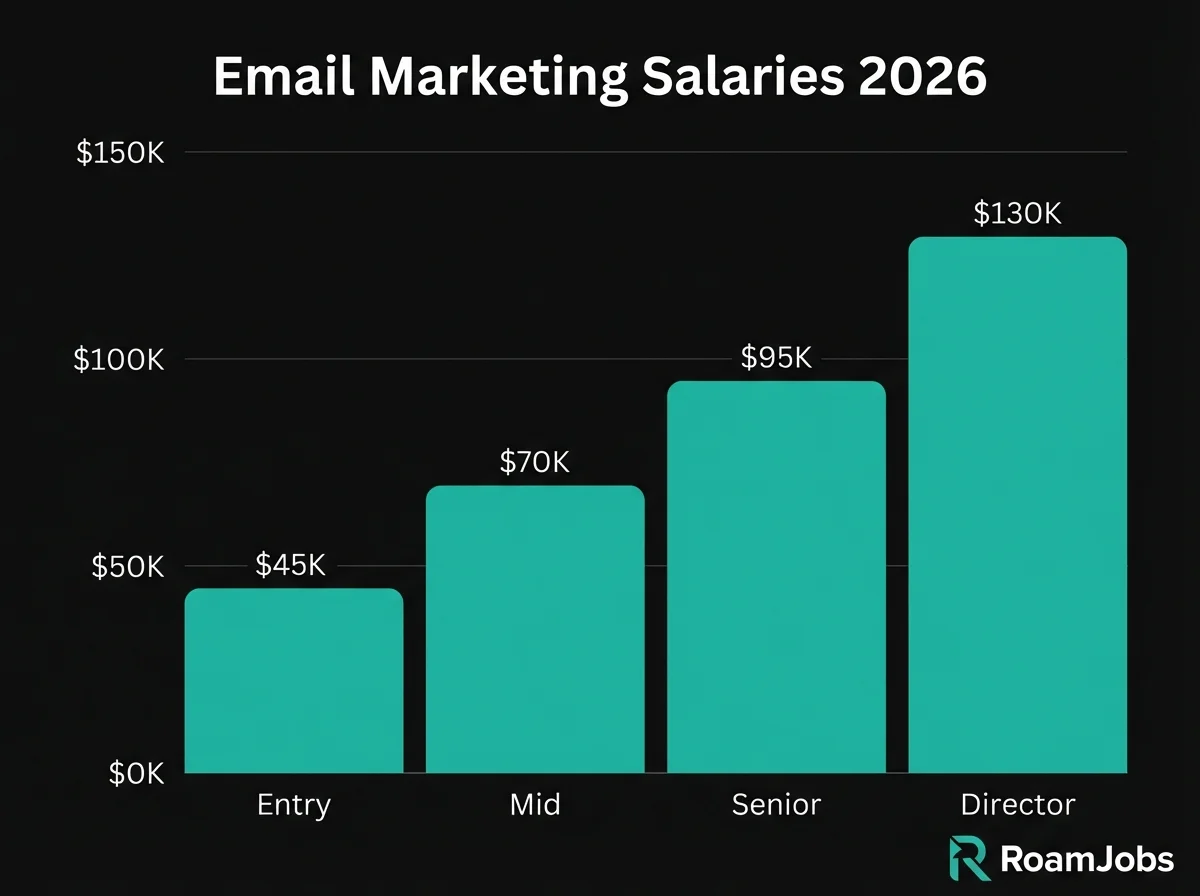
Remote email marketing compensation varies based on experience, platform expertise, and industry. These figures represent remote positions with US-based companies, the most competitive segment of the market.
Email Marketing Salary by Experience & Location
| Level | 🇺🇸 US Remote | 🇪🇺 EU Remote | 🌎 LATAM | 🌏 Asia |
|---|---|---|---|---|
| Entry Level (0-2 yrs) | $50,000 - $68,000 | $35,000 - $48,000 | $18,000 - $35,000 | $15,000 - $30,000 |
| Mid-Level (2-5 yrs) | $72,000 - $100,000 | $50,000 - $72,000 | $32,000 - $55,000 | $28,000 - $48,000 |
| Senior (5-8 yrs) | $100,000 - $140,000 | $70,000 - $100,000 | $50,000 - $80,000 | $42,000 - $72,000 |
| Director (8+ yrs) | $130,000 - $185,000 | $92,000 - $135,000 | $70,000 - $110,000 | $60,000 - $95,000 |
* Salaries represent base compensation for remote positions. Actual compensation may vary based on company, experience, and specific location within region.
Entry Level / Junior Email Marketer
0-2 years experience
What Companies Expect at Entry Level
Entry-level email marketers execute campaigns under the guidance of senior team members. You should be able to build basic email campaigns in your platform, write clear email copy following brand guidelines, set up simple automation triggers, pull basic reports on campaign performance, and manage subscriber lists and hygiene.
Core Skills to Develop
Email Fundamentals
- Understanding of email design best practices and responsive layouts
- Basic HTML/CSS for email template customization
- Copywriting fundamentals for subject lines and body content
- List management and basic segmentation principles
- Understanding of CAN-SPAM, GDPR, and email compliance
Platform Proficiency
- One primary platform deeply (Klaviyo, Mailchimp, or similar)
- Email builder and template creation
- Basic automation workflow setup
- Campaign scheduling and list selection
- Standard reporting and analytics views
Remote Work Skills
- Clear written communication for async collaboration
- Basic project management and deadline tracking
- Attention to detail for QA before sends
- Self-motivation without direct supervision
Portfolio and Experience Expectations
Entry-level candidates should demonstrate basic platform proficiency through certifications or personal projects. If you lack professional experience, build a portfolio by creating sample campaigns, volunteer for nonprofits, or document email strategies you would recommend for brands you admire. Show you understand email fundamentals even without job experience.
How to Break In
The most accessible path into email marketing starts with getting certified on major platforms. Klaviyo, Mailchimp, and HubSpot offer free certifications. Combine certification with practical experience: help a local business with their email, create a newsletter, or volunteer. Entry-level roles at agencies provide broad exposure across clients and platforms. E-commerce companies often hire junior email specialists because email directly drives revenue and they can measure your impact quickly.
Mid-Level Email Marketer
2-5 years experience
What Companies Expect at Mid-Level
Mid-level email marketers own campaigns end-to-end with minimal supervision. You should independently design and execute multi-step automation flows, build sophisticated segments based on behavior and attributes, improve deliverability through list hygiene and authentication, run structured A/B tests and apply learnings, and report on performance with actionable recommendations.
Skills That Define Mid-Level
Advanced Automation
- Building complex multi-branch flows with conditional logic
- Integrating behavioral triggers from website and product data
- Creating sophisticated welcome, cart abandonment, and winback sequences
- A/B testing within automations to optimize performance
- Understanding customer journey mapping and touchpoint optimization
Data and Segmentation Expertise
- Creating dynamic segments based on purchase history, engagement, and behavior
- Building RFM (Recency, Frequency, Monetary) segmentation models
- Personalizing content using merge tags and dynamic blocks
- Understanding predictive analytics and cohort analysis
- Connecting email data with broader marketing attribution
Deliverability Knowledge
- Managing sender reputation and IP warming
- Setting up and troubleshooting authentication (SPF, DKIM, DMARC)
- List cleaning strategies and re-engagement campaigns
- Monitoring blacklists and spam complaints
- Understanding email client rendering differences
Strategic Thinking
- Developing email marketing calendars and content strategy
- Aligning email with broader marketing and business objectives
- Identifying opportunities for new automations and campaigns
- Making trade-off decisions with limited resources
Portfolio Expectations
Mid-level portfolios should demonstrate measurable impact. Include examples of automations you built and their results, segmentation strategies that improved engagement, deliverability issues you resolved, and A/B tests that drove significant improvements. Quantify everything: “Redesigned cart abandonment flow, increasing recovery rate from 4.2% to 7.8%.”
Career Growth Considerations
Mid-level is when you decide your specialization path. Some email marketers go deep on lifecycle and automation, becoming the expert who designs complex customer journeys. Others develop broader marketing skills, adding growth marketing or CRM capabilities. Decide whether you want to become a deep email specialist or expand into adjacent disciplines.
Senior Email Marketer
5-8 years experience
What Companies Expect at Senior Level
Senior email marketers are strategic owners who drive channel performance and mentor others. You should set email marketing strategy aligned with business goals, architect sophisticated automation systems, solve complex deliverability and technical challenges, lead platform migrations and major initiatives, and mentor junior team members.
Skills That Define Senior Level
Strategic Leadership
- Developing annual email strategy and roadmap
- Setting KPIs and measurement frameworks
- Building business cases for tools and resources
- Aligning email strategy with lifecycle marketing and retention goals
- Partnering with product, data, and engineering teams
Technical Excellence
- Architecting complex automation ecosystems
- Managing platform migrations and integrations
- Building custom solutions with APIs when needed
- Advanced deliverability optimization across ISPs
- Understanding data infrastructure and CDP integration
Team and Stakeholder Management
- Mentoring junior email marketers
- Presenting email performance to executives
- Collaborating with cross-functional teams
- Managing agency relationships if applicable
- Building email marketing processes and documentation
Innovation and Experimentation
- Testing new approaches and technologies
- Building experimentation programs with statistical rigor
- Staying current on industry trends and best practices
- Evaluating new tools and platforms
- Sharing knowledge through internal training
Portfolio Expectations
Senior portfolios should demonstrate strategic impact and leadership. Include examples of email programs you built from scratch, significant performance improvements you drove, technical challenges you solved, teams or projects you led, and business outcomes you influenced. Show that you can think beyond individual campaigns to channel-level strategy.
Remote-Specific Challenges
Senior email marketers face unique remote challenges. Influencing strategy without physical presence requires exceptional communication. Mentoring remotely demands structured approaches. Building relationships with stakeholders across functions needs intentional effort. Successful senior remote email marketers over-communicate, document extensively, and build influence through demonstrated results.
Lead / Director Email Marketer
8+ years experience
What Companies Expect at Director Level
Directors of Email Marketing or Lifecycle Marketing lead teams and own significant business outcomes. You should build and manage email marketing teams, set vision and strategy for lifecycle marketing, own P&L responsibility for email channel revenue, drive organizational change and capability building, and represent email marketing at the executive level.
Skills That Define Director Level
Organizational Leadership
- Building and scaling email marketing teams
- Hiring, developing, and retaining talent
- Creating career frameworks and growth paths
- Managing performance across team members
- Building email marketing culture and best practices
Business Acumen
- Owning email revenue targets and forecasting
- Building business cases for investment
- Understanding unit economics and LTV impact
- Partnering with finance on attribution and reporting
- Making strategic decisions with incomplete information
Cross-Functional Influence
- Partnering with C-suite on customer strategy
- Aligning email with product, sales, and customer success
- Building relationships with data and engineering leadership
- Representing customer voice in strategic discussions
- Driving organizational adoption of lifecycle thinking
Vision and Innovation
- Anticipating industry trends and shifts
- Building multi-year capability roadmaps
- Evaluating emerging technologies like AI personalization
- Developing proprietary approaches and methodologies
- Building thought leadership externally
Portfolio Expectations
Director portfolios demonstrate organizational and business impact. Include teams you built and developed, revenue and growth you drove, strategic initiatives you led, organizational changes you implemented, and thought leadership contributions. At this level, you are evaluated on outcomes you enabled through others, not just your individual contributions.
Career Path Options
At the director level, career paths diverge significantly. Some pursue VP of Lifecycle Marketing or VP of Retention roles, expanding scope to include other retention channels. Others move into broader CMO tracks or transition to general management. Directors with strong technical backgrounds sometimes move into customer data platform or marketing technology leadership. Consider which path aligns with your strengths and interests.
Essential Skills and Tools for Remote Email Marketers
Success in remote email marketing requires mastering both strategic skills and the platforms that enable execution. This section covers the essential tools and skills you need to excel.
Email Marketing Platform Comparison
Email Marketing Platforms
Source: RoamJobs 2026 Platform Survey| Platform | Best For | Remote Friendliness | Learning Curve | Salary Premium |
|---|---|---|---|---|
| Klaviyo | E-commerce | Excellent | Medium | High |
| Mailchimp | SMB/Entry-level | Excellent | Low | Baseline |
| Customer.io | SaaS/Product-led | Excellent | Medium | Moderate |
| Braze | Enterprise/Mobile | Very Good | High | High |
| Iterable | Enterprise Cross-channel | Very Good | High | High |
| Salesforce Marketing Cloud | Enterprise/B2B | Good | Very High | Very High |
| HubSpot | B2B/Inbound | Very Good | Medium | Moderate |
Data compiled from RoamJobs 2026 Platform Survey. Last verified January 2026.
Platform Deep Dives
Klaviyo
Klaviyo dominates e-commerce email marketing and is the most commonly requested skill in remote email job postings. The platform excels at predictive analytics and integrations with Shopify, WooCommerce, and other e-commerce platforms. Key skills include building flows using Klaviyo’s visual builder, leveraging predictive analytics for segmentation, integrating product feeds for dynamic content, using custom events for behavioral triggers, and understanding Klaviyo’s attribution model.
Customer.io
Customer.io is popular among SaaS companies and product-led businesses. The platform focuses on behavioral email triggered by product usage. Important skills include building data-driven segments using attributes and events, creating complex branching logic in campaigns, integrating with product analytics tools, using webhooks for advanced automation, and building multi-channel workflows.
Braze
Braze serves enterprise companies with sophisticated cross-channel needs. The platform combines email with push notifications, in-app messaging, and SMS. Key expertise includes Canvas (Braze’s journey builder) design, Liquid templating for personalization, connected content for real-time data, audience segmentation and lookalike modeling, and cross-channel orchestration.
Iterable
Iterable is another enterprise platform focused on growth teams. Skills in demand include workflow studio for complex journeys, catalog and collection setup for personalization, experiment design and optimization, Iterable’s AI-powered send time optimization, and integration with data warehouses.
Salesforce Marketing Cloud
Salesforce Marketing Cloud commands the highest salary premiums due to its complexity and enterprise prevalence. Critical skills include Journey Builder for automation, AMPscript for dynamic content, SQL for data extensions and segmentation, understanding the SFMC data model, and Einstein AI features.
Litmus
While not a sending platform, Litmus is essential for email testing and analytics. Skills include email preview testing across clients, accessibility checking, analytics and engagement tracking, design system management, and collaboration workflow setup.
Technical Skills for Email Marketers
Beyond platform expertise, these technical skills increase your value.
HTML and CSS for Email
Email HTML differs significantly from web HTML. Key skills include table-based layout for compatibility, inline CSS techniques, media queries for responsive design, understanding email client quirks, and dark mode optimization.
Basic Data Skills
Data manipulation improves your segmentation and analysis. Learn basic SQL for querying email and customer data, Excel/Sheets proficiency for analysis, understanding of CDP and data warehouse concepts, API basics for platform integrations, and Google Analytics for conversion tracking.
Deliverability Technical Knowledge
Deliverability expertise sets senior email marketers apart. Master authentication protocols (SPF, DKIM, DMARC), understanding of ISP filtering algorithms, IP and domain reputation management, feedback loops and complaint handling, and BIMI implementation for brand verification.
Strategic Skills
Copywriting
Email copy directly impacts performance. Develop skills in subject line optimization, preview text strategy, value proposition communication, CTAs that drive action, and brand voice consistency.
Customer Journey Mapping
Understanding how email fits the broader customer experience improves your strategy. Learn customer lifecycle stage definition, touchpoint mapping and gap analysis, cross-channel coordination, timing and frequency optimization, and attribution across touchpoints.
Analytics and Experimentation
Data-driven optimization requires analytical rigor. Develop skills in statistical significance understanding, A/B test design and analysis, cohort analysis for long-term impact, attribution modeling, and building actionable dashboards.
Companies Actively Hiring Remote Email Marketers
The remote email marketing job market is robust across company types. This section highlights companies with active hiring and strong remote cultures.
E-commerce Companies
E-commerce businesses depend heavily on email for revenue, making them the largest employers of email marketers.
Shopify - The e-commerce platform giant hires email marketers to help merchants succeed and to run their own marketing. Digital by default with strong remote culture. Roles span merchant education, product marketing, and internal lifecycle.
Klaviyo - As the leading e-commerce email platform, Klaviyo hires email experts for customer success, product, and their own marketing. Hybrid-remote with Boston headquarters but strong distributed presence.
Chewy - The pet e-commerce company runs sophisticated email programs driving significant revenue. Email marketers work on lifecycle, promotional campaigns, and automation. Remote-friendly with dedicated email team.
Warby Parker - The eyewear brand has a data-driven email marketing team. Focus on lifecycle marketing and customer retention. Hybrid-remote options available.
Allbirds - Sustainable footwear brand with strong email program. Looking for email marketers who understand brand voice and sustainability messaging. Remote options available.
SaaS and Technology Companies
SaaS companies use email for user onboarding, engagement, and expansion.
HubSpot - The marketing platform employs email marketers across product marketing, customer marketing, and their own email operations. Remote-first with excellent culture.
Zapier - The automation platform practices what they preach with sophisticated email automation. Fully remote with strong async culture.
Notion - The productivity tool uses email for user onboarding and engagement. Growing marketing team with remote-friendly policies.
Calendly - Scheduling tool with product-led growth powered by email. Email marketers focus on activation and expansion. Remote-first company.
Webflow - The visual development platform hires email marketers for user lifecycle and product marketing. Remote-first with design-focused culture.
Airtable - Productivity platform with growing email marketing team. Focus on user activation and expansion. Remote-first company.
Agencies and Consultancies
Agencies offer broad exposure across clients and platforms.
Tinuiti - Performance marketing agency with strong email practice. Remote-friendly with diverse client portfolio. Good for developing platform expertise.
Jellyfish - Global agency with email marketing services. Distributed team working across major brands. Strong training and development.
Wpromote - Digital marketing agency with lifecycle marketing specialty. Remote-first with focus on e-commerce clients.
Power Digital - Growth marketing agency with email expertise. Remote-friendly with strong technology focus.
Consumer Brands
Consumer companies increasingly invest in email as a direct relationship channel.
HelloFresh - The meal kit company runs extensive email operations driving subscriptions and retention. Data-driven team with significant automation. Remote options available.
Peloton - Connected fitness company with sophisticated member email programs. Focus on engagement and retention. Hybrid-remote options.
Spotify - The streaming service uses email for user engagement and new feature adoption. Competitive compensation with remote options.
Airbnb - The travel platform has a large email team covering hosts, guests, and marketplace. Remote-flexible with strong email culture.
Where to Find Remote Email Marketing Jobs
- We Work Remotely - Strong marketing category with email-specific roles
- Remotive - Marketing-focused filters include email roles
- FlexJobs - Curated remote marketing positions
- Built In - Tech company jobs including email marketing
- LinkedIn - “Remote” filter plus “email marketing” search
- Klaviyo Partner Directory - Agencies hiring Klaviyo specialists
- eMailmonday Job Board - Email marketing-specific listings
- Company career pages - Many remote roles are not posted externally
Remote Email Marketing Interview Process
Email marketing interviews combine technical platform assessment with strategic thinking evaluation. Understanding each phase helps you prepare effectively.
Interview Structure Overview
Round 1: Recruiter Screen (30 minutes)
The recruiter evaluates basic fit and experience. Expect questions about your email marketing background, platforms you have used, remote work experience, and salary expectations.
Round 2: Hiring Manager Call (45-60 minutes)
The hiring manager assesses your email expertise and potential fit. Prepare for discussion of specific campaigns you have built, your approach to common email challenges, platform proficiency questions, and how you work remotely.
Round 3: Technical Assessment (60-90 minutes or take-home)
Most companies include a practical exercise. This may be building an automation flow in their platform, analyzing email performance data, writing email copy for a specific scenario, or developing a segmentation strategy.
Round 4: Cross-Functional Interviews (45-60 minutes each)
You meet with potential collaborators from product, data, or other marketing teams. These interviews assess collaboration skills and how you work across functions.
Round 5: Final Round (30-60 minutes)
Senior leadership evaluates strategic thinking and cultural alignment. Prepare for questions about your career goals, how you prioritize, and how you handle challenges.
Email Automation Interview Questions
How to answer: Structure your response around goals, timing, content strategy, and measurement. Show you think beyond individual emails to the full subscriber journey.
Strong answer approach:
- Start with goals: What should the welcome series accomplish? (Brand introduction, first purchase, preference collection)
- Outline email sequence: Typically 3-5 emails over 7-14 days
- First email: Immediate delivery with brand story and welcome offer
- Second email: Product education or bestseller showcase (Day 2-3)
- Third email: Social proof and customer stories (Day 5-6)
- Fourth email: Preference collection or quiz (Day 8-10)
- Fifth email: Final welcome offer reminder (Day 12-14)
- Discuss branching: Different paths based on whether they purchase, which emails they engage with
- End with measurement: Open rates, click rates, conversion rate, revenue per subscriber
What interviewers evaluate: Strategic thinking, understanding of customer psychology, technical knowledge of automation, measurement orientation.
How to answer: Demonstrate understanding of cart abandonment psychology, timing optimization, and sophisticated flow design.
Strong answer approach:
- Define timing strategy: First email 1-4 hours after abandonment, follow-ups at 24 and 48-72 hours
- Content progression: Reminder then product benefits then urgency/incentive
- Personalization elements: Include cart contents, dynamic product recommendations, recently viewed items
- Conditional logic: Different flows based on cart value, customer type (new vs. returning), product category
- Incentive strategy: Whether to discount, when to offer, testing discount depth
- Exit conditions: Purchase, longer abandonment period, unsubscribe
- Discuss testing: Subject lines, timing, incentive presence, number of emails
What interviewers evaluate: Technical automation skills, strategic thinking about incentives, understanding of A/B testing, data-driven approach.
How to answer: Use a specific example demonstrating technical skill, problem-solving, and results. Show the complexity while remaining clear.
Strong answer approach:
- Set context: Business goal, why automation was needed
- Describe the automation: Multiple triggers, branching logic, conditional waits
- Highlight complexity: Cross-platform data, multiple customer segments, dynamic content
- Explain challenges: Technical limitations, data quality issues, stakeholder alignment
- Detail solutions: Workarounds you built, tools you integrated, how you simplified
- Share results: Quantified impact on engagement, revenue, or efficiency
What interviewers evaluate: Technical depth, problem-solving ability, communication clarity, results orientation.
How to answer: Show you take a data-driven approach while understanding practical constraints.
Strong answer approach:
- Identify triggers for review: Performance decline, business changes, platform capabilities
- Describe evaluation framework: Compare to benchmarks, analyze step-by-step performance, review relevance
- Discuss rebuild vs. optimize: When incremental changes suffice vs. when full rebuild is needed
- Consider opportunity cost: Time to rebuild vs. impact of improvement
- Mention documentation: Ensuring learnings from old flow inform new design
- Touch on testing: How you validate the new flow performs better
What interviewers evaluate: Analytical thinking, practical judgment, resource awareness, systematic approach.
Segmentation and Personalization Questions
How to answer: Demonstrate a systematic discovery process that leads to actionable segments.
Strong answer approach:
- Start with data audit: What customer data is available? Purchase history, engagement, demographics, preferences
- Understand business goals: What outcomes matter most? Retention, AOV, acquisition
- Identify natural segments: New vs. returning, purchase frequency, product category preferences
- Build initial segments: Start simple with 4-6 core segments, expand based on learnings
- Develop testing plan: How you will validate segments perform differently
- Plan personalization: What content differs by segment, what remains consistent
What interviewers evaluate: Systematic thinking, business orientation, practical approach, testing mindset.
How to answer: Show you understand RFM conceptually and can apply it practically.
Strong answer approach:
- Define RFM: Recency (when did they last purchase), Frequency (how often), Monetary (how much)
- Explain scoring: How you score each dimension (typically 1-5 scale)
- Identify key segments: Champions (high RFM), at-risk (low recency, high historical FM), new customers
- Differentiate treatment: Champions get VIP treatment, at-risk get win-back, new get nurture
- Discuss implementation: How you build these segments in your platform
- Share results you have achieved: Specific improvements from RFM-based segmentation
What interviewers evaluate: Technical understanding, practical application, business impact orientation.
How to answer: Demonstrate practical wisdom about effort vs. impact trade-offs.
Strong answer approach:
- Acknowledge tension: More personalization takes more effort, not always worth it
- Framework for decisions: Segment size, lift potential, implementation complexity
- High-impact personalization: Dynamic product recommendations, name, purchase history
- Diminishing returns: Highly specific segments with minimal lift, complex logic with high maintenance
- Technical solutions: Dynamic content blocks that scale, predictive features in platforms
- Testing approach: Measure incremental lift from each personalization layer
What interviewers evaluate: Practical judgment, resource awareness, analytical approach, business sense.
How to answer: Show systematic diagnostic process and multiple solution paths.
Strong answer approach:
- Define underperformance: Is it opens, clicks, conversions, revenue?
- Diagnostic steps: Compare content, timing, frequency, segment composition
- Check segment definition: Is the segment correctly built? Data quality issues?
- Analyze engagement patterns: When do they engage, with what content?
- Consider segment-specific issues: Wrong message, wrong frequency, list fatigue
- Develop hypotheses and tests: Structured experiments to identify root cause
- Potential solutions: Content changes, timing adjustments, frequency reduction, re-segmentation
What interviewers evaluate: Diagnostic thinking, systematic problem-solving, testing orientation.
Deliverability Questions
How to answer: Demonstrate structured troubleshooting process for deliverability issues.
Strong answer approach:
- Acknowledge urgency: Open rate drops can indicate serious deliverability issues
- Immediate checks: Look at specific ISPs (Gmail vs. others), check spam placement, review authentication
- Technical diagnosis: Check SPF/DKIM/DMARC records, review sending IP reputation, look for blacklistings
- Content analysis: Any recent changes to templates, subject lines, or sending patterns?
- List quality: Sudden changes in bounce rates, complaints, engagement?
- External factors: Apple MPP changes, ISP policy updates, seasonal factors
- Resolution steps: Specific actions based on diagnosis, timeline for recovery
- Prevention: Monitoring systems to catch issues earlier
What interviewers evaluate: Technical depth, systematic troubleshooting, urgency awareness, prevention thinking.
How to answer: Provide clear, accurate explanations that show understanding beyond surface level.
Strong answer approach:
- SPF (Sender Policy Framework): Specifies which mail servers can send on behalf of your domain. Prevents spoofing by validating sending IP.
- DKIM (DomainKeys Identified Mail): Cryptographic signature proving email came from your domain and was not modified. Uses public/private key pair.
- DMARC (Domain-based Message Authentication, Reporting and Conformance): Policy layer that tells receiving servers what to do when SPF or DKIM fail. Provides reporting on authentication results.
- Why they matter together: Each addresses different attack vectors. DMARC aligns SPF and DKIM. Together they improve deliverability and prevent phishing.
- Implementation considerations: Proper alignment, gradual DMARC policy enforcement, monitoring reports
What interviewers evaluate: Technical accuracy, ability to explain complex topics clearly, understanding of importance.
How to answer: Demonstrate understanding of warm-up process and ISP relationship building.
Strong answer approach:
- Explain why warming matters: ISPs are suspicious of new senders, need to build reputation gradually
- Timeline: Typically 4-8 weeks depending on volume goals
- Volume ramp: Start with most engaged subscribers, gradually increase daily/weekly
- ISP-specific approach: Gmail, Microsoft, Yahoo have different sensitivity
- Content quality: Ensure high engagement during warm-up, avoid promotional content
- Monitoring: Watch bounce rates, complaints, inbox placement closely
- Adjustments: Slow down if metrics deteriorate, accelerate if performing well
- Maintaining reputation: Ongoing practices after warm-up complete
What interviewers evaluate: Practical experience, patience and thoroughness, ISP understanding.
How to answer: Show you balance list size against engagement and deliverability.
Strong answer approach:
- Philosophy: Quality over quantity, engaged lists perform better
- Regular cleaning: Remove hard bounces immediately, soft bounces after threshold
- Engagement-based suppression: Sunset policy for chronically unengaged subscribers
- Re-engagement before removal: Win-back campaigns before final suppression
- Double opt-in benefits: Cleaner lists from the start
- Preference management: Let subscribers control frequency vs. unsubscribing
- Metrics to monitor: Bounce rates, complaint rates, engagement by age
- Frequency: Regular hygiene schedule, more aggressive cleaning if deliverability issues
What interviewers evaluate: Balance between reach and quality, systematic approach, deliverability awareness.
A/B Testing and Analytics Questions
How to answer: Demonstrate rigorous testing methodology and practical considerations.
Strong answer approach:
- Hypothesis first: Start with clear hypothesis about what you expect to learn
- Variable isolation: Test one element at a time for clear learnings
- Sample size: Calculate required sample for statistical significance
- Duration: Long enough to reach significance, account for day-of-week effects
- Success metric: Primary metric aligned with business goal, secondary metrics to watch
- Segment considerations: Will results vary by segment? Test broadly or within segments?
- Winner determination: Statistical significance threshold, minimum detectable effect
- Implementation: How winning variant gets rolled out, documentation of learnings
What interviewers evaluate: Statistical understanding, methodical approach, practical implementation.
How to answer: Show nuanced understanding of email metrics and their limitations.
Strong answer approach:
- Revenue/conversions: Ultimate business impact, but requires attribution
- Click rate: Engagement signal, content relevance indicator
- Click-to-open rate: Content quality independent of subject line
- Open rate: Declining reliability due to Apple MPP, still useful for subject line testing
- Unsubscribe and complaint rates: List health indicators
- List growth: Net subscriber change over time
- Deliverability metrics: Inbox placement, bounce rates, domain reputation
- Context matters: Metrics priorities differ by email type (promotional vs. transactional vs. lifecycle)
What interviewers evaluate: Metric sophistication, business orientation, awareness of measurement limitations.
How to answer: Demonstrate sophisticated thinking about attribution complexities.
Strong answer approach:
- Attribution models: Last-click, first-touch, linear, time-decay, position-based
- Email-specific challenges: View-through attribution, cross-device tracking, offline impact
- Platform differences: ESP attribution vs. GA vs. internal data warehouse
- Common approaches: View window (24-48 hours), click window (7 days), incremental testing
- Incrementality testing: Holdout groups to measure true email impact
- Multi-touch considerations: Email’s role in customer journey alongside other channels
- Practical recommendations: Start simple, invest in incrementality testing, accept imperfection
What interviewers evaluate: Analytical sophistication, practical wisdom, ability to work with imperfect data.
How to answer: Share a specific example that shows learning orientation and intellectual humility.
Strong answer approach:
- Set up the test: What you were testing, your hypothesis
- The surprise: How results differed from expectations
- Analysis: Why you think results occurred, what you investigated
- Learning: What the test taught you about your audience or assumptions
- Application: How you applied this learning going forward
- Broader reflection: How this changed your approach to testing
What interviewers evaluate: Learning orientation, analytical curiosity, ability to update beliefs based on data.
Behavioral and Remote Work Questions
How to answer: Demonstrate organizational skills and prioritization judgment critical for remote work.
Strong answer approach:
- Set the context: Multiple campaigns, limited time, real stakes
- Prioritization framework: How you decided what to do first (business impact, dependencies, stakeholder needs)
- Communication: How you kept stakeholders informed of trade-offs
- Execution: How you managed your time and energy
- Outcome: What got done, what impact it had
- Reflection: What you learned about managing competing priorities
What interviewers evaluate: Self-management, prioritization, communication, stress handling.
How to answer: Share specific systems and tools that enable your remote productivity.
Strong answer approach:
- Task management: Tool and methodology (Asana, Notion, etc.)
- Campaign calendar: How you track what is sending when
- QA processes: Checklists before sends, review protocols
- Documentation: How you keep information accessible
- Communication: How you keep stakeholders informed without being asked
- Proactive identification: How you catch potential issues before they become problems
What interviewers evaluate: Organization, proactivity, reliability, systems thinking.
How to answer: Demonstrate ability to translate technical metrics into business language.
Strong answer approach:
- Audience awareness: Understanding what stakeholders care about (usually revenue, customers)
- Metrics translation: Connecting email metrics to business outcomes
- Visualization: Using charts and dashboards effectively
- Storytelling: Framing results as narratives with context
- Recommendations: Always including what the data means for decisions
- Appropriate detail: Knowing when to go deep vs. stay high-level
What interviewers evaluate: Communication skills, business orientation, stakeholder management.
How to answer: Show you can advocate for email best practices while maintaining relationships.
Strong answer approach:
- Situation: What was requested and why it was problematic
- Your concern: Technical, strategic, or customer experience issue
- How you communicated: Framing, data, alternatives
- Outcome: How the situation resolved
- Relationship: How you maintained the relationship
- Learning: What you would do differently
What interviewers evaluate: Professional courage, communication skills, relationship management, judgment.
How to answer: Demonstrate learning agility and self-direction critical for remote work.
Strong answer approach:
- Initial orientation: Documentation, certifications, video tutorials
- Hands-on exploration: Building test campaigns, experimenting with features
- Community resources: Forums, Slack groups, user communities
- Peer learning: Connecting with others who know the platform
- Project-based learning: Taking on increasingly complex projects
- Documenting learnings: Building your own reference materials
What interviewers evaluate: Learning agility, self-direction, resourcefulness.
How to answer: Show you stay current and have genuine enthusiasm for the field.
Strong answer approach:
- Pick 2-3 genuine interests: AI personalization, interactive email, privacy changes, etc.
- Explain why each matters: Business impact, customer experience, technical evolution
- Share how you stay current: Publications, communities, experimentation
- Connect to your work: How you have applied or want to apply these trends
- Acknowledge uncertainties: What you are still learning or watching
What interviewers evaluate: Industry awareness, genuine interest, continuous learning orientation.
Frequently Asked Questions
Frequently Asked Questions
What is the best email marketing platform to learn for remote jobs?
Klaviyo is the most in-demand platform for remote email marketing jobs, particularly in e-commerce. If you are targeting SaaS companies, Customer.io or HubSpot are strong choices. For enterprise roles, Braze, Iterable, or Salesforce Marketing Cloud command significant salary premiums. Start with Klaviyo or Mailchimp if you are new (both offer free certifications), then specialize based on your target industry. Most email marketing principles transfer across platforms, so learning one deeply makes picking up others easier.
Can I get a remote email marketing job without prior email experience?
Yes, though you will need to demonstrate relevant skills. Build a portfolio by creating sample campaigns for fictional brands, earning platform certifications (Klaviyo, Mailchimp, HubSpot all offer free ones), and volunteering for nonprofits or small businesses. Entry-level roles at agencies are often more accessible because agencies train juniors and expose them to multiple clients. Emphasize transferable skills: copywriting, data analysis, marketing fundamentals, and attention to detail.
How important is HTML/CSS knowledge for email marketing?
Basic HTML/CSS understanding is valuable but not always required. Most modern email platforms use drag-and-drop builders that do not require coding. However, understanding email HTML helps you troubleshoot rendering issues, customize templates, and work with developers. At senior levels, HTML knowledge becomes more important for complex customizations. Focus on email-specific HTML patterns (table layouts, inline CSS) rather than modern web development techniques.
What is the difference between email marketing and lifecycle marketing?
Lifecycle marketing is the broader discipline of engaging customers throughout their relationship with a brand, from acquisition through retention and reactivation. Email marketing is a channel within lifecycle marketing. Lifecycle marketers may work across email, SMS, push notifications, in-app messaging, and direct mail. Email marketing roles focus specifically on the email channel but often expand into lifecycle thinking. Senior email roles increasingly require lifecycle perspective.
How do I demonstrate email marketing results in my portfolio if my employer owns the data?
Use relative metrics rather than absolutes. Instead of 'generated $500K revenue,' say 'improved welcome series conversion by 45%.' Describe your process, strategy, and approach without revealing proprietary information. Include anonymized case studies with percentage improvements and strategic decisions. Show the thinking behind your work, not just the specific numbers. Most employers understand confidentiality constraints and value seeing your methodology.
Is email marketing becoming less important with social media and other channels?
No. Email consistently delivers the highest ROI of any marketing channel ($36-42 per dollar spent). Unlike social media, email provides direct access to customers without algorithm changes affecting reach. Companies are investing more in email as third-party cookie deprecation makes owned channels more valuable. The role is evolving to include more sophisticated automation, personalization, and cross-channel orchestration, making skilled email marketers more valuable, not less.
What salary should I expect working remotely for a US company from outside the US?
This varies significantly by company. Some companies pay location-agnostic salaries matching US rates regardless of where you live. Others use geographic pay bands that might be 20-50% lower than US rates for non-US locations. Even with geographic adjustment, working for US companies typically pays significantly more than local alternatives in most regions. Research specific company policies before interviewing and ask directly about their compensation philosophy for international employees.
How do I transition from B2C to B2B email marketing or vice versa?
The core skills transfer, but buyer journeys differ significantly. B2C tends toward shorter cycles, more emotional appeals, and promotional urgency. B2B involves longer nurture sequences, multiple stakeholders, and educational content. To transition, emphasize transferable skills (automation, segmentation, analysis), learn the new context's buyer journey, and consider agency roles that expose you to both. Highlight any experience relevant to your target (B2B experience from volunteer work, B2C skills from personal projects).
What certifications are most valuable for remote email marketing jobs?
Platform certifications carry the most weight: Klaviyo Product Certification, Salesforce Marketing Cloud Email Specialist, Braze Certified Practitioner. HubSpot Email Marketing Certification is excellent for beginners. Beyond platforms, Google Analytics certification and basic SQL knowledge help. Certifications matter most for entry and mid-level roles; senior roles prioritize demonstrated results. View certifications as door-openers rather than differentiators at advanced levels.
How do remote email marketers collaborate with other teams effectively?
Successful remote collaboration requires proactive communication and clear documentation. Share campaign calendars in accessible formats, document email strategies and guidelines for reference, create Loom videos explaining complex automations, attend cross-functional meetings even when not strictly necessary, build relationships through informal conversations, and provide regular performance updates without being asked. The best remote email marketers over-communicate and make their work visible to partners who cannot see them working day-to-day.
Career Paths in Email Marketing
Email marketing offers multiple advancement paths depending on your interests and strengths.
Individual Contributor Track
Email Marketing Coordinator → Email Marketing Specialist → Senior Email Marketing Specialist → Staff Email Marketer / PrincipalThis path is ideal for those who love the craft and want to remain hands-on. Staff and Principal roles can earn $130K-$165K+ while focusing on the most complex automation systems, deliverability challenges, and strategic initiatives without managing people.
Management Track
Senior Email Marketer → Email Marketing Manager → Director of Email/Lifecycle → VP of Lifecycle Marketing → CMOThe leadership path involves managing teams, budgets, and strategy. Directors typically manage teams of 3-10 email marketers and own significant revenue targets.
Cross-Functional Pivots
| From Email Marketing | Common Pivot To | Overlap Skills |
|---|---|---|
| Email Marketing | Growth Marketing | Automation, experimentation, metrics |
| Email Marketing | CRM Marketing | Customer data, lifecycle, segmentation |
| Email Marketing | Marketing Operations | Platform expertise, data flows, automation |
| Email Marketing | Product Marketing | Customer journey, messaging, launch campaigns |
| Email Marketing | Customer Success | Lifecycle thinking, engagement, retention |
Specialization Options
Within email marketing, you can specialize in:
Deliverability Specialist: Focus on inbox placement, authentication, and sender reputation. High demand at large senders and agencies.
Marketing Automation Architect: Design complex multi-channel automation systems. Valuable at enterprises with sophisticated martech stacks.
Email Design/Development: Specialize in email HTML, responsive design, and interactive email. Growing demand as email capabilities expand.
Lifecycle Strategy: Focus on customer journey design and cross-channel orchestration. Expanding role as companies invest in retention.
Related Marketing Career Guides
Email marketing connects to a broader ecosystem of marketing specializations. Explore these related guides to understand how email fits within the marketing career landscape.
Marketing Hub Guide
The Remote Marketing Jobs guide provides a comprehensive overview of all remote marketing specializations, including Content Marketing, SEO, Paid Ads, Growth Marketing, Product Marketing, and Social Media. Use this hub to compare roles and understand the full landscape of remote marketing careers.
Growth Marketing Guide
If you are interested in expanding beyond email into full-funnel growth, explore the Remote Growth Marketing Jobs guide. Growth marketers use email as a key channel while also working on acquisition, activation, and product-led growth.
Content Marketing Guide
Email and content marketing frequently overlap. The Remote Content Marketing Jobs guide explores opportunities focused on creating compelling content that can fuel your email programs.
Interview Preparation
The Remote Interview guide covers best practices for succeeding in video interviews, which are standard for remote email marketing hiring.
Salary Negotiation
Once you receive offers, the Negotiating Remote Salary guide helps you maximize compensation. Remote email marketing roles often have unique considerations including platform premium and industry-specific pay scales.
Next Steps: Launching Your Remote Email Marketing Career
Remote email marketing offers exceptional career opportunities for marketers who combine creative copywriting, technical platform skills, and analytical thinking. The channel’s proven ROI ensures continued investment, while its async-friendly nature makes it ideal for distributed work.
Immediate actions to take:
-
Get platform certified - Start with Klaviyo or HubSpot free certifications to validate your foundational knowledge. Add Salesforce Marketing Cloud or Braze certifications for enterprise roles.
-
Build your portfolio - Document campaigns you have created with relative metrics and strategic thinking. If you lack professional experience, create sample campaigns for brands you admire.
-
Develop technical skills - Learn basic email HTML, understand deliverability fundamentals, and get comfortable with data analysis in Excel or SQL.
-
Target your industry - E-commerce roles emphasize revenue and automation. SaaS roles focus on product engagement. Agencies provide broad exposure. Choose based on your interests.
-
Build your target company list - Research 15-20 companies with strong email programs. Follow their email marketers on LinkedIn, subscribe to their emails, and understand their approach.
-
Practice interview scenarios - Prepare to walk through specific campaigns, explain your automation philosophy, and demonstrate strategic thinking about segmentation and deliverability.
Remote email marketing is not just about sending campaigns. It is about building automated systems that nurture customer relationships at scale, driving measurable business results through the most reliable channel in digital marketing. The skills you develop in email marketing form a foundation for broader lifecycle, growth, and CRM careers.
Get the Remote Email Marketing Career Kit
Weekly curated remote email marketing jobs, platform tips, deliverability insights, and interview advice delivered to your inbox. Join marketers building remote careers.
Frequently Asked Questions
How do I find remote email marketing jobs?
To find remote email marketing jobs, start with specialized job boards like We Work Remotely, Remote OK, and FlexJobs that focus on remote positions. Set up job alerts with keywords like "remote email marketing" and filter by fully remote positions. Network on LinkedIn by following remote-friendly companies and engaging with hiring managers. Many email marketing roles are posted on company career pages directly, so identify target companies known for remote work and check their openings regularly.
What skills do I need for remote email marketing positions?
Remote email marketing positions typically require the same technical skills as on-site roles, plus strong remote work competencies. Essential remote skills include excellent written communication, self-motivation, time management, and proficiency with collaboration tools like Slack, Zoom, and project management software. Demonstrating previous remote work experience or the ability to work independently is highly valued by employers hiring for remote email marketing roles.
What salary can I expect as a remote email marketing?
Remote email marketing salaries vary based on experience level, company size, location-based pay policies, and the specific tech stack or skills required. US-based remote positions typically pay market rates regardless of where you live, while some companies adjust pay based on your location's cost of living. Entry-level positions start lower, while senior roles can command premium salaries. Check our salary guides for specific ranges by experience level and geography.
Are remote email marketing jobs entry-level friendly?
Some remote email marketing jobs are entry-level friendly, though competition can be high. Focus on building a strong portfolio or demonstrable skills, contributing to open source projects if applicable, and gaining any relevant experience through internships, freelance work, or personal projects. Some companies specifically hire remote junior talent and provide mentorship programs. Smaller startups and agencies may be more open to entry-level remote hires than large corporations.
Continue Reading
Remote Marketing Jobs 2026: Complete Guide to Content, SEO, Paid Ads & Growth
The definitive hub for remote marketing careers. Explore salary data, interview guides, and opportunities across content marketing, SEO, paid ads, growth, product marketing, email marketing, and social media roles.
Remote Content Marketing Jobs 2026: Complete Career Guide
Master remote content marketing careers with comprehensive salary data ($50K-$200K), 20+ interview questions, essential tools, and proven strategies for landing content marketing roles at top remote-first companies.
Remote Marketing Jobs 2026: Digital, Content, Growth & More
Find remote marketing positions across specializations with tips for portfolio, interviews, and salary negotiation.
Land Your Remote Job Faster
Get the latest remote job strategies, salary data, and insider tips delivered to your inbox.