Remote Design Jobs 2026: Complete Guide to UX, UI, Product & Brand Careers
The definitive hub for remote design careers. Explore salary data, interview guides, and opportunities across UX, UI, product design, research, and design management.
Updated January 27, 2026 • Verified current for 2026
Remote design is one of the most accessible paths into tech, with salaries ranging from $52K to $350K across six distinct specializations: UX Design, UI Design, Product Design, UX Research, Brand Design, and Design Management. This comprehensive guide helps you navigate the design career landscape—whether you’re transitioning from graphic design, choosing between UX and UI paths, or advancing to design leadership. Each specialization has unique portfolio requirements, interview processes, and career trajectories. The key to success is understanding which path aligns with your strengths and building a portfolio that demonstrates real impact.
Which Design Role Is Right for You?
Choosing the right design specialization depends on where your interests and strengths lie. Use this framework to identify your ideal path.
Decision Framework
Do you enjoy understanding user psychology and behavior?
If you’re fascinated by why users do what they do, consider UX Design or UX Research. UX Designers translate research insights into wireframes and user flows. UX Researchers focus purely on conducting studies, interviews, and usability tests. Both roles require empathy and analytical thinking.
Do you love visual aesthetics and creating beautiful interfaces?
If you have a strong eye for typography, color, and visual hierarchy, consider UI Design or Brand Design. UI Designers create the visual layer of digital products. Brand Designers extend visual identity across all company touchpoints. Both roles value aesthetic excellence and attention to detail.
Do you want to work across the entire design process?
If you enjoy both research and visual design, Product Design combines UX and UI skills. Product Designers own features from research through implementation, working closely with engineers and PMs. This generalist role is highly valued at startups and tech companies.
Are you interested in leading teams and shaping design culture?
If you want to mentor designers, hire teams, and influence design strategy, Design Management is your path. This requires strong IC experience plus people management skills. Design Managers balance hands-on work with leadership responsibilities.
Quick Role Comparison
Design Roles at a Glance
Source: RoamJobs 2026 Remote Salary Report| Role | US Salary (Senior) | Remote Friendliness | Entry Barrier | Portfolio Focus |
|---|---|---|---|---|
| UX Designer | $125K-$175K | High | Medium | Research + Wireframes |
| UI Designer | $115K-$160K | High | Medium | Visual Excellence |
| Product Designer | $140K-$195K | Very High | Medium-High | End-to-End Case Studies |
| UX Researcher | $140K-$190K | Very High | High | Research Methodology |
| Brand Designer | $105K-$150K | High | Medium | Identity Systems |
| Design Manager | $195K-$265K | High | Very High | Leadership + IC Work |
Data compiled from RoamJobs 2026 Remote Salary Report. Last verified January 2026.
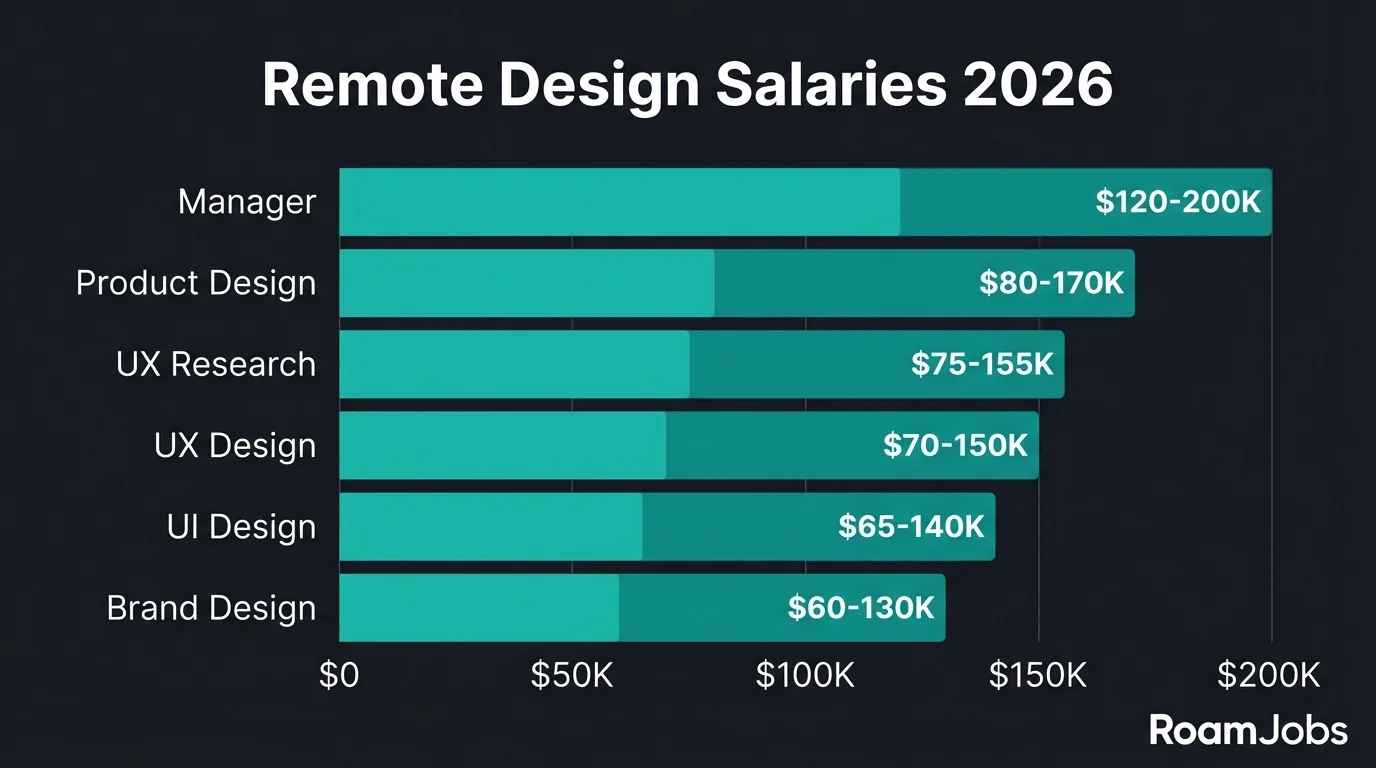
Comprehensive Salary Comparison: All Design Roles
Understanding compensation across design specializations helps you make informed career decisions. These figures represent remote positions with US-based companies.
Design Salary by Experience & Location
| Level | 🇺🇸 US Remote | 🇪🇺 EU Remote | 🌎 LATAM | 🌏 Asia |
|---|---|---|---|---|
| Entry Level (0-2 yrs) | $52,000 - $90,000 | $35,000 - $65,000 | $18,000 - $42,000 | $15,000 - $35,000 |
| Mid-Level (2-5 yrs) | $82,000 - $140,000 | $55,000 - $95,000 | $35,000 - $72,000 | $30,000 - $62,000 |
| Senior (5-8 yrs) | $115,000 - $200,000 | $78,000 - $140,000 | $55,000 - $105,000 | $45,000 - $92,000 |
| Lead/Director (8+ yrs) | $165,000 - $350,000 | $112,000 - $250,000 | $80,000 - $195,000 | $70,000 - $175,000 |
* Salaries represent base compensation for remote positions. Actual compensation may vary based on company, experience, and specific location within region.
Salary Trends by Specialization
Highest-paying design specializations:
- Design Management - Leadership premium once you reach director+ levels
- UX Research - Specialized methodology expertise commands strong compensation
- Product Design - End-to-end ownership valued at tech companies
- UX Design - Core digital product design skills in high demand
Fastest-growing compensation:
- Product Design - 10% YoY salary growth as companies seek generalists
- UX Research - 12% YoY growth as companies invest in research
- Design Management - Growing demand for remote design leadership
Remote compensation considerations:
- Design roles are generally more likely to see location-based pay adjustments
- Portfolio quality significantly impacts compensation regardless of location
- Product Design and UX Research have the highest rates of location-agnostic pay
Cross-Cutting Skills for All Remote Designers
Regardless of your specialization, certain skills separate successful remote designers from those who struggle with distributed work.
Design Skills Every Remote Designer Needs
Figma mastery
- Real-time collaboration features
- Component libraries and design systems
- Prototyping and handoff
- FigJam for remote workshops
Async design communication
- Writing clear design rationale
- Creating self-explanatory prototypes
- Recording Loom walkthroughs
- Documenting design decisions
Design system thinking
- Component-based design approach
- Scalable design patterns
- Documentation for developers
- Consistency across platforms
Cross-functional collaboration
- Working effectively with engineers
- Partnering with product managers
- Presenting to stakeholders
- Receiving and giving feedback
Soft Skills That Make Remote Designers Successful
Written communication excellence
- Clear articulation of design decisions
- Constructive critique in async reviews
- Documentation that stands alone
- Knowing when to escalate to synchronous discussion
Self-direction and proactivity
- Seeking feedback without waiting
- Identifying design opportunities
- Managing your own time effectively
- Staying visible to stakeholders
User advocacy
- Championing user needs remotely
- Sharing research insights broadly
- Building empathy across the org
- Translating user needs to business value
Collaboration across time zones
- Providing sufficient context in handoffs
- Recording design presentations for async viewing
- Respecting others’ working hours
- Building relationships despite distance
Top Companies Hiring Remote Designers
These companies actively hire remote designers across multiple specializations. Research each company’s design culture before applying.
Fully Remote / Remote-First Design Teams
Automattic (WordPress, WooCommerce, Tumblr) - 1,900+ distributed employees with strong design culture. Product designers work on massive scale products. Excellent async communication.
Buffer - Known for transparent culture and 4-day workweek. Small but impactful design team. Focus on product design.
Zapier - Workflow automation platform with strong design principles. Product design opportunities working on complex interaction patterns.
Doist (Todoist, Twist) - Design-led product company. Small team, high impact. Strong focus on thoughtful UX.
InVision - Design tools company with fully distributed team. Deep understanding of design needs.
GitLab - Exceptional documentation culture. UX Designers and UX Researchers work on developer tools.
Remote-First Tech Giants
Shopify - “Digital by default” e-commerce platform. Large design team with various specializations. Strong design system.
Figma - The design tool company. Remote-friendly with distributed design team. Dog-fooding their own product.
Canva - Visual design platform with growing remote presence. Opportunities across product and brand design.
Atlassian - “Team Anywhere” policy. Design systems and product design for developer tools.
Companies with Strong Remote Design Teams
HubSpot - CRM platform with @flex work arrangements. UX Design, UX Research, and Product Design opportunities.
Webflow - Visual web development. Strong design culture hiring remote designers.
Notion - Productivity workspace. Design-led product with high-quality design team.
Linear - Issue tracking tool. Small design team with exceptional design quality.
Discord - Communication platform. Remote-friendly with various design opportunities.
The Portfolio: Your Most Important Asset
For remote design roles, your portfolio is exponentially more important than for on-site positions. Hiring managers can’t observe your daily work—they judge you entirely on what you present.
What Remote Design Portfolios Must Demonstrate
Impact and outcomes
- Don’t just show final designs—show measurable impact
- Include metrics: conversion improvements, user satisfaction, time savings
- Explain the business context and constraints
Process transparency
- Show how you work, not just what you made
- Include research, iterations, and decision-making
- Demonstrate collaboration with engineers and PMs
Communication skills
- Your portfolio IS a communication skills test
- Clear writing that explains complex decisions
- Logical structure that guides viewers
Self-direction
- Show projects where you led the design process
- Include examples of identifying problems independently
- Demonstrate how you sought feedback
Portfolio Differences by Role
UX Design portfolios:
- User research methodologies and insights
- Wireframes and user flows
- Usability testing results and iterations
- Clear problem → solution → impact structure
UI Design portfolios:
- Visual design excellence across projects
- Attention to typography, color, and spacing
- Design system components
- Micro-interactions and polish
Product Design portfolios:
- End-to-end case studies
- Both research and visual design skills
- Cross-functional collaboration examples
- Shipped products with real impact
UX Research portfolios:
- Research methodology expertise
- Synthesis and insight generation
- Impact of research on product decisions
- Variety of research methods
Brand Design portfolios:
- Identity systems and guidelines
- Cross-channel application
- Strategic brand thinking
- Visual craftsmanship
Career Paths and Transitions
Common Design Career Progressions
Individual Contributor Track: Junior Designer → Designer → Senior Designer → Staff Designer → Principal Designer
Management Track: Senior Designer → Design Lead → Design Manager → Senior Design Manager → Head of Design → VP Design → CDO
Specialization Transitions:
- Graphic Design → UI Design → Product Design (visual path)
- Psychology/Research → UX Research → UX Design (research path)
- UI Design ↔ UX Design ↔ Product Design (common lateral moves)
- Any IC → Design Management (leadership path)
Transitioning Into Design Remotely
From Graphic Design:
- Build digital product projects
- Learn UX fundamentals
- Master Figma and prototyping
- Create case studies, not just visuals
From Development:
- Leverage technical understanding
- Build portfolio showing design thinking
- Focus on Product Design roles
- Highlight eng-design collaboration
From Other Fields:
- Take structured courses (Google UX Certificate, etc.)
- Build 3-5 strong portfolio projects
- Start with freelance/contract work
- Network in design communities
Remote Design Job Search Checklist
Remote Design Career Launch
- 1 Choose your specialization based on interests and strengths
Use the decision framework above to identify your ideal path
- 2 Build a portfolio with 4-6 strong case studies
Quality over quantity—each project should demonstrate impact and process
- 3 Master Figma including collaboration features
Remote design teams live in Figma—proficiency is non-negotiable
- 4 Create a portfolio website that showcases your work
Clean, fast, and focused on case studies with clear narratives
- 5 Update LinkedIn with remote-focused keywords
Set location to 'Remote' and highlight async collaboration skills
- 6 Practice design challenge presentations
Many interviews include live design challenges or take-home projects
- 7 Join design communities for networking
ADPList, Dribbble, Twitter design community, Slack groups
- 8 Create a target company list of 20-30 remote-friendly employers
Research their design culture, tools, and team structure
- 9 Prepare case study presentations for interviews
Practice presenting your process clearly in 15-20 minutes
- 10 Apply to 5-10 targeted positions per week
Customize portfolio links and cover letters for each role
Explore Each Design Specialization
Dive deep into the specific role that matches your career goals. Each guide includes detailed salary breakdowns by seniority, portfolio requirements, interview questions, and career paths.
UX Designer
Create user experiences through research, wireframes, and usability testing.
UI Designer
Design beautiful, functional interfaces with strong visual design skills.
Product Designer
Own end-to-end design from research to visual polish. The most versatile design role.
UX Researcher
Uncover user insights through interviews, testing, and data analysis.
Brand Designer
Create and maintain visual identity across all company touchpoints.
Design Manager
Lead design teams, hire talent, and shape design culture remotely.
Frequently Asked Questions
Frequently Asked Questions
Which design specialization has the best remote job opportunities?
Product Design has the highest volume of remote opportunities and the best balance of demand and compensation. Companies increasingly prefer generalists who can handle both UX and UI work. UX Research has excellent remote opportunities but a smaller job market. UI Design has strong opportunities but is more likely to see location-based pay adjustments. For the best combination of job availability, remote-friendliness, and compensation growth, Product Design is the optimal choice.
Do I need a design degree to get a remote design job?
No, design degrees are not required for most remote design positions. What matters is: (1) A strong portfolio demonstrating real skills and impact, (2) Proficiency with industry-standard tools (primarily Figma), (3) Understanding of design principles and methodology, and (4) Ability to communicate your design decisions clearly. Many successful remote designers come from bootcamps, self-study, or career transitions. Focus on building an excellent portfolio rather than credentials.
How important is Figma for remote design jobs?
Figma is essential for nearly all remote design roles. Its real-time collaboration features make it the default tool for distributed design teams. You should be proficient in: creating components and design systems, prototyping and interactions, collaborating with developers on handoff, using FigJam for remote workshops, and working with shared libraries. While some companies use Sketch or Adobe XD, Figma dominance is overwhelming in the remote design market.
Can I transition from graphic design to product design remotely?
Yes, but it requires intentional effort. Graphic designers have strong visual skills that transfer well to UI design. To transition: (1) Learn UX fundamentals through courses (Google UX Certificate, etc.), (2) Build digital product projects for your portfolio, (3) Master Figma and prototyping, (4) Create case studies showing process, not just visuals, (5) Start with roles that value visual skills (UI-heavy product design). The transition typically takes 3-6 months of focused learning and portfolio building.
What should a remote design portfolio include?
A strong remote design portfolio should include: (1) 4-6 detailed case studies showing process and impact, (2) Clear problem statements and business context, (3) Research methodology and insights, (4) Design iterations and decision rationale, (5) Final designs with measurable outcomes, (6) Your role and collaboration with others. For remote roles specifically, your portfolio must demonstrate written communication skills—the case studies themselves prove you can explain design decisions asynchronously.
How do remote design interviews differ from on-site interviews?
Remote design interviews are conducted via video conferencing and typically include: (1) Portfolio review presentation (15-30 minutes presenting 2-3 case studies), (2) Design challenge (take-home project or live whiteboard exercise), (3) Cross-functional interviews with PMs and engineers, (4) Culture fit conversations. Remote interviews place extra emphasis on communication skills—how clearly you present, how you handle feedback, and how you collaborate virtually. Practice presenting your work on video before interviews.
Should I specialize in UX or UI for better remote opportunities?
Neither pure UX nor pure UI is optimal for remote opportunities—Product Design (combining both) has the strongest market. However, if you must choose: UX Design has slightly better remote-friendliness because the work is more inherently async (research, documentation, wireframes). UI Design often requires more real-time collaboration with developers and brand teams. That said, the best strategy is developing strength in both areas while having a slight specialization based on your interests.
How do I build a portfolio without professional experience?
Build a strong portfolio through: (1) Redesign projects—improve existing products with full case studies, (2) Speculative projects—design solutions for problems you identify, (3) Volunteer work for nonprofits or open source projects, (4) Freelance projects (even small ones), (5) Personal projects that solve real problems. Each project should demonstrate your process: problem definition, research, iteration, and final solution. Quality and depth matter more than whether the project was 'real' professional work.
Start Your Remote Design Journey
The remote design job market offers exceptional opportunities for designers who can demonstrate their skills through strong portfolios and clear communication. Whether you’re drawn to the research depth of UX, the visual craft of UI, or the versatility of product design, there’s a remote path waiting for you.
Next steps:
- Choose your path - Review the role comparison above and select your target specialization
- Dive deep - Read the detailed guide for your chosen role (linked above)
- Build your portfolio - Create 4-6 case studies demonstrating your specialization
- Master your tools - Become proficient in Figma and relevant design tools
- Apply strategically - Target companies aligned with your values and design culture
Remote design isn’t just about working from anywhere—it’s about joining global design teams, working on products used by millions, and building a career that fits your life. For experienced designers ready to move into leadership, our remote design manager guide covers the transition from individual contributor to managing distributed design teams.
Get the Remote Design Career Guide
Weekly curated remote design jobs, portfolio tips, and interview advice delivered to your inbox.
Frequently Asked Questions
How do I find remote design jobs?
To find remote design jobs, start with specialized job boards like We Work Remotely, Remote OK, and FlexJobs that focus on remote positions. Set up job alerts with keywords like "remote design" and filter by fully remote positions. Network on LinkedIn by following remote-friendly companies and engaging with hiring managers. Many design roles are posted on company career pages directly, so identify target companies known for remote work and check their openings regularly.
What skills do I need for remote design positions?
Remote design positions typically require the same technical skills as on-site roles, plus strong remote work competencies. Essential remote skills include excellent written communication, self-motivation, time management, and proficiency with collaboration tools like Slack, Zoom, and project management software. Demonstrating previous remote work experience or the ability to work independently is highly valued by employers hiring for remote design roles.
What salary can I expect as a remote design?
Remote design salaries vary based on experience level, company size, location-based pay policies, and the specific tech stack or skills required. US-based remote positions typically pay market rates regardless of where you live, while some companies adjust pay based on your location's cost of living. Entry-level positions start lower, while senior roles can command premium salaries. Check our salary guides for specific ranges by experience level and geography.
Are remote design jobs entry-level friendly?
Some remote design jobs are entry-level friendly, though competition can be high. Focus on building a strong portfolio or demonstrable skills, contributing to open source projects if applicable, and gaining any relevant experience through internships, freelance work, or personal projects. Some companies specifically hire remote junior talent and provide mentorship programs. Smaller startups and agencies may be more open to entry-level remote hires than large corporations.
Continue Reading
Remote Jobs for Designers 2026: UX, UI, Product, and More
Complete guide to finding remote design positions including portfolio tips, interview prep, and salary expectations.
Remote Design Manager Jobs: Complete 2026 Career Guide
Everything you need to land a remote design manager job. Leading distributed design teams - salary data, interview questions, and companies hiring.
Remote Product Designer Jobs: Complete 2026 Career Guide
Everything you need to land a remote product designer job. End-to-end design from research to visual - salary data, interview questions, and companies hiring.
Land Your Remote Job Faster
Get the latest remote job strategies, salary data, and insider tips delivered to your inbox.