Remote UX Researcher Jobs: Complete 2026 Career Guide
Everything you need to land a remote UX researcher job. User interviews, usability testing, data analysis - salary data, interview questions, and companies hiring.
Updated January 20, 2026 • Verified current for 2026
Remote UX Researchers are the voice of the user in product development, conducting user interviews, usability tests, surveys, and behavioral analysis to inform product decisions. With salaries ranging from $70K to $250K for US-based remote positions, UX Research has emerged as one of the most remote-friendly design disciplines because the core work—talking to users and synthesizing insights—translates seamlessly to distributed environments. The role requires strong qualitative and quantitative research skills, excellent communication abilities, and the capacity to influence product strategy through compelling research narratives. Unlike UX Designers who create interfaces, UX Researchers focus purely on understanding user needs, behaviors, and pain points, then translating those insights into actionable recommendations that shape product direction. Companies with mature research practices are actively hiring remote researchers, making this an excellent time to enter or advance in the field.
What Does a Remote UX Researcher Actually Do?
A UX Researcher’s primary mission is to deeply understand users—their motivations, behaviors, frustrations, and unmet needs—and translate those insights into product decisions. In a remote context, this work becomes even more critical as teams lack the informal user feedback that might occur in physical office environments.
Day-to-Day Responsibilities
Planning and Executing Research Studies
The core of UX Research involves designing and running studies that answer critical product questions. Remote UX Researchers plan research projects that align with product roadmaps, recruit participants through various channels, conduct remote user interviews via video conferencing, run moderated and unmoderated usability tests, design and deploy surveys for quantitative insights, and analyze behavioral data to identify patterns.
Synthesis and Insight Generation
Raw research data means nothing without synthesis. Researchers analyze qualitative data through affinity mapping and thematic analysis, create user personas and journey maps, identify patterns across multiple research studies, generate actionable insights that inform product decisions, and build research repositories that democratize findings across the organization.
Communication and Influence
Research impact depends on how effectively insights are communicated. This includes presenting findings to stakeholders at all levels, writing research reports that tell compelling stories, creating highlight reels and video clips from user sessions, advocating for user needs in product discussions, and building a research culture across the organization.
Research Operations
Especially at senior levels, researchers manage the infrastructure that enables research at scale. This encompasses maintaining participant panels and recruitment channels, establishing research tools and methodologies, creating templates and best practices for consistent research, training product teams on research methods, and managing research budgets and vendor relationships.
UX Researcher vs UX Designer vs Product Designer
Understanding how these roles differ helps clarify what UX Researchers specifically do.
UX Researchers focus exclusively on understanding users. They don’t design solutions—they identify problems, validate assumptions, and provide insights that inform design decisions. Their deliverables include research reports, personas, journey maps, and strategic recommendations.
UX Designers take research insights and translate them into actual interface designs. They create wireframes, prototypes, and interaction patterns. While they may conduct some research, it’s not their primary focus.
Product Designers combine research and design skills, owning features from initial research through final implementation. They’re generalists who do everything but often with less depth in research methodology than dedicated researchers.
The key distinction is that UX Researchers are specialists who go deep on understanding users, while UX and Product Designers are focused on creating solutions. In mature product organizations, dedicated researchers enable designers to focus on design while providing deeper user insights than designers could generate on their own.
Why UX Research is Ideal for Remote Work
UX Research is exceptionally well-suited to remote work for several reasons.
User interviews work anywhere. The core research method—talking to users—works just as well over video as in person. In fact, remote interviews often yield better results because users are in their natural environment rather than a formal lab setting.
Asynchronous research methods thrive remotely. Unmoderated usability testing, surveys, diary studies, and analytics analysis are inherently asynchronous and work perfectly in distributed teams.
Research artifacts are naturally documentable. Research findings live in reports, repositories, and presentations—all easily shared across time zones. Unlike some design work that benefits from real-time collaboration, research artifacts can be consumed asynchronously.
Global user access is easier. Remote researchers can easily interview users across the world, providing more diverse perspectives than researchers limited to a single geographic location.
Deep work is more possible. Research requires focused analysis and synthesis time. Remote work provides more uninterrupted time for deep thinking than open office environments.
Salary Overview by Experience Level
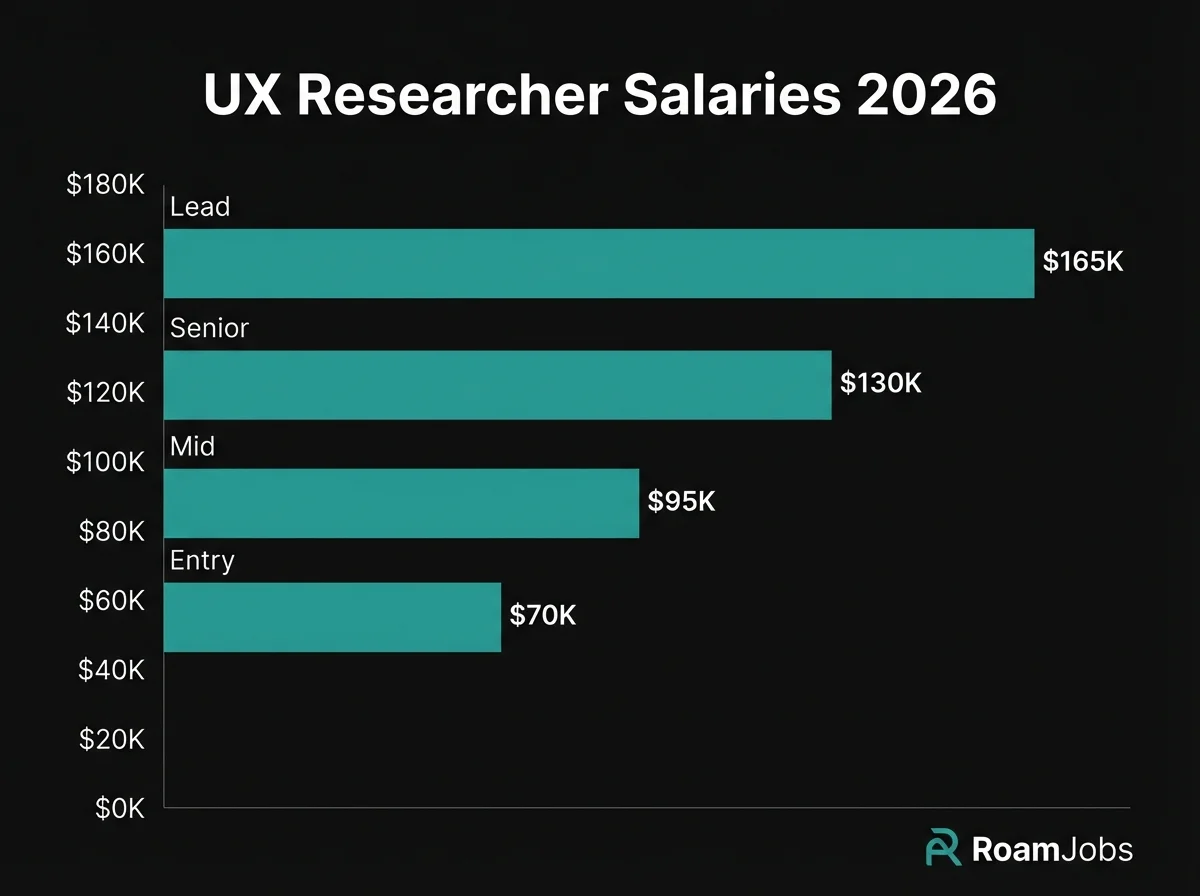
Understanding compensation across seniority levels helps you set appropriate expectations and negotiate effectively. These figures represent remote positions with US-based companies, the most competitive segment of the market.
UX Research Salary by Experience & Location
| Level | 🇺🇸 US Remote | 🇪🇺 EU Remote | 🌎 LATAM | 🌏 Asia |
|---|---|---|---|---|
| Entry Level (0-2 yrs) | $70,000 - $95,000 | $45,000 - $68,000 | $25,000 - $45,000 | $20,000 - $38,000 |
| Mid-Level (2-5 yrs) | $100,000 - $140,000 | $65,000 - $100,000 | $40,000 - $70,000 | $35,000 - $58,000 |
| Senior (5-8 yrs) | $140,000 - $190,000 | $95,000 - $140,000 | $60,000 - $100,000 | $50,000 - $85,000 |
| Director/Principal (8+ yrs) | $175,000 - $250,000 | $120,000 - $180,000 | $85,000 - $140,000 | $70,000 - $120,000 |
* Estimates, not survey data. Figures are RoamJobs estimates built from publicly reported salary ranges and adjusted for regional market rates; they are not from a proprietary RoamJobs survey. Actual base compensation varies by company, experience, and specific location within a region — verify against current offers before negotiating.
Career Progression: From Entry Level to Director
Each seniority level brings new responsibilities, skills, and expectations. Understanding these progressions helps you plan your career trajectory and prepare for advancement.
Entry Level / Junior UX Researcher
0-2 years experience
Breaking Into UX Research
Entry-level UX Research positions are competitive because many companies prefer hiring researchers with some experience. However, there are clear paths to breaking in.
Educational backgrounds that work:
- Psychology, sociology, anthropology, or cognitive science degrees
- Human-Computer Interaction (HCI) or Human Factors programs
- UX bootcamp certificates with strong research components
- Market research or academic research experience
- Journalism or documentary backgrounds (interview skills transfer)
Essential skills for entry level:
- Basic qualitative research methods (interviews, usability testing)
- Survey design and analysis fundamentals
- Affinity mapping and thematic analysis
- Clear written and verbal communication
- Familiarity with research tools (UserTesting, Maze, Dovetail)
What entry-level researchers do:
- Conduct moderated usability tests under supervision
- Take notes and assist with participant recruitment
- Help synthesize research data into reports
- Run screener surveys for participant recruitment
- Maintain research repositories and documentation
How to break in without experience:
- Conduct independent research projects for your portfolio
- Volunteer to do user research for nonprofits or open source projects
- Complete detailed case studies showing research methodology
- Get certifications (Google UX Certificate, UXPA, Nielsen Norman Group)
- Transition from adjacent fields (market research, academic research, QA testing)
Common entry-level titles:
- Associate UX Researcher
- Junior UX Researcher
- UX Research Associate
- Research Coordinator
Salary expectations: $70,000 - $95,000 for US remote roles. Entry-level research positions are less common than mid-level, so be prepared to start in research-adjacent roles or internships.
Mid-Level UX Researcher
2-5 years experience
Developing Methodological Depth
Mid-level researchers are the workhorses of research teams. At this level, you’re expected to independently plan and execute research projects with minimal oversight.
Skills expected at mid-level:
- Mastery of core qualitative methods (interviews, usability testing, contextual inquiry)
- Strong quantitative skills (survey design, basic statistical analysis)
- Advanced synthesis techniques (affinity diagramming, journey mapping, persona development)
- Stakeholder management and research socialization
- Research planning and project scoping
- Participant recruitment strategy
Expanded responsibilities:
- Lead end-to-end research projects independently
- Choose appropriate methodologies for different research questions
- Present findings directly to stakeholders and executives
- Mentor junior researchers and interns
- Contribute to research operations and best practices
- Partner with product managers and designers on research strategy
Methodology depth at this level:
Qualitative mastery:
- Semi-structured and structured interviews
- Think-aloud usability testing
- Contextual inquiry and field studies
- Card sorting and tree testing
- Diary studies and experience sampling
- Focus groups (though often less relevant for product research)
Quantitative capabilities:
- Survey design with validated scales
- A/B test analysis and interpretation
- Basic statistical analysis (t-tests, chi-square, correlation)
- Funnel and conversion analysis
- Segmentation and clustering basics
Common mid-level titles:
- UX Researcher
- User Researcher
- Design Researcher
- Product Researcher
Growth focus: At this level, focus on developing a specialty (generative vs. evaluative research, quantitative skills, specific domains) while maintaining broad competence. Build your reputation through impactful projects and start developing leadership skills.
Senior UX Researcher
5-8 years experience
Strategic Impact and Influence
Senior researchers are expected to shape product strategy, not just inform tactical decisions. At this level, your research directly influences product direction and business outcomes.
Strategic capabilities required:
- Connect research insights to business outcomes and metrics
- Identify strategic research opportunities proactively
- Build and maintain research roadmaps aligned with product strategy
- Influence product prioritization through compelling research narratives
- Establish research as a critical input to product decisions
- Navigate organizational politics to get research acted upon
Expanded scope:
- Lead multi-study research programs spanning months
- Conduct foundational research that shapes product vision
- Build research-informed frameworks (segmentation, personas, journey maps) that become organizational tools
- Partner with leadership on strategic product questions
- Evaluate and recommend research tools and methodologies
- Drive research democratization across the organization
Mixed methods expertise:
Senior researchers excel at combining qualitative and quantitative approaches:
- Design studies that triangulate multiple methods
- Use quantitative data to identify patterns, qualitative to explain why
- Build research programs that layer quick evaluative work with deep generative studies
- Create measurement frameworks for ongoing research tracking
Leadership without authority:
Senior researchers often influence without direct reports:
- Coach product teams on research best practices
- Build research champions across the organization
- Create training programs and workshops
- Establish research review processes
Common senior titles:
- Senior UX Researcher
- Staff UX Researcher
- Lead UX Researcher
- Senior Design Researcher
Career decisions at this level: Senior researchers typically choose between deepening their IC expertise toward Staff/Principal roles or moving into people management as Research Managers.
Lead / Director UX Researcher
8+ years experience
Research Leadership and Organization Building
Director and Principal level researchers shape how organizations think about research. Whether managing teams or serving as individual contributor leaders, they set research strategy and build research capabilities.
Director/Head of Research (People Manager Track):
- Build and manage research teams (hiring, performance management, career development)
- Set research strategy aligned with organizational goals
- Manage research budgets and vendor relationships
- Represent research in executive discussions
- Build research operations and infrastructure at scale
- Navigate organizational change and advocate for research investment
Principal Researcher (IC Track):
- Tackle the most complex and ambiguous research challenges
- Develop novel methodologies and approaches
- Mentor senior researchers across the organization
- Drive industry-leading research practices
- Publish and speak about research externally
- Shape product strategy through foundational research
Skills at the leadership level:
- Executive communication and influence
- Building and scaling research operations
- Budget management and ROI demonstration
- Cross-functional partnership at leadership level
- Research vision and strategy development
- Organizational design for research teams
Organizational impact:
- Define what “research-informed” means for the organization
- Build research culture that scales beyond the research team
- Create frameworks for research prioritization
- Establish research quality standards
- Drive research democratization while maintaining rigor
Common leadership titles:
- Director of UX Research
- Head of User Research
- VP of Research
- Principal UX Researcher
- Staff UX Researcher (at some companies)
Compensation at this level often includes significant equity components, especially at startups and public tech companies. Total compensation for Directors and VPs can reach $350,000+ at major tech companies.
Skills and Tools for Remote UX Researchers
Success in remote UX Research requires a combination of research methodology expertise, tool proficiency, and communication skills that work across distributed teams.
Research Tools Comparison
Remote Research Tools
Source: RoamJobs 2026 Research Tools Report| Tool | Best For | Price Range | Remote Features | Learning Curve |
|---|---|---|---|---|
| UserTesting | Unmoderated testing at scale | $$$ | Excellent | Low |
| Maze | Prototype testing | $$ | Excellent | Low |
| Lookback | Moderated research sessions | $$ | Excellent | Medium |
| Dovetail | Research repository & analysis | $$ | Excellent | Medium |
| dscout | Diary studies & mobile research | $$$ | Excellent | Medium |
| Optimal Workshop | Card sorting & tree testing | $$ | Excellent | Low |
| Hotjar/FullStory | Behavioral analytics | $$ | Excellent | Medium |
| Qualtrics/Typeform | Survey research | $-$$$ | Excellent | Low-Medium |
| Miro/FigJam | Remote workshops & synthesis | $ | Excellent | Low |
| Zoom/Teams | Moderated interviews | $ | Good | Low |
Data compiled from RoamJobs 2026 Research Tools Report. Last verified January 2026.
Research Methodology Types
Generative (Discovery) Research: Generative research explores unknown territories to identify opportunities and understand user needs. Methods include user interviews, contextual inquiry, ethnographic research, diary studies, and jobs-to-be-done interviews. This research happens early in the product development process to inform what to build.
Evaluative Research: Evaluative research tests specific designs or concepts to validate or refine them. Methods include usability testing, A/B testing, concept testing, preference testing, and accessibility audits. This research happens throughout development to ensure solutions meet user needs.
Foundational Research: Foundational research builds understanding that informs long-term strategy. Methods include market segmentation studies, competitive analysis, trend research, persona development, and journey mapping. This research creates frameworks used across multiple products or features.
Quantitative vs Qualitative Skills
Qualitative expertise (essential):
- Interview guide development and moderation
- Usability test facilitation
- Open coding and thematic analysis
- Affinity diagramming and pattern recognition
- Story extraction and narrative building
- Empathy and active listening
Quantitative skills (increasingly important):
- Survey design and sampling methodology
- Statistical analysis (SPSS, R, or Python)
- A/B test interpretation
- Behavioral analytics (Amplitude, Mixpanel, GA4)
- Data visualization
- Experimental design basics
The best researchers develop mixed-methods expertise, combining qualitative depth with quantitative rigor. This “full stack” research capability is increasingly valued at senior levels.
Analysis and Synthesis Tools
For qualitative analysis:
- Dovetail for tagging, analysis, and repository management
- Reframer for interview analysis and insight generation
- ATLAS.ti or NVivo for rigorous qualitative coding
- Miro or FigJam for affinity mapping and synthesis
- Notion or Confluence for documentation and sharing
For quantitative analysis:
- Excel/Google Sheets for basic analysis
- SPSS or R for statistical analysis
- Tableau or Looker for visualization
- Survey tools with built-in analysis (Qualtrics, SurveyMonkey)
- Product analytics platforms (Amplitude, Mixpanel)
Remote-Specific Skills
Asynchronous documentation:
- Write research reports that stand alone without verbal presentation
- Create video summaries for stakeholders in different time zones
- Build self-service research repositories
- Document methodology decisions for future reference
Remote facilitation:
- Master video conferencing for interviews (Zoom, Teams, Lookback)
- Develop rapport-building techniques that work virtually
- Handle technical issues smoothly during sessions
- Create inclusive research practices for global participants
Stakeholder communication:
- Over-communicate research progress and findings
- Create multiple formats for different consumption preferences
- Schedule findings presentations across time zones
- Build relationships with stakeholders you rarely see in person
Companies Hiring Remote UX Researchers
These companies have established research practices and actively hire remote researchers. Research each company’s research culture before applying.
Research-First Organizations
Meta (Facebook, Instagram, WhatsApp) - Massive research organization with specialized researchers across consumer and enterprise products. Strong mixed-methods culture. Competitive compensation with significant equity.
Google - Large research team with opportunities across Search, Cloud, Workspace, and more. Emphasis on quantitative rigor alongside qualitative methods. Remote-friendly for many roles.
Microsoft - Research opportunities across Office, Azure, Gaming, and LinkedIn. Strong academic research connections. Hybrid and remote options available.
Spotify - Music streaming with strong user research culture. Known for jobs-to-be-done methodology and rapid research practices. Distributed team across multiple regions.
Atlassian - Developer tools (Jira, Confluence). “Team Anywhere” policy makes this genuinely remote-friendly. Research-informed product development culture.
Remote-First Research Teams
GitLab - Fully distributed company with excellent research culture. Exceptional documentation practices. Research opportunities in developer experience.
Automattic (WordPress, WooCommerce) - Distributed-first organization. User research across massive scale products. Strong async culture.
Zapier - Workflow automation platform. Small but impactful research team. Known for excellent work-life balance.
Figma - Design tool company with growing research practice. Remote-friendly with distributed team.
Notion - Productivity workspace. Design-led with growing research investment.
Research-Mature Startups
Airbnb - Strong research culture established early. Opportunities in guest and host research. Remote-friendly positions available.
Stripe - Financial infrastructure. Research on complex B2B products. High compensation.
Shopify - E-commerce platform. Research on merchant and buyer experiences. “Digital by default” policy.
Canva - Visual design platform. Growing research team. Remote opportunities globally.
Duolingo - Language learning. Research on educational products. Known for experimentation culture.
Finding Unlisted Opportunities
Many research positions are never posted publicly or are filled through referrals. Here’s how to access the hidden market:
Build relationships proactively:
- Connect with research leaders on LinkedIn before you need a job
- Attend research community events (ResearchOps Community, UXPA, local meetups)
- Contribute to research discussions on Twitter/X and LinkedIn
- Join Slack communities (Mixed Methods, ResearchOps)
Target companies before openings:
- Identify companies with products you’d love to research
- Follow their research teams and leaders on social media
- Engage with their published research and methodologies
- Reach out for informational interviews
Leverage recruiters:
- Build relationships with design/UX recruiters
- Make your LinkedIn profile discoverable (clear headline, skills, location flexibility)
- Let recruiters know your preferences before you’re actively searching
Consider adjacent paths:
- Research-adjacent roles at target companies (research ops, design ops)
- Contract positions that could become full-time
- Agencies that place researchers at client companies
Interview Deep Dive
UX Research interviews are extensive and multifaceted. Expect portfolio presentations, methodology discussions, and behavioral interviews across 5-7 rounds.
Portfolio Presentation
Your portfolio presentation is the most critical interview component. Here’s how to structure it effectively.
How to structure your answer:
-
Context (1-2 minutes): What was the product, company situation, and research question? What was at stake?
-
Methodology (2-3 minutes): Why did you choose this approach? What methods did you use? How did you recruit participants? What was your sample size and why?
-
Execution (2-3 minutes): How did you conduct the research? What challenges did you encounter? How did you adapt?
-
Analysis (2-3 minutes): How did you analyze the data? What patterns emerged? How did you ensure rigor?
-
Insights (2-3 minutes): What did you learn? What were the key insights? How did you prioritize them?
-
Impact (2-3 minutes): How did the research influence decisions? What changed because of your work? What were the measurable outcomes?
Tips for success:
- Lead with impact, then explain how you got there
- Show, don’t just tell (include artifacts, quotes, data)
- Be specific about YOUR contribution vs. team work
- Prepare to go deep on methodology questions
- Connect research to business outcomes
Research Methodology Questions
Strong answer approach:
First, clarify the research questions: What specific behaviors are we seeing? What hypotheses exist about why users abandon? What decisions will this research inform?
Then outline a mixed-methods approach:
Quantitative foundation:
- Analyze existing funnel data to identify exact drop-off points
- Segment by user type, acquisition channel, device
- Identify patterns that suggest potential causes
Qualitative investigation:
- Conduct 8-10 moderated usability tests with users matching drop-off segments
- Use think-aloud protocol to understand real-time decision making
- Follow up with deeper interviews to understand context and motivations
Triangulation:
- Cross-reference quantitative patterns with qualitative insights
- Prioritize findings based on frequency and severity
- Generate specific, testable hypotheses for improvement
Deliverables:
- Research report with prioritized insights
- Journey map highlighting friction points
- Recommendations with expected impact
Qualitative methods when:
- You need to understand “why” and “how”
- Exploring new problem spaces or user segments
- Generating hypotheses rather than testing them
- Understanding context, emotions, and motivations
- Sample sizes are necessarily small
Quantitative methods when:
- You need to measure “how many” or “how much”
- Validating hypotheses at scale
- Comparing options or tracking changes over time
- Generalizing findings to larger populations
- Statistical significance matters for decisions
Mixed methods approach: The best research often combines both—use quantitative data to identify patterns, then qualitative research to understand why those patterns exist. Or conduct qualitative research to generate hypotheses, then validate at scale with quantitative methods.
For interviews and usability testing:
- 5-8 participants often reveal 80% of usability issues
- 12-15 participants typically reach saturation for interview themes
- Increase sample for multiple user segments or complex topics
- Stop when new sessions yield diminishing new insights
Factors that increase needed sample size:
- Multiple distinct user segments
- Complex or varied use cases
- High-stakes decisions requiring more confidence
- Diverse demographic requirements
How to justify sample size:
- Reference saturation principles from academic literature
- Plan for iterative sampling (start smaller, add if needed)
- Document when saturation was reached
- Be transparent about limitations
Approach to this common challenge:
First, understand their perspective. What’s driving the urgency? What are they afraid of? What’s the cost of delay in their mind?
Then, reframe research as reducing risk:
- “Research now prevents expensive rework later”
- “We can run a quick study in X days that will increase confidence”
- “Let’s identify the riskiest assumptions and test just those”
Offer appropriate-scope alternatives:
- Quick guerrilla testing (hours, not weeks)
- Leveraging existing research or data
- Lightweight methods that fit their timeline
- “Good enough” research for the decision at hand
If they still want to skip:
- Document the decision and risks
- Propose evaluation research after launch
- Stay constructive and maintain the relationship
- Pick your battles—not every decision needs extensive research
How to structure your answer:
The situation: Describe the research, what you found, and why it mattered.
Why findings weren’t acted upon: Be thoughtful and non-defensive. Possible reasons:
- Timing—research completed too late for the decision
- Stakeholder priorities differed from user needs
- Business constraints made recommendations impractical
- Research wasn’t communicated effectively
- Organizational politics or competing priorities
What you did:
- How you advocated for the findings
- How you tried to understand the resistance
- Compromises or alternatives you proposed
- How you documented the decision for the future
What you learned:
- How to better time research to decisions
- How to involve stakeholders earlier
- How to frame findings in business terms
- How to pick battles and when to let go
Demonstrate growth: Show that you learned from the experience and changed your approach for future research.
Prioritization framework:
Assess each request:
- What decision will this research inform?
- What’s the cost of making the wrong decision?
- How confident are stakeholders currently?
- When is the decision deadline?
Prioritize based on:
- Business impact of the decision
- Level of uncertainty/risk
- Decision timeline urgency
- Strategic alignment
- Feasibility with available resources
When you can’t do everything:
- Offer lightweight alternatives for lower-priority requests
- Empower stakeholders with self-service research methods
- Bundle similar questions into single studies
- Negotiate timelines or scope
- Say no clearly while explaining the reasoning
Build sustainable capacity:
- Create research templates and playbooks
- Build a participant panel for faster recruitment
- Train product teams on basic research methods
- Establish research prioritization rituals (quarterly planning, etc.)
Inclusive research practices:
Recruitment:
- Define participant criteria that represent actual user diversity
- Use multiple recruitment channels to reach different populations
- Screen for demographic diversity that matters for the product
- Avoid convenience sampling that skews toward majority groups
- Consider accessibility needs in study design
Study design:
- Test materials with diverse populations before launching
- Use inclusive language in surveys and interview guides
- Accommodate different communication styles and abilities
- Consider cultural contexts that may affect responses
- Offer participation in multiple formats (video, phone, text)
Analysis:
- Look for patterns that differ across demographic groups
- Avoid generalizing findings from non-representative samples
- Highlight when findings may not apply to all users
- Specifically analyze edge cases and minority experiences
Organizational advocacy:
- Push for inclusive recruitment even when it’s harder
- Highlight gaps in who you’re learning from
- Recommend additional research to fill gaps
- Build diverse participant panels over time
Remote research advantages:
- Access to geographically diverse participants
- Participants in natural environments (not labs)
- More efficient—no travel time between sessions
- Better for diary studies and longitudinal research
- Easier to record and share sessions
Challenges and solutions:
Technical issues:
- Have backup plans (phone, different platforms)
- Send participants technical check instructions
- Start with buffer time for troubleshooting
Building rapport virtually:
- Spend more time on warm-up conversation
- Use video to create more personal connection
- Be more explicit about creating comfortable atmosphere
- Follow up with participants after sessions
Reading non-verbal cues:
- Ask more explicit clarifying questions
- Pay attention to tone and pace, not just words
- Request camera-on when possible and appropriate
- Use think-aloud protocols more extensively
Ensuring engagement:
- Keep sessions shorter than in-person equivalents
- Build in more interactive elements
- Use screen sharing and collaborative tools
- Check in frequently on participant comfort
Making research actionable:
Know your audience:
- Executives need 1-page summaries with key decisions
- Product teams need detailed findings with recommendations
- Design teams need specific insights with user quotes and clips
- Create multiple versions for different consumers
Structure for scanning:
- Lead with insights and recommendations, not methodology
- Use clear headings and bullet points
- Include an executive summary (even for detailed reports)
- Make insights actionable (“Users struggle with X” becomes “Simplify the X flow”)
Make it memorable:
- Include compelling user quotes and video clips
- Use data visualization effectively
- Tell stories, not just report findings
- Create artifacts people will reference (personas, journey maps)
Enable action:
- Connect insights to specific product decisions
- Prioritize recommendations by impact and effort
- Identify owners for follow-up actions
- Schedule follow-up to discuss implications
Build research habits:
- Create regular research share-outs (weekly, monthly)
- Make research findable in a repository
- Reference past research in new projects
- Celebrate when research influences decisions
Quantifying research value:
Direct impact metrics:
- Decisions influenced by research (track them)
- Product changes that resulted from research
- Designs that were improved based on findings
- Launches delayed/changed due to research insights
Outcome metrics:
- User satisfaction improvements after research-informed changes
- Conversion improvements from usability fixes
- Reduced support tickets from research-driven improvements
- Time saved by avoiding wrong directions
Process metrics:
- Research requests received (indicates demand)
- Studies completed and coverage
- Stakeholder satisfaction with research
- Time from research to decision
Building a research measurement practice:
- Track decisions research influenced in a log
- Follow up on recommendations to see what was implemented
- Connect with product analytics to measure outcomes
- Create case studies of high-impact research
Acknowledge limitations:
- Research is one input among many for decisions
- Attribution is inherently difficult
- Focus on demonstrating value, not proving causation
- Build relationships that don’t require constant justification
Structure for this answer:
The situation: What did you find that stakeholders wouldn’t want to hear? Why was it important to share?
Your approach:
- Prepared the delivery carefully (timing, audience, format)
- Led with empathy—acknowledged the difficulty
- Presented evidence clearly and objectively
- Focused on users and business impact, not blame
- Offered constructive paths forward
How you framed it:
- “Here’s what we learned about user needs”
- “This helps us avoid a bigger problem later”
- “Now we have the chance to address this before launch”
- “Users gave us a gift by sharing their struggles”
The outcome:
- How stakeholders responded
- What decisions changed
- How relationships were preserved or improved
Lessons learned:
- Building trust before delivering hard news
- Involving stakeholders earlier in research
- Framing findings constructively
- Picking the right format for difficult messages
Building research from the ground up:
Phase 1: Quick wins (Months 1-3)
- Identify a high-visibility project that needs research
- Conduct impactful research that demonstrates value
- Create a compelling case study of research impact
- Build relationships with key stakeholders
Phase 2: Foundation (Months 3-6)
- Establish basic research operations (tools, participant panel)
- Create templates and playbooks for common methods
- Start a research repository for findings
- Run research training for product teams
Phase 3: Scale (Months 6-12)
- Define research prioritization process
- Build regular research rituals (share-outs, planning)
- Expand participant recruitment capabilities
- Create self-service research tools for simple needs
Phase 4: Maturity (Year 2+)
- Hire additional researchers as needed
- Build specialized research capabilities
- Establish research quality standards
- Integrate research into product development lifecycle
Keys to success:
- Start with impact, not infrastructure
- Build allies across the organization
- Be flexible on methods, firm on rigor
- Demonstrate value continuously
- Patience—culture change takes time
Questions that demonstrate research thinking:
About research maturity:
- How does research currently fit into product development?
- What does a typical research project look like here?
- How are research priorities set?
- What’s the ratio of researchers to product teams?
About research culture:
- How are research findings shared and used?
- Can you give an example of research that significantly influenced a decision?
- What happens when research and business priorities conflict?
- How do product teams currently get user feedback?
About growth and development:
- What methodologies is the team looking to grow?
- How do researchers develop their skills here?
- What does the career path for researchers look like?
- Are there opportunities for thought leadership or external sharing?
About remote work:
- How does the research team collaborate across time zones?
- What tools do you use for remote research?
- How do you build relationships with stakeholders remotely?
- What’s the expectation for in-person time, if any?
More Interview Questions with Detailed Answers
When to choose moderated testing:
- You need to ask follow-up questions and probe deeper
- The prototype or concept is complex and may confuse users
- You’re exploring new problem spaces where context is important
- Tasks are ambiguous or require explanation
- You want to observe emotional reactions in real-time
- You’re testing with specialized user populations
- The research questions are exploratory rather than evaluative
When to choose unmoderated testing:
- You need a larger sample size quickly
- Tasks are straightforward and self-explanatory
- You’re validating specific usability issues at scale
- Budget or time constraints prevent scheduling individual sessions
- You need to reach geographically diverse participants
- You want to reduce moderator bias in the research
- You’re measuring task completion rates or time-on-task
Hybrid approaches: Consider running a few moderated sessions first to identify key issues and refine your test script, then scale with unmoderated testing to quantify how widespread those issues are. This gives you both depth and breadth in your findings.
Addressing researcher bias:
Confirmation bias mitigation:
- Write neutral research questions that don’t presuppose answers
- Actively look for disconfirming evidence
- Have colleagues review your interview guides and analysis
- Use standardized analysis frameworks
Leading question prevention:
- Avoid questions that suggest expected answers
- Use open-ended questions before specific probes
- Test your guide with pilot participants
- Review session recordings to catch leading behavior
Analysis bias reduction:
- Use systematic coding approaches rather than cherry-picking
- Have multiple researchers analyze the same data independently
- Document your analysis process for transparency
- Actively seek out edge cases and outliers
Addressing participant bias:
Social desirability:
- Emphasize there are no right or wrong answers
- Normalize struggles and negative feedback
- Use indirect questioning when appropriate
- Observe behavior, not just self-reported attitudes
Recall bias:
- Focus on recent, specific experiences rather than general patterns
- Use critical incident technique for concrete examples
- Supplement interviews with behavioral data
- Consider diary studies for in-the-moment capture
Hawthorne effect:
- Make sessions feel comfortable and natural
- Use unmoderated testing when observation effects matter
- Conduct field research in natural contexts
- Analyze behavioral analytics alongside qualitative data
Navigate this diplomatically while maintaining research integrity:
Understand their perspective first:
- Why are they attached to this solution?
- What problem are they trying to solve?
- What constraints led them to this approach?
- What’s the timeline and business pressure?
Reframe the conversation:
- “Let’s make sure we’re solving the right problem first”
- “I can help us understand if this solution resonates with users and why”
- “Validation research is more valuable when we understand user mental models”
- “Let’s test a few approaches so we can compare effectiveness”
Propose a constructive middle ground:
- Concept testing that compares their solution against alternatives
- Research that validates the problem before testing solutions
- Quick tests that still include open-ended discovery questions
- Usability testing with tasks that reveal both strengths and weaknesses
If they insist on pure validation:
- Design research that tests specific aspects of the solution objectively
- Include questions that probe for alternative approaches
- Be transparent that validation research has limitations
- Document findings honestly, including any weaknesses discovered
Build the relationship for future research:
- Deliver valuable insights regardless of the constraints
- Help them see research as a partnership, not a hurdle
- Demonstrate how research makes their solutions better
- Earn trust for more open research in future projects
Investigate before concluding either source is wrong:
Check for methodology issues:
- Is the research sample representative of the analytics population?
- Are you measuring the same things? (Often, you’re not)
- Could there be selection bias in who participated in research?
- Are the time periods comparable?
Understand what each data source reveals:
- Analytics shows what users do, research explains why
- Analytics represents the full population, research is a sample
- Analytics captures actual behavior, research captures intentions and reasoning
- Both can be “true” if they’re measuring different things
Common reconciliation patterns:
Users say one thing but do another:
- Reported preferences don’t match behavioral data
- Both are valid—research reveals aspirations, analytics reveals reality
- Focus on the research to understand why behavior differs from intention
Segment differences:
- Research sample may over-represent certain segments
- Look for behavioral patterns in analytics that match research participants
- Consider whether research captured important but smaller segments
Context differences:
- Research was conducted in a specific scenario
- Analytics captures varied real-world contexts
- Identify when research findings apply and when they don’t
Present both perspectives:
- Share both data sources with stakeholders
- Explain what each reveals and their limitations
- Recommend additional research to resolve contradictions
- Use contradictions as opportunities for deeper investigation
Strategies for specialized populations:
B2B and professional participants:
- Partner with sales and customer success for warm introductions
- Use LinkedIn for targeted outreach
- Attend industry events and conferences
- Offer meaningful incentives (higher than consumer rates)
- Schedule around business hours with generous flexibility
- Leverage professional associations and communities
Niche consumer segments:
- Recruit through specialized online communities and forums
- Use social media targeting for Facebook/Instagram ads
- Partner with organizations serving those populations
- Ask current participants for referrals (snowball sampling)
- Extend recruitment timelines and offer flexible scheduling
- Consider panel services that specialize in specific segments
International and cross-cultural research:
- Work with local research agencies or recruiters
- Use professional translation and native moderators when possible
- Adjust incentive amounts for local economic context
- Account for time zone differences in scheduling
- Consider cultural differences in research participation norms
- Use recruitment platforms with global reach (UserTesting, Prolific)
Users with accessibility needs:
- Recruit through disability advocacy organizations
- Ensure research methods accommodate various needs
- Offer multiple participation formats (video, phone, text)
- Test your research tools for accessibility before recruiting
- Allow extra time and flexible rescheduling
- Compensate fairly and respectfully
General best practices:
- Start recruiting early—hard-to-reach participants take longer
- Overrecruit by 20-30% for no-shows
- Build ongoing participant relationships for future studies
- Create participant panels for repeated access
- Document what works for future projects
Strategic decisions for research scope:
When to prioritize depth:
- Exploring complex or emotional topics
- Understanding decision-making processes in detail
- Researching new problem spaces with little existing knowledge
- Developing rich personas or journey maps
- When insights need to be defensible and comprehensive
- Foundation research that will inform multiple products
When to prioritize breadth:
- Validating findings across different user segments
- Identifying the most common patterns or issues
- Comparative research across products or competitors
- When time and budget are limited
- Testing hypotheses generated from earlier deep research
- When stakeholder confidence requires larger samples
Practical approaches:
Sequential depth-then-breadth:
- Start with deep research on a smaller sample
- Use those insights to design broader validation
- Combine for both understanding and confidence
Parallel mixed-methods:
- Run quantitative surveys alongside qualitative interviews
- Use behavioral data to identify patterns, interviews to explain them
- Triangulate findings from multiple sources
Tiered sampling:
- Deep interviews with core users
- Lighter-touch surveys with broader population
- Follow-up deep dives on surprising survey findings
Factors that influence the decision:
- Research questions (exploratory vs. evaluative)
- Available timeline and budget
- Stakeholder confidence needs
- Existing knowledge about the topic
- Consequences of being wrong
- Resources for analysis (depth requires more analysis time)
Additional Interview Questions to Prepare
More methodology questions:
- How do you choose between moderated and unmoderated testing?
- Describe your approach to analyzing interview transcripts.
- How do you handle bias in research (both your own and participants’)?
- What’s your experience with quantitative research methods?
- How do you design a survey that minimizes response bias?
- How do you triangulate findings across multiple research methods?
- When would you recommend longitudinal research over cross-sectional studies?
More scenario questions:
- You have one week to understand a new user segment. What do you do?
- A PM wants you to validate their preferred solution. How do you handle it?
- Your research contradicts what analytics data suggests. What’s your approach?
- You discover a critical usability issue right before launch. What do you do?
- A stakeholder wants to join research sessions. How do you handle this?
- Your participant pool is mostly power users. How do you get insights about novices?
- You only have budget for 5 participants. How do you maximize value?
Remote-specific questions:
- How do you build rapport with research participants over video?
- What’s your approach to async communication about research?
- How do you ensure research visibility in a distributed organization?
- What challenges have you faced with remote research, and how did you overcome them?
- How do you collaborate with international stakeholders on research projects?
- What tools do you use for remote research operations?
Frequently Asked Questions
How do I find remote ux researcher jobs?
To find remote ux researcher jobs, start with specialized job boards like We Work Remotely, Remote OK, and FlexJobs that focus on remote positions. Set up job alerts with keywords like "remote ux researcher" and filter by fully remote positions. Network on LinkedIn by following remote-friendly companies and engaging with hiring managers. Many ux researcher roles are posted on company career pages directly, so identify target companies known for remote work and check their openings regularly.
What skills do I need for remote ux researcher positions?
Remote ux researcher positions typically require the same technical skills as on-site roles, plus strong remote work competencies. Essential remote skills include excellent written communication, self-motivation, time management, and proficiency with collaboration tools like Slack, Zoom, and project management software. Demonstrating previous remote work experience or the ability to work independently is highly valued by employers hiring for remote ux researcher roles.
What salary can I expect as a remote ux researcher?
Remote ux researcher salaries vary based on experience level, company size, location-based pay policies, and the specific tech stack or skills required. US-based remote positions typically pay market rates regardless of where you live, while some companies adjust pay based on your location's cost of living. Entry-level positions start lower, while senior roles can command premium salaries. Check our salary guides for specific ranges by experience level and geography.
Are remote ux researcher jobs entry-level friendly?
Some remote ux researcher jobs are entry-level friendly, though competition can be high. Focus on building a strong portfolio or demonstrable skills, contributing to open source projects if applicable, and gaining any relevant experience through internships, freelance work, or personal projects. Some companies specifically hire remote junior talent and provide mentorship programs. Smaller startups and agencies may be more open to entry-level remote hires than large corporations.
Do I need a psychology or research degree to become a UX Researcher?
A psychology or research degree is helpful but not required. Many successful UX Researchers come from diverse backgrounds including sociology, anthropology, design, journalism, and even entirely different fields. What matters more is demonstrable research skills, strong communication abilities, and a genuine curiosity about user behavior. If you lack formal research training, build your skills through bootcamps, certificates (Google UX Certificate, UXPA courses), independent research projects, and hands-on practice. Your portfolio demonstrating research methodology and impact matters more than your educational background in most hiring decisions.
How important are quantitative skills for UX Researchers?
Quantitative skills are increasingly important and can significantly enhance your career prospects and compensation. While many UX Researcher roles emphasize qualitative methods (interviews, usability testing), the best researchers combine qualitative depth with quantitative rigor. At minimum, you should be comfortable with survey design, basic statistical analysis, and interpreting analytics data. At senior levels, advanced quantitative skills (A/B testing, statistical significance, behavioral analytics) are often expected. Mixed-methods researchers who can move fluidly between qualitative and quantitative work are highly valued and command premium compensation.
What's the difference between a UX Researcher and a UX Designer career path?
UX Researchers and UX Designers have distinct but related career paths. Researchers focus on understanding users through interviews, testing, and analysis—their output is insights and recommendations. Designers focus on creating solutions through wireframes, prototypes, and visual design—their output is actual interface designs. Researchers typically come from research-oriented backgrounds (psychology, HCI, market research) while designers often have visual design backgrounds. At senior levels, researchers may become Research Directors or Principal Researchers, while designers become Design Directors or Principal Designers. Some professionals transition between the paths, though it requires building new portfolio work and skills in the target discipline.
How do I build a UX Research portfolio without professional experience?
Building a research portfolio without job experience is challenging but achievable. Conduct independent research projects on products you use—do usability testing with friends, run surveys, document your methodology and findings in detailed case studies. Volunteer to do research for nonprofits or open source projects. Complete bootcamp projects with rigorous research components. Transition experience from adjacent fields (academic research, market research, journalism) by reframing it as UX-relevant. Each portfolio piece should clearly show: the research question, your methodology and why you chose it, your analysis approach, key insights, and ideally the impact on product decisions. Quality and depth of 3-4 projects beats quantity of superficial ones.
Is UX Research more remote-friendly than UX Design?
Yes, UX Research is generally more remote-friendly than UX Design for several reasons. The core work—conducting user interviews and analyzing data—works equally well remotely. Research artifacts (reports, insights, recommendations) are inherently asynchronous and easily shared across time zones. Remote research can actually be superior, as participants are in their natural environments rather than unfamiliar lab settings. While UX Designers often need more real-time collaboration with developers and design reviews, researchers can largely work independently. Both disciplines have strong remote opportunities, but research roles are among the most naturally suited to distributed work.
What's the typical career progression timeline for UX Researchers?
Typical UX Research career progression looks like this: Entry/Associate level (0-2 years) learning core methods and conducting supervised research; Mid- level/Researcher (2-5 years) leading independent projects and developing methodology depth; Senior Researcher (5-8 years) driving strategic research and influencing product direction; Lead/Principal/Director (8+ years) either managing teams or serving as senior individual contributors. However, timelines vary significantly based on company size, research maturity, individual performance, and career focus. Progression tends to be faster at growing startups than established companies. Some researchers reach senior levels in 4-5 years at fast- moving companies, while others take 10+ years at more traditional organizations.
Should I specialize in generative or evaluative research?
Most researchers benefit from being strong in both generative and evaluative research, with a slight lean toward one based on interest and opportunity. Generative research (discovery, interviews, ethnography) is more common at companies with strategic research practices and tends to have more impact on product direction. Evaluative research (usability testing, validation) is more common and has lower barriers to entry, making it a good starting point. Companies with mature research practices value specialists, while smaller companies need generalists. The best approach is developing competence across the spectrum while developing deeper expertise in the area that most interests you. Your specialization should evolve based on the opportunities available and your career goals.
How do remote UX Research salaries compare to on-site positions?
Remote UX Research salaries vary based on company compensation philosophy. Remote- first companies like GitLab and Zapier often pay location-agnostic salaries benchmarked to expensive markets (SF/NYC), which benefits researchers in lower cost-of-living areas. Large tech companies (Google, Meta) typically adjust salaries based on location, with 15-40% reductions for researchers in lower-cost areas. Research roles generally see less geographic pay variation than some other disciplines because the work is so inherently remote-friendly. At senior levels, total compensation (including equity) at strong remote companies often matches or exceeds on-site equivalents. Research each company's specific compensation philosophy rather than assuming remote means lower pay.
What certifications or courses are most valuable for UX Researchers?
The most respected credentials for UX Researchers include: Nielsen Norman Group UX Certification (industry gold standard, especially for usability expertise); UXPA Certifications (strong for research methodology); Google UX Design Certificate (good entry point covering research fundamentals); Coursera/Interaction Design Foundation courses (affordable ongoing learning); Statistics and research methods courses from universities (for quantitative skills). However, certifications matter less than demonstrated research skills in your portfolio. Certifications are most valuable when breaking into the field or transitioning from adjacent disciplines. Once you have professional experience, your portfolio and track record become more important than credentials.
How do I transition from market research or academic research to UX Research?
Transitioning from market research or academic research to UX Research is relatively straightforward because many skills transfer directly. Focus on reframing your experience in UX-relevant terms: user interviews parallel in-depth interviews, usability testing uses similar facilitation skills, and analysis methods often transfer directly. Build UX-specific portfolio pieces that demonstrate understanding of product development context and fast-paced iteration. Learn UX-specific tools (Figma for understanding design context, UserTesting, Dovetail) and terminology. Network in UX communities to build relationships and learn cultural norms. The main adjustment is moving from research for knowledge to research for action—UX research is always oriented toward product decisions, not academic publication or comprehensive market understanding.
What's the job market like for remote UX Researchers in 2026?
The remote UX Research job market in 2026 is strong but competitive. Demand is growing as companies recognize research value, with salaries increasing 12% year- over-year. Remote opportunities are abundant—over 58% of research roles offer remote or hybrid arrangements. However, competition is intense, especially for entry-level positions, as many candidates entered the field during the pandemic- era UX boom. Senior researchers with demonstrated impact and strong portfolios are in high demand. The best opportunities are at research-mature organizations (tech companies, well-funded startups) that understand research value. Success requires strong portfolios, clear methodology expertise, and the ability to articulate research impact in business terms.
How important is the research repository and research ops aspect of the job?
Research operations and repository management are increasingly important parts of UX Research roles, especially at mid-senior levels. As organizations scale research, the ability to make findings accessible, avoid duplicate research, and enable research democratization becomes critical. At smaller companies, researchers often manage their own ops. At larger companies, dedicated Research Ops roles exist, but researchers still need to contribute to and use these systems effectively. Understanding research ops demonstrates maturity and scalability—it shows you're thinking beyond individual studies to organizational research effectiveness. When interviewing, asking about research infrastructure signals you're thinking at the right level.
Related Career Paths and Next Steps
UX Research connects to several related career paths worth exploring:
UX Design - If you want to move from understanding users to creating solutions, UX Design combines research insights with interface design. Many researchers develop design skills over time.
Product Management - Research skills translate well to product management, where understanding user needs is essential for prioritization and strategy decisions.
Design Strategy - Senior researchers often move into design strategy roles, applying research thinking to organizational and business challenges.
Research Operations - If you enjoy the infrastructure side of research, Research Ops focuses on building systems that enable research at scale.
Recommended Next Steps
- Assess your current skills against the seniority level descriptions above
- Identify gaps in methodology, tools, or soft skills
- Build targeted portfolio pieces that demonstrate the skills you’re developing
- Join research communities to network and learn (Mixed Methods, ResearchOps Community, UXPA)
- Target companies with research cultures that match your values and career stage
- Prepare thoroughly for interviews using the questions and frameworks above
Whether you’re breaking into UX Research, advancing to senior levels, or transitioning into leadership, the demand for skilled researchers who can uncover user insights and drive product decisions remains strong. Remote work has only expanded opportunities, making this an excellent time to build or advance your research career.
Get the Remote UX Research Career Guide
Weekly curated remote research jobs, portfolio tips, and interview advice delivered to your inbox.
Continue Reading
Remote Design Jobs 2026: Complete Guide to UX, UI, Product & Brand Careers
The definitive hub for remote design careers. Explore salary data, interview guides, and opportunities across UX, UI, product design, research, and design management.
Remote UX Designer Jobs: Complete 2026 Career Guide
Everything you need to land a remote UX designer job. User research, wireframing, usability testing - salary data, interview questions, and companies hiring.
Remote Product Designer Jobs: Complete 2026 Career Guide
Everything you need to land a remote product designer job. End-to-end design from research to visual - salary data, interview questions, and companies hiring.
Remote jobs worth opening, every Tuesday
A short weekly list of remote jobs picked for your field, with location limits called out when we can verify them.
Live intake · refreshed every 12 hours
Live openings: remote ux researcher
Sourced from publisher feeds, not direct employer postings. Links route through
/go/ with the same anti-fraud checks as our curated boards.