Remote Brand Designer Jobs: Complete 2026 Career Guide
Everything you need to land a remote brand designer job. Visual identity, brand systems, illustration - salary data, interview questions, and companies hiring.
Updated January 20, 2026 • Verified current for 2026
Remote brand designers create and maintain visual identity systems that define how companies present themselves across every touchpoint. This includes logos, typography systems, color palettes, illustration styles, brand guidelines, and marketing collateral. Remote brand design salaries range from $52,000 to $200,000 depending on experience level and company type, with the highest compensation at design-led tech companies and established agencies. The role requires exceptional visual design skills, strategic thinking about brand positioning, and the ability to create cohesive systems that scale across digital and physical applications. Remote brand design work is highly async-compatible since deliverables are visual and documentation-heavy, making it one of the most location-flexible design specializations. Success requires mastery of Adobe Creative Suite (especially Illustrator), strong typography skills, and the ability to articulate design decisions through written brand rationale.
What Remote Brand Designers Actually Do
Brand designers occupy a unique position in the design world, sitting at the intersection of visual design, marketing strategy, and business identity. Unlike UI designers who focus on digital product interfaces or UX designers who optimize user flows, brand designers create the foundational visual language that shapes how companies communicate with the world.
Day-to-Day Responsibilities
Logo and Identity Design
The most iconic brand design work involves creating logos and core identity elements. This goes far beyond designing a single mark. Brand designers develop complete logo systems including primary logos, secondary marks, favicons, app icons, and lockups for various applications. They consider how the logo works in full color, single color, reversed, and at different scales from billboards to social media avatars.
Brand Guideline Development
Creating comprehensive brand guidelines is a core brand designer responsibility. These documents codify every aspect of visual identity: typography hierarchies and font pairings, color palettes with specific values for print (CMYK/Pantone) and digital (RGB/hex), photography and illustration styles, iconography systems, layout principles, and voice and tone guidance. Remote brand designers excel at this work because it requires deep documentation skills that translate well to async collaboration.
Typography Systems
Brand designers select, pair, and systematize typefaces that express brand personality. This includes establishing hierarchies for headlines, body copy, captions, and UI elements. They consider licensing implications for web and app usage, accessibility requirements, and how fonts render across different platforms and devices.
Illustration and Visual Asset Creation
Many brand design roles include illustration work, from spot illustrations for marketing materials to full illustration systems that become part of brand identity. This might include custom icon sets, pattern libraries, character designs for mascots, or decorative elements that add personality to communications.
Marketing Collateral Design
Brand designers create templates and actual designs for marketing materials: pitch decks, social media graphics, email templates, digital ads, print materials, event signage, and merchandise. They ensure all materials align with brand guidelines while adapting appropriately for different contexts and audiences.
Brand Evolution and Stewardship
Established brand designers maintain and evolve existing identities over time. This includes auditing current brand usage for consistency, updating guidelines as the brand evolves, creating new asset types as needs emerge, and training other team members on brand application.
Brand Designer vs UI Designer vs Graphic Designer
Understanding how brand design differs from related disciplines helps you position yourself effectively in the job market.
Design Role Comparison
Source: RoamJobs 2026 Design Career Analysis| Aspect | Brand Designer | UI Designer | Graphic Designer |
|---|---|---|---|
| Primary Focus | Visual identity systems | Digital product interfaces | Individual visual pieces |
| Key Deliverables | Logos, guidelines, identity systems | App/web screens, components | Marketing materials, layouts |
| Strategic Involvement | High | Medium | Low-Medium |
| Typical Tools | Illustrator, Figma, After Effects | Figma, Sketch, Framer | InDesign, Photoshop, Canva |
| Career Path | Brand Director, Creative Director | Design Lead, Product Design | Art Director, Creative Lead |
| Remote Friendliness | Very High | Very High | High |
Data compiled from RoamJobs 2026 Design Career Analysis. Last verified January 2026.
Brand designers think in systems and long-term identity. Their work provides the foundation that other designers build upon. They focus on creating rules and guidelines that ensure consistency across all brand expressions.
UI designers focus on digital product interfaces, optimizing screens and interactions for usability and visual appeal. While they may work within brand guidelines, they typically don’t create them.
Graphic designers often work on individual pieces rather than systems. They might design a brochure, poster, or social graphic without necessarily considering how it fits into a broader identity framework.
Many roles blend these disciplines. A “Brand Designer” at a startup might handle UI work, while a “Visual Designer” at an agency might focus heavily on brand systems. Job titles vary significantly, so always read the full job description.
Remote Brand Design: Challenges and Opportunities
Why Brand Design Works Well Remotely
Brand design is inherently async-compatible. The work involves creating visual assets and documentation that exist independently from real-time collaboration. You can design a logo system, build out brand guidelines, or create illustration libraries without being on a video call. The deliverables are self-explanatory visual artifacts.
Documentation-heavy nature of brand work actually benefits from remote settings. Brand designers already communicate through written guidelines and visual examples. Remote work simply extends this communication style to team collaboration.
Brand design projects often have longer timelines than UI work, reducing the need for rapid real-time iteration. A brand identity project might span weeks or months, allowing for async feedback cycles that work well across time zones.
Remote Brand Design Challenges
Presenting brand concepts remotely requires different skills than in-person presentations. Without reading body language in real-time, you need stronger written rationale and more comprehensive concept documentation.
Building relationships with stakeholders takes more intentional effort when you can’t have casual in-person conversations. Brand work involves understanding company culture and personality, which requires deeper discovery processes remotely.
Accessing physical brand applications (print materials, signage, packaging) for quality control can be challenging remotely. Some brand designers maintain relationships with local print vendors or rely on detailed proofing processes.
Collaborative workshops for brand development require more structured facilitation remotely. Tools like FigJam, Miro, and Mural help, but require more preparation than whiteboard sessions.
Salary Breakdown by Seniority
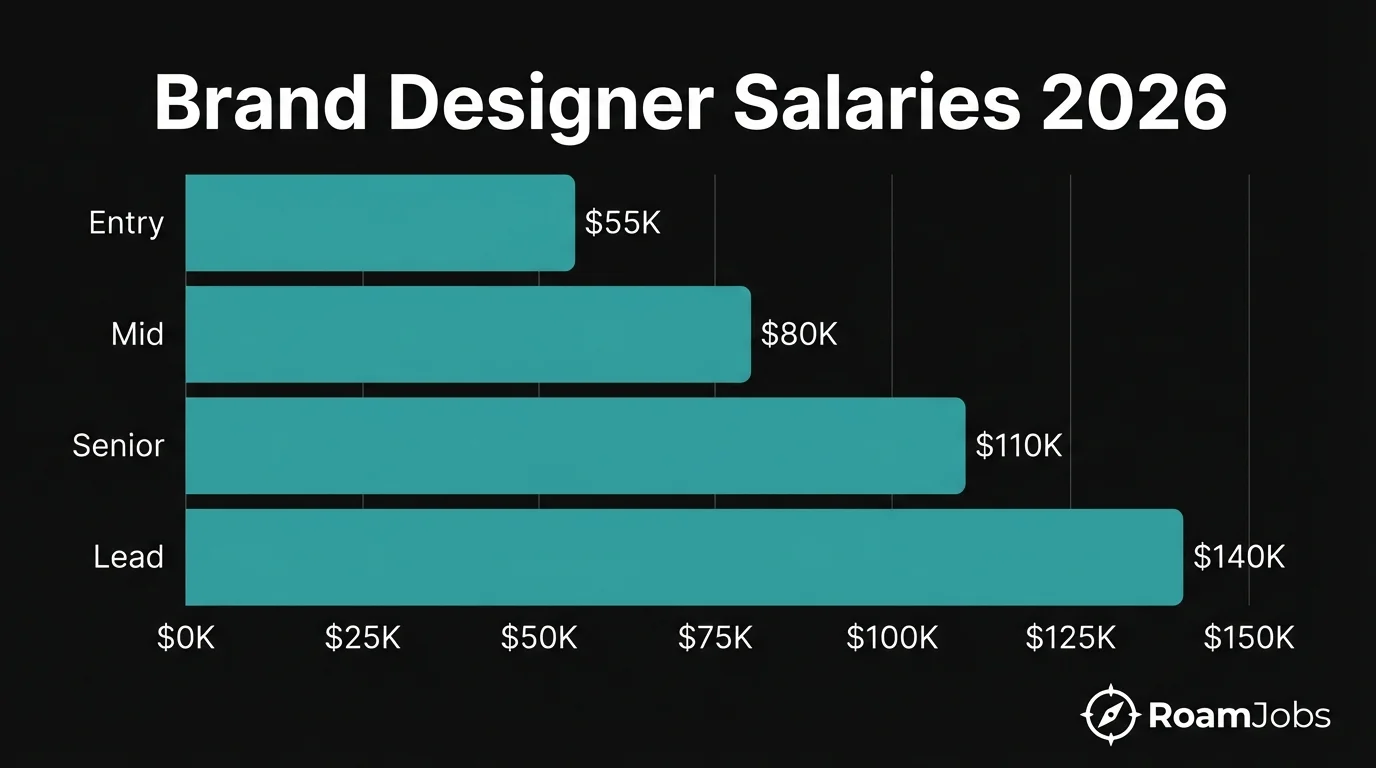
Brand design compensation varies significantly based on experience level, company type, and whether you’re working in-house or at an agency. These figures represent remote positions with US-based companies.
Brand Designer Salary by Experience & Location
| Level | 🇺🇸 US Remote | 🇪🇺 EU Remote | 🌎 LATAM | 🌏 Asia |
|---|---|---|---|---|
| Entry Level (0-2 yrs) | $52,000 - $72,000 | $35,000 - $52,000 | $18,000 - $35,000 | $15,000 - $30,000 |
| Mid-Level (2-5 yrs) | $75,000 - $105,000 | $52,000 - $78,000 | $32,000 - $55,000 | $28,000 - $48,000 |
| Senior (5-8 yrs) | $105,000 - $150,000 | $72,000 - $110,000 | $48,000 - $82,000 | $42,000 - $72,000 |
| Lead/Director (8+ yrs) | $140,000 - $200,000 | $98,000 - $155,000 | $70,000 - $120,000 | $60,000 - $105,000 |
* Salaries represent base compensation for remote positions. Actual compensation may vary based on company, experience, and specific location within region.
Entry Level / Junior Brand Designer
0-2 years experience
What Entry-Level Brand Designers Do
Junior brand designers typically work under the direction of senior designers or creative directors. Your responsibilities focus on execution rather than strategy: creating brand assets based on established guidelines, adapting existing identity elements for new applications, maintaining asset libraries, and supporting senior designers on larger identity projects.
At this level, you’re building foundational skills in logo construction, typography systems, and understanding how brand elements work together as a system. You’ll likely work on smaller brand projects or support roles on larger identity initiatives.
Skills Required at Entry Level
- Proficiency in Adobe Illustrator for vector-based logo and identity work
- Understanding of typography fundamentals: hierarchy, pairing, spacing
- Basic color theory and ability to create cohesive palettes
- Familiarity with brand guideline structure and documentation
- Portfolio showing 3-5 identity projects (school, personal, or freelance work)
- Strong attention to detail and ability to maintain consistency
- Written communication skills for explaining design decisions
Portfolio Focus for Entry-Level Candidates
Your portfolio should demonstrate fundamental brand design skills even without professional experience. Include:
- Complete identity projects: Show logos with multiple variations, color palettes, typography systems, and sample applications (business cards, social media templates, website mockups)
- Process documentation: Walk through your thinking from research and sketches to final deliverables
- Speculative brand work: Rebrand projects for existing companies or fictional brand identities show your ability to think strategically
- Typography explorations: Demonstrate understanding of type selection and hierarchy
Quality matters more than quantity at this level. Three well-documented identity projects outweigh ten logo designs without context.
How to Break Into Entry-Level Brand Design
Build speculative portfolio projects: Choose brands that need improvement or create fictional companies with clear positioning. Document your process thoroughly.
Offer discounted services to small businesses: Local restaurants, shops, and startups often need identity work and can provide real-world portfolio pieces.
Seek internships at agencies or in-house teams: Even part-time or short-term internships provide mentorship and professional portfolio pieces.
Contribute to open source or non-profit projects: Design communities like Open Source Design or platforms like Catchafire connect designers with non-profits needing brand help.
Take on freelance projects: Platforms like Fiverr and Upwork can provide initial clients, though rates are typically low. Focus on building portfolio pieces rather than maximizing income initially.
Mid-Level Brand Designer
2-5 years experience
What Mid-Level Brand Designers Do
Mid-level brand designers take on more strategic responsibility and work more independently. You’ll lead smaller brand projects from discovery through delivery, contribute significantly to larger identity initiatives, and begin developing brand strategy skills alongside execution excellence.
Responsibilities expand to include client or stakeholder presentations, developing brand concepts based on business objectives, creating comprehensive brand guidelines, and mentoring junior designers. You’re expected to understand not just how to execute brand work but why certain design decisions serve business and brand goals.
Skills Required at Mid-Level
- Expert proficiency in Adobe Illustrator and Figma
- Strong conceptual thinking for logo and identity development
- Ability to develop and document complete brand systems
- Understanding of brand strategy fundamentals: positioning, personality, differentiation
- Motion graphics basics for animated logos and brand moments
- Illustration skills (increasingly expected at mid-level and above)
- Experience presenting design work and receiving/incorporating feedback
- Async communication excellence for remote collaboration
Portfolio Focus for Mid-Level Candidates
Mid-level portfolios should demonstrate strategic thinking alongside visual execution:
- Complete identity projects with clear rationale: Show how brand decisions connect to business objectives and target audience insights
- Brand guideline excerpts: Demonstrate your ability to create comprehensive, usable documentation
- Before/after case studies: Show measurable impact when possible (increased recognition, improved consistency, positive reception)
- Variety of brand types: Consumer vs B2B, playful vs serious, startup vs established companies
- System thinking: Show how your work scales across applications and maintains consistency
Advancing to Mid-Level
Develop strategic skills: Read brand strategy books, study case studies of successful rebrands, understand how brand positioning works Build presentation skills: Practice presenting your work, get comfortable with stakeholder feedback, develop your design rationale vocabulary Expand technical skills: Learn motion graphics basics (After Effects), develop illustration capabilities, master Figma for collaborative brand work Seek increasing responsibility: Volunteer to lead smaller projects, mentor juniors, own specific brand workstreams
Senior Brand Designer
5-8 years experience
What Senior Brand Designers Do
Senior brand designers lead major identity initiatives and significantly shape brand strategy. You’re expected to take a project from initial brief through complete identity system delivery, managing complexity and making strategic decisions independently.
At this level, you partner with marketing leadership and executives to understand business objectives and translate them into brand direction. You develop creative concepts, build comprehensive brand systems, ensure consistency across touchpoints, and guide other designers in brand application.
Senior brand designers often specialize: some focus on identity systems and logo design, others on illustration and visual language, others on motion and animated identity. Your specialization becomes part of your value proposition.
Skills Required at Senior Level
- Mastery of brand strategy: positioning, architecture, personality frameworks
- Expert-level visual design across logo, typography, color, and illustration
- Motion design proficiency for contemporary brand expressions
- Leadership skills for guiding projects and mentoring team members
- Executive communication for presenting to leadership and stakeholders
- Understanding of brand implementation across digital and physical touchpoints
- Experience with brand research methodologies: competitive audits, stakeholder interviews, brand perception studies
- Deep knowledge of production requirements for various media
Portfolio Focus for Senior Candidates
Senior portfolios should demonstrate leadership, strategic thinking, and executional excellence:
- Major identity projects with business context: Show how your brand work contributed to company objectives
- Process depth: Include discovery phases, strategic frameworks, concept development, stakeholder collaboration
- Implementation scope: Demonstrate how your brand systems scaled across applications
- Team leadership examples: Show projects where you directed others or shaped creative direction
- Specialized expertise: Highlight your particular strengths (motion, illustration, typography)
What Makes Senior Brand Designers Valuable
Companies pay senior rates for designers who can:
- Think strategically: Connect brand decisions to business outcomes
- Lead independently: Take a project from brief to delivery without constant direction
- Communicate effectively: Present to executives, write compelling rationale, facilitate workshops
- Solve complex problems: Navigate competing stakeholder needs, balance consistency with flexibility
- Mentor others: Elevate team capabilities through guidance and feedback
Lead / Director Brand Designer
8-12 years experience
What Lead/Director Brand Designers Do
At the director level, brand designers shift focus from individual execution to leadership and strategy. You’re responsible for brand vision across the organization, managing brand teams or freelance resources, and ensuring brand consistency at scale.
Directors establish brand governance frameworks, define processes for brand development and application, partner with executive leadership on brand strategy, and often manage significant budgets for brand initiatives. You might oversee agencies, manage internal teams, or function as the primary brand authority in the organization.
Some directors maintain hands-on involvement in major identity work, while others focus primarily on leadership and strategy. The balance depends on company size and team structure.
Skills Required at Director Level
- Strategic brand leadership: vision setting, roadmap development, cross-functional alignment
- Team management: hiring, developing, and retaining brand design talent
- Executive presence: presenting to C-suite, board presentations, external communications
- Budget and resource management
- Agency relationship management
- Deep expertise in brand architecture for multi-product companies
- Understanding of brand measurement and ROI frameworks
- Change management skills for brand evolution initiatives
Portfolio Focus for Director Candidates
Director portfolios demonstrate leadership impact and strategic outcomes:
- Organizational brand impact: Show how your leadership shaped brand across the company
- Team development: Highlight designers you’ve mentored and team capabilities you’ve built
- Strategic initiatives: Major rebrands, brand architecture projects, significant identity evolutions
- Cross-functional collaboration: Examples of partnering with marketing, product, and executive leadership
- Measurable outcomes: Brand recognition improvements, consistency metrics, business impact
Path to Director Level
Reaching director level requires deliberate career development:
Build leadership experience: Seek opportunities to lead teams, mentor designers, and manage projects with multiple contributors Develop business acumen: Understand how brand connects to business strategy, revenue, and competitive positioning Expand your network: Build relationships with other brand leaders, join professional communities, speak at events Gain diverse experience: Work across different company sizes, industries, and brand challenges Demonstrate strategic impact: Document how your brand work contributed to business outcomes
Essential Skills and Tools
Brand design requires a specific combination of creative, technical, and communication skills. Remote work adds additional requirements for async collaboration and self-direction.
Core Design Tools
Brand Design Tools Comparison
Source: RoamJobs 2026 Tool Survey| Tool | Primary Use | Remote Importance | Learning Priority |
|---|---|---|---|
| Adobe Illustrator | Logo design, vector graphics, print production | Essential | High - Master first |
| Figma | Brand systems, collaboration, presentations | Essential | High - Master second |
| Adobe After Effects | Motion logos, animated brand elements | High | Medium - Learn fundamentals |
| Adobe InDesign | Brand guidelines, long-form documents | Medium | Medium - Learn basics |
| Adobe Photoshop | Photo editing, mockups, textures | Medium | Medium - Proficiency needed |
| Procreate/Illustrator | Custom illustration work | Medium | Depends on role focus |
Data compiled from RoamJobs 2026 Tool Survey. Last verified January 2026.
Adobe Illustrator remains the industry standard for logo design and vector-based brand work. Mastery is non-negotiable for brand designers. You should be comfortable with pen tool precision, creating complex symbols, preparing files for various outputs, and maintaining organized, editable files.
Figma has become essential for brand work, even though it originated as a UI design tool. Brand designers use Figma for creating brand guidelines (increasingly replacing InDesign), building component libraries, collaborating with stakeholders, and creating presentations. Its real-time collaboration features are particularly valuable for remote teams.
Adobe After Effects is increasingly expected as brands incorporate motion into their identities. At minimum, understand how to animate logos, create simple brand moments, and work with motion designers on animated guidelines.
Adobe InDesign remains useful for long-form brand guidelines and print materials, though Figma is taking over much of this territory. Basic proficiency is still valuable.
Logo Design and Identity Skills
Vector construction fundamentals: Understanding how to build logos that scale perfectly, using appropriate anchor points, creating mathematically precise relationships between elements.
Logo system thinking: Creating primary marks, secondary marks, wordmarks, monograms, and various lockups that work together as a system. Understanding when to use each variant.
Negative space and optical adjustments: Knowing when mathematical precision needs human correction for visual balance. Understanding how logos read at different sizes.
Trademark considerations: Understanding what makes logos protectable, avoiding common symbols that can’t be trademarked, working with legal teams on trademark searches.
Typography Mastery
Typography is arguably the most important brand design skill. It’s also one of the hardest to master.
Type selection: Understanding how different typefaces communicate different personalities. Building a vocabulary for discussing type characteristics.
Type pairing: Creating harmonious combinations of typefaces that provide necessary contrast while feeling cohesive.
Hierarchy systems: Establishing clear visual hierarchies that guide readers and express brand personality.
Typography for various media: Understanding how type behaves differently on screen vs print, at large vs small sizes, and across different platforms.
Licensing knowledge: Understanding font licensing for web, app, desktop, and commercial use. Knowing when to recommend custom typography vs licensing existing fonts.
Brand Guideline Creation
Brand guidelines are how your work lives beyond you. Strong guideline documentation skills separate professional brand designers from those who can only execute.
Clear organization: Structuring guidelines so users can find information quickly. Creating logical hierarchies of information.
Appropriate detail: Providing enough specification for consistency without overwhelming users. Knowing what to prescribe vs what to leave flexible.
Practical examples: Showing how guidelines apply in real situations, including do’s and don’ts that clarify boundaries.
Accessible language: Writing guidelines that non-designers can understand and apply correctly.
Motion Graphics Fundamentals
Modern brand identities include motion. Even if you’re not a motion specialist, understanding fundamentals is increasingly expected.
Logo animation: Bringing static logos to life with purposeful motion that expresses brand personality.
Micro-interactions: Understanding how brand elements move within digital products.
Video templates: Creating motion templates for social media, presentations, and marketing content.
Working with motion designers: Communicating effectively about timing, easing, and movement principles when collaborating with specialists.
Illustration Skills
Illustration is increasingly expected in brand designer roles, though the depth of skill varies by position.
Custom icon systems: Creating cohesive icon sets that express brand personality while maintaining clarity and consistency.
Spot illustrations: Creating decorative or explanatory illustrations for marketing and product use.
Illustration style definition: Developing and documenting illustration styles that others can follow.
Character design: Some roles require mascot or character work as part of brand identity.
Companies Hiring Remote Brand Designers
Remote brand design opportunities exist across company types: in-house at tech companies, at design agencies, and as specialized contractors. Each offers different benefits and challenges.
Tech Companies with Strong Brand Teams
Airbnb - Known for exceptional brand design, Airbnb’s team works on identity evolution, illustration systems, and marketing design. Remote positions available for experienced designers. Very selective hiring focused on craft excellence.
Figma - The design tool company has a strong brand team working on the Figma identity and marketing. Remote-friendly with high design standards. Competitive hiring process.
Notion - Productivity platform with distinctive brand expression. Small brand team with high impact. Known for illustration and playful brand personality.
Stripe - Payments company with award-winning brand and marketing design. Strong focus on craft and innovation. Remote positions for senior designers.
Shopify - E-commerce platform with “Digital by Default” policy. Brand design opportunities across the Shopify ecosystem. Large team with various specialization opportunities.
Canva - Visual design platform that practices what it preaches with strong brand design. Growing team with remote opportunities across experience levels.
Linear - Developer tools company known for exceptional design quality. Small team where brand designers have significant impact.
Webflow - Web design platform with strong brand team. Remote-first company with design-led culture.
Design Agencies with Remote Teams
Pentagram - Legendary design consultancy that has expanded remote work options. Opportunities for senior designers to work on major brand identity projects.
Collins - Brand consultancy known for bold, innovative work. Selective hiring but increasingly remote-flexible.
Instrument - Digital agency with strong brand capabilities. Portland-based but remote-friendly for the right candidates.
Ueno - Design agency (now part of Twitter) known for brand and digital work. Remote-first before acquisition.
MetaLab - Product studio with brand design capabilities. Remote-first Canadian company working with major tech clients.
Focus Lab - Brand identity agency specializing in startups and tech companies. Remote team distributed across US.
Ramotion - Design agency focusing on brand and product design for tech companies. Remote team with global clients.
Startups and Scale-ups
Many funded startups hire remote brand designers, especially those building design-led products:
- Series A-B startups often hire their first dedicated brand designer to establish identity as they scale
- Design tool companies (Framer, Loom, Pitch) tend to have strong brand teams
- Consumer brands going digital need brand designers who understand both traditional and digital contexts
- B2B SaaS companies increasingly invest in brand differentiation as markets mature
Finding Unlisted Opportunities
Many brand design positions are filled before being publicly posted. Strategies for uncovering hidden opportunities:
Follow design leaders on social media: Creative directors and design leaders often announce openings before formal job posts. Follow brand designers you admire on Twitter/X and LinkedIn.
Monitor Dribbble and Behance: Companies often post on design platforms before general job boards. Teams section on Dribbble shows which companies are actively posting.
Join design communities: Slack communities like Designer Hangout, Figma Community groups, and AIGA chapters share job opportunities among members.
Reach out directly: If you admire a company’s brand work, reaching out to their design team can surface opportunities or get you on their radar for future openings.
Work with recruiters: Creative recruiters at firms like Vitamin T, Creative Circle, and The Creative Group often have exclusive listings.
Remote Brand Design Interview Deep Dive
Brand design interviews assess your visual skills, strategic thinking, and ability to collaborate remotely. Preparation should address all three dimensions.
Portfolio Presentation
The portfolio presentation is the centerpiece of brand design interviews. You’ll typically present 2-3 projects in depth, walking through your process from brief to final deliverables.
Strong answer structure:
-
Context (1-2 minutes): Describe the company, their challenge, and what success would look like. Show you understood the business problem, not just the design task.
-
Discovery (2-3 minutes): Explain your research process. What did you learn about the audience, competitors, and company culture? How did research inform your direction?
-
Strategy (2-3 minutes): Describe your strategic approach. What brand attributes did you target? How did you position the brand relative to competitors? What was your creative concept?
-
Exploration (3-4 minutes): Show your ideation process. Walk through concept directions you explored, why you pursued certain paths, how you narrowed options.
-
Final Identity (3-4 minutes): Present the final logo and identity system. Explain why this solution works, how it expresses the strategy, and what makes it distinctive.
-
System and Application (2-3 minutes): Show how the identity extends across applications. Demonstrate your system thinking.
-
Impact (1-2 minutes): Share outcomes if available. Client reception, implementation results, any metrics on brand recognition or consistency.
Key principles:
- Lead with business context, not visual description
- Show your thinking, not just your output
- Include honest discussion of challenges and how you addressed them
- Demonstrate collaboration with stakeholders
- Be specific about your individual contribution if it was a team project
This question tests whether you explored adequately and can defend your decisions. It’s also checking if you can receive challenging feedback gracefully.
Strong response approach:
Acknowledge the observation without becoming defensive. “I appreciate that feedback, and I’d love to share more about our exploration process.”
Show range in your explorations. Present 3-4 meaningfully different concept directions you considered. Explain the strategic rationale for each, not just visual differences.
Explain your decision criteria. Discuss how you evaluated options against business objectives, audience needs, practical requirements, and competitive differentiation. Show that your final direction wasn’t arbitrary.
Demonstrate openness. “Given what you’re seeing, I’m curious what direction you feel might better serve the brand’s goals?” This shows collaborative maturity.
Avoid:
- Defensive reactions that suggest you can’t take feedback
- Claiming you knew the chosen direction was right from the start
- Lacking meaningful alternative directions to show
- Justifying based only on visual preferences without strategic rationale
This question assesses your understanding of brand guidelines as practical tools, not just showcase documents.
Strong response elements:
Understand the audience: “First, I’d want to understand who’s using the guidelines. Marketing teams have different needs than product teams or agencies. What tools do they use? What’s their design sophistication? What brand decisions do they make daily?”
Organize for findability: “I structure guidelines so users can quickly find what they need. Clear navigation, practical examples grouped by use case, and a search function for digital guidelines.”
Provide appropriate flexibility: “Good guidelines balance prescription with flexibility. Some elements need strict rules (logo clear space, primary colors), while others benefit from ranges and examples (photography style, illustration application).”
Include practical templates: “Guidelines are more useful with templates people can use immediately. Social media templates, presentation templates, and asset libraries reduce the barrier to on-brand work.”
Plan for maintenance: “Brand guidelines need updating as the brand evolves. I design them to be modular and easy to update, and I build in a review process to keep them current.”
Make them accessible: “Guidelines should be easy to access. I advocate for web-based guidelines over PDFs when possible, with downloadable assets and clear version control.”
This question assesses your communication skills and ability to navigate creative disagreements professionally.
Strong response structure:
Set the scene: Describe the project, stakeholder, and nature of the disagreement. Be specific but professional about the conflicting viewpoints.
Explain your rationale: Share why you believed your direction was right. Connect to brand strategy, research insights, or objective criteria rather than personal preference.
Describe your approach: How did you communicate your perspective? Did you present additional research, show competitive examples, create comparison mockups, or propose a testing approach?
Share the outcome: What happened? Whether you convinced them, compromised, or ultimately deferred to their direction, explain why and what you learned.
Reflect: What would you do differently? What does this experience tell you about handling similar situations in the future?
Key principles:
- Show respect for stakeholder perspectives even when disagreeing
- Demonstrate you can advocate for design decisions with reasoning, not ego
- Reveal willingness to accept decisions that don’t go your way
- Indicate you understand when to push back vs when to defer
Comprehensive response:
Clear, accessible guidelines: “Consistency starts with guidelines that are easy to find, understand, and apply. I advocate for living documentation that’s always current and accessible to everyone who needs it.”
Template and asset systems: “I create templates for common use cases so people start with on-brand foundations. Asset libraries with clearly organized logos, icons, and elements make correct usage the path of least resistance.”
Training and onboarding: “When new team members join or new tools launch, I run brand orientation sessions. Understanding the ‘why’ behind brand rules helps people make good decisions in situations guidelines don’t cover.”
Review processes: “For high-visibility materials, I establish review processes that catch issues before publication. This isn’t about control—it’s about supporting teams to do their best work.”
Regular audits: “I periodically review brand usage across channels to identify common issues. This informs guideline updates and targeted training.”
Feedback channels: “I create ways for people to ask brand questions and report issues. This surfaces problems early and shows me where guidelines need clarification.”
Champion network: “In larger organizations, I cultivate brand champions in each department who understand brand deeply and can answer questions locally.”
Strong response elements:
Structured presentations: “I present concepts with clear narrative structure—context, strategy, creative rationale, then visuals. This ensures reviewers understand the thinking before reacting to aesthetics.”
Async-first feedback collection: “I share presentation materials in advance with specific questions to guide feedback. This gives reviewers time to think deeply rather than reacting in the moment.”
Written feedback guidelines: “I ask for written feedback first, which tends to be more considered than verbal reactions. I provide frameworks like ‘What’s working? What concerns you? What questions do you have?’”
Structured sync discussions: “For complex or contentious feedback, I schedule video discussions. I come prepared with questions based on async feedback to make sync time productive.”
Feedback synthesis: “I consolidate feedback from multiple stakeholders, identify themes, note contradictions, and clarify next steps before revising.”
Iteration documentation: “I document how feedback influenced revisions so stakeholders see their input was heard. This builds trust for future feedback cycles.”
Thoughtful response approach:
Listen and understand: “First, I try to understand what’s driving the requests. Sometimes feedback that seems off-base reflects legitimate concerns that I can address differently.”
Educate on rationale: “I explain the reasoning behind my recommendations, connecting to the agreed strategy and objectives. Sometimes stakeholders don’t realize the implications of changes they’re requesting.”
Show, don’t just tell: “When possible, I create mockups showing both directions so stakeholders can see the difference. Visual comparison often clarifies what verbal description can’t.”
Propose alternatives: “If their core concern is valid but their solution problematic, I propose alternatives that address their need without compromising brand effectiveness.”
Document trade-offs: “I clearly document the trade-offs of different approaches so the decision is informed. ‘If we go this direction, the benefits are X but we lose Y.’”
Know when to defer: “Ultimately, it’s their brand. If I’ve clearly communicated my perspective and they still want to proceed differently, I execute their direction professionally while noting my recommendation for the record.”
Reflect on collaboration: “I also ask myself whether I’m being appropriately collaborative. Good brand design serves business needs—I need to be sure I’m not prioritizing design purity over practical value.”
Balanced response:
Continuous learning habits: “I follow design publications, study award-winning identity work, and analyze what makes certain brands resonate. I look at both contemporary work and enduring design.”
Trend vs timeless distinction: “I distinguish between surface trends (specific visual styles that date quickly) and deeper shifts (how brands communicate, platform requirements, cultural evolution). I’m cautious about the former and attentive to the latter.”
Research before recommending: “Before incorporating trending elements, I research their origins and longevity. Is this a momentary style or a meaningful evolution? Will it still make sense in 5 years?”
Context-dependent application: “Some brands should feel current and of-the-moment; others need to project timelessness. I match my approach to brand positioning and audience expectations.”
Principles over trends: “I prioritize fundamental design principles—clarity, hierarchy, consistency, appropriateness—over stylistic trends. Good fundamentals make design work regardless of current fashions.”
Client education: “When clients request trendy elements, I discuss longevity considerations. I help them understand the difference between ‘contemporary’ and ‘will look dated in two years.’”
Technical response:
Design for extreme constraints first: “I start by sketching at small scales where constraints are tightest. A logo that works at 16px will scale up beautifully, but a complex design won’t simplify gracefully.”
Simplicity as foundation: “I prioritize simple, distinctive forms that maintain recognition at any scale. This usually means bold shapes, limited detail, and strong silhouettes.”
Create a logo system: “I design a system of logo variations: full lockup for large applications, simplified mark for medium, and ultra-simplified icon for smallest uses. These maintain brand recognition while adapting to context.”
Test throughout process: “I continuously test designs at actual sizes during development, not just at presentation scale. Pixel-perfect rendering at small sizes, visual impact at large sizes.”
Consider different contexts: “Favicon has different requirements than app icon. I consider not just size but background colors, surrounding content, and viewing distance for each application.”
Optical adjustments: “Mathematical precision doesn’t equal visual perfection. I make optical adjustments so logos look balanced and intentional at each size.”
Strategic response:
Deep discovery first: “Major rebrands require extensive research: brand perception studies, stakeholder interviews, customer research, competitive analysis. I need to understand what equity exists and why before deciding what to preserve.”
Identify what to preserve: “I analyze which brand elements carry meaningful equity—recognition, emotional connection, differentiated positioning—versus elements that are merely familiar. Not everything familiar is valuable.”
Evolution vs revolution framework: “I present options on a spectrum from evolution (refining existing elements) to revolution (starting fresh). Business objectives, competitive landscape, and equity analysis inform where on this spectrum to land.”
Internal alignment: “Major rebrands require organizational buy-in. I build consensus through workshops, presentations, and involving stakeholders in the process appropriately.”
Transition planning: “I plan the transition from old to new identity. This includes timeline, rollout sequence, interim guidelines, and communication strategy for internal and external audiences.”
Risk mitigation: “I identify risks (customer confusion, lost recognition) and build in mitigation strategies. Testing concepts with target audiences, phased rollouts, and clear communication reduce transition friction.”
Measure and adjust: “Post-launch, I establish metrics to track rebrand success and create feedback mechanisms to identify needed adjustments.”
Comprehensive discovery questions:
Business context:
- “What business challenge is this brand work trying to solve?”
- “Who are your primary competitors, and how do you want to be positioned relative to them?”
- “What does success look like? How will we know if the brand work achieved its goals?”
- “What’s your timeline and what’s driving it?”
Audience understanding:
- “Who is your target audience? Can you describe your ideal customer in detail?”
- “What do you want audiences to think, feel, and do when they encounter your brand?”
- “What existing relationships do you have with customers, and how might they react to change?”
Brand aspirations:
- “If you could describe your brand personality in three words, what would they be?”
- “Which brands (in or outside your industry) do you admire, and why?”
- “What should your brand never be mistaken for?”
Practical requirements:
- “Where will this brand live? What are the primary touchpoints?”
- “Are there technical constraints I should know about? (Specific colors that can’t change, legacy systems, etc.)”
- “Who needs to approve this work, and what does their involvement look like?”
Current state:
- “What’s working with your current brand, if anything?”
- “What specifically isn’t working or needs to change?”
- “What have you tried before, and what were the results?”
Communication-focused response:
Lead with strategy, not visuals: “I start with the strategic foundation: business objectives, audience insights, brand positioning. This frames visual solutions as strategic decisions, not aesthetic preferences.”
Provide context before showing work: “Before revealing designs, I recap the brief, remind stakeholders of agreed criteria, and explain how I’ll present. This creates productive viewing conditions.”
Explain design decisions in business terms: “Instead of ‘I chose this typeface because it has beautiful letterforms,’ I say ‘This typeface projects the professionalism and approachability that research showed resonates with your audience.’”
Show, don’t just tell: “I demonstrate concepts in realistic contexts—mockups, applications, comparisons—so stakeholders see how the brand will actually work, not just abstract logo presentations.”
Provide vocabulary: “I give stakeholders language to articulate their reactions beyond ‘I like it’ or ‘I don’t like it.’ ‘Does this feel too corporate or appropriately professional? Too playful or energetically approachable?’”
Guide productive feedback: “I ask specific questions: ‘Does this concept capture the innovative positioning we discussed?’ rather than open-ended ‘What do you think?’”
Anticipate concerns: “I proactively address likely concerns. If a direction is bold, I acknowledge that and explain why it serves business goals. This shows I’ve considered their perspective.”
Honest assessment approach:
Describe your skill level accurately: Whether you’re proficient, learning, or primarily collaborate with specialists, be honest about where you are. Overstating leads to problems later.
If proficient: “I create animated logos and brand motion systems in After Effects. Recent examples include [specific projects]. I understand timing, easing, and how motion expresses brand personality. I can create motion guidelines and templates for ongoing use.”
If developing: “I have foundational After Effects skills and can create basic logo animations. For complex motion work, I’ve collaborated with motion specialists. I understand motion principles well enough to art direct and provide constructive feedback, even if I’m not executing advanced animation myself.”
If limited: “My motion skills are developing. I can work with motion designers effectively—I understand principles, can provide clear briefs, and give productive feedback. I’m actively building After Effects skills because I recognize motion is increasingly essential to brand work.”
Show awareness regardless of level: “I recognize motion is now standard for brand identities. Even static logos need motion considerations—how they’ll animate in video, social media, presentations. I factor motion potential into my design process even for primarily static deliverables.”
Practical response:
Understand project phases: “Brand projects have different intensity at different phases. Discovery and final delivery are typically most demanding, while stakeholder review periods create natural breaks. I map project timelines to identify overlapping high-intensity periods.”
Clear communication: “I’m transparent with stakeholders about my workload. If I’m managing competing deadlines, I communicate proactively rather than letting things slip.”
Time blocking: “I protect focused time for creative work, especially conceptual development. I batch similar tasks (feedback review, administrative work) to minimize context-switching.”
Buffer building: “I build buffers into timelines for unexpected complications. Brand work often involves stakeholder feedback delays or scope discoveries that affect timeline.”
Daily and weekly planning: “I start each day knowing my top priorities. Weekly reviews help me see the bigger picture and adjust focus as needed.”
Knowing my limits: “I’ve learned how much concurrent project work I can handle well. I advocate for realistic workloads rather than over-committing and delivering mediocre work.”
Structured onboarding plan:
First 30 days—Learn and listen:
- “Deep dive into existing brand materials, guidelines, and assets”
- “Meet stakeholders across departments to understand how they use and perceive the brand”
- “Review recent brand work to understand current state and quality”
- “Identify immediate pain points and quick wins”
- “Understand the brand’s history and how it got to its current state”
Days 31-60—Assess and plan:
- “Conduct a brand audit: consistency across touchpoints, guideline completeness, asset availability”
- “Identify gaps between brand aspirations and current execution”
- “Develop prioritized recommendations based on business impact and effort required”
- “Begin addressing quick wins to build trust and demonstrate value”
- “Draft a longer-term roadmap for brand evolution”
Days 61-90—Execute and establish:
- “Implement high-priority improvements identified in assessment”
- “Establish processes for ongoing brand work: request handling, review workflows, asset management”
- “Create or improve key brand resources: guidelines, templates, asset libraries”
- “Build relationships that enable effective brand stewardship”
- “Present 6-12 month brand recommendations to leadership”
Throughout:
- “Regular check-ins with manager to ensure I’m focusing on the right priorities”
- “Ask lots of questions—I’d rather clarify than assume”
- “Document what I’m learning to help future team members onboard”
Mature response:
Assess the situation honestly: “First, I clarify what ‘not happy’ means. Is this perfectionism, or is there a genuine problem that will affect the brand or business? If it’s perfectionism, I recognize that done and good is better than perfect and late.”
Communicate early: “If there’s a real issue, I communicate immediately, not at the deadline. I explain the concern, what it would take to address it, and give stakeholders information to make decisions.”
Propose options: “I present options with trade-offs: ‘We can deliver as planned with these limitations, or we can delay X days to address Y. Here’s my recommendation and why.’”
Take responsibility: “I own my part in the timeline issue rather than making excuses. What could I have done differently to avoid this situation?”
Deliver what’s needed: “If the deadline is firm, I deliver the best possible work by that deadline. I document concerns and propose a follow-up plan to address them.”
Learn and prevent: “After the deadline, I reflect on how to prevent similar situations. Better scope definition? Earlier stakeholder alignment? More realistic timeline estimation?”
Maintain perspective: “Not every piece of work will be my best. What matters is consistent quality over time, not perfection on every deliverable.”
Comprehensive accessibility approach:
Color contrast fundamentals: “Brand colors need to meet accessibility standards when used for text and UI elements. I test primary palette combinations against WCAG guidelines and provide guidance on which combinations are accessible.”
Don’t rely on color alone: “I design systems that don’t depend solely on color to convey meaning. Icons, patterns, labels, and other elements ensure information is accessible to colorblind users.”
Typography accessibility: “I consider legibility in type selection—x-height, character differentiation, weight availability. I establish minimum sizes for different contexts and ensure sufficient line height and spacing.”
Guideline documentation: “Brand guidelines include accessibility requirements: minimum contrast ratios, accessible color pairings, typography minimums. This makes accessibility part of standard brand implementation.”
Testing and validation: “I use tools to test color combinations and conduct user testing when possible. I stay current on accessibility standards and evolving best practices.”
Balance brand and accessibility: “Sometimes brand preferences conflict with accessibility requirements. I advocate for accessibility while finding creative solutions that maintain brand personality within constraints.”
Strategic brand architecture response:
Understand the frameworks: “Brand architecture determines how company and product brands relate. Common models include branded house (strong master brand), house of brands (independent brands), and hybrid approaches. I’m familiar with when each serves business goals.”
Discovery and analysis: “Brand architecture decisions require understanding business strategy, market positioning, acquisition plans, and audience needs. I conduct research to inform recommendations rather than applying models prescriptively.”
Visual system design: “I design visual systems that express chosen architecture—from unified design languages for branded house approaches to distinctive identities with subtle connections for endorsed brands.”
Flexibility and evolution: “Good architecture accommodates growth. I design systems that can integrate acquisitions, launch new products, and evolve without requiring complete overhaul.”
Stakeholder alignment: “Architecture decisions have significant business implications. I facilitate stakeholder discussions, present trade-offs clearly, and build consensus around strategic direction.”
Examples: [Describe relevant experience with multi-brand systems if you have it, or explain how you’d approach it if you haven’t worked at that scale]
Professional response:
Start with curiosity: “I try to understand what’s driving the feedback. Often executive feedback reflects business concerns that I can address differently than their specific suggestion.”
Seek to understand their perspective: “I ask clarifying questions: ‘Help me understand what’s concerning you about this direction?’ ‘What would success look like from your perspective?’ This often reveals the underlying need.”
Acknowledge their expertise: “Executives understand their business deeply. Their instincts about audience, market, and brand positioning often have merit even if expressed in design terms that don’t quite fit.”
Educate without condescending: “If I disagree, I explain my reasoning in business terms, connecting design decisions to outcomes they care about. I avoid jargon and ‘trust me, I’m the designer’ arguments.”
Propose alternatives: “Instead of just defending my approach, I show alternatives that address their concern while maintaining design integrity. ‘Here’s what I hear you wanting. Here are two ways to achieve that.’”
Know when to defer: “Sometimes I disagree but don’t have strong evidence to support my position. In those cases, I execute their direction professionally. Being right isn’t always worth the relationship cost.”
Document and learn: “I note outcomes of these situations. Sometimes executives are right and I learn something. Sometimes my concerns prove valid and inform future conversations.”
Structured response framework:
Choose a genuine challenge: Select a project with real complexity—competing stakeholder views, difficult constraints, significant scope, or meaningful business stakes. Avoid trivial examples.
Describe the challenge specifically: “The challenge was [specific obstacle]. We were working with [context that made it difficult].”
Explain your approach: “I addressed this by [specific actions]. When [specific complication] arose, I [how you adapted].”
Show what you learned: “This project taught me [specific lessons about brand design, stakeholder management, or process].”
Connect to the role: “This experience prepared me for [relevant aspect of the role you’re interviewing for].”
Be authentic: Show genuine reflection, including mistakes and how you recovered. Interviewers value self-awareness over pretending everything went perfectly.
Frequently Asked Questions
Frequently Asked Questions
How do I transition from graphic design to brand design?
The transition from graphic design to brand design involves shifting from executing individual pieces to creating systems and strategic foundations. Start by reframing your portfolio: group related work into case studies that show systematic thinking, add brand rationale to existing projects, and create speculative brand identity projects that demonstrate logo systems, typography selection, and guideline development. Build strategic skills by studying brand positioning frameworks, reading books like 'Designing Brand Identity' by Alina Wheeler, and analyzing how successful brands maintain consistency. Seek projects that involve identity work, even at smaller scale—small business identities, non-profit rebrands, or personal projects. The main gap to address is demonstrating strategic thinking about brand positioning, not just visual execution quality.
Should I specialize in agency or in-house brand design?
Agency and in-house brand design offer different advantages. Agency work provides variety—you'll work across industries, face diverse challenges, and build a broad portfolio quickly. It's excellent for developing versatility and client management skills. However, agency life often means tighter deadlines and less ability to see brand work evolve over time. In-house roles offer depth—you'll deeply understand one brand, see your work implemented across touchpoints, and influence brand evolution long-term. You'll have more time for craft and iteration, but less variety. Early in your career, agency experience builds skills quickly. Later, in-house roles often provide better work-life balance and strategic influence. Many designers move between both throughout their careers.
Do I need strong illustration skills to be a brand designer?
Illustration skills are increasingly valuable but not universally required for brand design roles. Job requirements vary significantly: some positions explicitly require illustration as a core skill, while others focus on logo and identity system design without illustration. At minimum, you should be able to create simple icons and basic spot illustrations. Strong illustration skills expand your opportunities and often command higher compensation. If illustration isn't your strength, be strategic about roles you pursue and consider developing basic illustration capabilities over time. Review job descriptions carefully—positions titled 'Brand Designer' at different companies may have very different illustration expectations.
How is brand design different from product design career paths?
Brand design and product design are distinct career paths that sometimes overlap. Brand designers create visual identity systems—logos, typography, colors, brand guidelines—that define how companies present themselves. Product designers create user interfaces and experiences for digital products. Brand design careers often lead to Creative Director or Chief Creative Officer roles focused on brand expression. Product design careers typically lead to Design Lead, Head of Design, or VP Design roles focused on product experience. Some designers combine both—working on product interface while maintaining brand consistency—but specialization is common at senior levels. Your choice depends on whether you're more drawn to identity and visual systems (brand) or user experience and interface design (product).
What portfolio pieces matter most for brand design jobs?
The most valuable brand design portfolio pieces are complete identity systems that demonstrate both strategic thinking and visual execution. Include: (1) Logo systems showing primary marks, secondary marks, and variations across contexts; (2) Brand guidelines demonstrating how you document and communicate brand standards; (3) Applied brand work showing the identity across real touchpoints—web, print, social, environmental; (4) Process documentation revealing your strategic thinking and how you arrived at solutions. Quality beats quantity—three comprehensive identity projects outweigh ten logo designs without context. Include at least one project with strong business rationale showing you understand how brand serves business objectives.
How do I prove brand design experience without professional brand projects?
Build brand design experience through speculative projects, pro bono work, and freelance engagements. Create comprehensive rebrand case studies for existing companies you believe could improve—document your research, strategic rationale, and complete identity system as if it were a real project. Seek pro bono work for non-profits, local businesses, or community organizations that need identity help. Take on small freelance projects through platforms or personal networks. Contribute to design communities by creating identity work for open source projects or design challenges. Each project should be documented as thoroughly as professional work, demonstrating your process and strategic thinking alongside final deliverables.
What's the difference between remote brand design at an agency versus a tech company?
Remote brand design at agencies involves working on multiple client projects, typically shorter engagements with varied industries. You'll develop broad skills and thick portfolios quickly but may face tighter deadlines and more demanding stakeholder dynamics. Tech company brand roles focus on one brand deeply—you'll own or contribute to company identity, marketing design, and brand consistency across products. Projects are longer-term, allowing more iteration and craft. Tech companies often pay higher salaries, especially for senior roles, while agencies offer variety and portfolio-building opportunities. Consider agencies early in your career for skill development, then potentially transitioning to in-house tech roles for depth and compensation.
How important is motion design for brand designers in 2026?
Motion design has become essential for contemporary brand design. Modern brands exist primarily in motion—social media, video content, digital products, presentations. At minimum, brand designers should understand motion principles, be able to design for motion (creating assets that animate well), and collaborate effectively with motion specialists. Ideally, you should have basic After Effects skills to create logo animations, simple brand moments, and motion templates. Senior brand designers increasingly create or direct motion guidelines that define how brands move. If motion isn't currently a strength, prioritize developing at least foundational skills—it significantly expands your opportunities and compensation potential.
What salary can I expect as a remote brand designer outside the US?
Remote brand design salaries vary significantly by region and whether you're working for US-based companies. For US companies hiring internationally: EU-based designers typically earn 60-75% of US rates, LATAM designers earn 35-55% of US rates, and Asia-based designers earn 30-50% of US rates. However, some US companies pay location-agnostic salaries—the same rate regardless of where you live. Local market rates are typically lower than working for US companies remotely. Your portfolio quality and experience level affect compensation more than location at senior levels. When evaluating offers, consider cost of living in your location—lower salary in a lower-cost area may provide better quality of life than higher salary in an expensive city.
How do I handle brand design critiques in async remote environments?
Async brand design critiques require more structure than in-person reviews. When presenting work: (1) Provide thorough written context—brief, strategy, design rationale—before showing visuals; (2) Ask specific questions to guide feedback; (3) Present options with clear trade-offs rather than single solutions; (4) Use video walkthroughs (Loom, etc.) to add nuance that text can't convey. When receiving feedback: (1) Ask clarifying questions before reacting; (2) Summarize feedback to confirm understanding; (3) Respond to feedback systematically, explaining how you'll address or why you won't; (4) Document feedback and responses for future reference. The key is providing enough context that reviewers can give informed feedback without real-time discussion.
What remote brand design certifications or courses are worth pursuing?
For brand design specifically, practical portfolio work matters more than certifications. However, useful learning resources include: Brand Strategy courses (Koto's Brand Strategy course, Brand Master Academy) for developing strategic thinking; Typography courses (Skillshare, Hoefler's typography resources) for deepening type knowledge; Motion design courses (School of Motion, Motion Design School) for After Effects skills. Adobe certifications have limited value for brand design hiring but can fill knowledge gaps. The most valuable 'credential' is a strong portfolio with documented case studies. Invest time in portfolio projects over certifications—hiring managers care far more about demonstrated skills than course completion badges.
How do I negotiate salary for remote brand design positions?
Research market rates using this guide's salary data, Glassdoor, and design community surveys. Understand whether the company uses location-based pay adjustments—this significantly affects negotiation dynamics. Lead with your value: document the impact of your brand work (successful launches, brand recognition improvements, consistency metrics) and articulate what you'll bring to their specific brand challenges. Consider total compensation beyond base salary: equity, bonuses, professional development budgets, equipment allowances. If the offer is below market, provide data to support your counter—'Based on my research and experience level, I was expecting $X-Y range.' Be prepared to walk away if the offer doesn't meet your needs, but also recognize that perfect compensation with a great team may be worth more than maximum salary at a difficult company.
Building Your Remote Brand Design Career
Remote brand design offers exceptional opportunities for creative professionals who can combine visual excellence with strategic thinking and strong async communication. The field rewards those who can create cohesive visual systems that work across contexts while articulating their decisions clearly in writing.
Next Steps to Land Your Remote Brand Design Role
Remote Brand Design Job Search Action Plan
- 1 Audit your portfolio for brand system projects
Ensure you have 3-5 complete identity projects showing logos, typography, color, and applications
- 2 Add strategic rationale to every case study
Explain the business context, target audience, and how design decisions serve brand goals
- 3 Master Adobe Illustrator if you haven't already
Logo and identity work requires expert-level vector skills
- 4 Build Figma proficiency for collaborative brand work
Modern brand guidelines and collaboration increasingly happen in Figma
- 5 Develop basic After Effects skills for logo animation
Motion is expected in contemporary brand design—even foundational skills help
- 6 Create a target list of 20-30 companies with strong brand cultures
Research their brand work, team structure, and remote policies
- 7 Practice presenting brand concepts on video
Remote interviews require strong screen presence and clear verbal communication
- 8 Prepare answers for common brand design interview questions
Use this guide's interview section to prepare thoughtful responses
- 9 Update LinkedIn with brand design keywords and remote availability
Recruiters search for specific skills—make sure you're findable
- 10 Apply to 5-10 well-matched positions weekly with customized applications
Quality applications to aligned roles outperform spray-and-pray approaches
Related Career Guides
Explore adjacent design paths:
- Remote Design Jobs Hub - Overview of all remote design career paths including UX, UI, and product design
- Remote UI Designer Jobs - For designers interested in digital product interface work
- Remote Jobs for Marketers - Brand design often intersects with marketing—explore related opportunities
Prepare for your job search:
- Remote Portfolio Guide - Build a portfolio that showcases your brand design work effectively
- Remote Interview Guide - Master video interviews and async communication assessments
- Negotiating Remote Salary - Maximize compensation for your remote brand design role
Your Path Forward
Brand design is a rewarding specialization that combines visual creativity with strategic impact. The brands you create become the face of companies, shaping how millions of people perceive and interact with businesses. Remote work enables you to do this meaningful work from anywhere while collaborating with talented teams worldwide.
Success in remote brand design comes from: exceptional visual skills in logo and identity design, strong strategic thinking about brand positioning, excellent async communication through documentation and written rationale, and the self-direction to deliver great work without constant oversight.
Start where you are, build your portfolio systematically, and pursue opportunities that match your current level while stretching your capabilities. The remote brand design career you want is achievable with focused effort and continuous skill development.
Get Remote Brand Design Jobs in Your Inbox
Weekly curated remote brand design opportunities plus portfolio tips, interview prep, and salary insights.
Frequently Asked Questions
How do I find remote brand designer jobs?
To find remote brand designer jobs, start with specialized job boards like We Work Remotely, Remote OK, and FlexJobs that focus on remote positions. Set up job alerts with keywords like "remote brand designer" and filter by fully remote positions. Network on LinkedIn by following remote-friendly companies and engaging with hiring managers. Many brand designer roles are posted on company career pages directly, so identify target companies known for remote work and check their openings regularly.
What skills do I need for remote brand designer positions?
Remote brand designer positions typically require the same technical skills as on-site roles, plus strong remote work competencies. Essential remote skills include excellent written communication, self-motivation, time management, and proficiency with collaboration tools like Slack, Zoom, and project management software. Demonstrating previous remote work experience or the ability to work independently is highly valued by employers hiring for remote brand designer roles.
What salary can I expect as a remote brand designer?
Remote brand designer salaries vary based on experience level, company size, location-based pay policies, and the specific tech stack or skills required. US-based remote positions typically pay market rates regardless of where you live, while some companies adjust pay based on your location's cost of living. Entry-level positions start lower, while senior roles can command premium salaries. Check our salary guides for specific ranges by experience level and geography.
Are remote brand designer jobs entry-level friendly?
Some remote brand designer jobs are entry-level friendly, though competition can be high. Focus on building a strong portfolio or demonstrable skills, contributing to open source projects if applicable, and gaining any relevant experience through internships, freelance work, or personal projects. Some companies specifically hire remote junior talent and provide mentorship programs. Smaller startups and agencies may be more open to entry-level remote hires than large corporations.
Continue Reading
Remote Design Jobs 2026: Complete Guide to UX, UI, Product & Brand Careers
The definitive hub for remote design careers. Explore salary data, interview guides, and opportunities across UX, UI, product design, research, and design management.
Remote UI Designer Jobs: Complete 2026 Career Guide
Everything you need to land a remote UI designer job. Visual design, design systems, interfaces - salary data, interview questions, and companies hiring.
Remote Jobs for Designers 2026: UX, UI, Product, and More
Complete guide to finding remote design positions including portfolio tips, interview prep, and salary expectations.
Land Your Remote Job Faster
Get the latest remote job strategies, salary data, and insider tips delivered to your inbox.