Remote Fullstack Developer Jobs: Complete 2026 Career Guide
Everything you need to land a remote fullstack developer job. Salary data by seniority, interview questions, companies hiring, and career paths.
Updated January 20, 2026 • Verified current for 2026
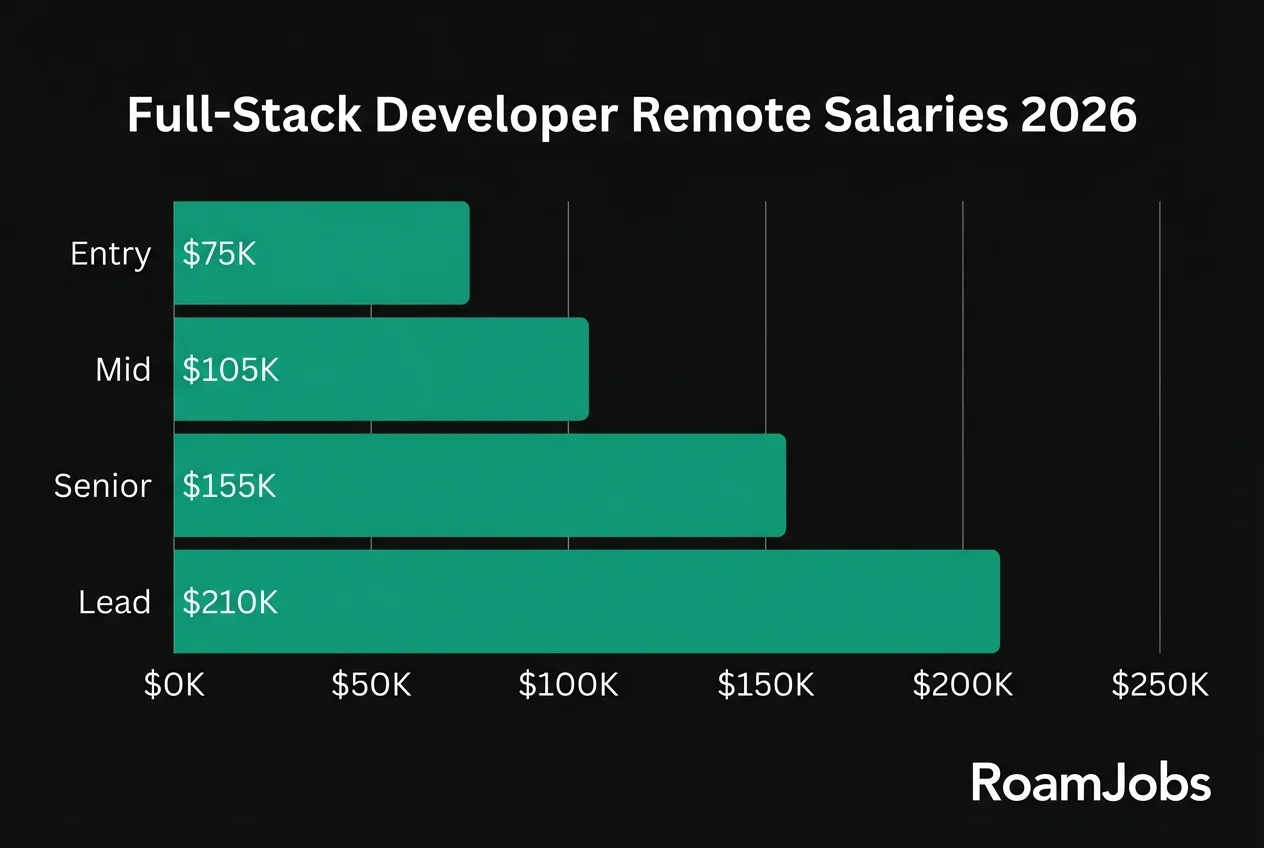
Remote fullstack developers are the versatile engineers who build complete applications from database to user interface. They command salaries ranging from $72,000 to $210,000 for US-based remote positions, with lead and director roles reaching $290,000+. Fullstack developers are uniquely valuable in remote settings because they can independently own entire features without requiring constant handoffs between frontend and backend teams. The role requires proficiency in both client-side technologies (React, Vue, or Angular) and server-side systems (Node.js, Python, Ruby, or Go), plus increasingly important DevOps fundamentals. Companies prize fullstack developers for their ability to work autonomously across the stack, making them ideal for async remote environments where self-sufficiency and broad technical judgment accelerate development cycles. Whether you are transitioning from a specialist role or starting your engineering career, fullstack development offers one of the most accessible paths into remote work with strong compensation growth at every level.
What Remote Fullstack Developers Actually Do
Remote fullstack developers occupy a unique position in software engineering: they are the generalists who can build complete features and applications without depending on specialists at every layer of the stack. Understanding the day-to-day reality of this role helps you evaluate whether it matches your interests and strengths.
Day-to-Day Responsibilities
A typical day for a remote fullstack developer involves context-switching between multiple technical domains. You might start the morning debugging a React component that is not rendering correctly, then pivot to optimizing a database query that is causing slow page loads. After lunch, you could be writing API endpoints to support a new feature, followed by configuring deployment pipelines to push your changes to staging.
Core responsibilities include:
Building user interfaces - Creating responsive, accessible frontend components using modern frameworks. This involves translating design mockups into functional code, implementing state management, and ensuring cross-browser compatibility.
Developing backend services - Writing APIs, implementing business logic, managing database operations, and handling authentication and authorization. You need to understand how data flows through your system and how to structure it efficiently.
Database design and management - Creating schemas, writing migrations, optimizing queries, and understanding when to use SQL versus NoSQL solutions. Fullstack developers must be comfortable with data modeling.
Integration work - Connecting frontend to backend, integrating third-party services and APIs, and ensuring smooth data flow between systems. This often involves debugging across multiple layers simultaneously.
DevOps basics - Setting up CI/CD pipelines, managing deployments, configuring environments, and monitoring application performance. While deep infrastructure expertise is not required, basic operational skills are essential.
Code review and collaboration - Reviewing pull requests from teammates, providing constructive feedback, and participating in architectural discussions. Remote fullstack developers must excel at async written communication.
Fullstack vs Specialist: The Ongoing Debate
The question of whether to specialize or generalize is central to career planning as a software engineer. Fullstack development offers distinct advantages and tradeoffs compared to frontend or backend specialization.
Advantages of fullstack:
Higher autonomy - You can ship complete features without waiting for other team members. This is particularly valuable in remote settings where async handoffs can slow development.
Startup appeal - Early-stage companies prize fullstack developers because small teams need engineers who can handle any technical challenge. This means more opportunities at fast-growing companies.
Broader perspective - Understanding both ends of the stack makes you a better engineer overall. You can make informed architectural decisions because you understand the implications across the entire system.
Career flexibility - You can transition into pure frontend, backend, or even DevOps roles if your interests change. Fullstack experience provides optionality.
Tradeoffs to consider:
Depth vs breadth - Fullstack developers often sacrifice deep expertise in any single area. A specialized frontend developer likely knows React internals better than you do.
Interview complexity - You need to prepare for both frontend and backend technical questions, which doubles the interview preparation workload.
Technology churn - Keeping current with both frontend and backend ecosystems is challenging. The JavaScript frontend landscape alone evolves rapidly.
Role ambiguity - Some companies use “fullstack” as a euphemism for “we expect you to do everything.” Clarify expectations during interviews.
Who Thrives as a Remote Fullstack Developer
The fullstack role attracts certain personality types and is better suited to some environments than others.
Ideal personality traits:
- Curiosity that extends across technical domains rather than obsessive depth in one area
- Comfort with ambiguity and incomplete information
- Strong self-direction and ability to unblock yourself
- Excellent written communication skills
- Enjoyment of variety and context-switching
Best environments for fullstack developers:
Startups and small companies - Teams of 5-20 engineers often expect everyone to work across the stack. You will have the most impact and learning opportunities here.
Product-focused teams - Companies that organize around product features rather than technical layers value fullstack developers who can own entire feature areas.
Remote-first organizations - Companies built for distributed work understand the value of engineers who can operate independently across the stack.
Environments where specialists may be preferred:
Large tech companies - FAANG and similar organizations typically hire frontend, backend, and infrastructure specialists rather than generalists.
Performance-critical systems - If you are building low-latency trading systems or graphics engines, deep specialization usually wins.
Enterprise organizations - Large companies often have rigid team structures that assume specialists.
Salary Breakdown by Seniority Level
Understanding compensation at each career stage helps you benchmark offers and plan your progression. These figures represent US-based remote positions at companies headquartered in the United States, the most competitive segment of the market.
Fullstack Developer Salary by Experience & Location
| Level | 🇺🇸 US Remote | 🇪🇺 EU Remote | 🌎 LATAM | 🌏 Asia |
|---|---|---|---|---|
| Entry Level (0-2 yrs) | $72,000 - $98,000 | $45,000 - $68,000 | $28,000 - $48,000 | $22,000 - $42,000 |
| Mid-Level (2-5 yrs) | $105,000 - $145,000 | $65,000 - $100,000 | $45,000 - $78,000 | $38,000 - $68,000 |
| Senior (5-8 yrs) | $145,000 - $210,000 | $95,000 - $145,000 | $72,000 - $115,000 | $58,000 - $95,000 |
| Lead/Director (8+ yrs) | $190,000 - $290,000 | $130,000 - $200,000 | $95,000 - $160,000 | $85,000 - $145,000 |
* Estimates, not survey data. Figures are RoamJobs estimates built from publicly reported salary ranges and adjusted for regional market rates; they are not from a proprietary RoamJobs survey. Actual base compensation varies by company, experience, and specific location within a region — verify against current offers before negotiating.
Entry Level / Junior Fullstack Developer
0-2 years experience
What Entry-Level Looks Like
Entry-level remote fullstack positions are competitive but achievable with the right preparation. At this stage, employers expect you to have foundational knowledge across the stack without assuming deep production experience.
Technical expectations:
- Proficiency in one frontend framework (React is most common, followed by Vue)
- Basic backend development with Node.js, Python, or Ruby
- Understanding of REST API design and consumption
- Familiarity with SQL databases (PostgreSQL preferred) and basic query writing
- Git version control and basic collaboration workflows
- Fundamental understanding of HTTP, web security basics, and browser DevTools
What you should demonstrate:
- Portfolio projects showing end-to-end application development
- Ability to learn new technologies quickly and independently
- Strong communication skills in writing (critical for remote work)
- Eagerness to receive and apply feedback
- Problem-solving approach when encountering unfamiliar challenges
Realistic expectations:
Entry-level remote fullstack roles are harder to land than entry-level specialist positions. Many companies prefer hiring junior developers in-office where they can receive more direct mentorship. However, remote-first companies with strong documentation cultures (like GitLab) do hire entry-level engineers.
Salary influences:
- Location-agnostic companies pay toward the higher end ($85K-$98K)
- Startups with equity may offer lower base ($72K-$85K) plus meaningful ownership
- Companies with location-based pay adjust downward for non-coastal locations
How to stand out:
- Build 2-3 complete fullstack projects with deployed demos
- Contribute to open source projects using your target tech stack
- Write technical blog posts demonstrating your learning process
- Seek internships or apprenticeships at remote-first companies
- Network in developer communities and attend virtual meetups
Mid-Level Fullstack Developer
2-5 years experience
The Mid-Level Sweet Spot
Mid-level fullstack developers represent the most common hiring target for remote positions. At this stage, companies expect you to independently deliver features with minimal guidance while growing toward senior responsibilities.
Technical expectations:
- Deep proficiency in your primary stack (e.g., React + Node.js + PostgreSQL)
- Experience with state management patterns (Redux, Zustand, or framework-native solutions)
- Understanding of database optimization, indexing, and query performance
- API design experience including versioning, pagination, and error handling
- Authentication and authorization implementation (JWT, OAuth, session management)
- Basic DevOps skills: CI/CD pipelines, container basics, cloud platform familiarity
- Testing across the stack: unit tests, integration tests, end-to-end tests
Behavioral expectations:
- Self-sufficient project execution with appropriate check-ins
- Accurate estimation of work complexity and timeline
- Constructive code review feedback to peers
- Proactive identification and communication of blockers
- Mentorship of junior team members
Depth vs breadth challenge:
The mid-level stage is where you must navigate the specialist vs generalist tension. You need enough depth in both frontend and backend to be productive, but you cannot match specialists in either domain. Focus on:
- Being genuinely strong in one area (your “spike”)
- Being competent enough in the other to ship features independently
- Building judgment about when to consult specialists
Career progression signals:
To advance from mid to senior, focus on:
- Owning larger, more ambiguous projects
- Making architectural decisions and defending them
- Influencing technical direction beyond your immediate work
- Mentoring junior developers effectively
- Building relationships across the organization
Salary negotiation leverage:
At mid-level, you have significant negotiation power because companies desperately need reliable fullstack engineers. Use competing offers, highlight specific project outcomes, and research market rates on levels.fyi and Glassdoor.
Senior Fullstack Developer
5-8 years experience
Senior: Technical Leadership Emerges
Senior fullstack developers combine deep technical skills with emerging leadership capabilities. At this level, you are expected to drive technical decisions, mentor others, and deliver complex projects with minimal oversight.
Technical expectations:
- Mastery of your primary stack with ability to evaluate alternatives
- System design skills: scalability, reliability, performance optimization
- Security best practices: OWASP Top 10, secure coding, threat modeling
- Advanced database knowledge: replication, sharding, caching strategies
- Infrastructure as code and deployment automation
- Performance profiling and optimization across the stack
- Incident response and production debugging
Leadership expectations:
- Technical mentorship of junior and mid-level engineers
- Code review that elevates team quality standards
- Architectural documentation and decision records
- Cross-team collaboration on technical initiatives
- Interview participation and hiring decisions
- On-call responsibilities and production ownership
Common paths at senior level:
- Individual contributor track - Continue deepening technical skills toward Staff Engineer
- Management track - Transition toward Engineering Manager role
- Architecture track - Focus on system design and technical strategy
- Product-focused track - Move closer to product decisions as Technical Product Manager
What differentiates senior compensation:
- Companies with strong remote cultures pay toward $180K-$210K
- Equity becomes a more significant component (0.1%-0.5% at startups)
- Total compensation including bonus and equity can exceed base salary by 30-50%
- Location-agnostic pay policies benefit senior engineers most
Avoiding the “senior plateau”:
Many engineers stagnate at senior level. To continue growing:
- Seek projects that stretch your technical and leadership skills
- Build relationships with staff and principal engineers
- Contribute to technical strategy beyond your team
- Develop expertise in emerging technologies relevant to your company
- Consider specializing in a high-value niche while maintaining fullstack breadth
Lead / Director Fullstack Developer
8+ years experience
Lead and Director: Architecture and Strategy
At the lead and director level, fullstack expertise evolves into architectural leadership and technical strategy. You are responsible for systems that span teams and products, and your decisions affect the organization’s technical trajectory.
Titles at this level:
- Staff Fullstack Engineer
- Principal Engineer
- Tech Lead
- Engineering Director (with direct reports)
- Distinguished Engineer
Technical expectations:
- System architecture across multiple services and teams
- Technology selection and build-vs-buy decisions
- Technical due diligence for acquisitions or major vendor choices
- Performance and scalability at organizational scale
- Security architecture and compliance frameworks
- Technical debt strategy and remediation planning
Strategic expectations:
- Roadmap influence and technical vision
- Cross-functional partnership with Product, Design, and Business
- Engineering team structure and hiring strategy
- Industry awareness and competitive technical positioning
- Open source strategy and developer relations
How fullstack background helps:
Your breadth across the stack becomes a strategic advantage at this level. You can:
- Evaluate tradeoffs that span frontend and backend domains
- Bridge communication between specialized teams
- Make holistic architectural decisions
- Identify integration challenges before they become problems
- Mentor engineers across multiple specializations
Compensation complexity:
At director+ levels, compensation structures vary significantly:
- Base salary: $190K-$290K (US remote)
- Equity: 0.25%-1%+ at growth-stage companies
- Performance bonus: 15-30% of base
- Signing bonus: $25K-$100K
- Total compensation can reach $400K-$600K at well-funded companies
Remote considerations:
Director-level roles require exceptional async communication and trust. Some companies reserve these roles for people who can occasionally travel for strategic alignment. Remote-first companies like GitLab and Automattic promote to these levels fully remotely.
Skills and Technology Stack Comparison
Choosing the right technology stack significantly impacts your job opportunities and career trajectory. This section compares the major fullstack stacks and outlines learning priorities.
Fullstack Technology Stacks Compared
Source: RoamJobs 2026 Technology Survey| Stack | Frontend | Backend | Job Market | Learning Curve | Best For |
|---|---|---|---|---|---|
| MERN | React | Node.js + Express | Highest demand | Moderate | Startups, rapid development |
| PERN | React | Node.js + PostgreSQL | Very high demand | Moderate | Data-heavy applications |
| Next.js + tRPC | React (Next.js) | Next.js API + tRPC | Growing rapidly | Steeper | Type-safe fullstack apps |
| MEAN | Angular | Node.js + Express | Moderate demand | Steep | Enterprise applications |
| Ruby on Rails | Hotwire/Stimulus | Ruby on Rails | Steady demand | Gentle | MVPs, content platforms |
| Django + React | React | Python Django | Moderate demand | Moderate | Data science integration |
| Laravel + Vue | Vue.js | PHP Laravel | Moderate demand | Gentle | Traditional web apps |
| T3 Stack | Next.js | tRPC + Prisma | Emerging | Steep | Modern TypeScript apps |
Data compiled from RoamJobs 2026 Technology Survey. Last verified January 2026.
Frontend Technologies Required
Every fullstack developer needs solid frontend skills. Here is what the market demands in 2026:
Essential frontend technologies:
React - Dominates the market, with a majority of fullstack job postings requiring React experience. Learn hooks, context, and common patterns thoroughly. Understanding React internals helps with debugging and performance optimization.
TypeScript - No longer optional. TypeScript appears in the vast majority of remote fullstack listings. Strong typing improves code quality and is essential for async collaboration where team members cannot quickly ask clarifying questions.
CSS and styling - Tailwind CSS has become the default in the startup ecosystem. Also understand CSS fundamentals, flexbox, grid, and responsive design patterns. Component libraries like shadcn/ui accelerate development.
State management - Understand when to use local state, context, and external state managers. Zustand and Jotai are gaining ground over Redux for simpler applications. Server state management with React Query or SWR is increasingly important.
Testing - Jest for unit tests, React Testing Library for component tests, Cypress or Playwright for end-to-end tests. Remote teams especially value engineers who write comprehensive tests.
Secondary frontend skills:
- Vue.js (strong alternative to React, especially in enterprise)
- Next.js (the dominant React meta-framework for production apps)
- Performance optimization and Core Web Vitals
- Accessibility (WCAG compliance, screen reader testing)
- Build tools (Vite has largely replaced webpack for new projects)
Backend Technologies Required
Backend fundamentals matter more than specific framework choices, but market realities mean certain technologies dominate.
Essential backend technologies:
Node.js - The most common backend for fullstack roles, especially when paired with React. Understand the event loop, async patterns, and the npm ecosystem. Express remains common, but Fastify and Hono offer better performance.
PostgreSQL - The default database for most fullstack applications. Master SQL queries, indexing strategies, migrations, and basic optimization. Understand when to reach for Redis (caching), MongoDB (document storage), or other databases.
REST API design - Design clean, consistent APIs with proper HTTP methods, status codes, pagination, and error handling. Understand API versioning strategies.
Authentication and authorization - Implement JWT-based auth, OAuth integrations, session management, and role-based access control. Security here is critical.
Secondary backend skills:
- Python (Django or FastAPI) as an alternative to Node.js
- GraphQL (valuable for complex data requirements)
- Message queues (Redis, RabbitMQ, or SQS for async processing)
- Serverless functions (AWS Lambda, Vercel Functions)
- ORMs (Prisma has become the standard for TypeScript backends)
DevOps Fundamentals for Fullstack Developers
Remote fullstack developers increasingly need operational skills. You do not need to become a DevOps specialist, but basic competence is expected.
Essential DevOps skills:
Git workflows - Feature branches, pull request workflows, merge strategies, rebasing. This is non-negotiable for remote collaboration.
CI/CD pipelines - GitHub Actions is the most common. Understand how to run tests, build artifacts, and deploy automatically. Being able to configure your own pipelines sets you apart.
Container basics - Docker fundamentals: writing Dockerfiles, docker-compose for local development, understanding images and containers. Kubernetes awareness is valuable but not required for most fullstack roles.
Cloud platform familiarity - AWS, GCP, or Azure basics. Understand how to deploy to platforms like Vercel, Netlify, Railway, or Render. Know when to use managed services versus self-hosted solutions.
Monitoring and observability - Basic logging practices, error tracking (Sentry), application monitoring (Datadog, New Relic). Understanding how to debug production issues is valuable.
Learning Path for Aspiring Fullstack Developers
If you are building fullstack skills from scratch, follow this progression:
Phase 1 (Months 1-3): Frontend foundations
- HTML, CSS, and JavaScript fundamentals
- React basics: components, hooks, state management
- Build 2-3 frontend-only projects
Phase 2 (Months 4-6): Backend introduction
- Node.js and Express basics
- SQL and PostgreSQL fundamentals
- Build REST APIs and connect to your frontend projects
Phase 3 (Months 7-9): Fullstack integration
- Authentication implementation
- Deployment and DevOps basics
- Build 2-3 complete fullstack projects with deployed demos
Phase 4 (Months 10-12): Professional polish
- TypeScript across the stack
- Testing at all levels
- Advanced patterns: caching, optimization, real-time features
- Contribute to open source and build your portfolio
Companies Hiring Remote Fullstack Developers
Understanding which companies hire remote fullstack developers helps you target your job search effectively. These companies actively recruit fullstack talent for distributed positions.
Remote-First Companies Preferring Fullstack
These organizations specifically value fullstack developers over specialists because their team structures and product needs align with generalist skills.
Zapier - Workflow automation platform with 700+ remote employees. Fullstack engineers own features end-to-end. Strong async culture with no required meetings. Tech stack: React, Node.js, Python, AWS.
Buffer - Social media management platform. Small engineering team where fullstack capability is essential. Transparent salary and remote practices. Tech stack: React, Node.js, MongoDB.
Automattic (WordPress, WooCommerce, Tumblr) - 2,000+ distributed employees. Product-focused teams value engineers who can work across the stack. Tech stack varies by product: React, PHP, Node.js.
Doist (Todoist, Twist) - Productivity software company with fully remote team. Emphasis on async communication and work-life balance. Tech stack: React, Python, Kotlin.
Notion - Productivity workspace. Growing engineering team with fullstack expectations. Tech stack: React, Node.js, PostgreSQL.
Linear - Project management tool with remote-first culture. Small team where fullstack skills enable rapid iteration. Tech stack: React, TypeScript, GraphQL.
Supabase - Open-source Firebase alternative. Building in the open with remote team. Fullstack opportunities in dashboard and platform work. Tech stack: React, PostgreSQL, Elixir.
PostHog - Open-source product analytics. Transparent culture with remote engineering team. Tech stack: React, Django, PostgreSQL, ClickHouse.
Cal.com - Open-source scheduling platform. Fully remote with fullstack expectations. Tech stack: Next.js, TypeScript, Prisma, PostgreSQL.
Larger Companies with Fullstack Remote Roles
These established companies offer fullstack positions within their remote or hybrid structures.
Shopify - E-commerce platform operating “digital by default.” Fullstack roles across merchant products. Tech stack: React, Ruby on Rails, GraphQL. Location-based compensation.
GitLab - The gold standard for remote work. Fullstack opportunities on product teams. Comprehensive remote culture documentation. Tech stack: Vue.js, Ruby on Rails, Go.
Stripe - Financial infrastructure. Remote-first with employees in 40+ countries. Fullstack roles in dashboard and internal tools. Tech stack: React, Ruby, Java, Go.
Twilio - Communications platform. Remote-friendly with fullstack opportunities in product teams. Tech stack: React, Java, Python.
HubSpot - CRM and marketing platform. Flexible remote arrangements. Fullstack roles across product suites. Tech stack: React, Java, Python.
Atlassian - Makers of Jira and Confluence. “Team Anywhere” policy allows permanent remote. Fullstack opportunities across products. Tech stack: React, Java, TypeScript.
Vercel - Frontend cloud platform. Creators of Next.js. Distributed team with fullstack opportunities in dashboard and infrastructure. Tech stack: Next.js, TypeScript, Go.
Render - Cloud platform. Remote-first with fullstack focus on dashboard and developer experience. Tech stack: React, Go, PostgreSQL.
Startups and Emerging Companies
Early-stage companies often offer the best fullstack opportunities because small teams need versatile engineers.
How to find remote fullstack startups:
-
Y Combinator company list - Filter by “remote-friendly” and review recent batches. Many YC companies hire fullstack developers.
-
AngelList/Wellfound - Set filters for remote, fullstack, and your preferred company stage. Apply directly through the platform.
-
Remote-focused VC portfolios - Firms like Distributed Ventures, Remote First Capital, and traditional VCs (a16z, Index) list portfolio companies that often hire remotely.
-
Hacker News “Who’s Hiring” - Monthly thread with many remote startup postings. Search for “remote” and “fullstack.”
-
Remote job boards - WeWorkRemotely, RemoteOK, and Himalayas aggregate startup postings.
Evaluating startup opportunities:
- Verify funding stage and runway (ask directly)
- Research founders’ backgrounds and track records
- Understand equity structure and refresh grants
- Ask about remote culture maturity
- Check Glassdoor and Blind for employee perspectives
Finding Unlisted Opportunities
Many fullstack positions are never publicly posted. Here is how to access the hidden job market:
Direct outreach to companies:
- Identify companies using your preferred tech stack
- Find engineering managers or CTOs on LinkedIn
- Send personalized messages referencing specific technical interests
- Offer to have exploratory conversations about their engineering challenges
Network in developer communities:
- Active participation in Discord servers (Reactiflux, TypeScript, etc.)
- Engagement on Twitter/X with engineering accounts
- Open source contributions to projects used by target companies
- Virtual meetup attendance and follow-up connections
Referral cultivation:
- Connect with engineers at target companies through content engagement
- Offer value before asking for referrals (share resources, answer questions)
- Be specific about what you are looking for when asking for introductions
Recruiters specializing in remote engineering:
- Build relationships with technical recruiters
- Keep your LinkedIn profile optimized for inbound messages
- Respond professionally even to roles that do not interest you
Interview Deep Dive: 20+ Questions with Answers
Remote fullstack developer interviews test both frontend and backend skills, plus system design and remote work capability. Here are the questions you will encounter with guidance on strong answers.
Frontend Interview Questions
Strong answer structure:
The virtual DOM is a lightweight JavaScript representation of the actual DOM. When state changes in a React component, React creates a new virtual DOM tree, compares it with the previous version using a diffing algorithm, calculates the minimal set of changes needed, and then updates only those specific DOM nodes.
This improves performance because:
- DOM operations are expensive; batching them reduces overall work
- The diffing algorithm is O(n) complexity through heuristics
- React can batch multiple state changes into single DOM updates
Demonstrate depth by mentioning:
- Reconciliation process and fiber architecture
- Key prop importance for list rendering
- When virtual DOM might not be beneficial (simple static sites)
- Comparison to other approaches (Svelte’s compile-time approach)
Strong answer structure:
Start with measurement before optimization:
-
Profile with React DevTools - Identify components re-rendering unnecessarily using the Profiler tab. Look for components re-rendering when their props have not changed.
-
Check for common issues:
- Inline function definitions causing re-renders
- Missing or incorrect dependency arrays in useEffect
- Large lists without virtualization
- Unnecessary state lifting
-
Apply targeted optimizations:
- React.memo for expensive pure components
- useMemo for expensive calculations
- useCallback for stable function references passed as props
- Code splitting with lazy() and Suspense
- Virtualization for long lists (react-window)
-
Measure Core Web Vitals - Use Lighthouse and real user monitoring to verify improvements.
Key insight: Avoid premature optimization. Measure first, optimize only what matters, and verify improvements.
Strong answer structure:
Authentication involves multiple layers:
Frontend implementation:
- AuthContext or state management for user session
- Protected route components checking authentication status
- Token storage strategy (httpOnly cookies preferred over localStorage for security)
- Automatic token refresh before expiration
- Login/logout flows with proper redirect handling
Backend integration:
- JWT or session-based authentication
- Secure token transmission (HTTPS only)
- Refresh token rotation for long sessions
- CSRF protection if using cookies
Security considerations:
- Never store sensitive data in localStorage
- Implement proper token expiration
- Handle authentication errors gracefully
- Consider OAuth for third-party login
Demonstrate depth by discussing tradeoffs between JWT and session-based auth, or by mentioning specific libraries (NextAuth.js, Auth0 React SDK).
Strong answer structure:
React Server Components (RSC) are components that execute on the server and send rendered HTML to the client without JavaScript for interactivity.
Key characteristics:
- Execute only on the server, never ship to client bundle
- Can directly access backend resources (databases, file system)
- Cannot use hooks or browser APIs
- Reduce JavaScript bundle size significantly
When to use:
- Data fetching components that do not need interactivity
- Content-heavy pages where performance matters
- Components accessing sensitive backend resources
- Reducing client-side JavaScript for better performance
When not to use:
- Interactive components requiring event handlers
- Components using browser APIs
- Real-time updating interfaces
Implementation with Next.js:
- App Router makes RSC the default
- Mark client components with ‘use client’ directive
- Compose server and client components thoughtfully
Backend Interview Questions
Strong answer structure:
Core resources and endpoints:
Posts:
GET    /api/posts              - List posts (paginated)
GET    /api/posts/:id          - Get single post
POST   /api/posts              - Create post (auth required)
PATCH  /api/posts/:id          - Update post (auth required)
DELETE /api/posts/:id          - Delete post (auth required)

Comments:
GET    /api/posts/:id/comments - List comments for post
POST   /api/posts/:id/comments - Create comment (auth required)
DELETE /api/comments/:id       - Delete comment (auth required)

Users:
GET    /api/users/:id          - Get user profile
PATCH  /api/users/:id          - Update profile (auth required)
Design considerations:
- Pagination: cursor-based for large datasets, offset for simple cases
- Filtering: query parameters (GET /api/posts?author=123&status=published)
- Response structure: consistent envelope with data, meta, errors
- HTTP status codes: 200 success, 201 created, 400 bad request, 401 unauthorized, 404 not found
- Versioning strategy: URL prefix (/api/v1/) or header-based
Demonstrate depth by discussing HATEOAS, rate limiting, or caching strategies.
Strong answer structure:
SQL databases (PostgreSQL, MySQL):
- Structured schema with defined tables and relationships
- ACID transactions for data integrity
- Complex queries with JOINs across tables
- Best for: relational data, financial systems, applications requiring strong consistency
NoSQL databases (MongoDB, DynamoDB):
- Flexible schema, document or key-value storage
- Horizontal scaling more natural
- Eventually consistent (configurable)
- Best for: rapidly evolving schemas, high write throughput, document-centric data
Decision factors:
- Data relationships: complex relationships favor SQL
- Schema flexibility: evolving structure favors NoSQL
- Consistency requirements: strict consistency favors SQL
- Scale patterns: read-heavy favors either; write-heavy may favor NoSQL
- Query complexity: complex analytics favor SQL
Hybrid approaches: Many applications use both: PostgreSQL for core data with Redis for caching, or PostgreSQL with MongoDB for specific document storage needs.
Strong answer structure:
SQL injection prevention:
- Parameterized queries / prepared statements (never string concatenation)
- ORM usage with proper escaping
- Input validation and sanitization
- Principle of least privilege for database users
Other critical security concerns:
Authentication/Authorization:
- Secure password hashing (bcrypt, argon2)
- JWT validation and secure secret management
- Session management and timeout policies
- Role-based access control
Input handling:
- Validate all user input server-side
- Sanitize output to prevent XSS
- File upload validation (type, size, content)
Infrastructure:
- HTTPS everywhere
- Secure headers (CORS, CSP, HSTS)
- Rate limiting to prevent abuse
- Secrets management (not in code)
OWASP Top 10 awareness demonstrates professional security knowledge.
Strong answer structure:
Rate limiting algorithms:
Fixed window: Count requests per fixed time window (e.g., 100 requests per minute). Simple but allows burst at window boundaries.
Sliding window: Track requests over rolling time period. More accurate but requires more memory.
Token bucket: Tokens added at fixed rate, consumed per request. Allows controlled bursts while maintaining average rate.
Leaky bucket: Requests processed at constant rate, excess queued or dropped. Smoothest output but may add latency.
Implementation approaches:
In-memory (single server): Simple but does not work for distributed systems.
Redis-based: Atomic operations enable distributed rate limiting. Use INCR with EXPIRE for simple counting or sorted sets for sliding windows.
API gateway: Offload rate limiting to infrastructure layer (Kong, AWS API Gateway).
Tradeoffs:
- Precision vs. performance (sliding window more precise, more expensive)
- Consistency across distributed systems
- User experience (return Retry-After header)
- Different limits for different endpoints or user tiers
System Design Questions
Strong answer structure:
Clarify requirements:
- Scale: How many URLs created/day? Redirects/day?
- Latency: What redirect latency is acceptable?
- Analytics: Do we need click tracking?
- Custom URLs: Support custom short codes?
High-level design:
URL shortening:
- User submits long URL
- Generate unique short code (base62 encoding of counter or hash)
- Store mapping in database
- Return short URL
URL redirect:
- User requests short URL
- Lookup mapping in cache (Redis) or database
- Return 301/302 redirect to original URL
Components:
- Load balancer (distribute traffic)
- Application servers (stateless, horizontally scalable)
- Cache layer (Redis for hot URLs)
- Database (PostgreSQL for durability, sharded by short code)
- Analytics service (async click tracking)
Short code generation:
- Counter-based: Simple, sequential, requires coordination
- Hash-based: Stateless but collision handling needed
- Pre-generated: Background service creates codes, app claims them
Scale considerations:
- Read-heavy workload (1000:1 read:write typical)
- Cache heavily; most URLs follow power law distribution
- Database sharding by short code for horizontal scale
- CDN for static assets and redirect caching
Strong answer structure:
Key challenges:
- Concurrent edits from multiple users
- Conflict resolution
- Low latency synchronization
- Offline support
Conflict resolution approaches:
Operational Transformation (OT):
- Transform operations against concurrent operations
- Used by Google Docs
- Complex to implement correctly
Conflict-free Replicated Data Types (CRDTs):
- Data structures that merge automatically
- No central coordination needed
- Used by Figma, some newer editors
Architecture:
Client:
- Rich text editor (ProseMirror, Slate, Quill)
- Local operation queue
- WebSocket connection for real-time sync
- Offline support with local storage
Server:
- WebSocket servers for real-time connections
- Document service for persistence
- Presence service (cursor positions, active users)
- History/versioning service
Data flow:
- User makes edit, applied locally immediately
- Operation sent to server via WebSocket
- Server transforms and broadcasts to other clients
- Other clients apply transformed operation
Scaling considerations:
- WebSocket connections require sticky sessions or pub/sub
- Document sharding by document ID
- Consider operational batching for high-frequency edits
- Snapshot periodically to reduce operation replay
Strong answer structure:
Core components:
Cart service:
- Add/remove items, update quantities
- Calculate totals with taxes and shipping
- Store in Redis (session) or database (persistent)
Inventory service:
- Real-time stock levels
- Reserve inventory during checkout
- Handle reservation timeouts
Order service:
- Create orders from carts
- Manage order status workflow
- Store order history
Payment service:
- Integration with payment providers (Stripe)
- Handle payment intents and confirmation
- Refund processing
Checkout flow:
- Validate cart items are still available
- Reserve inventory (with timeout)
- Create payment intent
- Process payment
- Convert cart to order
- Release inventory reservation (now committed)
- Send confirmation
Failure handling:
- Payment fails: release inventory reservation
- Timeout: release reservation automatically
- Idempotency keys prevent duplicate charges
- Transaction outbox pattern for reliable event publishing
Scale considerations:
- Inventory updates need strong consistency
- Payment processing should be idempotent
- Order creation should be atomic with payment confirmation
- Consider async processing for non-critical paths (emails, analytics)
Behavioral and Remote Work Questions
Strong answer approach:
Use the STAR method (Situation, Task, Action, Result) with emphasis on remote work skills:
Situation: Describe the feature and why it required independent work (time zones, specialization, urgency).
Task: Clarify what you were responsible for and the success criteria.
Action: Highlight:
- How you broke down the work into manageable pieces
- Documentation and communication practices (daily updates, RFC documents)
- How you unblocked yourself when stuck
- When and how you asked for input appropriately
- Testing and validation approach
Result: Quantify outcomes when possible (shipped on time, user adoption, performance metrics).
Key signals to convey:
- Self-direction without requiring constant oversight
- Proactive communication keeping stakeholders informed
- Good judgment about when to ask for help vs. figure it out
- Quality standards maintained despite independence
Strong answer structure:
Approach to technical disagreements:
-
Understand the other perspective - Ask clarifying questions to fully grasp the alternative viewpoint. Written async communication sometimes loses nuance.
-
Document tradeoffs objectively - Create a written comparison of approaches with pros, cons, and criteria for decision.
-
Focus on shared goals - Frame discussion around project objectives rather than personal preferences.
-
Propose experiments - If appropriate, suggest prototyping both approaches to gather data.
-
Escalate thoughtfully - Know when to involve a senior engineer or manager for tie-breaking.
Remote-specific considerations:
- Written communication can seem harsher than intended; assume good intent
- Video calls for nuanced discussions when async is not working
- Document decisions and reasoning for future reference
- Disagree and commit once decisions are made
Example to share: Describe a specific technical disagreement, how you handled it professionally, and the outcome.
Strong answer structure:
Physical setup:
- Dedicated workspace separate from living areas
- Ergonomic considerations (desk, chair, monitor height)
- Reliable internet with backup option
- Professional environment for video calls
Daily routine:
- Consistent start and end times (mention flexibility if appropriate)
- Morning routine that transitions into work mode
- Scheduled breaks and lunch away from desk
- Clear end-of-day shutdown ritual
Productivity practices:
- Task prioritization system (describe your approach)
- Focus time blocks for deep work
- Async communication during specific windows
- Regular movement and breaks
Communication practices:
- Over-communication of status and blockers
- Daily standups or written updates
- Clear response time expectations
- Video on for meetings when appropriate
Key signals:
- You have thought intentionally about remote work
- You have systems that work for you
- You understand remote work challenges and address them proactively
Strong answer structure:
Self-directed learning approach:
-
Start with documentation - README, architecture docs, wiki pages. Contribute improvements as you learn.
-
Read the code - Trace request flows, understand patterns used, identify conventions.
-
Set up locally - Get the development environment running; this often reveals implicit dependencies.
-
Make small changes - Start with documentation fixes or small bugs to build confidence.
-
Use search tools effectively - Git history, code search, Slack archives for context.
When to ask for help:
- After spending reasonable time (30-60 min) stuck
- With specific questions showing your research
- Async first (Slack, comments) before scheduling calls
- Document answers for future reference
Building understanding:
- Request architecture overview sessions (recorded for future hires)
- Pair programming sessions for complex areas
- Code review participation (reviewing others’ PRs teaches patterns)
- Ask “why” not just “how” to understand decisions
Key signal: You can learn independently while knowing when async or synchronous help is most efficient.
Strong answer structure:
Before starting:
- Read requirements completely, twice
- Identify ambiguities and ask clarifying questions
- Estimate time and plan scope accordingly
- Set up version control from the start
Implementation approach:
-
Start with the data model - Design database schema based on requirements
-
Build API endpoints - Implement backend with basic functionality first
-
Create frontend skeleton - Set up routing and component structure
-
Connect frontend to backend - Get the happy path working end-to-end
-
Add error handling and edge cases - Make it robust
-
Write tests - Unit tests for critical logic, integration tests for API
-
Polish and document - README, setup instructions, architectural decisions
Quality markers:
- Clean, readable code with consistent style
- Appropriate abstraction (not over-engineered)
- Error handling at all layers
- Tests covering critical functionality
- Documentation explaining decisions
- Deployed demo if time allows
- Stay within stated time limit
- Document what you would improve with more time
- Ship something complete rather than something partial
Additional Technical Questions
Strong answer structure:
Event loop basics: Node.js is single-threaded but non-blocking through its event loop architecture. The event loop continuously checks the call stack and callback queues, executing callbacks when the stack is empty.
Phases:
- Timers (setTimeout, setInterval callbacks)
- Pending callbacks (I/O callbacks deferred from previous cycle)
- Poll (retrieve new I/O events, execute I/O callbacks)
- Check (setImmediate callbacks)
- Close callbacks (socket.on(‘close’))
Implications for code:
Non-blocking I/O: All I/O operations should be async. Blocking calls freeze the entire application.
CPU-intensive work: Long synchronous computations block the event loop. Solutions:
- Worker threads for CPU-bound tasks
- Breaking work into chunks with setImmediate
- Offloading to separate services
Async patterns:
- Callbacks (legacy)
- Promises (modern standard)
- Async/await (syntactic sugar over promises)
Common pitfalls:
- Unhandled promise rejections
- Callback hell (solved by promises/async-await)
- Memory leaks from unclosed connections
- Blocking event loop with synchronous code
Strong answer structure:
Offset-based pagination:
SELECT * FROM posts ORDER BY created_at DESC LIMIT 20 OFFSET 40Pros:
- Simple to implement
- Allows jumping to specific pages
- Works with any sorting
Cons:
- Performance degrades at high offsets (database scans skipped rows)
- Inconsistent results if data changes between requests
Cursor-based pagination:
SELECT * FROM posts WHERE created_at < :cursor ORDER BY created_at DESC LIMIT 20Pros:
- Consistent performance regardless of position
- Stable results even with data changes
- Natural for infinite scroll
Cons:
- Cannot jump to arbitrary pages
- More complex implementation
- Requires stable, unique sort key
Keyset pagination: Similar to cursor but uses actual column values.
Recommendations:
- Small datasets or admin interfaces: offset pagination is fine
- Large datasets with infinite scroll: cursor-based
- Real-time feeds: cursor-based essential
- Consider caching page counts for offset pagination
API design:
- Return next/previous cursor in response
- Include total count only if needed (expensive query)
- Use consistent parameter names across endpoints
Strong answer structure:
Measurement first:
- Profile frontend with Chrome DevTools and Lighthouse
- Profile backend with APM tools (Datadog, New Relic)
- Identify actual bottlenecks before optimizing
Frontend optimizations:
Loading:
- Code splitting and lazy loading
- Image optimization (WebP, responsive images, lazy loading)
- Preloading critical resources
- Reducing bundle size (tree shaking, removing unused dependencies)
Runtime:
- Memoization of expensive computations
- Virtualization for long lists
- Debouncing user inputs
- Web workers for CPU-intensive tasks
Backend optimizations:
Database:
- Add appropriate indexes based on query patterns
- Optimize N+1 queries (eager loading, batching)
- Query analysis with EXPLAIN
- Consider read replicas for read-heavy loads
Caching:
- Application-level caching (Redis)
- HTTP caching headers
- CDN for static assets and cacheable responses
- Cache invalidation strategy
Architecture:
- Connection pooling
- Async processing for slow operations
- Response compression
- Consider microservices for scaling specific components
Monitoring:
- Real user monitoring for actual performance
- Alerting on performance regressions
- Continuous profiling in production
Strong answer structure:
Pipeline stages:
1. Build and lint:
- Install dependencies
- Run linters (ESLint, Prettier)
- Type checking (TypeScript)
- Build frontend and backend
2. Test:
- Unit tests (Jest)
- Integration tests (API tests, component tests)
- E2E tests (Cypress/Playwright) - can be parallelized
- Code coverage reporting
3. Security checks:
- Dependency vulnerability scanning (npm audit, Snyk)
- SAST (static analysis security testing)
- Secret scanning
4. Build artifacts:
- Docker image creation
- Asset compilation and optimization
- Environment-specific configuration
5. Deploy (by environment):
- Deploy to staging automatically on main branch
- Manual approval gate for production
- Database migrations
- Health checks post-deployment
- Rollback capability
GitHub Actions example workflow:
- Trigger on pull request and main branch push
- Cache dependencies for faster builds
- Parallel test execution
- Environment secrets management
- Deployment to Vercel/Railway/AWS
Best practices:
- Fast feedback (run quick checks first)
- Fail fast (stop pipeline on first failure)
- Reproducible builds
- Infrastructure as code for deployment
Strong answer structure:
Frontend error handling:
Boundaries:
- React Error Boundaries catch component errors
- Global error handler for unhandled exceptions
- Promise rejection handling
User experience:
- Graceful degradation when components fail
- Informative error messages for users
- Retry mechanisms for transient failures
Tracking:
- Error reporting service (Sentry, Bugsnag)
- Context capture (user ID, browser, route)
- Source map upload for readable stack traces
Backend error handling:
Structured approach:
- Custom error classes with codes and messages
- Centralized error handling middleware
- Different handling for operational vs programmer errors
Response format:
{
  "error": {
    "code": "VALIDATION_ERROR",
    "message": "Invalid email format",
    "details": [...]
  }
}
Logging:
- Structured logging (JSON format)
- Log levels (debug, info, warn, error)
- Request ID correlation across services
- Sensitive data redaction
Production monitoring:
- Centralized logging (Datadog, CloudWatch)
- Alerting on error rate spikes
- Dashboards for error trends
- On-call rotation and runbooks
Best practices:
- Never expose internal errors to users
- Log enough context to debug without sensitive data
- Monitor error rates, not just presence
- Review and fix recurring errors regularly
Frequently Asked Questions
How do I find remote fullstack developer jobs?
To find remote fullstack developer jobs, start with specialized job boards like We Work Remotely, Remote OK, and FlexJobs that focus on remote positions. Set up job alerts with keywords like "remote fullstack developer" and filter by fully remote positions. Network on LinkedIn by following remote-friendly companies and engaging with hiring managers. Many fullstack developer roles are posted on company career pages directly, so identify target companies known for remote work and check their openings regularly.
What skills do I need for remote fullstack developer positions?
Remote fullstack developer positions typically require the same technical skills as on-site roles, plus strong remote work competencies. Essential remote skills include excellent written communication, self-motivation, time management, and proficiency with collaboration tools like Slack, Zoom, and project management software. Demonstrating previous remote work experience or the ability to work independently is highly valued by employers hiring for remote fullstack developer roles.
What salary can I expect as a remote fullstack developer?
Remote fullstack developer salaries vary based on experience level, company size, location-based pay policies, and the specific tech stack or skills required. US-based remote positions typically pay market rates regardless of where you live, while some companies adjust pay based on your location's cost of living. Entry-level positions start lower, while senior roles can command premium salaries. Check our salary guides for specific ranges by experience level and geography.
Are remote fullstack developer jobs entry-level friendly?
Some remote fullstack developer jobs are entry-level friendly, though competition can be high. Focus on building a strong portfolio or demonstrable skills, contributing to open source projects if applicable, and gaining any relevant experience through internships, freelance work, or personal projects. Some companies specifically hire remote junior talent and provide mentorship programs. Smaller startups and agencies may be more open to entry-level remote hires than large corporations.
Should I specialize in frontend or backend instead of being a fullstack developer?
The answer depends on your career goals, personality, and target companies. Fullstack development offers versatility, startup appeal, and the ability to ship features independently—ideal for remote work where async handoffs slow development. Specialists typically achieve deeper expertise and may command higher salaries in their specific domain. The pragmatic approach: develop T-shaped skills with depth in one area (your 'spike') and competence across the stack. Many successful engineers start fullstack and specialize later, or specialize first and broaden. Neither path is inherently better; choose based on what energizes you and aligns with your target job market.
What technology stack should I learn for remote fullstack jobs in 2026?
The MERN/PERN stack (React + Node.js + PostgreSQL) dominates the remote fullstack market, making up a majority of postings. For maximum employability: master React with TypeScript on the frontend, Node.js with Express or Fastify for backend, and PostgreSQL for databases. Next.js is increasingly important as it unifies frontend and backend concerns. Secondary skills to develop include Redis for caching, basic AWS/cloud knowledge, and Docker for containerization. If you already know a different stack (Django, Rails, Laravel), you can find remote roles—just understand your market is smaller. TypeScript across the stack is no longer optional; it appears in the vast majority of modern job postings.
How deep do fullstack developers need to go in frontend and backend?
Expectations vary by company and seniority. At junior to mid-level, you need working proficiency in both: you should be able to build React components with state management, write REST APIs, design basic database schemas, and debug issues across the stack. You do not need to match specialists—a frontend expert will know React internals better than you. At senior level, depth expectations increase: you should understand performance optimization, security best practices, and architectural patterns in both domains. The key is being able to independently ship complete features without blocking on specialists. Companies hiring fullstack developers accept the depth tradeoff in exchange for velocity and autonomy.
Is it possible to get a remote fullstack job without professional experience?
Yes, but it is harder than getting an entry-level specialist role. Remote companies are cautious about junior hires because mentorship is more challenging remotely. To succeed: build 2-3 impressive fullstack projects with deployed demos that prove you can ship complete applications. Contribute to open source using your target stack. Create content (blog posts, tutorials) demonstrating your learning ability. Target remote-first companies with strong documentation cultures (GitLab, Automattic) or smaller startups that need versatile engineers. Consider starting with contract work or freelancing to build a remote track record. Bootcamp graduates and self-taught developers land remote fullstack jobs, but portfolio quality and demonstrated remote readiness are critical.
How do I transition from frontend-only or backend-only to fullstack?
Transitioning is straightforward with intentional practice. If you are a frontend developer: learn Node.js basics (similar JavaScript mental model), understand REST API design, study database fundamentals with PostgreSQL. Build backend APIs for your existing frontend projects. If you are a backend developer: learn React fundamentals, understand component architecture and state management, practice CSS and responsive design. Build frontends for your existing APIs. In both cases: complete 1-2 fullstack projects demonstrating end-to-end capability. Seek hybrid projects at your current job that let you work across the stack. Many companies support internal transitions; express interest to your manager. The transition typically takes 3-6 months of focused learning while continuing your current role.
What are the biggest challenges of being a remote fullstack developer?
The top challenges are: (1) Keeping skills current across two rapidly evolving ecosystems—frontend tooling changes quickly, and staying competent in both requires continuous learning. (2) Context-switching costs—moving between frontend and backend work incurs cognitive overhead that specialists avoid. (3) Interview preparation—you must prepare for both frontend and backend technical questions, doubling the effort. (4) Role ambiguity—some companies use 'fullstack' to mean 'we expect you to do everything'; clarify expectations during interviews. (5) Depth limitations—you may hit ceilings requiring specialist knowledge in complex domains. Mitigate these by choosing a primary area of depth, maintaining deliberate learning habits, and joining companies that respect fullstack boundaries.
How do fullstack developer salaries compare to frontend or backend specialists?
Salaries are comparable at most levels, with specialists sometimes earning 5-15% more in their specific domain at senior+ levels. At entry and mid-level, fullstack and specialist salaries are essentially equivalent. The premium for specialists emerges at senior levels where deep expertise commands higher compensation—a React performance expert or distributed systems specialist may out-earn a generalist. However, fullstack developers often access more opportunities (more open positions) and can negotiate effectively given their versatility. Total compensation depends more on company, location policy, and negotiation skill than on fullstack vs specialist designation. Fullstack developers at well-funded remote-first companies can earn $180K-$210K+ at senior level.
What is the career progression path for fullstack developers?
Common progression paths include: (1) Individual contributor track—Junior to Mid to Senior to Staff to Principal Engineer, focusing on technical depth and architectural influence. (2) Management track—Senior Engineer to Tech Lead to Engineering Manager to Director, shifting toward people leadership while maintaining technical credibility. (3) Architecture track—Senior to Staff to Principal with focus on system design, technical strategy, and cross-team influence. (4) Product-focused track—Technical Product Manager or founding engineer roles where business and technical skills merge. Your fullstack background provides optionality: you can specialize later (backend architect, frontend platform lead) or leverage your breadth for management and architecture roles. Many CTOs and VPs of Engineering started as fullstack developers.
Should I use a portfolio or GitHub to showcase my fullstack skills?
Both, with different purposes. GitHub demonstrates code quality, testing practices, documentation habits, and contribution consistency—employers review your repositories. Your portfolio website presents projects in context: the problem solved, your technical approach, and outcomes achieved. For fullstack developers specifically: deploy working demos that employers can interact with. A portfolio with deployed fullstack apps is more impressive than static screenshots. Minimum requirements: 2-3 repositories with clean code, tests, and comprehensive READMEs on GitHub, plus a portfolio site with deployed demos, clear project descriptions, and your professional background. Update both regularly; stale profiles signal stagnation.
How do I prepare for system design interviews as a fullstack developer?
Fullstack system design interviews test your ability to design complete applications rather than distributed infrastructure. Focus on: (1) Web application architecture—how frontend, backend, and database interact at scale. (2) Database design—schema modeling, indexing strategies, when to use SQL vs NoSQL. (3) Caching strategies—what to cache, where (CDN, Redis, browser), and invalidation approaches. (4) Authentication and authorization—session management, JWT, OAuth flows at scale. (5) Real-time features—WebSocket architecture, polling vs push. Study common patterns: URL shortener, social feed, e-commerce checkout, collaborative editor. Practice explaining your designs clearly with diagrams. Resources: 'Designing Data-Intensive Applications' by Kleppmann, 'System Design Interview' by Alex Xu, and Grokking the System Design Interview course.
What makes someone successful as a remote fullstack developer specifically?
Beyond technical skills, remote fullstack success requires: (1) Written communication excellence—you document decisions, write clear PRs, and communicate status proactively since there is no hallway conversation. (2) Self-direction—you break down ambiguous problems, create your own structure, and maintain productivity without supervision. (3) Judgment about when to ask for help vs figure it out—remote engineers cannot immediately tap someone's shoulder, so you must calibrate this balance. (4) Over-communication—visibility into your work, progress, and blockers since your manager cannot see you working. (5) Async collaboration skills—providing complete context in messages, writing code that others can review without clarification, and respecting time zones. Technical competence is table stakes; these soft skills determine remote success.
How long does it take to become job-ready as a fullstack developer?
Timeline varies dramatically based on background and learning intensity. For complete beginners learning full-time: 9-15 months to job-ready competence through bootcamp or self-study. For developers transitioning from adjacent roles (frontend to fullstack): 3-6 months to gain complementary skills. For developers with professional experience in other domains: 6-12 months combining learning with side projects. 'Job-ready' means: proficiency in a modern stack (React + Node.js + PostgreSQL minimum), 2-3 deployed portfolio projects, ability to pass technical interviews, and basic understanding of deployment and testing. Accelerate by building real projects rather than following tutorials, contributing to open source, and seeking feedback from experienced developers. The job search itself adds 2-4 months for most candidates.
Your Path to Remote Fullstack Development
Remote fullstack development offers a compelling career path combining technical breadth, autonomy, and strong compensation. The role is particularly well-suited to remote work because fullstack developers can independently own features without the async handoffs that slow specialists.
Key Takeaways
Market opportunity is strong. Fullstack developers are among the most commonly hired remote engineering roles. Companies value engineers who can ship complete features without coordination overhead.
The technology landscape favors standardization. React plus Node.js plus PostgreSQL (the PERN stack) dominates the market. Master this combination with TypeScript, and you will qualify for the majority of remote fullstack positions.
Compensation is competitive. Entry-level remote fullstack developers earn $72K-$98K, mid-level $105K-$145K, senior $145K-$210K, and lead/director levels $190K-$290K—all for US-based remote positions. International salaries are lower but often excellent relative to local markets.
The interview process tests breadth. Prepare for frontend questions (React patterns, performance), backend questions (API design, databases), system design (web application architecture), and behavioral questions emphasizing remote work skills.
Remote success requires more than technical skills. Written communication, self-direction, async collaboration, and proactive status updates matter as much as coding ability for remote fullstack developers.
Next Steps for Your Journey
If you are new to development:
- Follow the learning path outlined earlier (frontend foundations, then backend, then integration)
- Build 2-3 deployed fullstack projects for your portfolio
- Contribute to open source projects using your target stack
- Create content demonstrating your learning and abilities
If you are transitioning from a specialist role:
- Identify skills gaps in your non-primary area
- Build projects that force you to work across the stack
- Seek hybrid responsibilities in your current role
- Update your portfolio and resume to reflect fullstack capability
If you are ready to job search:
- Optimize your GitHub profile and portfolio website
- Research target companies and their tech stacks
- Practice interview questions across both frontend and backend
- Apply to 5-10 targeted roles per week with customized materials
Remote fullstack development rewards engineers who embrace continuous learning, communicate effectively in writing, and thrive on variety. The path requires investment, but the combination of technical satisfaction, career flexibility, and remote work freedom makes it worthwhile.
Remote Fullstack Developer Readiness
- 1 Proficient in React with hooks and modern patterns
Component architecture, state management, performance optimization
- 2 Capable backend development with Node.js and databases
REST API design, PostgreSQL queries, authentication
- 3 TypeScript competence across the stack
Type definitions, generics, strict mode configuration
- 4 2-3 deployed fullstack projects in portfolio
Complete applications with working demos, not just tutorials
- 5 Git workflow mastery
Branching, pull requests, code review practices
- 6 Basic DevOps capability
CI/CD pipelines, Docker basics, deployment to cloud platforms
- 7 Testing at all levels
Unit tests, API tests, end-to-end tests with reasonable coverage
- 8 System design fundamentals
Web application architecture, database design, caching strategies
- 9 Professional online presence
GitHub with quality repos, LinkedIn optimized for remote, portfolio site
- 10 Remote work readiness
Dedicated workspace, communication tools proficiency, async collaboration skills
Related Resources
Continue your preparation with these related guides:
Remote Engineering Jobs: Complete Guide - Overview of all software engineering specializations with salary comparisons and career paths.
Remote Frontend Developer Jobs - Deep dive into frontend-specific skills, interview questions, and companies hiring.
Remote Backend Developer Jobs - Comprehensive guide to backend specialization with system design focus.
Remote Interview Preparation - General interview strategies and preparation techniques for remote roles.
Negotiating Remote Salary - How to negotiate compensation for remote engineering positions.
Get Remote Fullstack Developer Jobs in Your Inbox
Weekly curated remote fullstack positions, salary insights, and interview tips.
Continue Reading
Full-Stack Remote Job Trends in 2026: Market Data, Salaries & Hiring Shifts
What's actually happening in the full-stack remote job market in 2026. Stack preferences, salary ranges, hiring patterns, and what gets candidates rejected.
Remote Engineering Jobs 2026: Complete Guide to All Software Roles
The definitive hub for remote software engineering careers. Explore salary data, interview guides, and opportunities across frontend, backend, DevOps, ML, security, and more.
Remote Frontend Developer Jobs: Complete 2026 Career Guide
Everything you need to land a remote frontend developer job. Salary data by seniority, interview questions, companies hiring, and career paths.
Remote Backend Developer Jobs: Complete 2026 Career Guide
Everything you need to land a remote backend developer job. Salary data by seniority, interview questions, companies hiring, and career paths.
Remote jobs worth opening, every Tuesday
A short weekly list of remote jobs picked for your field, with location limits called out when we can verify them.
Live intake · refreshed every 12 hours
Live openings: remote fullstack developer
Sourced from publisher feeds, not direct employer postings. Links route through
/go/ with the same anti-fraud checks as our curated boards.