Remote Machine Learning Engineer Jobs: Complete 2026 Career Guide
Everything you need to land a remote ML engineer job. AI, deep learning, MLOps - salary data, interview questions, and companies hiring.
Updated January 20, 2026 • Verified current for 2026
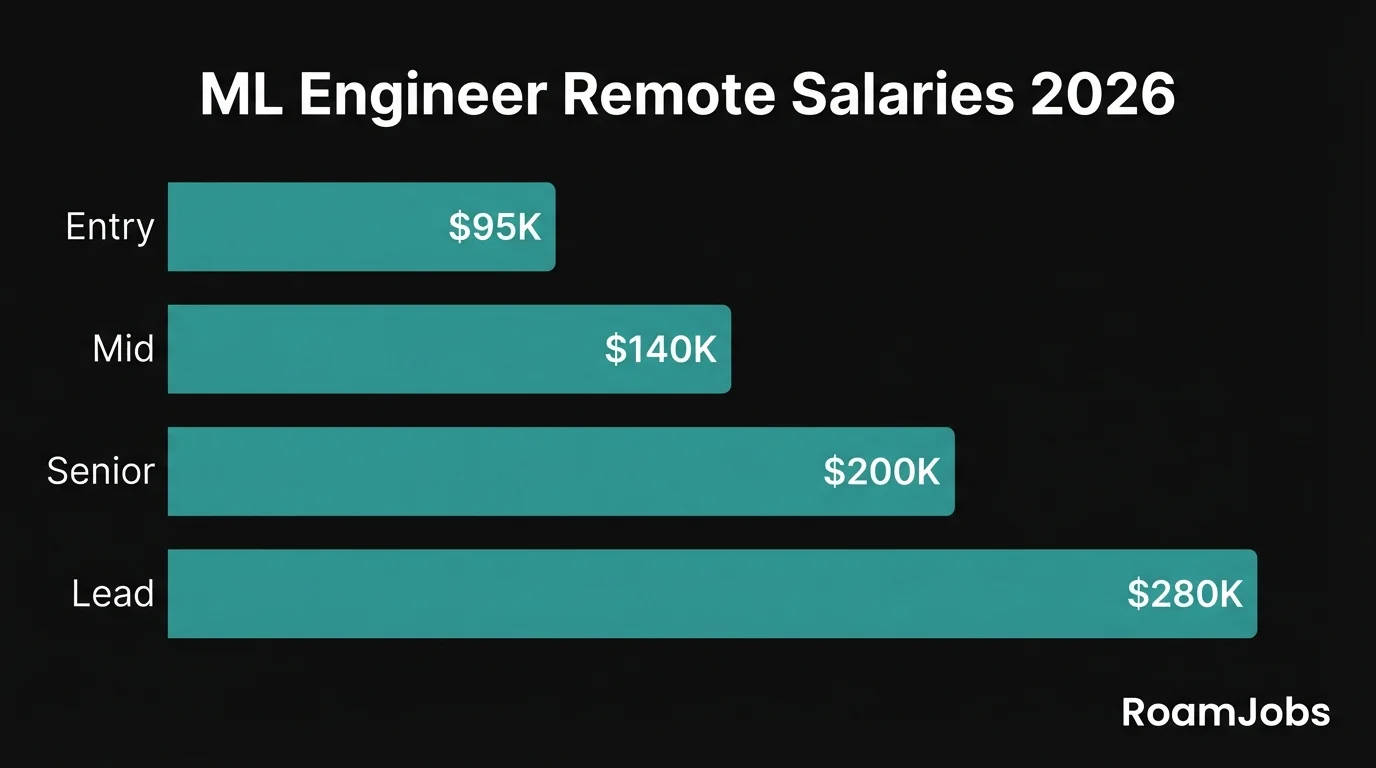
Remote Machine Learning Engineers design, build, and deploy ML models that power everything from recommendation systems to autonomous vehicles to generative AI applications. With salaries ranging from $95,000 to $280,000+ for US-based remote positions (and total compensation exceeding $400,000 at senior levels with equity), ML engineering represents the highest-paying software engineering specialization in 2026. The field combines software engineering fundamentals with deep mathematical knowledge, requiring expertise in Python, deep learning frameworks like PyTorch and TensorFlow, and increasingly, large language models and MLOps infrastructure. Remote ML roles are highly accessible because the work is computationally intensive and asynchronous by nature—model training jobs run for hours or days, and experimentation happens independently. Companies worldwide compete for ML talent, creating exceptional opportunities for engineers who can demonstrate both theoretical understanding and production engineering skills.
What Does a Remote Machine Learning Engineer Do?
Machine Learning Engineers sit at the intersection of software engineering and data science, building the infrastructure and systems that bring ML models from research notebooks to production applications serving millions of users. Unlike data scientists who focus primarily on model experimentation and analysis, ML engineers are responsible for the entire lifecycle—from data pipelines to model training to deployment and monitoring.
Day-to-Day Responsibilities
A typical day for a remote ML engineer varies based on seniority and company, but generally includes a mix of these activities:
Model Development and Training
- Designing neural network architectures for specific use cases
- Writing training pipelines that efficiently process large datasets
- Implementing loss functions, optimizers, and regularization techniques
- Running experiments across GPU clusters and tracking results
- Debugging model performance issues and identifying data quality problems
MLOps and Infrastructure
- Building and maintaining ML pipelines using tools like Kubeflow, Airflow, or custom systems
- Implementing feature stores and feature engineering pipelines
- Setting up model versioning, experiment tracking, and reproducibility systems
- Deploying models to production with appropriate serving infrastructure
- Creating monitoring and alerting systems for model performance in production
Collaboration and Communication
- Working with data engineers to ensure clean, reliable data pipelines
- Collaborating with product teams to understand requirements and constraints
- Communicating model capabilities and limitations to stakeholders
- Writing documentation for models, APIs, and systems
- Participating in code reviews and knowledge sharing sessions
Research and Experimentation
- Reading papers and staying current with ML advances
- Implementing new techniques and evaluating their applicability
- Running A/B tests to validate model improvements
- Building proof-of-concept systems for new ML applications
ML Engineer vs Data Scientist vs Research Scientist
Understanding the distinctions between these roles helps you target the right opportunities and develop appropriate skills.
ML Role Comparison
Source: RoamJobs 2026 ML Career Analysis| Aspect | ML Engineer | Data Scientist | Research Scientist |
|---|---|---|---|
| Primary Focus | Production systems | Analysis & insights | Novel algorithms |
| Coding Skills | Very High | High | Medium-High |
| Math Depth | High | High | Very High |
| System Design | Critical | Moderate | Low |
| Publications | Rare | Occasional | Expected |
| Salary Range | $95K-$280K | $85K-$220K | $120K-$300K |
| PhD Preference | 25% | 15% | 70% |
| Remote Friendliness | High | High | Medium |
Data compiled from RoamJobs 2026 ML Career Analysis. Last verified January 2026.
ML Engineers are software engineers first. They write production-quality code, build scalable systems, and care deeply about reliability, latency, and cost. Their success is measured by models running in production, not just accuracy metrics in notebooks.
Data Scientists are analysts who use statistical methods and ML to derive insights. They work more with stakeholders, create visualizations, and may never deploy models to production. Many data scientists transition to ML engineering as they develop stronger software skills.
Research Scientists push the boundaries of what’s possible with ML. They publish papers, develop novel algorithms, and often work at AI research labs or universities. Most positions require PhDs and involve less production engineering.
Remote Work Challenges for ML Engineers
While ML engineering is inherently suited to remote work, the role presents unique challenges in distributed environments:
Compute Resource Management Remote ML engineers typically don’t have local access to powerful GPUs. You’ll work with cloud compute (AWS, GCP, Azure), on-premises clusters accessed via VPN, or emerging ML platforms. Managing costs, coordinating resource allocation, and debugging remote training jobs requires strong infrastructure skills.
Collaboration on Complex Problems ML debugging often requires collaborative exploration—examining data, reviewing model outputs, and iterating on hypotheses together. Remote teams compensate with excellent documentation practices, screen-sharing sessions for pair debugging, and async tools like Loom for explaining complex concepts.
Data Access and Security Many companies restrict access to sensitive training data, especially in healthcare, finance, and other regulated industries. Remote ML engineers often work with anonymized or synthetic data for development, with production access tightly controlled through secure environments.
Experiment Tracking and Reproducibility When team members run experiments from different locations, tracking and reproducing results becomes critical. Strong remote ML teams invest heavily in experiment tracking tools (Weights & Biases, MLflow) and enforce reproducibility practices.
Salary Breakdown by Seniority Level
ML engineering compensation is among the highest in software engineering, with significant variation based on experience, specialization, and company tier. The following breakdown reflects US remote positions, which represent the most competitive segment of the market.
Machine Learning Engineer Salary by Experience & Location
| Level | 🇺🇸 US Remote | 🇪🇺 EU Remote | 🌎 LATAM | 🌏 Asia |
|---|---|---|---|---|
| Entry Level (0-2 yrs) | $95,000 - $125,000 | $55,000 - $85,000 | $35,000 - $65,000 | $30,000 - $55,000 |
| Mid-Level (2-5 yrs) | $140,000 - $195,000 | $85,000 - $130,000 | $60,000 - $100,000 | $50,000 - $90,000 |
| Senior (5-8 yrs) | $190,000 - $280,000 | $120,000 - $185,000 | $90,000 - $150,000 | $80,000 - $130,000 |
| Staff/Director (8+ yrs) | $250,000 - $400,000 | $165,000 - $280,000 | $130,000 - $220,000 | $115,000 - $200,000 |
* Salaries represent base compensation for remote positions. Actual compensation may vary based on company, experience, and specific location within region.
Entry Level / Junior ML Engineer
0-2 years experience
What to Expect
Entry-level ML engineering positions are competitive but increasingly accessible to candidates without PhDs. Companies hire junior ML engineers from several backgrounds: computer science graduates with ML coursework, software engineers transitioning into ML, bootcamp graduates with strong portfolios, and self-taught practitioners with impressive projects.
Required Skills
- Strong Python fundamentals: Object-oriented programming, data structures, algorithms
- ML framework basics: PyTorch or TensorFlow for model building and training
- Math foundations: Linear algebra, calculus, probability, and basic statistics
- Data manipulation: pandas, NumPy, data preprocessing techniques
- Version control: Git workflows for collaborative ML development
- Basic SQL: Querying data for feature engineering and analysis
Realistic Expectations
Junior ML engineers rarely design novel architectures or work on cutting-edge research. Typical responsibilities include:
- Implementing existing model architectures for specific use cases
- Writing data preprocessing and feature engineering pipelines
- Maintaining and improving existing ML systems
- Running experiments and documenting results
- Learning the team’s MLOps stack and production systems
How to Break In
- Build 3-5 substantial ML projects beyond Kaggle competitions
- Contribute to open-source ML projects (even documentation helps)
- Create a technical blog explaining ML concepts
- Complete online courses from fast.ai, Coursera (Andrew Ng), or Stanford
- Practice coding interviews with a focus on ML-specific problems
- Target companies with structured junior ML programs
Compensation Details
Entry-level salaries range from $95,000-$125,000 for US remote positions. Companies like Google, Meta, and OpenAI pay at the higher end ($115K-$140K base plus equity), while smaller companies and agencies typically offer $95K-$115K. Total compensation with signing bonuses and equity can reach $150K-$180K at top-tier companies.
Mid-Level ML Engineer
2-5 years experience
Career Stage
Mid-level ML engineers have shipped models to production and understand the full ML lifecycle. You’re expected to work independently on well-defined problems, contribute to system design discussions, and mentor junior team members.
Expected Skills
- Production ML systems: Building end-to-end pipelines that scale
- Deep learning expertise: CNNs, RNNs, Transformers, attention mechanisms
- MLOps fundamentals: CI/CD for ML, model serving, monitoring
- Cloud platforms: AWS SageMaker, GCP Vertex AI, or Azure ML
- Experiment tracking: Weights & Biases, MLflow, or similar tools
- Distributed training: Data parallelism, model parallelism basics
- Software engineering: Clean code, testing, documentation
Specialization Paths
Mid-level is when most ML engineers begin specializing:
Computer Vision: Image classification, object detection, segmentation, GANs Natural Language Processing: Text classification, NER, transformers, LLMs Recommendation Systems: Collaborative filtering, content-based, hybrid approaches MLOps/Platform: Building internal ML platforms and infrastructure Applied Research: Adapting research papers for production use cases
Growth Trajectory
Strong mid-level engineers advance by:
- Taking ownership of critical ML systems end-to-end
- Driving technical decisions for significant projects
- Building expertise in high-demand areas (LLMs, GenAI)
- Developing cross-functional collaboration skills
- Contributing to hiring and team building
Compensation Details
Mid-level salaries range from $140,000-$195,000 base for US remote positions. At this level, equity becomes more significant—total compensation at top companies regularly exceeds $250,000. Companies compete aggressively for mid-level talent with LLM experience, where salaries at the higher end are common.
Senior ML Engineer
5-8 years experience
Role Scope
Senior ML engineers are technical leaders who design complex systems, make architectural decisions, and drive projects from conception to production. You’re expected to solve ambiguous problems, influence technical direction, and multiply team productivity through mentorship and tooling.
Key Responsibilities
- System architecture: Designing ML systems that scale to millions of users
- Technical leadership: Guiding technical decisions across multiple teams
- Complex problem solving: Tackling problems without clear solutions
- Production excellence: Ensuring reliability, latency, and cost efficiency
- Research integration: Evaluating and implementing state-of-the-art techniques
- Stakeholder management: Translating business needs to technical solutions
Technical Depth
Senior ML engineers are expected to have deep expertise in:
- Advanced architectures: Transformer variants, mixture of experts, multimodal models
- Large-scale training: Distributed training across hundreds of GPUs
- Model optimization: Quantization, pruning, distillation, efficient inference
- System design: Designing for reliability, scalability, and cost
- LLM applications: Fine-tuning, RAG, prompt engineering, evaluation
- ML infrastructure: Feature stores, model registries, serving systems
Leadership Expectations
At the senior level, technical skills are necessary but not sufficient. You must also:
- Mentor junior and mid-level engineers effectively
- Influence technical decisions without direct authority
- Communicate complex concepts to non-technical stakeholders
- Drive alignment across teams with competing priorities
- Contribute to hiring through interviews and process improvement
Compensation Details
Senior ML engineer salaries range from $190,000-$280,000 base for US remote positions. Total compensation with equity at top companies regularly exceeds $350,000-$450,000. Staff engineer promotions typically bring base salaries to $250,000+ with total compensation exceeding $500,000 at companies like Google, Meta, and OpenAI.
Lead / Director ML Engineer
8+ years experience
Leadership Scope
Director and Principal ML Engineers define technical strategy for entire ML organizations. Whether on the individual contributor (Principal/Distinguished) or management (Director/VP) track, you’re responsible for decisions that affect product direction, team structure, and multi-year roadmaps.
Principal/Staff IC Path
Principal ML Engineers remain hands-on while driving technical direction:
- Technical vision: Setting multi-year technical strategy
- Cross-company impact: Influencing ML practices across the organization
- External presence: Speaking at conferences, publishing, open-source leadership
- Difficult problems: Tackling the hardest technical challenges
- Architecture ownership: Defining standards and patterns for ML systems
Director/VP Management Path
ML Engineering Directors lead teams and organizations:
- Team building: Hiring, developing, and retaining ML talent
- Strategy setting: Aligning ML capabilities with business objectives
- Resource allocation: Prioritizing projects and managing budgets
- Executive communication: Representing ML to leadership
- Organization design: Structuring teams for effective delivery
Skills Beyond Technical
At this level, success requires:
- Strategic thinking: Connecting ML capabilities to business value
- Influence without authority: Driving change across organizations
- Executive presence: Communicating effectively with senior leadership
- Industry perspective: Understanding competitive landscape and trends
- Long-term planning: Making decisions with multi-year implications
Compensation Details
Director and Principal ML Engineer base salaries range from $250,000-$400,000+ for US remote positions. Total compensation with equity at top companies exceeds $600,000-$1,000,000+. At this level, compensation packages are highly negotiable and vary significantly based on company stage, equity grants, and individual negotiation.
Essential Skills and Tools
Deep Learning Frameworks
The framework landscape has consolidated around a few dominant options. Your choice significantly impacts job opportunities and the types of projects you can pursue.
Deep Learning Framework Comparison
Source: 2026 ML Framework Survey| Framework | Industry Adoption | Best For | Learning Curve | Remote Job Demand |
|---|---|---|---|---|
| PyTorch | Dominant | Research & Production | Medium | Very High |
| TensorFlow | High | Production Systems | Steep | High |
| JAX | Growing | Research & Scale | Steep | Medium-High |
| Keras | Moderate | Prototyping | Easy | Medium |
| Hugging Face | Very High | NLP & LLMs | Easy | Very High |
Data compiled from 2026 ML Framework Survey. Last verified January 2026.
PyTorch has become the default choice for most ML engineers. Its pythonic design, dynamic computation graphs, and excellent debugging experience make it ideal for both research and production. Meta’s continued investment and the broader ecosystem (torchvision, torchaudio, PyTorch Lightning) ensure its dominance.
TensorFlow remains important for production systems, particularly at Google and companies with existing TensorFlow infrastructure. TensorFlow Serving and TensorFlow Extended (TFX) provide mature production tooling.
JAX is gaining adoption for large-scale training, particularly at Google and Anthropic. Its functional approach and excellent XLA compilation make it ideal for distributed training across TPUs and GPUs.
Hugging Face Transformers has become essential for NLP and LLM work. Understanding the transformers library, datasets, and the Hub ecosystem is critical for modern ML engineering.
MLOps and Infrastructure Tools
Production ML requires a sophisticated toolchain beyond model training. Familiarity with these tools is essential for mid-level and senior positions.
Experiment Tracking
- Weights & Biases: The most popular commercial option, excellent for teams
- MLflow: Open-source, widely adopted, integrates with many platforms
- Neptune.ai: Strong for teams needing advanced collaboration features
- Comet ML: Good balance of features and ease of use
Model Serving
- TorchServe: PyTorch’s official serving solution
- TensorFlow Serving: Mature, high-performance serving for TF models
- Triton Inference Server: NVIDIA’s solution for GPU-accelerated inference
- Seldon Core: Kubernetes-native model serving with advanced features
- BentoML: Developer-friendly serving framework
Pipeline Orchestration
- Kubeflow Pipelines: Kubernetes-native ML workflows
- Apache Airflow: General-purpose orchestration, widely adopted
- Prefect: Modern alternative to Airflow with better developer experience
- Dagster: Data orchestration with strong ML integrations
- Metaflow: Netflix’s framework for data science workflows
Feature Engineering
- Feast: Open-source feature store standard
- Tecton: Enterprise feature platform
- Hopsworks: Full ML platform with feature store
- Databricks Feature Store: Integrated with Databricks ecosystem
Cloud ML Platforms
Most remote ML engineers work with cloud infrastructure. Deep expertise in at least one platform is expected.
AWS SageMaker
- Most widely used cloud ML platform
- Integrated training, serving, and monitoring
- Strong integration with broader AWS ecosystem
- SageMaker Studio for development environments
Google Cloud Vertex AI
- Excellent for TensorFlow and JAX workloads
- TPU access for large-scale training
- AutoML capabilities for rapid prototyping
- Strong integration with BigQuery for data
Azure Machine Learning
- Enterprise-focused with strong security features
- Good for organizations using Microsoft stack
- Integrates with Azure DevOps for MLOps
Mathematics and Statistics
ML engineering requires stronger mathematical foundations than typical software engineering. Essential areas include:
Linear Algebra
- Vector and matrix operations
- Eigenvalues and eigenvectors
- Matrix decomposition (SVD, PCA)
- Understanding of high-dimensional spaces
Calculus and Optimization
- Gradient descent and variants (SGD, Adam, AdamW)
- Backpropagation mathematics
- Loss function design and properties
- Convex vs. non-convex optimization
Probability and Statistics
- Probability distributions and their properties
- Bayesian reasoning and inference
- Hypothesis testing and A/B experiments
- Information theory basics (entropy, KL divergence)
LLM and Generative AI Skills
The rapid adoption of large language models has created enormous demand for engineers with LLM expertise. Key skills include:
Foundation Model Understanding
- Transformer architecture deep dive
- Attention mechanisms and their variants
- Scaling laws and model behavior
- Pre-training vs. fine-tuning paradigms
Practical LLM Engineering
- Prompt engineering and optimization
- Fine-tuning techniques (LoRA, QLoRA, full fine-tuning)
- Retrieval-Augmented Generation (RAG)
- Evaluation methodologies for generative models
- Hallucination detection and mitigation
LLM Infrastructure
- Efficient inference (quantization, speculative decoding)
- Serving at scale (vLLM, TensorRT-LLM)
- Cost optimization for LLM workloads
- Multi-model orchestration
Emerging Paradigms
- Agents and tool use
- Multi-modal models (vision-language, audio)
- Constitutional AI and alignment techniques
- Synthetic data generation
Companies Hiring Remote ML Engineers
The ML engineering job market spans AI-first startups to enterprise tech giants. Understanding different company types helps target your search effectively.
AI-First Companies
These companies build AI as their core product, offering the most cutting-edge work and often the highest compensation.
OpenAI - The creator of GPT and DALL-E. Hybrid-remote with strong remote engineering culture. Compensation at the very top of market. Extremely competitive hiring but exceptional for career development.
Anthropic - Building Claude and focused on AI safety. Remote-friendly with distributed teams. Strong engineering culture with research overlap. Competitive compensation with equity upside.
Cohere - Enterprise-focused LLM company. Distributed team across multiple countries. Focus on production deployments and enterprise integration.
Mistral AI - European AI company building open-weight models. Remote-friendly with Paris headquarters. Rapidly growing and well-funded.
Stability AI - Open-source focused AI company. Fully distributed team. Known for Stable Diffusion and generative models.
Hugging Face - The GitHub of machine learning. Remote-first culture with global team. Focus on open-source ML tooling and model hosting.
Tech Giants with Strong ML Teams
Large tech companies offer scale, resources, and compensation that smaller companies can’t match.
Meta AI - Massive investment in AI research and infrastructure. Strong remote options for many roles. PyTorch development, FAIR research, and production ML for products.
Google DeepMind - Combined research organization. Hybrid-remote depending on role. Access to unprecedented compute resources and research opportunities.
Amazon - ML teams across AWS (SageMaker), Alexa, advertising, and logistics. Many remote positions available. Focus on applied ML at massive scale.
Microsoft - Azure AI, Copilot products, and research (MSR). Strong remote culture post-pandemic. Integration with OpenAI products creates unique opportunities.
Apple - ML for Siri, Photos, and on-device inference. More limited remote options but increasing flexibility. Focus on privacy-preserving ML.
Companies Building LLM Products
The explosion of LLM applications has created ML engineering demand at companies building on foundation models.
Notion - AI features for the workspace tool. Remote-first culture. ML for writing assistance, search, and automation.
Canva - AI design tools at massive scale. Distributed team. ML for image generation, editing, and design assistance.
Figma - AI features for design tools. Strong remote culture. ML for design automation and collaboration.
Grammarly - NLP-first company expanding into LLMs. Remote-friendly. Long history of production NLP systems.
Jasper - AI content creation platform. Remote-first. Focus on LLM applications for marketing and content.
Copy.ai - AI copywriting and content tools. Remote-first startup. Building LLM-powered writing assistance.
Remote-First Companies with ML Teams
These companies have strong remote cultures with growing ML needs.
GitLab - DevOps platform with AI features. Gold standard for remote work. Growing ML team for code assistance and automation.
Zapier - Workflow automation with AI integration. Strong async culture. ML for intelligent automation and recommendations.
Automattic - WordPress and Tumblr parent company. Fully distributed since founding. Growing ML capabilities for content and recommendations.
Stripe - Financial infrastructure with ML for fraud, risk, and optimization. Remote-first with global team. High-impact ML applications.
Shopify - E-commerce platform with extensive ML. Digital-by-default policy. ML for recommendations, search, and merchant tools.
DataDog - Observability platform with ML for anomaly detection. Remote-friendly. Interesting ML problems at scale.
Vercel - Frontend platform with AI features. Small, remote team. Growing AI capabilities for developer tools.
Supabase - Open-source Firebase alternative. Fully remote, building in public. Emerging AI features and vector database support.
Interview Deep Dive
ML engineering interviews are among the most comprehensive in software engineering, testing coding skills, ML theory, system design, and research ability. Thorough preparation across all areas is essential.
Coding Interviews
ML coding interviews test both general software engineering and ML-specific implementation skills.
This tests understanding of neural network fundamentals without framework abstractions.
Strong answer approach:
import numpy as np

def sigmoid(x):
    return 1 / (1 + np.exp(-x))

def relu(x):
    return np.maximum(0, x)

def forward_pass(X, weights, biases, activations):
    """
    X: input data (batch_size, input_dim)
    weights: list of weight matrices
    biases: list of bias vectors
    activations: list of activation functions
    """
    current = X
    for W, b, activation in zip(weights, biases, activations):
        z = np.dot(current, W) + b
        current = activation(z)
    return current
Key points to demonstrate: understanding of matrix dimensions, activation function implementation, and layer-by-layer computation. Discuss numerical stability (log-sum-exp for softmax), vectorization for efficiency, and extension to backpropagation.
This tests understanding of fundamental classification metrics.
Strong answer:
def compute_metrics(y_true, y_pred):
    """Compute precision, recall, and F1 for binary classification."""
    true_positives = sum(1 for t, p in zip(y_true, y_pred) if t == 1 and p == 1)
    false_positives = sum(1 for t, p in zip(y_true, y_pred) if t == 0 and p == 1)
    false_negatives = sum(1 for t, p in zip(y_true, y_pred) if t == 1 and p == 0)

    precision = true_positives / (true_positives + false_positives) if (true_positives + false_positives) > 0 else 0
    recall = true_positives / (true_positives + false_negatives) if (true_positives + false_negatives) > 0 else 0
    f1 = 2 * precision * recall / (precision + recall) if (precision + recall) > 0 else 0

    return {'precision': precision, 'recall': recall, 'f1': f1}
Discuss edge cases (zero division), multi-class extensions (micro/macro averaging), and when to prefer different metrics (imbalanced classes, different costs of errors).
Classic interview question testing algorithm understanding and implementation skills.
Key implementation points:
- Initialize centroids (random selection or k-means++)
- Assign points to nearest centroid
- Update centroids as mean of assigned points
- Repeat until convergence or max iterations
import numpy as np

def kmeans(X, k, max_iters=100, tol=1e-4):
    n_samples = X.shape[0]
    # Initialize centroids randomly
    idx = np.random.choice(n_samples, k, replace=False)
    centroids = X[idx]

    for _ in range(max_iters):
        # Assign points to nearest centroid
        distances = np.sqrt(((X[:, np.newaxis] - centroids) ** 2).sum(axis=2))
        labels = np.argmin(distances, axis=1)

        # Update centroids
        new_centroids = np.array([X[labels == i].mean(axis=0) for i in range(k)])

        # Check convergence
        if np.all(np.abs(new_centroids - centroids) < tol):
            break
        centroids = new_centroids

    return labels, centroids
Discuss: k-means++ initialization, handling empty clusters, computational complexity, limitations (assumes spherical clusters), and alternatives (DBSCAN, hierarchical).
Tests deep understanding of modern neural network architectures.
Scaled dot-product attention:
import numpy as np

def attention(Q, K, V, mask=None):
    """
    Q: queries (batch, seq_len, d_k)
    K: keys (batch, seq_len, d_k)
    V: values (batch, seq_len, d_v)
    """
    d_k = Q.shape[-1]
    scores = np.matmul(Q, K.transpose(0, 2, 1)) / np.sqrt(d_k)

    if mask is not None:
        scores = scores + mask * -1e9

    weights = softmax(scores, axis=-1)
    return np.matmul(weights, V), weights

def softmax(x, axis=-1):
    exp_x = np.exp(x - np.max(x, axis=axis, keepdims=True))
    return exp_x / np.sum(exp_x, axis=axis, keepdims=True)
Discuss: why scaling by sqrt(d_k) (prevents softmax saturation), multi-head attention, positional encoding, computational complexity (O(n^2) for sequence length), and efficient attention variants (linear attention, sparse attention).
ML Theory Questions
These questions test your understanding of machine learning concepts and your ability to reason about model behavior.
Strong answer structure:
The bias-variance tradeoff describes the fundamental tension in machine learning between two sources of error:
Bias is the error from overly simplistic assumptions in the learning algorithm. High-bias models underfit the data, missing relevant relations between features and target. Example: using linear regression for a highly non-linear relationship.
Variance is the error from sensitivity to fluctuations in the training set. High-variance models overfit, capturing noise rather than the underlying pattern. Example: a deep neural network with insufficient regularization on a small dataset.
Total error = Bias^2 + Variance + Irreducible error
Relationship to model complexity:
- Simple models (few parameters): high bias, low variance
- Complex models (many parameters): low bias, high variance
Practical implications:
- Regularization (L1, L2, dropout) reduces variance at cost of some bias
- Ensemble methods (bagging reduces variance, boosting reduces bias)
- Cross-validation helps find the optimal complexity
- Modern deep learning uses implicit regularization (SGD, early stopping)
Key points:
Without non-linear activations, a neural network is just a linear transformation regardless of depth. Stacking linear layers: f(x) = W2(W1x + b1) + b2 = (W2W1)x + (W2b1 + b2) = W’x + b’
This is still linear and can only learn linear decision boundaries.
Non-linear activations enable:
- Learning complex, non-linear patterns
- Universal approximation (with enough neurons, can approximate any continuous function)
- Hierarchical feature learning at different abstraction levels
Common activations and their properties:
- ReLU: fast, sparse, but dying ReLU problem
- Sigmoid/tanh: bounded, but vanishing gradient issues
- GELU/SiLU: smooth, used in modern transformers
- Softmax: for probability outputs
Mechanism: For each mini-batch, batch normalization normalizes activations to have zero mean and unit variance, then applies learnable scale (gamma) and shift (beta) parameters.
x_norm = (x - batch_mean) / sqrt(batch_var + epsilon)
output = gamma * x_norm + beta
Why it helps:
- Reduces internal covariate shift: Stabilizes the distribution of layer inputs during training
- Allows higher learning rates: Normalized activations are less sensitive to weight initialization
- Regularization effect: Batch statistics introduce noise, acting as regularization
- Gradient flow: Helps prevent vanishing/exploding gradients
Limitations:
- Batch size dependence (performs poorly with small batches)
- Different behavior during training and inference
- Not ideal for RNNs or variable-length sequences
Alternatives: Layer Normalization (preferred for transformers), Group Normalization, Instance Normalization
The problem: In deep networks, gradients can become exponentially small as they propagate backward through many layers. This happens when:
- Activation functions squash gradients (sigmoid, tanh)
- Weight magnitudes are small
- Many layers multiply small values together
Result: early layers learn extremely slowly or not at all.
Solutions:
- ReLU activation: Gradient is 1 for positive inputs, no squashing
- Residual connections (ResNets): Skip connections provide gradient highways
- Careful initialization: Xavier/He initialization scales weights appropriately
- Normalization layers: BatchNorm, LayerNorm stabilize activations
- Gated architectures: LSTMs/GRUs have explicit gates for gradient flow
- Attention mechanisms: Direct connections between all positions in transformers
L1 Regularization (Lasso):
- Adds sum of absolute values of weights to loss: lambda * sum(|w|)
- Produces sparse solutions (many weights exactly zero)
- Useful for feature selection
- Non-differentiable at zero (use subgradient methods)
L2 Regularization (Ridge):
- Adds sum of squared weights to loss: lambda * sum(w^2)
- Shrinks weights toward zero but rarely exactly zero
- Smooth, differentiable everywhere
- Equivalent to Gaussian prior on weights
When to use:
- L1: When you suspect many features are irrelevant, want interpretable sparse models
- L2: Default choice for preventing overfitting, when all features may contribute
- Elastic Net: Combination of both for best of both worlds
In deep learning:
- L2 (weight decay) is standard for regularization
- Dropout is often preferred over explicit L1/L2
- L1 sometimes used in specific architectures (sparse autoencoders)
System Design Questions
System design questions test your ability to architect production ML systems at scale.
Requirements clarification:
- Scale: 100M users, 10M products, 1B events/day
- Latency: under 100ms for recommendations
- Real-time: Update recommendations based on current session behavior
High-level architecture:
-
Data Layer
- Event streaming (Kafka) for real-time user behavior
- Feature store (Feast) for user and item features
- Data warehouse (Snowflake/BigQuery) for historical data
-
Offline Training Pipeline
- Collaborative filtering model (matrix factorization or neural CF)
- Content-based model for cold start
- Two-tower architecture for candidate generation
- Training on historical interactions with negative sampling
-
Online Serving
- Candidate generation: Approximate nearest neighbor search (FAISS/Milvus)
- Ranking model: Lightweight neural network for scoring candidates
- Feature retrieval from online feature store
- Model serving with TensorFlow Serving or Triton
-
Real-time Personalization
- Session-based model for in-session behavior
- Context features (time, device, location)
- Real-time feature computation on streaming data
-
Infrastructure Considerations
- Caching at multiple levels (CDN, application, model)
- A/B testing framework for model comparison
- Monitoring for model drift and performance
Key challenges:
- Extreme class imbalance (under 0.1% fraud)
- Latency requirements (under 500ms to not block transactions)
- Evolving fraud patterns (concept drift)
- Explainability requirements for regulatory compliance
Architecture:
-
Feature Engineering
- Transaction features: amount, time, merchant category
- User history: spending patterns, typical locations
- Aggregated features: velocity, deviation from patterns
- Graph features: connections between entities
-
Model Architecture
- Two-stage system:
- Fast rules-based filter (catches obvious fraud)
- ML model for nuanced detection
- Ensemble of models: XGBoost for tabular features, neural network for sequences
- Handle imbalance: SMOTE, class weights, focal loss
- Two-stage system:
-
Real-time Serving
- Feature computation on streaming data (Flink/Spark Streaming)
- Online feature store for user profiles
- Model serving with strict latency SLAs
- Fallback rules if model latency exceeded
-
Continuous Learning
- Human-in-the-loop for labeling
- Feedback loop from confirmed fraud/false positives
- Regular model retraining (daily/weekly)
- Online learning for rapid adaptation
-
Monitoring & Explainability
- SHAP values for explaining decisions
- Alert on distribution shifts
- Performance dashboards for detection rates
Requirements:
- Support 10,000 concurrent users
- Response latency under 2 seconds for first token
- Handle context from customer history and knowledge base
- Cost-effective operation
Architecture:
-
Model Selection & Optimization
- Fine-tuned model on customer service data
- Quantization (INT8/INT4) for efficiency
- Consider smaller distilled models for simple queries
-
Serving Infrastructure
- vLLM or TensorRT-LLM for efficient inference
- Multiple GPU instances with load balancing
- Streaming responses for perceived latency improvement
- KV-cache optimization for multi-turn conversations
-
RAG Pipeline
- Vector database (Pinecone/Weaviate) for knowledge base
- Embedding model for query/document encoding
- Hybrid search: semantic + keyword
- Context window management with summarization
-
Request Processing
- Query classification: route simple queries to smaller models
- Prompt engineering with guardrails
- Context assembly: user history + retrieved documents
- Response filtering for safety
-
Scaling & Cost
- Auto-scaling based on request queue depth
- Caching for common queries
- Batching requests for GPU efficiency
- Multi-tier: GPU for generation, CPU for retrieval
-
Monitoring
- Response quality metrics (user satisfaction)
- Hallucination detection
- Token usage and cost tracking
- Latency percentiles
Behavioral and Remote Work Questions
Strong answer structure (STAR method):
Situation: Describe the context - what model, what application, what was expected
Task: What was your responsibility in addressing the issue
Action: What you did to diagnose and fix the problem
- How you identified the discrepancy
- Root cause analysis (data drift, feature pipeline issues, serving bugs)
- Steps taken to resolve
- Preventive measures implemented
Result: Quantify the outcome
- Performance after fix
- Monitoring/alerting added
- Process improvements
Key themes to hit:
- Ownership and accountability
- Systematic debugging approach
- Learning from failures
- Proactive prevention
Strong answer elements:
Async collaboration:
- Detailed documentation of experiments and decisions
- Using experiment tracking tools (W&B, MLflow) as communication
- Written technical design docs before implementation
- Loom videos for explaining complex concepts
Managing long-running work:
- Setting up experiments to run overnight/weekends
- Clear experiment naming and logging
- Automated notifications when training completes
- Batch planning to maximize GPU utilization
Staying connected:
- Regular sync meetings with collaborators (but not too many)
- Active participation in team Slack channels
- Sharing interesting papers and findings
- Pair debugging sessions via screen share
Self-management:
- Dedicated workspace and schedule
- Clear boundaries between work and personal time
- Breaking large projects into trackable milestones
- Regular communication of progress and blockers
What interviewers look for:
- Ability to simplify without being condescending
- Use of analogies and concrete examples
- Understanding of what stakeholders actually need to know
- Patience and empathy
Good answer elements:
- Specific situation with clear context
- How you assessed the audience’s technical level
- Specific techniques used (analogies, visualizations, examples)
- Outcome: did they understand? Did it influence decisions?
- What you learned about communication
Example framework: “When presenting our fraud model to the risk team, I realized they didn’t need to understand transformer architectures - they needed to understand model confidence, false positive rates, and how to interpret alerts. I created a dashboard showing model decisions with explanations in business terms, and we practiced with historical cases. The result was the team trusted the model enough to deploy it, and they knew when to override its recommendations.”
Strong answer framework:
-
Clarify the business problem
- What decision will this model inform?
- What does success look like in business terms?
- What are the constraints (latency, cost, accuracy)?
-
Define measurable objectives
- Translate business goals to ML metrics
- Identify proxy metrics if direct measurement is difficult
- Establish baselines (current performance, simple baselines)
-
Start simple and iterate
- Build simplest viable solution first
- Get feedback early from stakeholders
- Iterate based on real-world performance
-
Document assumptions
- Make assumptions explicit
- Validate assumptions with data
- Communicate uncertainty clearly
-
Create feedback loops
- Build monitoring from day one
- Establish regular check-ins with stakeholders
- Plan for iteration and improvement
Key insight: Ambiguity is normal in ML projects. The skill is managing uncertainty, not eliminating it.
Decision framework:
Favor simple models (logistic regression, XGBoost) when:
- Limited training data (< 10K examples)
- Interpretability is important
- Fast iteration is needed
- Feature engineering captures the signal well
- Latency/cost constraints are tight
- Baseline hasn’t been established
Favor complex models (deep learning) when:
- Large amounts of training data available
- Raw input data is high-dimensional (images, text, audio)
- Features are difficult to engineer manually
- State-of-the-art performance is required
- You have compute resources for training and serving
- Interpretability can be handled post-hoc (SHAP, attention)
Best practice: Always start with a simple baseline. It’s fast to implement, establishes a performance floor, and sometimes surprises you by being sufficient.
Systematic debugging approach:
-
Verify the performance degradation
- Check metrics calculation is correct
- Compare to historical baselines
- Identify when degradation started
-
Check for data issues
- Data drift: feature distribution changes
- Label drift: target distribution changes
- Data quality: missing values, corrupt data
- Upstream pipeline failures
-
Check for model issues
- Model was updated incorrectly
- Serving code differs from training
- Feature computation differs online/offline
- Incorrect model version deployed
-
Check for infrastructure issues
- Serving latency causing timeouts
- Memory issues causing prediction failures
- Load balancing serving different model versions
-
Investigate systematically
- Compare online predictions to offline batch
- Examine specific failing examples
- Check feature values at serving time
- Review recent deployments and changes
-
Implement fixes and monitoring
- Fix root cause
- Add alerting for similar issues
- Improve data validation
- Document findings
Comprehensive answer structure:
Understanding the task:
- What type of task? (classification, generation, extraction)
- What makes it domain-specific?
- What data is available for fine-tuning?
- What are the quality requirements?
Approach decision tree:
-
Start with prompting
- Zero-shot: test base model capabilities
- Few-shot: add examples to prompt
- Often sufficient for many use cases
-
Consider RAG before fine-tuning
- If the issue is knowledge, not style
- Build retrieval system with domain knowledge
- Faster to iterate than fine-tuning
-
Fine-tuning approaches
- Full fine-tuning: expensive, requires significant data
- LoRA/QLoRA: parameter-efficient, faster iteration
- Instruction tuning: for general improvement
- RLHF/DPO: for alignment to preferences
Practical considerations:
- Data quality > quantity for fine-tuning
- Evaluation is critical and often hardest part
- Start small (7B) before scaling to larger models
- Monitor for capability degradation in unrelated tasks
- Consider cost of fine-tuning vs. prompting at scale
Effective answer elements:
Acknowledge disagreement is healthy:
- Different perspectives improve solutions
- Important to separate ideas from egos
- Goal is finding best approach, not winning
Structured approach:
- Understand the other perspective fully
- Identify the core disagreement (assumptions, constraints, priorities)
- Propose experiments or evidence to resolve
- Agree on decision criteria before investigating
- Commit to the decision once made
Specific example: Describe a real disagreement, how you handled it constructively, and what you learned. Show that you can both advocate for your position and accept different outcomes.
Remote-specific considerations:
- Written communication for complex technical debates
- Avoid misunderstandings from async communication
- Schedule sync discussions for nuanced topics
- Document decisions and reasoning for future reference
Frequently Asked Questions
Frequently Asked Questions
Do I need a PhD to become a Machine Learning Engineer?
No, a PhD is not required for most ML engineering positions. While PhDs are common among research scientists and preferred for some research-focused roles, the majority of ML engineering positions (75%+) hire candidates with bachelor's or master's degrees. What matters more is demonstrated skills: strong software engineering fundamentals, practical ML experience through projects or work, and the ability to ship production systems. Many successful ML engineers transition from software engineering backgrounds, complete online courses and bootcamps, or are self-taught with impressive portfolios. That said, a PhD can accelerate your career in research-adjacent roles and opens doors at organizations with strong research focus like DeepMind or FAIR.
What's the difference between an ML Engineer and a Data Scientist?
ML Engineers are primarily software engineers who specialize in building production machine learning systems. They focus on model deployment, MLOps infrastructure, scalability, and reliability. Data Scientists are primarily analysts who use statistical methods and ML to derive insights and build models, often working closely with stakeholders and focusing more on experimentation than production systems. ML Engineers typically have stronger software engineering skills, while Data Scientists often have stronger statistical and communication skills. The roles are converging somewhat, especially at smaller companies, but the core focus differs: ML Engineers care most about reliable, scalable production systems, while Data Scientists care most about extracting insights and building effective models. Compensation is generally higher for ML Engineers due to the engineering complexity involved.
How do I transition from Software Engineering to ML Engineering?
The SWE to ML Engineer transition is one of the most common and achievable paths. Start by leveraging your existing strengths: production systems experience, code quality, and debugging skills are highly valued in ML engineering. Then build ML-specific skills: complete foundational courses (fast.ai, Andrew Ng's courses), implement classic algorithms from scratch, and build 2-3 end-to-end ML projects that go beyond notebooks to deployed systems. Look for opportunities in your current role to work on ML-adjacent projects—data pipelines, feature engineering, or model serving. Consider internal transfers at your company where your domain knowledge is valuable. When applying externally, emphasize your production engineering experience alongside ML skills. Many companies prefer engineers who can ship reliable systems over ML specialists who struggle with production code.
Should I specialize in LLMs/GenAI or learn traditional ML first?
We recommend building strong fundamentals before specializing heavily in LLMs. Understanding classical ML (regression, classification, clustering), neural network basics, and traditional deep learning (CNNs, RNNs) provides essential context that makes LLM work more effective. That said, the job market in 2026 strongly rewards LLM expertise, so don't wait too long to develop these skills. A balanced approach: spend 3-6 months on ML fundamentals, then dive into transformers, attention mechanisms, and LLM applications. The strongest candidates understand both the 'why' (theory) and 'how' (practical implementation) of modern ML. Pure LLM specialists without fundamentals often struggle when problems don't fit the LLM paradigm or when debugging requires understanding underlying mechanisms.
What's the best way to build an ML portfolio for remote job applications?
An effective ML portfolio demonstrates end-to-end skills, not just model training. Include 3-5 projects that show: data collection or processing, model development with clear methodology, deployment (web app, API, or edge device), and documentation explaining your choices. Avoid common Kaggle datasets (Titanic, MNIST) that every applicant uses. Instead, tackle interesting problems: a recommendation system for a niche domain, a computer vision application solving a real problem, or an NLP tool you actually use. For LLM-focused roles, build RAG applications, fine-tuned models for specific tasks, or agent systems. Host projects on GitHub with clear READMEs, deploy demos where possible, and write blog posts explaining your approach. Active open-source contributions, even to documentation, demonstrate collaboration skills crucial for remote work.
How important is math for ML Engineering versus pure software engineering?
Math is more important for ML engineering than typical software roles but less critical than for research positions. You need working knowledge of: linear algebra (matrix operations, eigenvalues), calculus (gradients, optimization), probability (distributions, Bayes theorem), and statistics (hypothesis testing, confidence intervals). You don't need to prove theorems, but you should understand why algorithms work and how to debug when they don't. For practical ML engineering, intuition matters more than formal rigor—knowing when gradient descent might struggle, understanding the bias-variance tradeoff, or recognizing when a loss function is inappropriate. Resources like 3Blue1Brown for intuition and textbooks like 'Mathematics for Machine Learning' (free online) provide sufficient background for most roles.
What programming languages should I learn for ML Engineering?
Python is essential—virtually all ML work happens in Python, and proficiency with the scientific stack (NumPy, pandas, scikit-learn, PyTorch/TensorFlow) is non-negotiable. Beyond Python, useful languages depend on your focus: C++ is valuable for performance-critical inference code, CUDA for custom GPU kernels, Rust is emerging for high-performance ML systems, and SQL remains critical for data work. For production systems, familiarity with Go or Java helps when integrating with existing infrastructure. Don't spread yourself too thin—deep Python expertise plus one systems language covers most needs. Prioritize learning frameworks and tools (Docker, Kubernetes, cloud platforms) over additional languages.
How do remote ML Engineer salaries compare to on-site positions?
Remote ML engineering salaries increasingly match or exceed on-site equivalents, especially at remote-first companies. Companies like GitLab, Zapier, and many AI startups pay location-agnostic salaries benchmarked to high-cost markets. Large tech companies (Google, Meta, Amazon) typically apply location-based adjustments of 15-40% for remote workers outside major tech hubs. However, the full picture is nuanced: remote positions eliminate commuting costs and time, enable living in lower cost areas while earning competitive salaries, and often include home office stipends. Senior remote ML engineers at top companies can earn $300K-$500K+ total compensation regardless of location. The salary arbitrage opportunity—earning SF-level pay from a lower-cost location—is particularly pronounced in ML due to talent scarcity.
What are the biggest challenges of remote ML Engineering work?
The main challenges are compute resource management, collaboration on complex debugging, and maintaining visibility. For compute, you'll work with cloud GPUs, VPN-accessed clusters, or ML platforms rather than local hardware—managing costs and coordinating resources requires planning. Collaborative debugging is harder remotely; successful teams develop strong async practices, use tools like Weights & Biases for experiment sharing, and schedule focused pair debugging sessions. Visibility can be challenging when your work involves long training runs that aren't immediately visible; overcome this with regular progress updates, documented experiments, and clear communication about what you're learning from failures. The benefits (flexibility, focus time, global opportunities) generally outweigh challenges for engineers who adapt well to async work.
How long does it take to become job-ready as an ML Engineer?
For software engineers transitioning to ML, 6-12 months of focused study and project work typically suffices. For career changers without programming background, expect 1.5-3 years for a competitive profile. The timeline depends on starting point and intensity: someone with strong Python skills and math background can accelerate significantly, while building programming fundamentals takes time. Milestones to track: complete 2-3 quality online courses (3-4 months), build 3-5 portfolio projects demonstrating end-to-end skills (3-6 months), contribute to open source or publish technical content (ongoing), and practice interview preparation (2-3 months before applying). Quality matters more than speed—a strong portfolio from 18 months of focused work beats a weak one from rushing through in 6 months.
What should I know about ML system design interviews?
ML system design interviews evaluate your ability to architect production ML systems at scale. Common questions involve recommendation systems, fraud detection, search ranking, or content moderation. The interview format typically allocates 45-60 minutes: 5-10 minutes for requirements clarification, 15-20 minutes for high-level architecture, 15-20 minutes for deep dives on specific components, and 5-10 minutes for monitoring and iteration. Practice with structured frameworks: define the ML problem clearly, establish metrics and baselines, design data pipelines and feature engineering, select appropriate modeling approaches, plan serving infrastructure, and address monitoring and iteration. Resources: 'Designing Machine Learning Systems' by Chip Huyen, ML system design interview prep courses, and studying how companies like Netflix, Uber, and Spotify have published their architectures.
How do I evaluate ML engineering job offers and companies?
Beyond salary, evaluate: the ML maturity of the organization (is ML core to the product or an afterthought?), data availability and quality (ML without good data is frustrating), compute resources and infrastructure, team composition and mentorship opportunities, and remote work culture quality. Ask interviewers specific questions: What models are in production? How often do you ship new models? What's your MLOps stack? How do remote team members collaborate on experiments? Red flags include companies treating ML as magic, unrealistic expectations about what ML can solve, or no clear path to production for models. Green flags include experiment tracking systems in place, clear model deployment processes, and realistic timelines for ML projects. For remote roles specifically, evaluate async communication culture, timezone overlap with your team, and how performance is measured for distributed contributors.
Related Guides and Next Steps
Machine Learning Engineering intersects with several other technical disciplines. Depending on your background and interests, these guides can help you develop complementary skills or explore adjacent career paths.
For Career Development
Remote Engineering Jobs: Complete Guide - The comprehensive hub covering all software engineering specializations, helping you understand where ML fits in the broader engineering landscape and how to transition between roles.
Remote Data Engineer Jobs - Data engineering skills are increasingly important for ML engineers who need to build and maintain the pipelines feeding their models. Understanding this discipline improves your effectiveness and opens hybrid role opportunities.
Remote Backend Developer Jobs - Backend engineering fundamentals are essential for building production ML systems. If you’re coming from a data science background, strengthening backend skills significantly improves your ML engineering capabilities.
For Interview Preparation
Review the Remote Interview Guide for comprehensive preparation strategies, including technical and behavioral interview frameworks applicable to ML roles.
For Job Search Strategy
The Remote Application Strategy Guide covers how to stand out in competitive remote job markets, particularly relevant for the high-demand ML field where top positions receive hundreds of qualified applicants.
Start Your Remote ML Engineering Career
The demand for Machine Learning Engineers continues to accelerate as AI transforms every industry. Remote opportunities are abundant because ML work is inherently suited to distributed collaboration—experiments run asynchronously, results are tracked in shared systems, and code review and documentation enable effective async work.
Your action plan:
- Assess your current level - Identify gaps between your skills and the requirements for your target seniority level
- Build targeted skills - Focus on high-demand areas: PyTorch, MLOps, and LLM applications
- Create demonstrable evidence - Build portfolio projects that showcase end-to-end ML capabilities
- Prepare strategically - Practice the specific interview formats used for ML roles
- Target appropriate companies - Start with companies matching your current level, then aim up
The investment in ML skills pays substantial dividends. Few other engineering specializations offer the combination of intellectual challenge, compensation, and remote flexibility that ML engineering provides in 2026.
Get the Remote ML Engineering Career Guide
Weekly curated remote ML engineering jobs, salary insights, interview tips, and industry news delivered to your inbox.
Frequently Asked Questions
How do I find remote machine learning engineer jobs?
To find remote machine learning engineer jobs, start with specialized job boards like We Work Remotely, Remote OK, and FlexJobs that focus on remote positions. Set up job alerts with keywords like "remote machine learning engineer" and filter by fully remote positions. Network on LinkedIn by following remote-friendly companies and engaging with hiring managers. Many machine learning engineer roles are posted on company career pages directly, so identify target companies known for remote work and check their openings regularly.
What skills do I need for remote machine learning engineer positions?
Remote machine learning engineer positions typically require the same technical skills as on-site roles, plus strong remote work competencies. Essential remote skills include excellent written communication, self-motivation, time management, and proficiency with collaboration tools like Slack, Zoom, and project management software. Demonstrating previous remote work experience or the ability to work independently is highly valued by employers hiring for remote machine learning engineer roles.
What salary can I expect as a remote machine learning engineer?
Remote machine learning engineer salaries vary based on experience level, company size, location-based pay policies, and the specific tech stack or skills required. US-based remote positions typically pay market rates regardless of where you live, while some companies adjust pay based on your location's cost of living. Entry-level positions start lower, while senior roles can command premium salaries. Check our salary guides for specific ranges by experience level and geography.
Are remote machine learning engineer jobs entry-level friendly?
Some remote machine learning engineer jobs are entry-level friendly, though competition can be high. Focus on building a strong portfolio or demonstrable skills, contributing to open source projects if applicable, and gaining any relevant experience through internships, freelance work, or personal projects. Some companies specifically hire remote junior talent and provide mentorship programs. Smaller startups and agencies may be more open to entry-level remote hires than large corporations.
Continue Reading
Remote Data Engineer Jobs: Complete 2026 Career Guide
Everything you need to land a remote data engineer job. Data pipelines, warehouses, ETL - salary data, interview questions, and companies hiring.
Remote Engineering Jobs 2026: Complete Guide to All Software Roles
The definitive hub for remote software engineering careers. Explore salary data, interview guides, and opportunities across frontend, backend, DevOps, ML, security, and more.
Remote Backend Developer Jobs: Complete 2026 Career Guide
Everything you need to land a remote backend developer job. Salary data by seniority, interview questions, companies hiring, and career paths.
Land Your Remote Job Faster
Get the latest remote job strategies, salary data, and insider tips delivered to your inbox.